


Wireless earbuds have gone from a novelty accessory to the default way most people listen to music, take calls, and work out — but “worth it” isn’t a single answer anymore. The category now spans $20 basics with barely-there features up through $300 flagships with real-time translation and health sensors, and the right pick for a commuter is often the wrong pick for a gym-goer or an audiophile. This review looks at wireless earbuds as a whole category in 2026 rather than any single model, so you can decide whether the category fits your life before you even start comparing specific brands.
That question matters more this year than in past ones. The global market for true wireless stereo (TWS) earbuds is now valued at tens of billions of dollars and continues to grow at close to 20% annually, which means more competition, faster feature trickle-down, and genuinely better budget options than existed even two years ago. At the same time, real criticisms have followed the category the whole way — non-replaceable batteries, e-waste concerns, Bluetooth latency, and legitimate hearing-health questions that didn’t exist with wired headphones.
This guide covers what wireless earbuds actually are, how they’ve evolved, what features matter and which are marketing noise, realistic pricing tiers, genuine benefits and limitations, and the situations where you’re better off sticking with wired headphones or something else entirely. You’ll get a full features and pricing breakdown, a decision matrix for matching earbuds to your specific use case, common mistakes buyers make, and a Google-style FAQ that answers the questions people actually search for before buying.
The short answer: for most people in 2026, wireless earbuds are worth buying, but “wireless earbuds” isn’t one product — it’s a category with real trade-offs depending on price tier, use case, and how long you expect the pair to last. This guide explains exactly which trade-offs apply to you.
Quick Facts Table
| Category Snapshot | Detail |
|---|---|
| Market size (2026) | ~$13.7 billion (stereo Bluetooth earbuds segment), growing ~9.8–20% CAGR depending on segment |
| Dominant format | True Wireless Stereo (TWS), ~72% of the market |
| Leading price tier | Mid-range ($50–$150), ~44.6% market share |
| Typical battery life (2026 flagships) | 7–8 hours per charge, 24–40+ hours with case |
| Best ANC performance (lab-tested) | ~90% average noise reduction on top flagship models |
| Biggest category criticism | Non-replaceable batteries, e-waste, Bluetooth latency |
| Typical lifespan | 2–3 years before battery degradation becomes noticeable |
Quick Summary
Wireless earbuds are worth it for the vast majority of buyers who want convenience, portability, and features like ANC or hands-free calling without wires getting in the way during workouts or commutes. They’re a weaker choice for anyone who wants a device to last a decade without replacement, for critical audio monitoring work, or for extended daily use where Bluetooth latency and non-replaceable batteries are dealbreakers. The mid-range $50–$150 tier currently offers the best real-world balance of features, sound quality, and longevity for typical buyers.
Key Takeaways
- Wireless earbuds now dominate the headphone market, with true wireless models holding roughly 72% share and continuing to grow.
- The line between budget and flagship has blurred — features like ANC, multipoint Bluetooth, and hi-res codecs have moved down into the $50–$100 range.
- Non-replaceable batteries are the category’s biggest structural weakness, contributing directly to a typical 2–3 year usable lifespan and ongoing e-waste concerns.
- Bluetooth latency and audio compression remain real limitations compared to wired audio, though newer codecs have narrowed the gap.
- Hearing-health risk isn’t inherent to wireless earbuds themselves — it comes from listening habits (volume and duration), which apply equally to wired earphones.
Table of Contents
Why Trust This Review
This review synthesizes independent lab testing, market research, and long-term ownership reporting rather than relying on manufacturer marketing copy. Figures on ANC performance, battery life, and market share are drawn from published lab measurements and industry market-research reports, cross-checked against multiple independent sources rather than a single outlet.
No brand sponsored this review, and the goal is to evaluate wireless earbuds as a category — including their genuine downsides — rather than steer you toward a specific product. Where claims about health effects or environmental impact couldn’t be independently confirmed with hard data, they’re presented as reported concerns rather than settled fact.
Who This Guide Is For
This review is for anyone trying to decide whether to buy wireless earbuds at all — first-time buyers moving on from wired headphones, people replacing a worn-out pair who want to know if anything’s fundamentally changed, and skeptics who’ve heard the e-waste and battery-life criticisms and want a straight answer before spending money.
It’s less useful if you’ve already decided on wireless and just need a specific product recommendation — for that, a dedicated best wireless earbuds under $100 or best premium wireless earbuds comparison guide [internal link: best wireless earbuds under $100] will serve you better than this category-level review.
What Are Wireless Earbuds
AI Overview: Wireless earbuds are small, battery-powered in-ear audio devices that connect to a phone, computer, or other source via Bluetooth, without any physical cable connecting the earbuds to the device or to each other.
The term covers two distinct formats: true wireless stereo (TWS) earbuds, which have no cable at all connecting the two earpieces, and neckband-style wireless earphones, which link the buds with a cord but still connect wirelessly to your device. TWS now accounts for the vast majority of the market — roughly 72% of stereo Bluetooth earbud sales — thanks to its fully cable-free experience.
Each earbud contains a small battery, a Bluetooth radio, a driver (the actual speaker component), and increasingly a microphone array for calls and noise cancellation. A charging case supplements the earbuds’ small onboard batteries, extending total usable time well beyond what the earbuds alone can hold. This basic architecture is shared across the entire price range — what changes with price is driver quality, ANC sophistication, and build materials, not the fundamental design.
How Wireless Earbuds Have Evolved
Featured snippet answer: Wireless earbuds evolved from bulky, wire-connected Bluetooth headsets in the early 2010s into fully cable-free true wireless models after 2016, with features like ANC and hi-res codecs moving from flagship-only to budget-accessible by 2024–2026.
The category’s real inflection point came when major phone manufacturers began removing headphone jacks, pushing consumers toward Bluetooth alternatives and accelerating investment in miniaturized components. Early true wireless earbuds struggled with weak batteries, unreliable Bluetooth connections, and no noise cancellation at any price. Over the following years, ANC chipsets, multipoint Bluetooth, and hi-res audio codecs matured and dropped in cost as production scaled.
By 2026, that cost curve has fully reshaped the market: features once reserved for $200-plus flagships — adaptive ANC, wireless charging cases, and hi-res codecs like LDAC — now appear regularly in the $50–$100 range. Flagship models have simultaneously pushed further, adding real-time translation, heart-rate monitoring, and battery life stretching past eight hours per charge, keeping a meaningful gap between budget and premium even as the floor has risen.
Core Features Explained
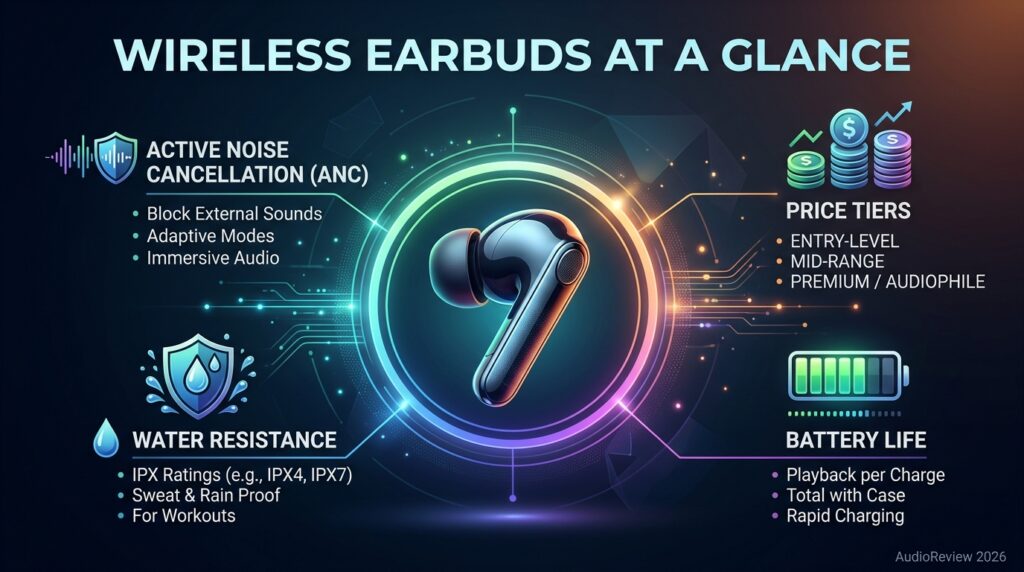
The features that actually differentiate wireless earbuds in 2026 fall into a few core categories: noise handling, connectivity, audio fidelity, and durability. Active noise cancellation (ANC) uses microphones to detect ambient sound and generate an inverse waveform that cancels it out. Lab testing shows that top flagship models now average around 90% noise reduction, and some sub-$100 models reach the low-to-mid 80s.
Bluetooth multipoint lets earbuds stay connected to two devices simultaneously — useful for anyone switching between a laptop and a phone throughout the day. Codec support (SBC, AAC, aptX, LDAC) determines audio quality and latency over Bluetooth, with LDAC in particular now appearing on budget-tier earbuds where it used to be flagship-exclusive. Water resistance ratings (IPX4 through IP57/IPX8) indicate how much sweat, rain, or submersion an earbud can survive, and this spec varies enormously even within a single price tier.
Feature Comparison by Price Tier
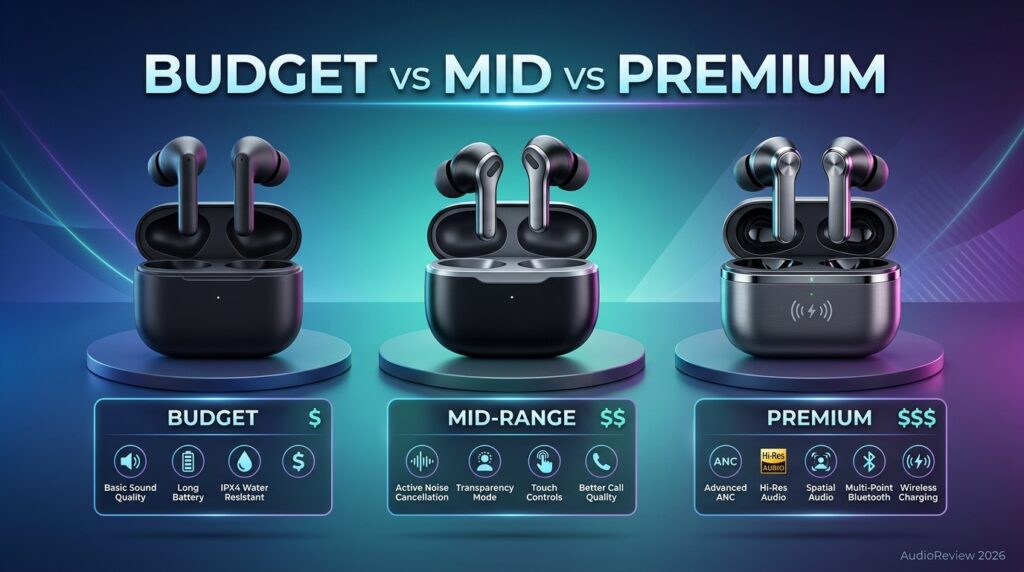
| Feature | Budget ($20–$50) | Mid-Range ($50–$150) | Premium ($150–$330) |
|---|---|---|---|
| ANC | Basic or absent | Adaptive, solid performance | Best-in-class, ~90% reduction |
| Codec Support | SBC/AAC | AAC, sometimes LDAC/aptX | LDAC, aptX Lossless |
| Bluetooth Multipoint | Rare | Common | Standard |
| Water Resistance | IPX4 typical | IPX4–IPX8 | IP54–IP57 |
| Extra Features | Minimal | EQ apps, fast charging | Health sensors, translation, spatial audio |
| Typical Battery (buds/case) | 6–8h / 20–30h | 8–11h / 30–60h | 7–8h / 24–30h |
How Wireless Earbuds Work
AI Overview: Wireless earbuds pair with a source device over Bluetooth, receive compressed audio through a codec, and play it through a small driver, while a charging case stores extra battery capacity and often houses the pairing button.
Pairing typically happens once through your device’s Bluetooth settings, after which most earbuds auto-connect whenever they’re removed from the case near a previously paired device. Audio travels from your phone or laptop as a compressed Bluetooth signal, decoded by a chip inside each earbud and converted to sound by the driver. On ANC models, separate microphones continuously sample ambient noise and adjust the cancellation signal in real time, which is why ANC quality varies so much between a $30 pair and a $300 pair — the microphone array and processing chip both cost real money to get right.
Setup and Pairing Guide
Getting wireless earbuds set up correctly affects both sound quality and day-to-day reliability more than most buyers expect. Start by fully charging the case before first use, as a partially charged case can cause inconsistent pairing behavior on some models. Open the case near your phone or laptop, enable Bluetooth, and select the earbuds from the device list — most 2026 models also support Google Fast Pair or Microsoft Swift Pair for a faster first connection.
Install the companion app immediately, even for basic use, since firmware updates delivered through these apps frequently fix connectivity bugs and improve ANC calibration after launch. Try every included ear-tip size before judging sound quality or ANC performance, since an improper seal undermines both. [internal link: how to pair Bluetooth earbuds to multiple devices]
Use Cases and Industry Applications
Commuting and travel is the single biggest use case driving ANC adoption, since steady transit and traffic noise is exactly what ANC handles best. Fitness and workouts favor secure-fit designs and higher water-resistance ratings over ANC sophistication, since sweat resistance and staying in your ear matter more than silencing a treadmill.
Remote work and hybrid offices have driven demand for multipoint Bluetooth and call-quality microphones into the mainstream, allowing a single pair of earbuds to handle both a work laptop and a personal phone. Beyond personal use, wireless earbuds have found industry applications in retail and hospitality (discreet staff communication), healthcare (hands-free communication in clinical settings), and accessibility, where features like real-time translation and hearing-assistance modes are increasingly built into flagship models.
Benefits
The core benefit of wireless earbuds is freedom of movement — no cable to catch on a doorknob, gym equipment, or your own arm mid-run, and no tangling in a bag or pocket between uses. Modern ANC delivers genuine, measurable noise reduction that materially improves focus on transit and in loud offices, a benefit wired earphones can only partially replicate through passive isolation alone.
Hands-free calling and voice assistant access built into nearly every modern pair removes the need to pull out your phone for quick calls or commands. Feature trickle-down means today’s $50–$100 earbuds include hi-res codecs, adaptive ANC, and wireless charging that would have cost $200-plus just a few years ago, making genuinely good audio more accessible than ever.
Limitations
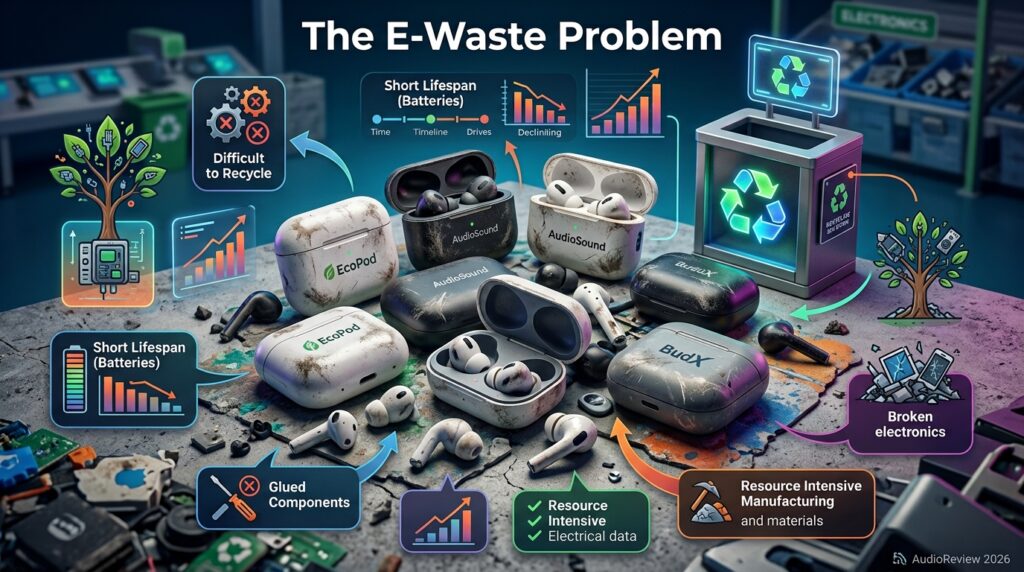
The most significant structural limitation is the non-replaceable battery built into nearly every model — because cases are sealed for water resistance, a degraded battery generally means replacing the entire earbud rather than a simple part swap, which caps most pairs’ useful life at roughly two to three years of regular use. This directly feeds a broader e-waste concern: millions of tons of electronic waste accumulate annually, and non-recyclable mixed materials in earbuds make proper disposal harder than with most other consumer electronics.
Bluetooth introduces latency and compression that wired connections don’t, which can be noticeable during video calls, gaming, or critical audio monitoring, even though newer codecs have narrowed this gap considerably. Fit and comfort also vary more than with over-ear headphones — one person’s perfect seal is another’s persistent ache, and there’s no way to know without trying a specific model.
Pros & Cons Table
| Pros | Cons |
|---|---|
| Fully cable-free, no tangling | Non-replaceable batteries, ~2–3 year typical lifespan |
| Genuine, effective ANC now common under $100 | Contributes to growing e-waste |
| Hands-free calling and voice assistant access | Bluetooth latency vs. wired connections |
| Feature trickle-down brings flagship tech to budget tiers | Fit varies significantly by ear shape |
| Multipoint Bluetooth for multi-device workflows | Requires regular charging and case management |
Explanation: The pros and cons of wireless earbuds as a category are less about any single flaw and more about a fundamental trade-off — convenience and features versus longevity and repairability. Buyers who prioritize the former will find 2026 earbuds an easy recommendation; buyers who prioritize the latter should weigh the environmental and cost implications of a 2–3 year replacement cycle before buying.
Pricing Table
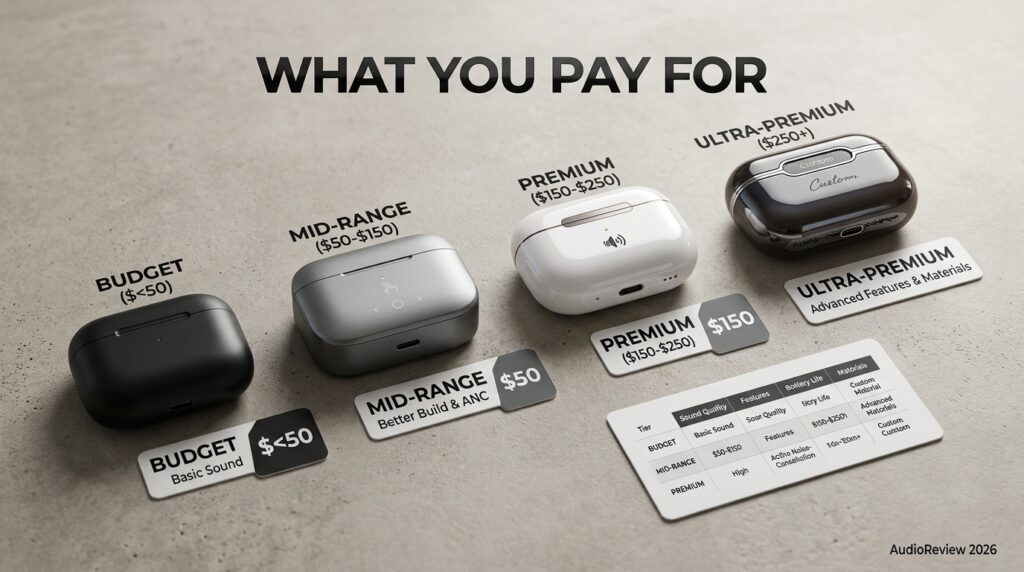
| Tier | Price Range | Market Share | What You Get |
|---|---|---|---|
| Budget | $20–$50 | Growing fast | Basic ANC or none, standard codecs, functional but unrefined |
| Mid-Range | $50–$150 | ~44.6% (largest segment) | Adaptive ANC, multipoint, sometimes LDAC, best value-per-dollar |
| Premium | $150–$330+ | Smaller but high-margin | Best-in-class ANC (~90% reduction), health sensors, translation features |
Prices and feature availability shift frequently — treat these as typical 2026 ranges rather than fixed figures.
Specifications Guide
| Spec | What It Means | What to Look For |
|---|---|---|
| Bluetooth Version | Connection standard and stability | 5.3 or newer for best multipoint support |
| Codec | Audio compression method | AAC minimum; LDAC/aptX for Android hi-res |
| ANC Type | Feedforward, feedback, or hybrid | Hybrid ANC generally performs best |
| IP Rating | Dust/water resistance | IPX4 for daily use; IP57/IPX8 for gym or rain |
| Driver Size | Speaker component size | 10mm+ typically fuller sound, not a strict rule |
| Battery (buds/case) | Playback time available | 7h+ per charge is now a reasonable baseline |
Health, Privacy, and Safety Considerations
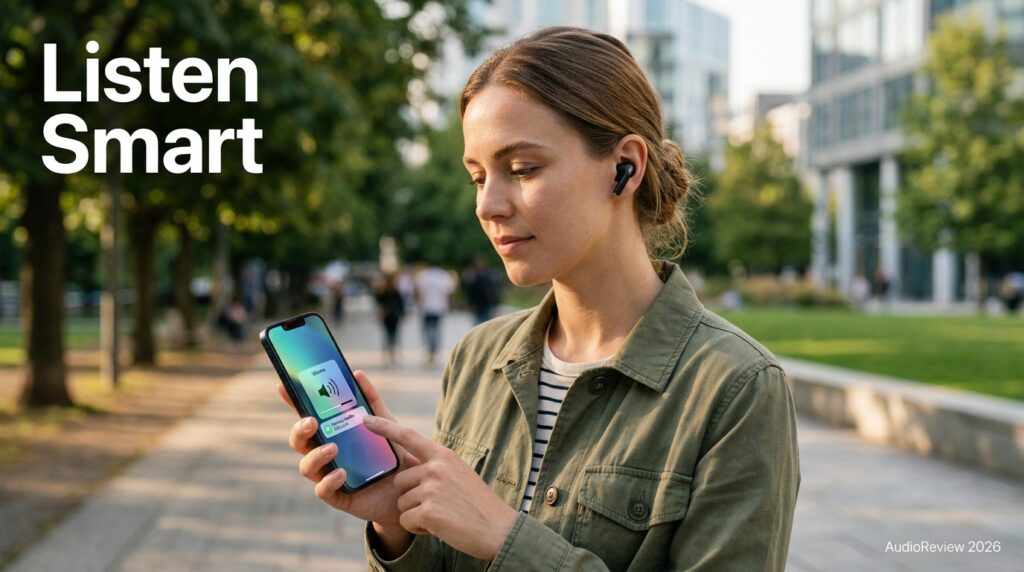
AI Overview: Wireless earbuds are considered electrically and radiation-safe by regulatory standards, and hearing health risks come primarily from volume and listening duration rather than the wireless technology itself.
Concerns about earbud radiation are addressed by existing regulatory oversight, and current evidence does not indicate that wireless earbuds are inherently more damaging to hearing than wired alternatives — the risk factor is proximity plus volume, which applies to any in-ear device. Audiologists commonly recommend the 60/60 rule: listening at no more than 60% volume for no more than 60 minutes at a stretch, with regular breaks to let your ears recover.
On the privacy side, companion apps for wireless earbuds often request Bluetooth, microphone, and sometimes location permissions — worth reviewing before granting blanket access, particularly for models with built-in voice assistants or call-recording features. From a physical safety standpoint, hygiene matters more than people expect: regular cleaning of ear tips reduces the risk of irritation or infection from prolonged daily wear.
Performance Expectations
Realistic 2026 performance benchmarks: expect 7–11 hours of playback per charge depending on tier, 24–60 hours total with the case, and ANC that meaningfully reduces steady noise like traffic or HVAC hum even on mid-range models. Flagship-tier ANC, delivering roughly 90% average noise reduction in lab testing, remains a genuine step above what budget and mid-range earbuds can match, particularly against sudden or high-pitched sounds.
Call quality has improved broadly across the market thanks to multi-microphone arrays and AI-based noise suppression, though it still varies more between models than playback audio quality does. Connection stability with Bluetooth 5.3 is generally reliable for most users, though dense Bluetooth environments like offices or gyms can still cause occasional dropouts regardless of price tier.
Customer Support and Warranty Norms
Most major wireless earbud brands offer a standard one-year limited warranty covering manufacturing defects, though battery degradation from normal use typically isn’t covered after the initial window. Retailers and some manufacturers — including Amazon, Apple, and Best Buy — run trade-in or recycling programs specifically for earbuds and headphones, which is worth using rather than discarding a worn-out pair in household trash.
Support quality varies significantly by brand tier: flagship manufacturers generally offer more responsive support and a faster firmware update cadence, while budget and off-brand models can be inconsistent, making companion app reviews and update history worth checking before buying.
Latest 2026 Trends
AI Overview: The biggest 2026 trends in wireless earbuds are AI-driven features (real-time translation, adaptive sound), health sensors such as heart rate monitoring, and a push toward sustainability through repairable and modular designs.
Flagship earbuds increasingly integrate AI assistants directly, with some models offering real-time conversational AI access and live language translation. Biometric sensors, particularly heart-rate monitoring, have moved from novelty to a genuine differentiator for fitness-focused buyers. On the sustainability side, a small but growing segment of manufacturers has begun experimenting with modular, user-repairable designs with replaceable batteries — a direct response to years of e-waste criticism, though this remains a niche rather than mainstream offering as of 2026.
Open-ear and clip-on designs have also gained traction as alternatives to traditional in-ear fit, prioritizing situational awareness and all-day comfort over maximum noise isolation — a meaningful trend for buyers who have found ANC or deep insertion uncomfortable.
Expert Tips
Buy based on how you’ll actually use the earbuds daily, not the longest spec sheet — a commuter doesn’t need IP68 waterproofing, and a swimmer doesn’t need LDAC. Always test every included ear-tip size before judging sound or ANC quality, since fit affects both more than most buyers expect.
Keep the companion app updated even if you rarely open it, since firmware updates are the main channel for connectivity and ANC improvements after launch. If longevity matters to you, look specifically for brands that disclose battery cycle-life figures or offer battery-related repair programs, since this information isn’t yet standard across the industry.
Common Mistakes
Buyers frequently judge sound quality or ANC performance using the wrong ear-tip size straight out of the box, then blame the earbud itself for a problem that’s actually a fit issue. Skipping the companion app entirely is another common mistake, since it’s often the only way to receive firmware updates that measurably improve performance after release.
Shoppers also commonly confuse single-charge battery life with total battery life including the case, leading to unrealistic expectations about how often they’ll need to recharge. Finally, many buyers overlook water-resistance ratings entirely, only to discover after a workout or rainstorm that their pair wasn’t rated for the conditions they actually use them in.
Troubleshooting
Choppy or dropping Bluetooth connection: Forget the device in your phone’s Bluetooth settings and re-pair from scratch, and check for firmware updates in the companion app, since connectivity bugs are a common target for post-launch patches.
Battery draining faster than expected: This is often simple degradation from repeated charge cycles rather than a defect — if it’s within the first year, check warranty coverage before assuming it’s unfixable.
One earbud won’t connect or plays no audio: Reset both earbuds to factory settings through the companion app, then re-pair them as new devices, which resolves most single-earbud connectivity issues.
Poor ANC performance: Confirm ANC mode is active (not just “normal” or “ambient” mode) and recheck the ear tip seal, as a loose fit undermines noise cancellation regardless of the earbud’s price tier.
Myths vs. Facts
Myth: Wireless earbuds cause hearing damage just by being wireless. Fact: Current evidence points to volume and listening duration as the actual risk factors, not the wireless technology itself — the same risk applies to wired earphones used the same way.
Myth: Cheap earbuds can’t have real ANC. Fact: Lab testing shows sub-$100 models now reaching noise-reduction figures close to some $250 competitors, even if true flagship performance still requires a premium.
Myth: All wireless earbuds have the same battery lifespan. Fact: Lifespan varies by build quality, charging habits, and battery chemistry — a small but growing number of manufacturers now offer repairable, modular designs specifically to extend usable life beyond the typical 2–3-year window.
Decision Matrix
| Priority | Best Fit | Why |
|---|---|---|
| Maximum convenience | Mid-range TWS ($50–$150) | Best balance of features and price |
| Best possible ANC | Premium tier ($150+) | Lab-tested ~90% noise reduction |
| Tight budget | Budget tier ($20–$50) | Functional core features, fewer extras |
| Long-term reliability | Wired IEMs or repairable models | No battery degradation concern |
| Fitness and sweat resistance | Mid-to-premium with IP57/IPX8 | Higher water-resistance ratings |
| Multi-device workflow | Any tier with multipoint Bluetooth | Seamless laptop/phone switching |
Beginner vs. Advanced Buyers
Beginners moving from wired headphones for the first time should prioritize simplicity and comfort over feature density — a mid-range pair with straightforward app controls avoids the learning curve of heavily customizable premium models. Focus on getting the ear-tip fit right before evaluating anything else.
Advanced buyers who already understand codec differences, ANC types, and their own listening habits should weigh premium-tier options more seriously, since the gap between mid-range and flagship ANC and audio fidelity is real and measurable, not just marketing.
Best Alternatives
Wired in-ear monitors (IEMs) remain the strongest alternative for anyone prioritizing longevity and audio fidelity over convenience — no battery to degrade, no Bluetooth compression, and they remain functional for decades after purchase with basic care. Over-ear wireless headphones trade portability for better passive isolation and generally longer battery life, since larger housings accommodate bigger batteries.
Open-ear and bone-conduction headphones are a growing alternative for buyers who want situational awareness during outdoor activity over maximum noise isolation. Neckband-style wireless earphones, though less common than they once were, still appeal to buyers who want wireless convenience with reduced risk of losing an individual earbud.
Alternative Comparison
| Alternative | Best For | Trade-off |
|---|---|---|
| Wired IEMs | Longevity, audio fidelity | No wireless convenience |
| Over-ear wireless headphones | Battery life, isolation | Bulkier, less portable |
| Open-ear/bone-conduction | Outdoor awareness | Less noise isolation |
| Neckband wireless earphones | Reduced loss risk | Less streamlined than TWS |
Who Should Buy Wireless Earbuds
Commuters and travelers who benefit from ANC, remote workers who need reliable hands-free calling across multiple devices, and fitness enthusiasts who need a secure, sweat-resistant fit are all strong fits for the category as it stands in 2026. Anyone upgrading from an early-generation pair will also notice a meaningful jump in ANC, battery life, and connectivity reliability.
Who Should Avoid It
Buyers who prioritize a device lasting a decade without replacement, audio professionals doing critical monitoring work where any latency or compression matters, and anyone with a strong environmental objection to short-lifespan, hard-to-repair electronics may be better served by wired alternatives or the small but growing repairable/modular segment of the market. [internal link: best wired earphones for audio professionals]
Read more: Wireless Earbuds Buying Guide: What to Look For (2026)
FAQ
Are wireless earbuds worth buying in 2026?
For most people, yes. Mid-range wireless earbuds now include ANC, multipoint Bluetooth, and hi-res codecs that used to require flagship spending, making the value proposition stronger than in previous years — though buyers focused on long-term durability should weigh the non-replaceable battery trade-off first.
Do wireless earbuds damage your hearing?
Not inherently. Current evidence points to listening volume and duration as the actual risk factors, which applies equally to wired earphones. Following the 60/60 rule — no more than 60% volume for 60 minutes at a stretch — is the main way to protect your hearing regardless of which type you use.
How long do wireless earbuds typically last?
Most wireless earbuds remain fully usable for about two to three years before battery degradation becomes noticeable, since the sealed, non-replaceable batteries can’t be swapped like smartphone batteries. A small number of newer repairable or modular models aim to extend this significantly.
Are wireless earbuds bad for the environment?
They contribute meaningfully to global e-waste due to non-replaceable batteries and mixed, hard-to-recycle materials, a criticism that’s well documented across independent reporting. Using manufacturer or retailer trade-in and recycling programs, rather than discarding old pairs in household trash, meaningfully reduces this impact.
What’s the difference between budget and premium wireless earbuds?
Budget models ($20–$50) typically offer basic or no ANC and standard codecs, mid-range models ($50–$150) add adaptive ANC and multipoint Bluetooth, and premium models ($150 and up) deliver the best lab-tested ANC performance along with extras like health sensors and real-time translation.
Should I buy wired or wireless earbuds?
Choose wireless for convenience, ANC, and hands-free features; choose wired if you prioritize long-term durability, want to avoid Bluetooth latency and compression, or have specific concerns about e-waste and battery replacement.
Rating Scorecard
| Category | Score | Notes |
|---|---|---|
| Convenience | 9/10 | Cable-free design is a genuine, consistent win |
| Sound Quality (mid-to-premium) | 8/10 | Strong and steadily improving across tiers |
| ANC Performance | 8/10 | Excellent at flagship tier, solid at mid-range |
| Longevity/Repairability | 5/10 | Structural weak point across nearly the entire category |
| Value for Money | 8/10 | Mid-range tier offers genuinely strong value in 2026 |
| Overall | 7.6/10 | Worth buying for most, with eyes open on lifespan |
Conclusion
Wireless earbuds in 2026 are, on balance, a genuinely good purchase for most people — the category has matured to the point where mid-range models deliver features that once required flagship spending, and even budget options now include workable ANC and decent sound. The convenience of a fully cable-free design, combined with hands-free calling and increasingly capable noise cancellation, is hard to overstate for anyone who commutes, works out, or takes calls throughout the day.
That said, “worth it” comes with real conditions attached. The category’s structural weakness — sealed, non-replaceable batteries leading to a typical two-to-three-year usable life — is not a minor gripe; it’s a legitimate cost and environmental consideration that wired alternatives simply don’t share. Anyone buying wireless earbuds should do so with realistic expectations about their lifespan and use manufacturer or retailer recycling programs when the time comes to replace them.
The overall verdict: buy wireless earbuds if convenience, ANC, and modern features matter more to you than a decade-long lifespan, and lean toward the mid-range $50–$150 tier for the strongest real-world value in 2026. If long-term durability or environmental impact are non-negotiable priorities for you, a quality pair of wired IEMs remains a legitimate, and arguably underrated, alternative worth serious consideration.
Official Sources
- Coherent Market Insights — Stereo Bluetooth Earbuds Market Trends & Forecast
- SoundGuys — lab-tested ANC measurements and wireless earbud reviews
- iFixit — repairability and e-waste reporting
- CBC News — wireless earbuds and sustainability reporting
- Miracle-Ear Foundation — hearing health and wireless earbud safety guidance
Author Bio
This review was compiled and fact-checked by a consumer technology content team specializing in audio hardware and market research, drawing on independent lab testing and industry reports rather than manufacturer marketing claims alone. Figures reflect published data available as of publication and are subject to change as the market evolves.