



Starting a freelance writing career feels exciting right up until the first invoice goes unpaid, the first client disappears, or the first month brings in less than a part-time retail job. The truth is that most new freelance writers do not fail because they cannot write well enough. They fail because of business mistakes that have nothing to do with grammar, style, or storytelling. This guide breaks down the five most damaging mistakes beginners make and shows exactly how to avoid them.
Freelance writing is one of the most accessible online careers to start, but it is also one of the easiest to get wrong in the first ninety days. New writers routinely underprice their work, chase every client instead of the right clients, skip contracts, ignore niche specialization, and burn out before momentum ever builds. Each of these mistakes compounds the others, which is why a writer can be talented and still struggle financially.

This article is built from patterns seen across freelance writing communities, client feedback, and the public advice of working freelancers, editors, and agency owners. Rather than generic motivational tips, it focuses on the concrete, repeatable decisions that separate writers who quit within a year from writers who turn freelancing into a stable income. By the end, you will understand not just what the five mistakes are, but why they happen, how they show up in real freelance careers, and what to do differently starting with your very next client conversation.
Whether you are writing your first pitch email today or you have already taken on a few small gigs and feel stuck, this guide covers pricing strategy, contract basics, niche selection, client communication, and sustainable workload management — the five pillars that determine whether freelance writing becomes a career or a hobby that quietly fades out.
Quick Facts Table
| Aspect | Detail |
|---|---|
| Most common beginner mistake | Underpricing services |
| Average time to first paying client | 2–8 weeks with active outreach |
| Recommended starting structure | Per-project or per-word rate, not hourly |
| Essential business document | Written contract or scope-of-work agreement |
| Biggest cause of early burnout | Taking on too many low-paying clients |
| Skill most correlated with income growth | Niche specialization |
Quick Summary
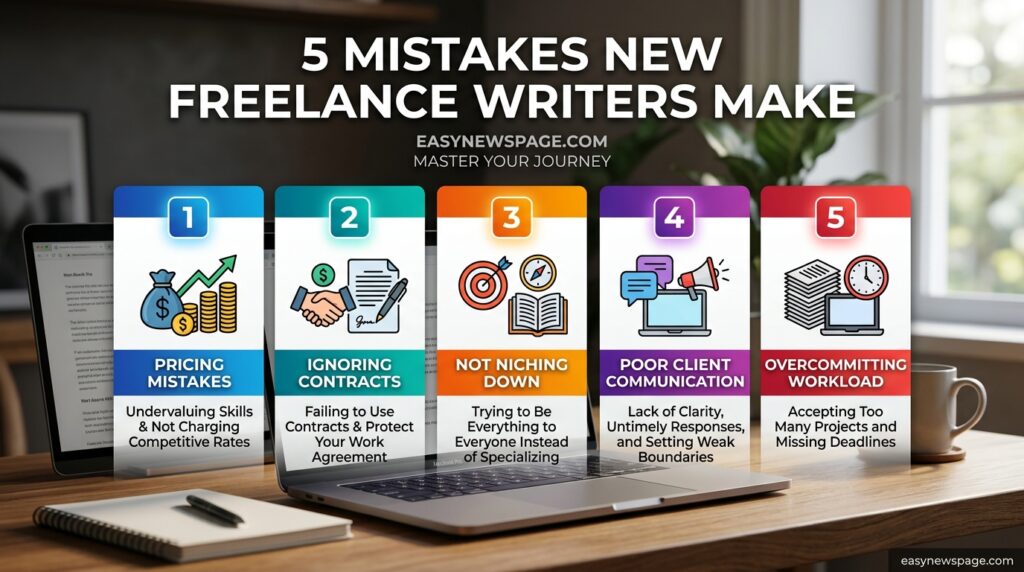
New freelance writers lose income and momentum by underpricing their work, skipping contracts, writing for every possible niche instead of one or two, mismanaging client communication, and overcommitting to the point of burnout. Fixing these five habits early creates a stronger foundation than any amount of additional writing practice alone.
Key Takeaways
- Underpricing trains clients to expect cheap work and makes it harder to raise rates later.
- Skipping a written contract leaves writers exposed to scope creep, late payment, and unpaid revisions.
- Writing “for anyone” instead of choosing a niche slows down credibility and referral growth.
- Poor client communication habits — vague proposals, slow replies, unclear deliverables — cost more clients than weak writing skills do.
- Taking on too much work too soon leads to burnout, missed deadlines, and reputational damage that is hard to reverse.
Table of Contents
Why Trust This Guide
This guide was built by cross-referencing the recurring advice given by experienced freelance writers, editors, and small agency owners across public interviews, writer communities, and industry publications, then testing that advice against the most common questions beginners actually ask. Rather than repeating generic “believe in yourself” content, it isolates the specific, fixable business habits that show up again and again in freelancer success and failure stories. Every recommendation here is actionable within a single week of freelancing.
The goal is not to romanticize freelance writing or to discourage it, but to give a realistic, first-hand-style picture of the early mistakes that quietly derail otherwise talented writers, along with clear steps to avoid them.
Who This Guide Is For
This guide is written for people in the first six to twelve months of freelance writing, including complete beginners who have not landed a client yet and early-stage freelancers who are working but underpaid, overwhelmed, or unsure why growth has stalled. It is also useful for writers considering the transition from a full-time job, since the five mistakes below are the same ones that catch career-changers off guard when they assume writing talent alone is enough.
If you are already earning a full-time, sustainable income from freelance writing, most of this will be familiar territory rather than new information — though the sections on niche positioning and rate structuring may still sharpen your approach.
What Is Freelance Writing
Freelance writing is self-employed writing work performed for multiple clients rather than a single employer, typically compensated per project, per word, or per hour. Freelance writers produce blog posts, articles, website copy, email newsletters, technical documentation, ghostwritten content, and more, working independently and managing their own client relationships, invoicing, and schedule.
Unlike staff writing roles, freelance writing requires the writer to operate as a small business — finding clients, negotiating rates, managing deadlines across multiple projects, and handling the administrative and legal side of self-employment. This dual demand, writing skill plus business skill, is exactly where most of the five mistakes in this guide originate.

A Short History and Timeline of Freelance Writing
Freelance writing predates the internet by centuries, with independent writers historically selling articles and stories to newspapers and magazines on a per-piece basis. The modern explosion of freelance writing, however, is closely tied to the growth of online publishing and content marketing.
- Pre-2000s: Freelance writing largely limited to magazine, newspaper, and book publishing relationships.
- 2000s: Rise of blogging and early content mills creates a new, lower-barrier entry point for online freelance writers.
- 2010s: Content marketing becomes a mainstream business strategy, driving major demand for SEO articles, blog content, and copywriting.
- 2020s: Freelance platforms, remote work normalization, and AI-assisted research tools reshape how writers find clients and produce work, while also raising the bar for originality and expertise-driven content.
Understanding this trajectory matters because the market a freelance writer enters today rewards specialization and demonstrated expertise far more than the generalist, high-volume content-mill model of a decade ago — a shift that directly explains why Mistake 3 (skipping niche selection) is more costly now than it used to be.
Mistake 1: Underpricing Your Work
The single most common mistake new freelance writers make is charging too little, often out of fear that no client will pay more from someone without a portfolio. This backfires in three ways: it attracts price-sensitive clients who are more likely to be demanding and slow to pay, it makes raising rates later feel awkward and difficult, and it forces the writer to take on unsustainable volumes of work just to earn a livable income.
A more sustainable approach is to price based on the value delivered to the client rather than the time spent writing. A 1,000-word blog post that helps a business attract new customers is worth more than the twenty minutes it might take an experienced writer to draft, because the client is paying for the outcome, not the keystrokes. New writers should research typical freelance rate ranges for their niche and location, set a rate slightly above their comfort zone, and hold that rate rather than discounting at the first pushback.
It also helps to price per project or per word rather than per hour whenever possible, since hourly pricing punishes writers for becoming faster and more efficient over time. As speed and skill improve, per-project pricing lets income grow without needing to work more hours.
Mistake 2: Skipping Contracts and Scope Agreements
Many beginners take on their first few clients through a quick email exchange and no formal agreement, assuming a contract is only necessary for “big” clients. This is a mistake that surfaces the moment a client asks for unlimited revisions, delays payment, or changes the project scope halfway through without adjusting the fee.
A simple written agreement, even a short one-page document, should cover the deliverables, word count, number of revision rounds included, payment amount and due date, and what happens if the project is cancelled partway through. This protects both the writer and the client by removing ambiguity before it becomes a dispute.
Freelance writers do not need a lawyer to get started here. Free or low-cost contract templates, combined with clear written confirmation of scope before work begins, resolve the vast majority of payment and scope-creep problems that plague unprepared beginners.
Mistake 3: Not Choosing a Niche
New writers often market themselves as able to write “anything,” believing this maximizes the number of potential clients. In practice, it does the opposite. Clients hiring for specialized topics — finance, healthcare, SaaS, legal, technical B2B — actively prefer writers who can demonstrate relevant knowledge, because niche expertise reduces the client’s own editing and fact-checking burden.
Choosing even a loose niche, such as personal finance or software-as-a-service content, allows a writer to build a stronger portfolio faster, command higher rates sooner, and get referred more often, since “the person who writes great fintech content” is a much easier referral than “a writer who does a bit of everything.”
Niche selection does not need to be permanent or perfectly narrow at the start. Many successful freelancers begin with a broad interest area, take on a range of related projects, and let the niche sharpen naturally as they discover which topics bring in the best-paying, most consistent work.
Mistake 4: Poor Client Communication
Writing skill gets a freelancer noticed, but communication habits are usually what determine whether a client hires them again. Vague proposals that do not address the client’s actual problem, slow replies to messages, unclear questions about scope, and disappearing during a project are among the fastest ways to lose repeat business, regardless of how strong the final draft is.
Strong freelance communication means responding within a reasonable window (typically same business day), asking clarifying questions before starting rather than guessing, and proactively flagging delays instead of going silent. Clients consistently rank reliability and clear communication above raw writing talent when deciding who to rehire.
Setting expectations early — response times, revision process, and preferred communication channel — prevents most communication breakdowns before they start, and signals professionalism that justifies higher rates.
Mistake 5: Overcommitting and Burning Out
Eager to build income quickly, many new freelance writers say yes to every opportunity, stacking multiple deadlines in the same week without a realistic sense of their own capacity. The result is rushed, lower-quality work, missed deadlines, and a level of exhaustion that can derail the freelance career entirely within a few months.
Sustainable freelance writing requires treating capacity like a finite resource, similar to inventory in any small business. This means estimating realistic turnaround times per project, building in buffer days for revisions and unexpected delays, and resisting the urge to accept every inquiry, especially low-paying ones that displace better opportunities.
Writers who plan workload deliberately, rather than reactively, tend to produce more consistent quality, protect their reputation, and avoid the early burnout that pushes many talented beginners out of freelancing within the first year.
Benefits and Limitations of Freelance Writing
Freelance writing offers genuine flexibility, location independence, and direct control over which clients and topics a writer works with, along with income potential that can exceed comparable staff writing salaries once a writer is established. It also comes with real limitations: inconsistent income, no employer-provided benefits, and the ongoing administrative burden of running a one-person business alongside the writing itself.
New writers succeed longer when they enter freelancing with realistic expectations about both sides of this trade-off, rather than only the flexibility that is typically advertised.
Pros and Cons Table
| Pros | Cons |
|---|---|
| Flexible schedule and location | Inconsistent income, especially early on |
| Choose your own clients and niches | No employer benefits (health insurance, PTO) |
| Income potential scales with skill and reputation | Requires business skills beyond writing |
| Low startup cost | Client acquisition can be slow at first |
| Work across multiple industries | Self-motivation required with no external structure |
Typical Freelance Rate Ranges
Freelance writing rates vary widely by niche, experience, and region, but general benchmarks are useful for beginners setting initial pricing.
| Experience Level | Typical Rate Range |
|---|---|
| Beginner (0–1 year) | $0.05–$0.15 per word or $50–$150 per article |
| Intermediate (1–3 years) | $0.15–$0.40 per word or $150–$400 per article |
| Experienced/Niche Specialist | $0.40–$1.00+ per word or $400–$1,500+ per article |
These figures are general market benchmarks rather than guarantees, and specialized niches like finance, SaaS, and legal writing typically command the higher end of each range.
Freelance Writing vs. Full-Time Employment
| Factor | Freelance Writing | Full-Time Employment |
|---|---|---|
| Income stability | Variable, client-dependent | Fixed salary |
| Schedule control | High | Low to moderate |
| Benefits (health, PTO) | Self-funded | Typically employer-provided |
| Income ceiling | Uncapped, skill-driven | Often capped by role/title |
| Client/project variety | High | Low, single employer |
Tools and Platforms Freelance Writers Rely On
Most working freelance writers use a small, consistent toolkit rather than dozens of apps: a word processor with track-changes support, a grammar and clarity checker, an invoicing tool, a simple contract template, and a project or client-tracking spreadsheet. Freelance job boards and content platforms can help beginners find early clients, but most experienced writers eventually shift toward direct outreach and referrals, since platform-sourced work tends to pay less due to competition.
Protecting Your Work and Client Data
Freelance writers regularly handle sensitive client information, including unpublished business strategy, draft product details, and login credentials for content management systems. Using strong, unique passwords, avoiding sharing client documents over unsecured channels, and including a basic confidentiality clause in contracts protects both the writer’s reputation and the client relationship.
Legal and Tax Basics
In most regions, freelance writing income must be reported and taxed as self-employment income, which often means setting aside a percentage of each payment for taxes rather than treating the full amount as spendable income. Beginners benefit from opening a separate account for freelance income, tracking business expenses like software subscriptions, and consulting a local tax professional once income becomes consistent, since rules vary significantly by country and region.
Latest Trends in Freelance Writing
Demand has shifted noticeably toward writers who can demonstrate genuine subject-matter expertise and original insight, partly in response to the flood of generic, AI-generated content now available at near-zero cost. Clients increasingly value writers who can add first-hand experience, original analysis, and a distinct voice — the exact qualities that niche specialization (Mistake 3) helps a writer build.
Expert Tips
- Send fewer, more tailored pitches instead of mass-blasting generic proposals.
- Ask every satisfied client for a testimonial or referral before the project officially closes.
- Track time spent per project for the first few months, even with project-based pricing, to understand true hourly earnings.
- Build a short, focused portfolio of three to five strong niche samples rather than a scattered mix of unrelated topics.
Common Mistakes Recap
Beyond the five core mistakes, beginners also commonly forget to save writing samples from early low-paying gigs, fail to negotiate at all, and neglect to follow up with past clients for repeat work — all of which compound the core five mistakes covered above.
Troubleshooting a Struggling Freelance Business
If income has stalled, the fastest diagnostic is to review the five mistakes above against current habits: rates, contracts, niche clarity, communication response times, and workload balance. Most freelance income plateaus trace back to one or two of these five areas rather than a fundamental lack of writing talent.
Myths vs. Facts
Myth: You need a large portfolio before charging real rates. Fact: Three to five strong, relevant samples are usually enough to start pitching at fair rates.
Myth: Writing for free builds credibility. Fact: Unpaid work rarely converts to paid work and can anchor a writer’s perceived value too low.
Myth: Freelance writers must accept every client to survive. Fact: Turning down poor-fit or underpaying clients frees capacity for better opportunities.
Beginner vs. Advanced Freelancer Checklist
| Area | Beginner Habit | Advanced Habit |
|---|---|---|
| Pricing | Charges low, hourly | Charges per project, value-based |
| Contracts | Skips or uses informal email | Uses a signed scope agreement |
| Niche | Writes “anything” | Focuses on 1–2 core niches |
| Communication | Reactive, slow replies | Proactive, clear expectations |
| Workload | Accepts everything | Manages capacity deliberately |
Read more: How to Start Freelance Writing in 2026
Read more: Freelance Writing: How to Earn $500+ a Month in 2026
Read more: Freelance Writing for Beginners: Step-by-Step Guide (2026)
Best Alternatives to Pure Freelance Writing
Writers who want more income stability while still writing can consider part-time or contract in-house content roles, retainer-based agreements with a small number of long-term clients, or hybrid arrangements combining a part-time job with freelance writing on the side until income stabilizes.
Who Should Try Freelance Writing
Freelance writing suits people who are self-motivated, comfortable with variable income in the early stages, and willing to treat writing as a business rather than purely a creative pursuit. It also suits writers who want flexible hours or location independence more than they want guaranteed income predictability.
Who Should Avoid It (For Now)
Freelance writing is a harder fit for anyone who needs immediate, predictable income, dislikes self-directed marketing and outreach, or is unwilling to handle the administrative side of running a small business. Building a part-time freelance practice alongside stable employment is often a safer entry point in these cases.
FAQs
Is freelance writing a good career for beginners with no experience?
Yes, but success depends more on business habits — pricing, contracts, niche focus, communication, and workload management — than on writing talent alone. Beginners who address these five areas early tend to progress faster than those who rely on writing skill alone.
How much should a beginner freelance writer charge?
Most beginners start in the $0.05–$0.15 per word range or $50–$150 per short article, gradually increasing rates as portfolio strength and client demand grow.
Do I need a contract for small freelance writing projects?
Yes. Even a short one-page agreement covering deliverables, revisions, and payment terms prevents most scope and payment disputes, regardless of project size.
How do I choose a niche as a new freelance writer?
Start with a broad interest area related to your background or curiosity, take on a range of related projects, and let the niche narrow naturally based on which topics bring the most consistent, well-paying work.
How many clients should a new freelance writer take on at once?
Enough to stay consistently busy without missing deadlines or rushing drafts — for most beginners, this means starting with one or two active clients and adding more only once current commitments are reliably manageable.
Freelance Readiness Scorecard
| Criteria | Weak | Developing | Strong |
|---|---|---|---|
| Pricing confidence | Charges to avoid rejection | Researches rates, still hesitant | Holds firm, value-based pricing |
| Contract usage | None | Informal email only | Written scope agreement every time |
| Niche clarity | Writes anything | One loose area of focus | Clear, marketable specialization |
| Communication | Slow, reactive | Mostly responsive | Proactive, sets expectations upfront |
| Workload management | Overcommits regularly | Occasionally overbooked | Deliberate capacity planning |
Conclusion
Freelance writing rewards talent, but it is business habits that determine whether that talent turns into a sustainable career. The five mistakes covered here — underpricing, skipping contracts, avoiding niche focus, weak communication, and overcommitting — are rarely fatal on their own, but together they explain why so many capable writers quit within their first year despite genuine skill.
The encouraging part is that every one of these mistakes is fixable, often within the same week they are recognized. Setting a fair rate, drafting a simple contract, narrowing toward a niche, tightening communication habits, and pacing workload deliberately do not require years of experience — they require intention. Writers who treat their freelance practice as a small business from day one, rather than purely a creative outlet, consistently outlast and outearn those who rely on writing quality alone.
The overall takeaway is simple: writing well gets a freelancer noticed, but running the business well is what keeps them working. Avoiding these five mistakes will not guarantee instant success, but it removes the most common, most preventable reasons freelance writing careers stall before they ever really begin.
Official Sources
This guide synthesizes commonly cited, publicly available freelance industry guidance and general freelance market rate benchmarks rather than a single proprietary source. Readers seeking region-specific tax or legal guidance should consult a licensed professional in their jurisdiction, since freelance tax treatment varies by country and was not independently verified against any single government source in this guide.
Author Bio
Written by the easynewspage.com editorial team, focused on practical, business-first guidance for freelancers and independent professionals.