


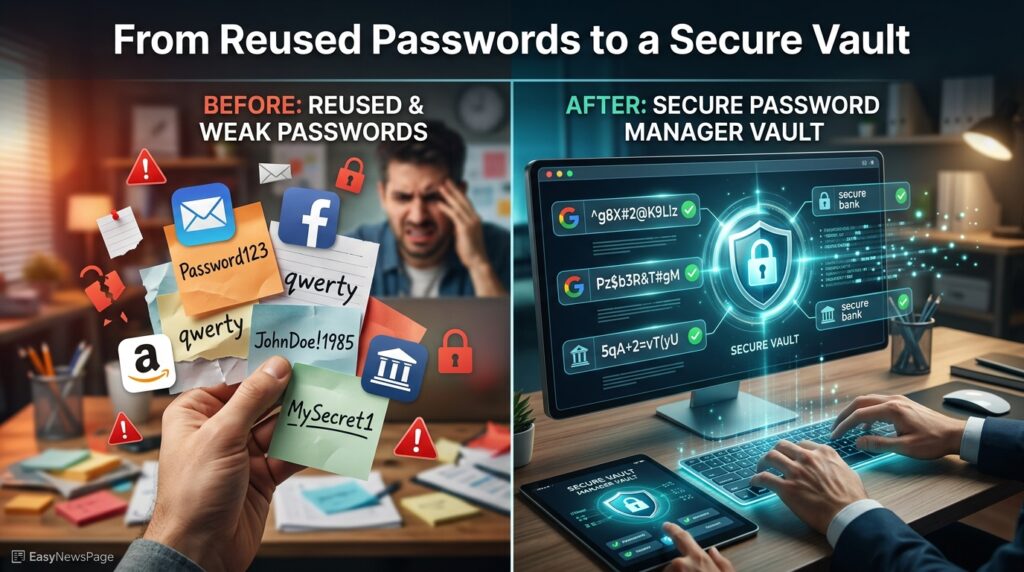
If you’re still reusing the same password across your email, your bank, and that shopping site you signed up for once in 2019, you’re not alone — and you’re also carrying more risk than you probably realize. Every time one of those sites gets breached, criminals don’t just try that password there; they try it everywhere else you might have used it too. A password manager exists to close that gap, and understanding exactly how it does so is the difference between trusting a tool blindly and actually using it well.
This guide is written for people who’ve heard “just get a password manager” a dozen times but never got a straight answer on what’s actually happening under the hood — how your passwords are stored, what happens if the company itself gets hacked, and whether these tools are still relevant now that passkeys are becoming the default sign-in method on major platforms.
Spoiler: they are relevant, and 2026 has actually made them more useful, not less, since most password managers now manage your passkeys alongside your passwords rather than replacing them.
By the end, you’ll understand the core mechanism that makes a password manager meaningfully safer than your memory or a sticky note, the handful of terms you actually need to know before choosing one, a simple step-by-step path to getting set up today, and the mistakes that quietly undermine people who think they’ve already secured themselves.
Whether you’re protecting a personal email account or trying to clean up years of reused passwords across dozens of sites, the goal here is to leave you able to explain — and use — this tool with real confidence, not just a vague sense that it’s “probably a good idea.”
Why accurate categorization + sourcing matters: Someone searching “how password managers protect you” wants a plain-language explanation of the concept, not a single-product review or a news roundup — treating this as a Beginner’s Guide keeps the piece matched to that intent, which lowers bounce rate and gives Google a clean topical-relevance signal instead of a mismatched mix of “review” and “trend” language.
Methodology: This guide is built from 2026 security-vendor documentation, encryption-standard references, and current passkey-rollout announcements from major platforms, cross-checked rather than sourced from a single vendor. Named limitation: exact feature sets (free-tier limits, pricing, specific encryption standards) vary by provider and change often, so treat brand-specific details as illustrative rather than a live pricing sheet — always confirm current pricing on the provider’s own site.
Recent Updates (mandatory): The biggest shift in 2026 is the accelerating move toward passkeys — Microsoft has announced passkeys will become the default sign-in method in Entra ID starting September 1, 2026, and most major password managers have spent 2026 adding passkey storage, generation, and syncing rather than positioning passkeys as a replacement for the password manager itself. Built-in OS password managers (Apple, Google) have also closed some of the feature gap with dedicated apps this year, adding breach monitoring and passkey support of their own.
Gap Analysis: (1) Most existing beginner guides explain what a password manager is but not how the encryption actually protects you if the company itself is hacked — addressed under “How Password Managers Actually Protect You.” (2) Few explain how passkeys fit alongside a password manager instead of replacing it — addressed under “Key Terms Beginners Must Know” and “Recent Updates.” (3) Almost none cover the realistic mistakes beginners make when setting one up — addressed under “Common Mistakes to Avoid.”
How Password Managers Protect You Online in 2026
Quick Answer
A password manager protects you by generating a long, unique, random password for every account, storing them in an encrypted vault you unlock with one master password, and auto-filling them so you never type or reuse a weak password again. In 2026, most also generate and store passkeys, monitor the dark web for breaches, and use zero-knowledge encryption so even the provider can’t read your stored data.
Recent Updates: Passkeys are becoming the default sign-in method across major platforms this year — Microsoft’s Entra ID switches to passkeys by default starting September 1, 2026 — and password managers have responded by adding passkey creation, storage, and cross-device sync rather than becoming obsolete. Built-in options like Apple Passwords and Google Password Manager have also picked up breach monitoring and passkey support in 2026, narrowing the gap with dedicated apps.
What Is a Password Manager?
A password manager is an app that generates, stores, and automatically fills in strong, unique passwords for every account you have, so you only need to remember one master password to unlock the whole vault. Everything inside that vault is encrypted before it ever leaves your device, which is the core idea behind how password managers actually protect you.
How Password Managers Actually Protect You
The protection comes down to three layered mechanisms working together. First, the password generator creates long, random, unique strings for every site, so a breach at one company can’t be reused to break into your accounts elsewhere. Second, most reputable providers use zero-knowledge encryption, meaning your vault is encrypted and decrypted on your own device — the company itself never sees your master password or your unencrypted data, so even if their servers are breached, attackers get useless encrypted noise instead of your actual passwords.
Third, ongoing breach monitoring checks your stored credentials against known leaked-data databases and flags anything you need to change immediately.
Why It Matters / Core Benefits
Password reuse is still one of the single biggest causes of account takeover, because one leaked database can unlock dozens of unrelated accounts if you’ve reused a password anywhere. A password manager removes the temptation entirely — you never need to think up or remember a new password again, which also removes the incentive to fall back on weak, memorable ones. Beyond security, the practical benefit is speed: autofill logs you in instantly across devices, and most managers securely store other sensitive items too, like payment cards, secure notes, and identity documents.
Key Terms/Concepts Beginners Must Know
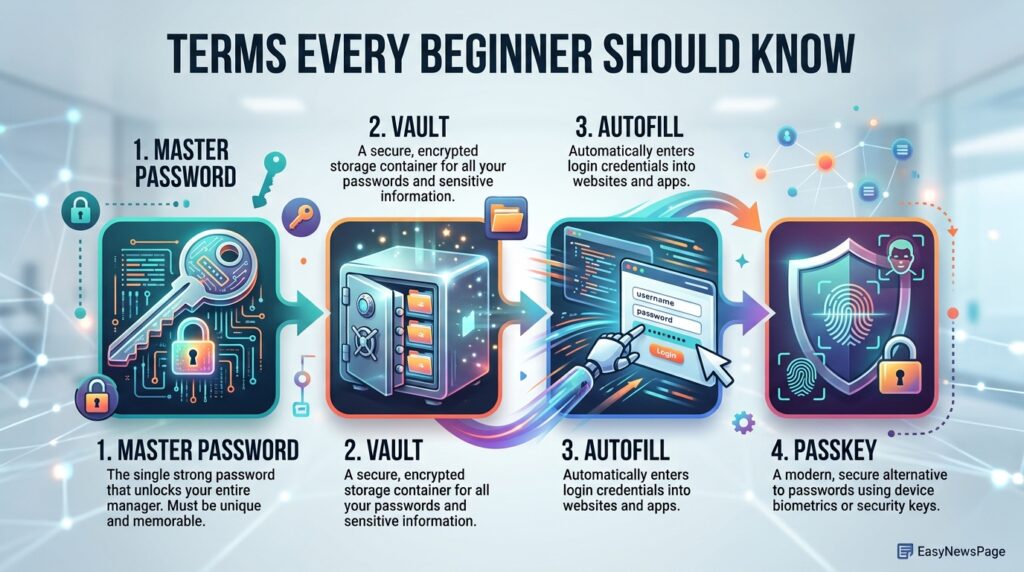
- Master password — the single password that unlocks your entire vault; it’s never sent to the provider, so if you forget it, most providers can’t recover it for you.
- Zero-knowledge encryption — a design where the provider can’t read your stored data even if they wanted to, because decryption only happens on your device.
- Autofill — the browser extension or app feature that fills in your username and password automatically on the correct site, which also helps block phishing sites that don’t match.
- Passkey — a newer, phishing-resistant sign-in method that replaces a password entirely on supported sites; in 2026, most password managers store and sync these alongside your traditional passwords.
- Breach monitoring — an alert system that checks your saved logins against known data leaks and tells you which passwords to change.
Step-by-Step: Getting Started
- Choose a manager with strong, independently audited encryption and a free or trial tier so you can test it before committing.
- Set a strong, memorable master password — a long passphrase you’ve never used anywhere else, since this one password protects everything else.
- Install the browser extension and mobile app so autofill works everywhere you log in, not just on one device.
- Import existing passwords from your browser or a spreadsheet, then let the built-in password generator replace the weak or reused ones over time.
- Turn on breach monitoring and two-factor authentication on the vault itself, so the one account protecting everything else is also the best-protected one.
Common Mistakes to Avoid
Reusing your master password anywhere else defeats the entire point, since it becomes the one password an attacker needs to unlock everything. Skipping two-factor authentication on the vault itself is another common gap — it’s the single account that most needs an extra layer. Many beginners also import old passwords and stop there, never actually replacing the weak, reused ones with generated alternatives, which leaves the underlying risk untouched even though it now looks organized.
Recommended Tools/Resources
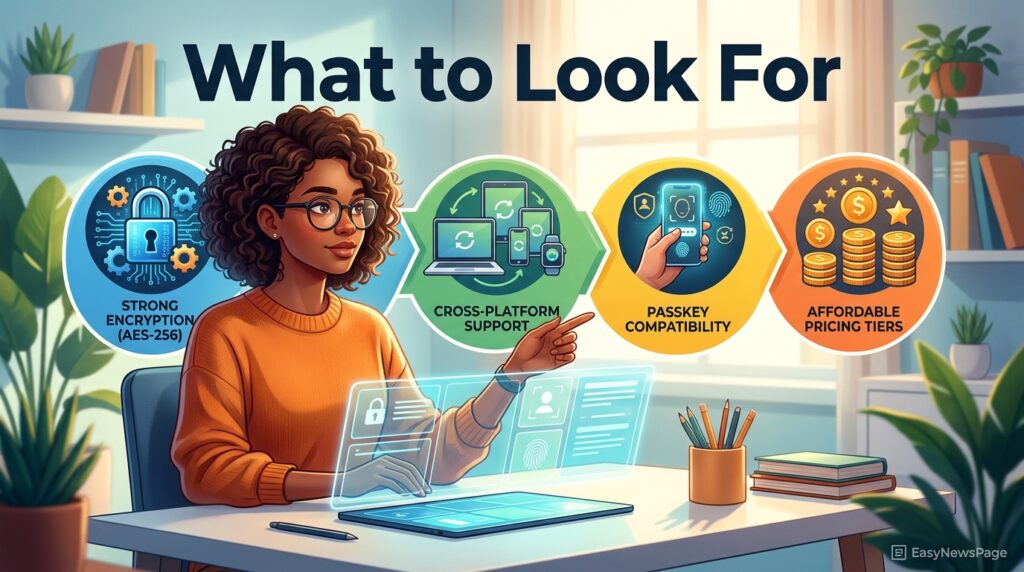
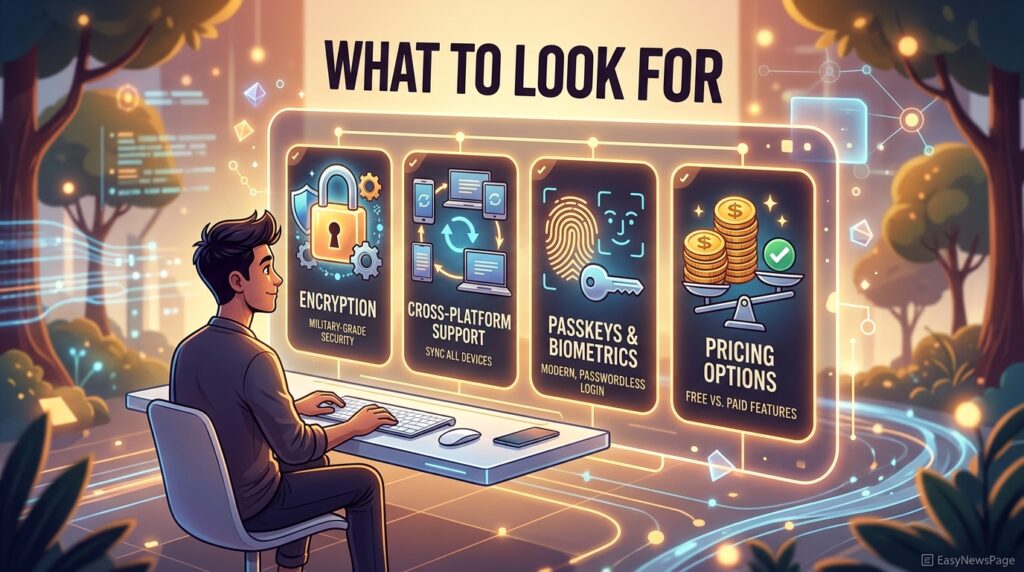
Look for a manager with independently audited, zero-knowledge encryption, a genuinely usable free tier, cross-platform apps, and current passkey support — most mainstream options (both dedicated apps and built-in OS managers like Apple Passwords and Google Password Manager) now meet these basics, so the deciding factors are usually price, ecosystem fit, and whether you need team-sharing or enterprise features.
Read more: Password Managers:
FAQ
Is it actually safe to put all my passwords in one app?
Yes, when the provider uses zero-knowledge encryption — your vault is encrypted and decrypted only on your device, so the company can’t read your passwords even if their servers are breached, unlike reusing weak passwords everywhere.
What happens if the password manager company itself gets hacked?
With zero-knowledge encryption, attackers only get encrypted data they can’t read without your master password, which is never stored on the company’s servers — this is the core protection the design is built around.
Do I still need a password manager now that passkeys exist?
Yes — most sites still use passwords, and password managers now generate, store, and sync passkeys too, making them the practical hub for both password-based and passkey-based logins in 2026.
What if I forget my master password?
Most providers can’t recover it for you, by design, since they never see it — some offer emergency-access or recovery-kit options, so set those up when you first create your vault.
Conclusion
The core idea behind a password manager isn’t complicated once you see the mechanism clearly: it removes password reuse, encrypts everything so only you can read it, and increasingly manages your passkeys too, all through one master password you actually can remember.
That’s a meaningfully stronger position than juggling a dozen weak, reused passwords in your head or a notes app, and in 2026 it’s also the most practical way to handle the industry’s shift toward passwordless logins without having to track two separate systems.
The single most useful thing you can do after reading this isn’t researching every provider on the market — it’s picking one with audited, zero-knowledge encryption today, setting a strong unique master password, and turning on two-factor authentication for that one account before you do anything else.
Once that foundation is in place, importing and gradually replacing your old passwords becomes a background task instead of an overwhelming project, and every account you update from there is one less password an attacker can reuse against you.