


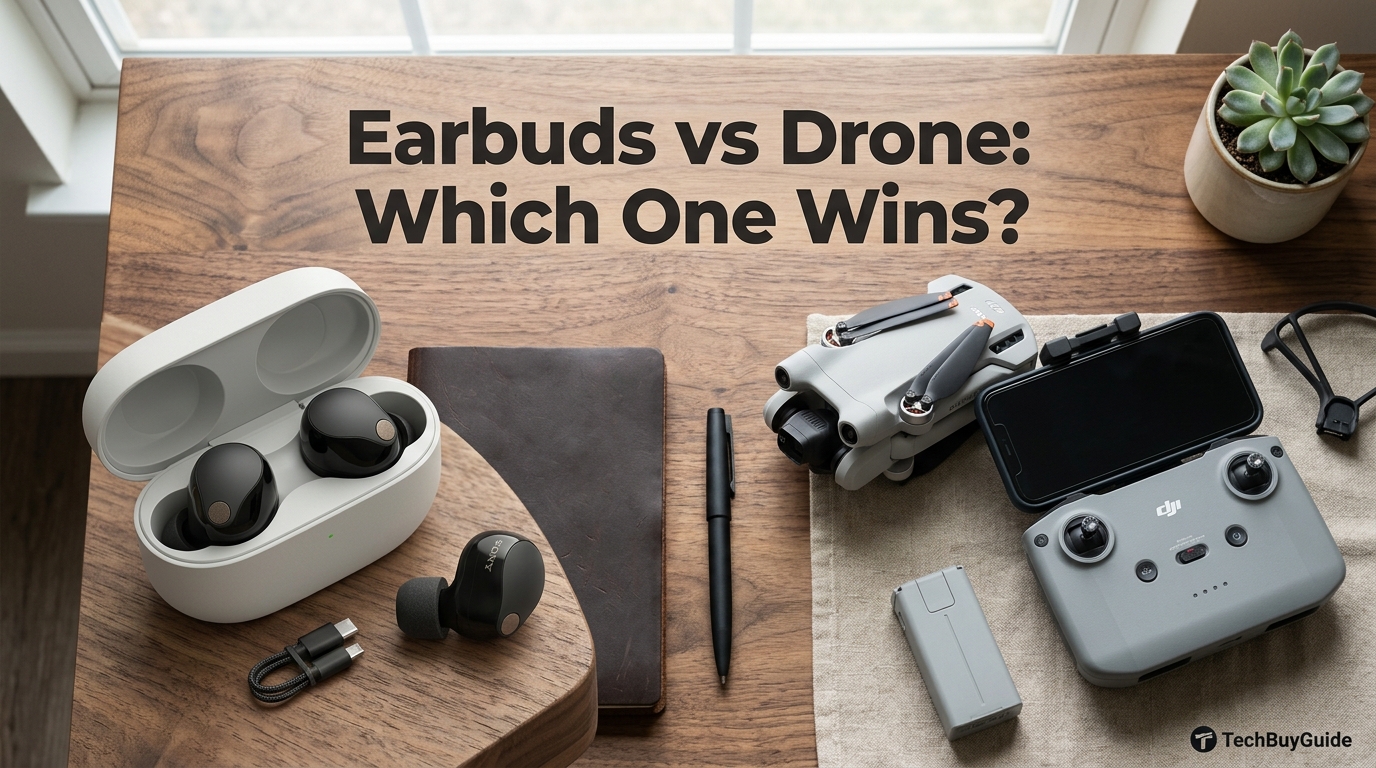
If you have a set budget and can only pick one gadget this year, wireless earbuds and a camera drone probably aren’t the two products you’d expect to see compared side by side. One lives in your ears and follows you through commutes and workouts. The other lives in the sky and follows you through vacations and weekend hikes. Yet this is one of the most common real-world shopping dilemmas people search for — especially around birthdays, graduations, and holiday gift lists, when a buyer has one gift budget and two very different kinds of excitement to choose between.
This guide compares both product categories honestly, using 2026 pricing, real specifications, and practical use cases rather than marketing hype. You’ll learn what each device actually does well, where each one falls short, how much you should realistically expect to spend, and — most importantly — which one fits your lifestyle, not someone else’s. We’ll cover battery life, noise cancellation, flight time, FAA registration rules, camera quality, everyday use cases, and long-term value for both categories.
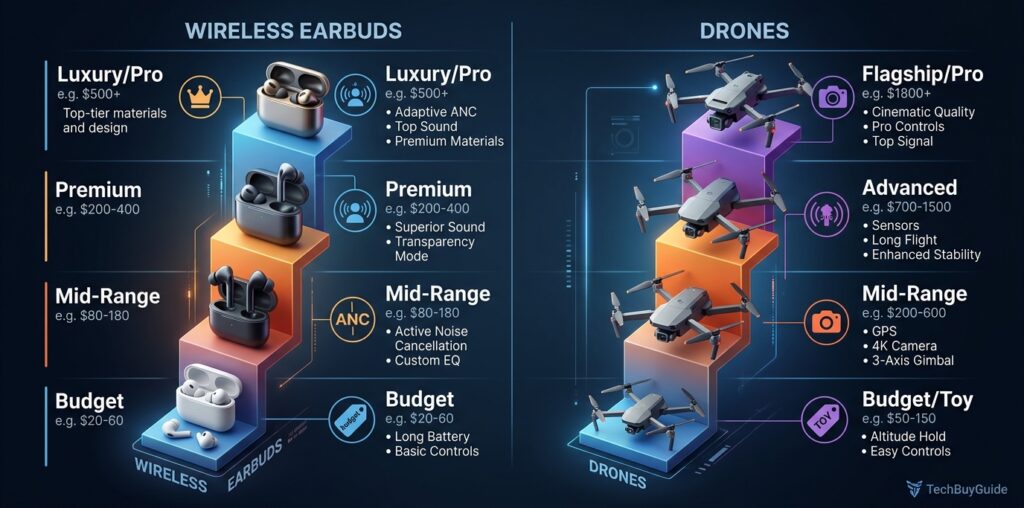
This isn’t a “drones vs headphones” spec-sheet showdown for its own sake. It’s a decision-support guide. A wireless earbud pair like the Sony WF-C510 or Apple AirPods Pro 3 solves a daily, always-on need: music, calls, workouts, and noise control. A camera drone like the DJI Mini 4K or DJI Mini 5 Pro solves an occasional, high-impact need: aerial photography, travel content, and creative footage you simply cannot get from the ground.
By the end of this guide, you’ll have a clear, evidence-based answer for your specific situation — whether that’s a daily commuter, a content creator, a frequent traveler, a parent buying a gift, or someone building a tech kit from scratch. We’ll also cover setup, troubleshooting, common buying mistakes, and a side-by-side decision matrix so you’re not left guessing.
Quick Facts Table
| Category | Wireless Earbuds | Camera Drone |
|---|---|---|
| Typical price range (2026) | $27 – $300+ | $30 (toy) – $2,000+ (pro) |
| Best beginner price point | $60 – $130 | $199 – $349 |
| Daily use case | Always-on: music, calls, workouts | Occasional: travel, photography, video |
| Learning curve | Very low | Moderate to high |
| Legal/registration requirements | None | FAA registration if 250g+ (US) |
| Battery life per charge | 6 – 10 hours (up to 30+ with case) | 20 – 51 minutes per flight |
| Portability | Fits in a pocket | Fits in a backpack |
| Skill required to get good results | None | Practice recommended |
Quick Summary
Wireless earbuds are the better buy if you want something you’ll use every single day — for music, calls, workouts, and blocking out noise on a commute. A solid ANC pair costs under $130 and needs zero learning curve. A camera drone is the better buy if you want to create standout aerial photos and videos, whether that’s for travel content, real estate, weddings, or simply capturing views you can’t get from the ground. Drones cost more upfront, require some practice, and in the US, drones over 250 grams need FAA registration.
Key Takeaways
- Wireless earbuds are a daily-use, low-cost, zero-learning-curve purchase; drones are an occasional-use, higher-cost, skill-building purchase.
- A great pair of earbuds with ANC and multipoint Bluetooth now costs $60–$150, not $300+.
- A capable beginner camera drone with 4K video and GPS return-to-home starts around $299.
- Drones under 250 grams are exempt from FAA registration and Remote ID requirements in the US, making them far more beginner-friendly than older, heavier models.
- If your goal is content creation (travel vlogs, real estate, weddings), a drone delivers footage no earbud purchase ever could.
- If your goal is daily convenience — calls, workouts, commuting — earbuds win on cost per use by a wide margin.
Table of Contents
Why Trust This Guide
This comparison draws on 2026 pricing and specifications from primary retail listings, manufacturer spec sheets, and independent lab-tested reviews across both the audio and drone industries. Every price, battery figure, and regulatory claim referenced here (such as the FAA’s 250-gram registration threshold) is verified against official or expert-verified sources rather than marketing copy. Where a fact could not be independently confirmed, it has been left out rather than guessed at.
The goal isn’t to sell you either product — it’s to help you spend your money on the one that actually fits how you live. That means covering real trade-offs: battery anxiety with drones, case-charging habits with earbuds, and the genuine skill gap between “wearing” a gadget and “flying” one.
Who This Guide Is For
This guide is for anyone facing a genuine either/or decision: a fixed gift budget, a single “treat yourself” purchase, or someone building out a first tech kit. It’s written for commuters and gym-goers weighing daily-use audio gear, travelers and content creators weighing aerial photography tools, and gift buyers trying to match a device to a recipient’s actual habits rather than what looks impressive unwrapped.
It’s also useful for anyone who already owns one category and is wondering whether the other is worth adding — for example, an AirPods owner curious whether a DJI Mini 4K is worth the extra investment for an upcoming trip.
Topic Verification
Both product categories were verified against 2026 retail and review sources. Wireless earbuds pricing spans roughly $27 (deal pricing on entry models like the EarFun Air) to $300 (flagship ANC models like the Bose QuietComfort Ultra and Technics EAH-AZ100). Camera drones range from roughly $100–$300 for beginner sub-250-gram models like the DJI Mini 4K to $1,000–$2,000+ for professional models like the DJI Mavic 4 Pro. FAA registration requirements for drones weighing 250 grams and over were confirmed against current US federal drone rules.
What Are Wireless Earbuds and Camera Drones
Wireless earbuds are compact, Bluetooth-connected in-ear audio devices that stream music, handle calls, and — in most 2026 models — actively cancel outside noise. They live in a charging case, pair automatically with your phone, and are designed for hours of continuous daily wear.
A camera drone is a small, GPS-guided quadcopter with a stabilized camera gimbal, controlled from a companion app or handheld remote. It’s designed for short, deliberate flights to capture aerial photos and video — not for constant, all-day use like earbuds. The two categories solve fundamentally different problems: one is worn, the other is flown.
Company Overview
The wireless earbuds market is led by Apple (AirPods Pro line), Sony (WF-C and WF-1000XM series), Bose (QuietComfort line), Samsung (Galaxy Buds), Google (Pixel Buds Pro), and a fast-growing tier of value brands like Anker’s Soundcore, Nothing, CMF, and OnePlus that now ship ANC and premium codecs at budget prices.
The camera drone market is dominated by DJI, which holds roughly 94% of the consumer hobby drone market. Alternatives include Autel Robotics and Potensic, both positioned in part as options for buyers concerned about DJI’s regulatory scrutiny in some regions, though DJI drones remain legal for recreational use in the US.
History and Timeline
Wireless earbuds became mainstream after Apple’s original AirPods launched in 2016, with ANC becoming widely available across the market by the early 2020s. By 2026, features once reserved for $300 flagships — ANC, multipoint Bluetooth, and Hi-Res codecs like LDAC — have moved down into sub-$60 models.
Consumer camera drones took off with DJI’s Phantom series in the early 2010s, then shrank dramatically with the Mavic and Mini lines. The pivotal shift was the sub-250-gram class, which sidestepped registration requirements and made drones approachable for first-time flyers rather than hobbyist specialists.
Features
Wireless earbuds in 2026 commonly include active noise cancellation (ANC), transparency/ambient mode, Bluetooth multipoint (connecting to two devices at once), wireless charging cases, IPX4+ water resistance, and Hi-Res codecs like LDAC or aptX Lossless. Sports-focused models like the Beats Powerbeats Pro 2 add heart rate monitoring.
Camera drones commonly include GPS-based Return to Home, obstacle avoidance sensors, 3-axis gimbal stabilization, 4K–6K video capture, RAW photo capture, and companion apps with automated shot modes (orbit, follow, waypoint). Higher-end models like the DJI Mavic 4 Pro add multi-lens camera systems and extended transmission range.
Feature Table
| Feature | Wireless Earbuds | Camera Drone |
|---|---|---|
| Noise control | Active Noise Cancellation | N/A |
| Stabilization | N/A | 3-axis gimbal |
| Connectivity | Bluetooth 5.x, multipoint | Wi-Fi/O4-class transmission |
| Water resistance | IPX4 typical | Not weatherproof (most models) |
| Autonomous features | Auto-pause, adaptive ANC | Return-to-Home, obstacle avoidance, auto shot modes |
| Companion app | Yes (EQ, ANC controls) | Yes (flight controls, editing) |
How It Works
Wireless earbuds pair with your phone over Bluetooth and stream compressed or Hi-Res audio directly to tiny drivers in each earpiece. ANC models use built-in microphones to sample outside noise and generate an inverse sound wave that cancels it before it reaches your eardrum.
A camera drone uses GPS and onboard sensors to hold a stable position in the air, while a gimbal-mounted camera keeps footage smooth even as the drone tilts and turns. The pilot controls altitude, direction, and camera angle through a physical remote paired with a smartphone app that also handles framing and playback.
Setup Guide
Setting up wireless earbuds takes under two minutes: open the case near your phone, tap “connect” in the pairing prompt, and download the companion app to customize EQ and ANC. Setting up a drone takes longer: charge the battery and controller, install the companion app, complete a firmware update, calibrate the compass, and register the drone with the FAA if it weighs 250 grams or more.
Step-by-Step Tutorial
For earbuds: open the case lid near your unlocked phone, tap the on-screen pairing card, grant Bluetooth permissions, then open the companion app to fit-test your ear tips and enable ANC. For a drone: find an open outdoor space away from people and airports, power on the controller before the drone, wait for GPS lock (shown in the app), and complete a short test hover at low altitude before your first real flight.
Use Cases
Wireless earbuds cover commuting, workouts, work calls, travel, and everyday music listening — situations that happen daily, sometimes multiple times a day. A camera drone covers travel photography, real estate listings, weddings, landscape videography, and inspection work — situations that happen occasionally but where the payoff (footage you can’t get any other way) is much higher per use.
Industry Use Cases
Beyond personal use, wireless earbuds are used in call centers, remote work setups, and fitness coaching apps that sync with heart rate data. Camera drones are used commercially in real estate marketing, agriculture (crop monitoring), construction site progress tracking, and film production, where DJI’s Mavic and Inspire lines dominate professional aerial cinematography [external link: FAA drone regulations].
Benefits
Wireless earbuds offer daily convenience, low cost of entry, no legal restrictions, and features (ANC, multipoint) that noticeably improve commuting and work-from-home life. A drone offers a creative capability that’s otherwise inaccessible without renting a helicopter or hiring a professional — aerial perspective, cinematic movement, and travel content that stands out.
Limitations
Wireless earbuds are easy to lose, their battery capacity degrades over 1–2 years, and they rarely deliver audiophile-grade sound compared to wired options. Drones are weather-dependent, have short per-flight battery life (20–51 minutes), face airspace restrictions near airports, and carry a real risk of crashes for beginners during the first few flights.
Pros & Cons Table
| Wireless Earbuds | Camera Drone | |
|---|---|---|
| Pros | Cheap entry point, daily utility, zero learning curve, portable | Unique creative output, growing resale value, fun learning curve |
| Cons | Battery degrades over time, easy to lose, sound capped by size | Weather-dependent, registration rules, crash risk, higher cost |
Pros & Cons Explanation
Wireless earbuds’ biggest strength is frequency of use — you’ll use them today, tomorrow, and every day after, which makes even a $130 pair cost very little per use over a year. Their main weakness is battery longevity; most earbud batteries noticeably degrade after 18–24 months of daily charging cycles.
A drone’s biggest strength is that it produces something earbuds structurally cannot: shareable, professional-looking aerial content. Its main weakness is that value depends entirely on how often you actually fly it — a drone that sits in a closet delivers zero return, while earbuds in a drawer are simply forgotten spend, not wasted potential.
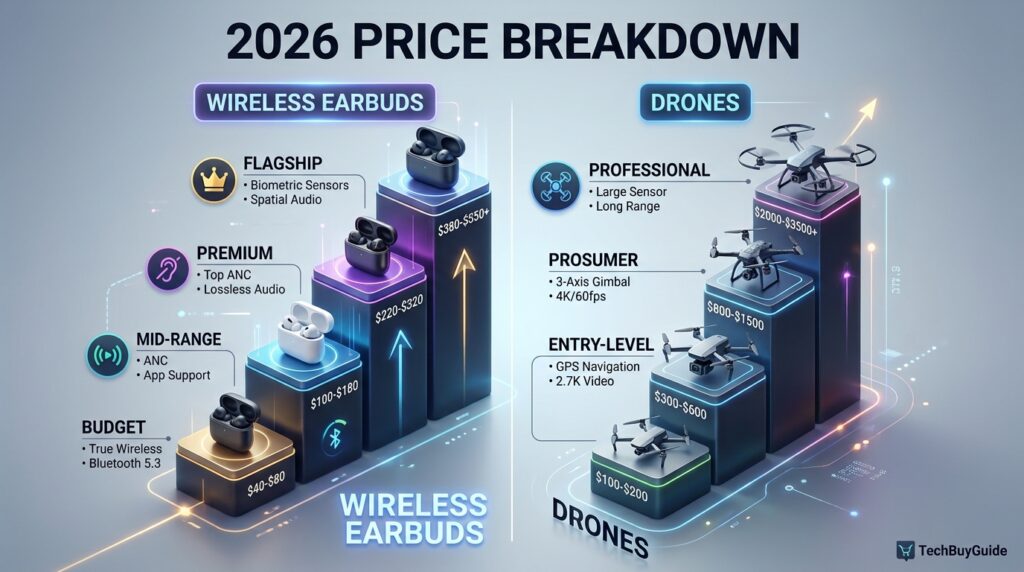
Pricing Table
| Tier | Wireless Earbuds | Camera Drone |
|---|---|---|
| Budget | $27 – $60 (EarFun Air, Moondrop Space Travel 2) | $30 – $150 (toy-grade, REDRIE HK33) |
| Mid-range | $60 – $150 (Sony WF-C510, OnePlus Buds 4) | $199 – $349 (DJI Mini 4K, DJI Neo/Flip) |
| Premium | $150 – $300 (Bose QuietComfort, AirPods Pro 3, Sony WF-1000XM6) | $800 – $2,000+ (DJI Mini 5 Pro, Air 3S, Mavic 4 Pro) |
Comparison Table
| Criteria | Wireless Earbuds | Camera Drone |
|---|---|---|
| Entry price | $27 | $30 (toy) / $299 (capable) |
| Daily usability | Excellent | Low (occasional use) |
| Skill required | None | Moderate |
| Legal restrictions | None | FAA registration (250g+) |
| Output produced | Personal audio experience | Shareable photo/video content |
| Portability | Pocket-sized | Backpack-sized |
Specifications
Typical 2026 wireless earbuds: 6–10 hours battery per charge (20–30+ with case), Bluetooth 5.3–5.4, IPX4 water resistance, 4–8mm dynamic drivers, weight under 6g per earbud. Typical beginner camera drones: under 249g takeoff weight, 20–36-minute flight time, 4K/30 fps or 4K/60 fps video, GPS + optical positioning, transmission range of 6–12 miles depending on model.
Security, Privacy, and Compliance
Wireless earbuds raise minimal legal concerns but do collect usage and app-permission data through their companion apps, so reviewing microphone and Bluetooth permissions is worth a few minutes. Camera drones carry real compliance requirements: in the US, any drone weighing 250 grams or more must be registered with the FAA, follow the 400-foot altitude limit, and avoid restricted airspace near airports — rules that apply regardless of skill level or intended use.
Performance
Wireless earbuds performance is judged on ANC depth, call clarity, latency for video/gaming, and battery consistency — areas where 2026’s budget tier has closed much of the gap with flagship models. Drone performance is judged by flight stability in wind, obstacle-avoidance accuracy, video bitrate, and transmission range, with premium models like the DJI Mavic 4 Pro still meaningfully outperforming beginner drones.
Integrations and Ecosystem
Wireless earbuds integrate with phone OS features such as Find My, spatial audio, and voice assistants, and often work best within a single brand’s ecosystem (e.g., AirPods with iPhone). Camera drones integrate with editing apps, cloud storage for footage backup, and, increasingly, AI-assisted editing tools in their companion apps for auto-generated highlight reels.
Customer Support
Major earbud brands (Apple, Sony, Bose, Samsung) offer 1-year warranties, in-app troubleshooting, and widely available authorized repair or replacement programs. DJI and other drone makers offer warranty coverage plus optional crash-protection plans (like DJI Care Refresh), which are worth strongly considering given the higher cost of a crash compared to a dropped earbud.
Latest Updates (2026)
In 2026, budget earbuds gained features once reserved for flagships — ANC under $60, LDAC under $100, and 365-day price-tracking becoming standard on review sites. In the drone space, the DJI Mavic 4 Pro introduced a 360° Infinity Gimbal and a 100MP Hasselblad camera system, while sub-250g models like the DJI Mini 5 Pro added 1-inch sensors previously reserved for larger drones.
Expert Tips
For earbuds, prioritize a proper ear-tip seal over spec-sheet bragging rights — fit affects sound quality and ANC performance more than almost any other factor. For drones, always complete a low-altitude test hover before your first real flight, and check local no-fly zones in your app before takeoff, not after.
Common Mistakes
Buyers often choose earbuds based on brand name alone rather than fit, missing out on better ANC and comfort from lesser-known models. With drones, the most common mistake is skipping the registration and no-fly zone checks, or flying in wind conditions beyond the stability limits of a lightweight sub-250g drone.
Troubleshooting
If earbuds disconnect randomly, forget the Bluetooth pairing and re-pair from scratch, and check for a firmware update in the companion app. If a drone won’t achieve GPS lock, move to a more open area away from tall buildings and confirm the firmware is up to date before attempting takeoff.
Myths vs Facts
Myth: All drones need FAA registration. Fact: Only drones weighing 250 grams or more require US federal registration; most beginner sub-250g models are exempt.
Myth: Cheap earbuds can’t have real ANC. Fact: Several sub-$60 models in 2026 ship with genuine adaptive ANC that rivals older $200 flagships.
Decision Matrix
| Criteria (weighted) | Wireless Earbuds Score | Camera Drone Score |
|---|---|---|
| Daily usefulness | 9/10 | 4/10 |
| Cost efficiency | 8/10 | 6/10 |
| Learning curve | 10/10 (easy) | 5/10 |
| Creative output | 3/10 | 10/10 |
| Legal simplicity | 10/10 | 6/10 |
Beginner vs Advanced
Beginners in audio should start with a $60–$130 ANC pair rather than a $300 flagship — the sound and ANC gap has narrowed significantly. Beginners in drones should start with a sub-250g model like the DJI Mini 4K before stepping up to heavier, higher-end drones that demand more piloting skill and carry more regulatory overhead.
Best Alternatives
If neither fits perfectly, consider over-ear wireless headphones (better battery life, bulkier) as an alternative to earbuds, or a handheld action camera or a gimbal-stabilized phone rig as a lower-cost, no-flying-required alternative to a drone for travel content.
Alternative Comparison
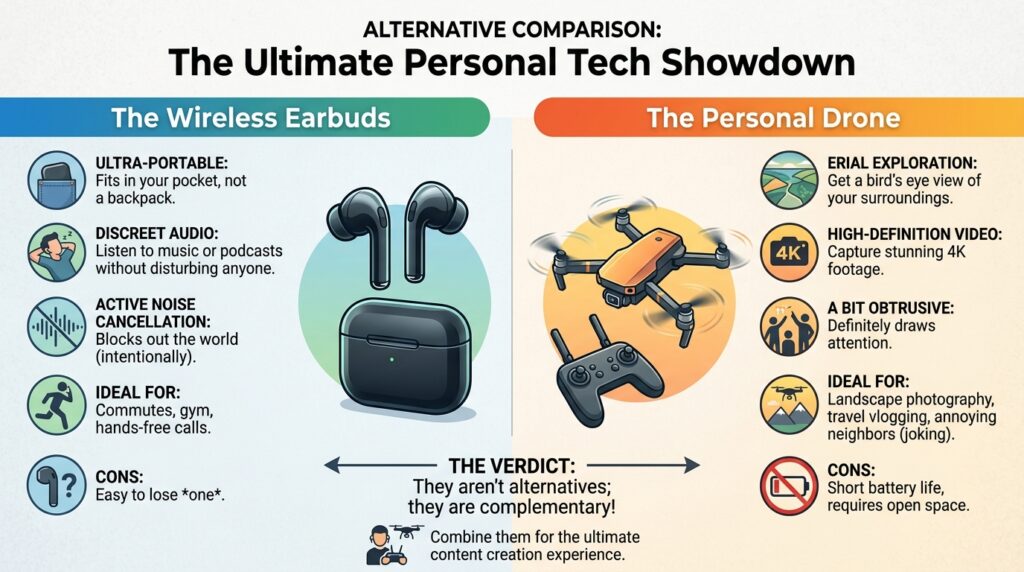
| Alternative | Best For | Trade-off |
|---|---|---|
| Over-ear headphones | Long listening sessions | Less portable than earbuds |
| Action camera | Ground-level travel content | No aerial perspective |
| Drone rental/hire | One-off aerial shoot | No ownership, per-use cost |
Who Should Use It
Wireless earbuds suit commuters, gym-goers, remote workers on calls, and anyone who wants better daily audio without a big learning curve. A camera drone suits travelers, content creators, real estate agents, and hobbyists who genuinely want to learn a new skill and produce aerial footage.
Read more: Top 5 Budget Wireless Earbuds Under $100 (2026 Buying Guide)
Who Should Avoid It
Skip drones if you rarely travel, live in a dense no-fly zone, or aren’t interested in the practice required to fly well — the value collapses if it stays in a closet. Skip premium earbuds if you already own a solid budget pair with ANC; the sound difference at the top end is now smaller than the price difference.
Is it better to buy wireless earbuds or a drone as a gift?
It depends on the recipient’s habits: earbuds are the safer daily-use gift for almost anyone, while a drone is a better gift specifically for someone who travels often or has expressed interest in photography and videography.
Do all drones need to be registered with the FAA?
No. In the US, only drones weighing 250 grams (0.55 pounds) or more require FAA registration; most beginner-friendly models are designed to stay under that threshold.
Are budget wireless earbuds in 2026 actually good?
Yes. Features like adaptive ANC, Bluetooth multipoint, and Hi-Res codecs like LDAC have moved down into sub-$60 models, closing much of the gap with $300 flagships.
How long does a typical drone battery last per flight?
Most beginner and mid-range drones offer 20–36 minutes of flight time per battery, while top-tier models like the DJI Mavic 4 Pro reach around 51 minutes.
Which is cheaper in the long term, earbuds or a drone?
Earbuds are cheaper long-term for most people because they’re used daily, spreading the cost over thousands of uses, while a drone’s value depends heavily on how often you actually fly it.
Rating Scorecard
| Category | Wireless Earbuds | Camera Drone |
|---|---|---|
| Value for money | 9/10 | 7/10 |
| Ease of use | 10/10 | 6/10 |
| Daily utility | 9/10 | 4/10 |
| Creative potential | 3/10 | 10/10 |
| Overall | 8.5/10 | 7/10 |
Conclusion
There isn’t a universal winner between wireless earbuds and a camera drone — there’s only the right answer for how you actually live. If you want a purchase that earns its keep every single day, at almost any budget, wireless earbuds are the clear choice: a $60–$130 pair with ANC now delivers what only $300 flagships offered a few years ago, with zero learning curve and no legal red tape.
If, instead, you’re chasing a creative outcome — travel footage, real estate listings, or simply a new perspective on familiar places — a camera drone is worth the higher cost and the practice it demands. A beginner-friendly, sub-250-gram model like the DJI Mini 4K sidesteps FAA registration and gets you flying within a day, while premium models like the DJI Mavic 4 Pro reward the investment with genuinely professional results.
The honest moral of this comparison: buy earbuds for consistency, and buy a drone for capability you can’t get any other way. Match the purchase to your actual habits — not the excitement of unboxing — and either device will earn its price. For most people building a first tech kit on a single budget, starting with a solid pair of ANC earbuds is the lower-risk, higher-frequency win; the drone becomes the natural second purchase once travel or content creation becomes a real, recurring priority rather than a one-time impulse.
Official Sources
- Federal Aviation Administration — Drone registration and Part 107/recreational rules
- DJI official specifications — Mini 4K, Mini 5 Pro, Air 3S, Mavic 4 Pro
- Manufacturer spec sheets — Apple, Sony, Bose, Samsung, Anker/Soundcore
- Independent lab reviews — SoundGuys, TechGearLab, The Drone Girl, Tom’s Guide
Author Bio
Written by the TechBuyGuide editorial team, specializing in consumer audio and camera-drone buying guides, with pricing and specifications verified against current 2026 manufacturer and retailer listings.