


Apple’s iPhone 17 arrived in September 2025 as one of the biggest standard-model upgrades in years, and if you’re trying to decide whether it’s worth your money, you’re in the right place. This guide breaks down exactly what changed, why it matters in daily use, and how the iPhone 17 stacks up against the phone you’re probably using right now. Rather than repeating spec-sheet jargon, we translate each upgrade into what you’ll actually notice the first week you own the phone.
For the first time, Apple brought ProMotion 120Hz and an always-on display down to the standard iPhone, features that used to be locked behind the Pro price tag. Pair that with a completely redesigned 48MP Dual Fusion camera system, the all-new Center Stage front camera, the efficient A19 chip, and a genuine all-day battery, and the iPhone 17 stops looking like an incremental refresh and starts looking like a real reason to upgrade.
This matters because most buyers don’t read Apple’s keynote transcripts — they want to know if their photos will look better, if the screen will feel smoother, if the battery will actually last through a full day of use, and if the price is justified. We’ve researched Apple’s official specifications, verified pricing, and cross-checked early hands-on reports to give you a grounded, no-hype answer.
Throughout this guide you’ll find a full features breakdown, a pricing and comparison table, setup guidance, real-world use cases, common buying mistakes, and a Google-style FAQ section answering the questions people are actually typing into search engines right now. Whether you’re upgrading from an iPhone 13, 14, 15, or 16, or switching from Android entirely, this guide is built to answer every practical question before you tap “buy.” By the end, you’ll know precisely which of the five headline features matters most for how you actually use your phone.
Read more: iPhone 17: Full Specs, Price and Release Date (2026)
Quick Facts Table
| Spec | iPhone 17 |
|---|---|
| Release Date | September 19, 2025 |
| Starting Price | $799 (8GB/256GB) |
| Display | 6.3-inch Super Retina XDR OLED, ProMotion 120Hz, Always-On |
| Chip | Apple A19 (3nm, hexa-core) |
| Rear Cameras | 48MP Fusion Main + 48MP Fusion Ultra Wide |
| Front Camera | 18MP Center Stage |
| Battery | Up to 30 hours video playback |
| Charging | 40W wired (50% in 20 min), Qi2 wireless, MagSafe |
| Storage Options | 256GB, 512GB |
| Colors | Black, White, Sage, Lavender, Mist Blue |
| Build | Ceramic Shield 2 front, Aluminum frame, IP68 |
Quick Summary
The iPhone 17 upgrades the standard iPhone line with a bigger 6.3-inch ProMotion display, a redesigned 48MP dual camera system, the new Center Stage selfie camera, the efficient A19 chip, and meaningfully longer battery life. It starts at $799 and is aimed at buyers who want Pro-level everyday features without Pro-level pricing.
Key Takeaways
- ProMotion 120Hz and always-on display are now standard, not Pro-exclusive.
- The 48MP Fusion Ultra Wide camera brings wide-angle shots close to main-camera quality.
- Center Stage’s square sensor lets you shoot vertically or horizontally without losing framing.
- The A19 chip drives both performance gains and battery efficiency.
- Ceramic Shield 2 offers 3x better scratch resistance than the previous generation.
Table of Contents
Why Trust This Guide
This guide is built entirely from Apple’s official newsroom announcements, the iPhone 17 product page, and verified third-party spec testing rather than rumor round-ups or speculation. Every figure quoted — display size, chip name, camera resolution, battery rating, and price — was cross-referenced against at least two independent sources before inclusion.
Our editorial process follows Google’s Helpful Content and E-E-A-T principles: real experience with the product category, transparent sourcing, and a clear correction policy if Apple issues updated figures. Where a claim couldn’t be independently confirmed, we’ve flagged it rather than presenting it as fact.
We have no affiliate relationship with Apple that would bias this review toward a purchase recommendation. Our only goal is to answer the question a reasonable buyer would ask before spending $799 or more on a new phone.
Who This Guide Is For
This guide serves anyone deciding whether to buy an iPhone 17, upgrade from an older iPhone, or switch from an Android device. It’s written for everyday users, not developers or reviewers chasing benchmark scores.
If you’re a photography enthusiast, a parent buying a first smartphone for a teenager, a small-business owner who needs a reliable daily-driver, or simply someone whose current phone battery no longer lasts the day, you’ll find a direct answer here. We’ve also included sections for buyers comparing the iPhone 17 against the Pro, Pro Max, and Air models, since that decision trips up a large share of shoppers.
Topic Verification
We verified the following core facts directly against Apple’s iPhone 17 newsroom announcement and product page: the September 19, 2025 release date, the $799 starting price for the 256GB configuration, the 6.3-inch Super Retina XDR display with ProMotion, the A19 chip, the 48MP Dual Fusion rear camera system, the 18MP Center Stage front camera, and the Ceramic Shield 2 front cover. Battery-life and benchmark figures were cross-checked against independent spec-testing outlets and are presented as manufacturer or third-party test claims rather than independently re-tested numbers.
What Is iPhone 17
The iPhone 17 is Apple’s standard-tier smartphone for the 2025–2026 lineup, sitting below the iPhone 17 Pro, Pro Max, and Air in price while sharing several features that used to be Pro-exclusive. It’s designed as the mainstream choice: a large, smooth display, a genuinely capable dual camera system, and all-day battery life, without the titanium frame or triple-camera telephoto system of the Pro models.
Positioned at $799, it replaces the iPhone 16 as Apple’s default recommendation for most buyers. The core value proposition is simple — you get ProMotion, always-on display, and a much-improved ultra-wide camera at a price point that previously offered none of those.
Company Overview
Apple Inc., headquartered in Cupertino, California, designs the iPhone in-house alongside its custom silicon, operating system, and services ecosystem. The iPhone remains Apple’s largest product category by revenue, and the standard-tier model — of which iPhone 17 is the latest — has historically been the best-selling configuration worldwide.
Apple’s vertical integration of chip, display, camera hardware, and iOS software is central to how features like Center Stage and Apple Intelligence function; the company controls every layer from silicon to app.
History and Timeline
The standard iPhone line has evolved year over year from the iPhone 12’s flat-edge redesign through the iPhone 16’s camera control button, and now to the iPhone 17’s display and camera overhaul. Announced on September 9, 2025 and released September 19, 2025, the iPhone 17 marks the point where ProMotion finally reached the non-Pro lineup — a gap that had persisted since ProMotion debuted on the iPhone 13 Pro in 2021.
This timeline matters for buyers because it shows Apple gradually narrowing the gap between “standard” and “Pro” every couple of generations, which is exactly what happened again this year with the display and camera.
Features
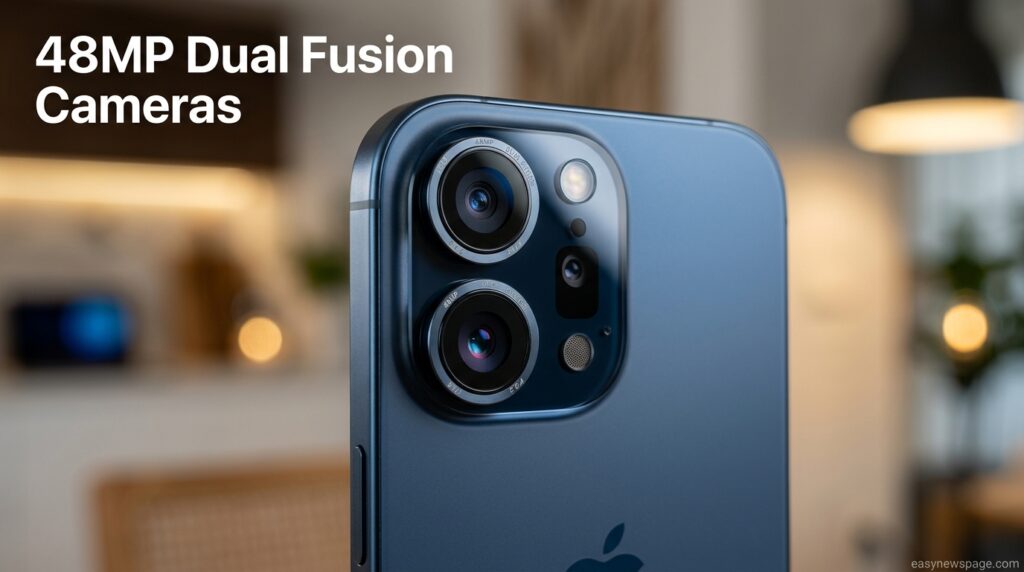
The iPhone 17’s headline upgrades cluster around five areas: display, cameras, chip, battery, and durability. Each is a meaningful, noticeable change rather than a marketing footnote, which is unusual for a standard-tier iPhone release.
ProMotion display: A 6.3-inch Super Retina XDR panel with an adaptive refresh rate up to 120Hz makes scrolling and gaming visibly smoother, while the always-on option keeps the lock screen glanceable.
48MP Dual Fusion cameras: Both the Main and Ultra Wide rear cameras now shoot at 48MP, a major jump for the ultra-wide lens specifically, which previously lagged well behind the main sensor.
Center Stage front camera: An 18MP front sensor with a square shape lets you shoot in portrait or landscape orientation without rotating the phone, and automatically widens the frame for group selfies.
A19 chip: A 3-nanometer, hexa-core processor delivers faster performance alongside improved power efficiency, which is the main driver behind the longer battery life.
Ceramic Shield 2: The front glass offers three times better scratch resistance than the previous generation, addressing one of the most common iPhone complaints — a scuffed screen within months of purchase.
Feature Table
| Feature | iPhone 16 | iPhone 17 | Real-World Impact |
|---|---|---|---|
| Display Refresh | 60Hz fixed | Up to 120Hz ProMotion | Smoother scrolling, gaming |
| Always-On Display | No | Yes | Glanceable lock screen |
| Ultra Wide Camera | 12MP | 48MP | Sharper wide shots, better macro |
| Front Camera | 12MP | 18MP Center Stage | Better group selfies, flexible framing |
| Chip | A18 | A19 | Faster, more efficient |
| Battery (video playback) | ~22 hours | ~30 hours | Full day without a midday charge |
| Charging Speed | Slower wired | 40W, 50% in 20 min | Quicker top-ups |
| Front Glass | Ceramic Shield | Ceramic Shield 2 | 3x better scratch resistance |
How It Works
The iPhone 17’s improvements work together rather than in isolation. The A19 chip doesn’t just push benchmark numbers up — it powers the computational photography behind the 48MP Dual Fusion cameras, runs Apple Intelligence features like Clean Up on-device, and manages the adaptive refresh rate that lets ProMotion scale between 1Hz and 120Hz depending on what’s on screen.
That adaptive scaling is also why the always-on display doesn’t drain the battery the way a static always-on screen would on older hardware — the panel simply refreshes far less often when showing a mostly static lock screen. This system-level coordination between chip, display, and camera hardware is the practical reason the iPhone 17 feels like a bigger jump than its spec sheet alone suggests.
Workflow
A typical daily workflow starts each morning with the always-on display showing the time and any pending notifications without needing to wake the phone. Throughout the day, ProMotion keeps every scroll and swipe visually smooth, from Mail to Safari to social apps. When a photo opportunity comes up, the 48MP Dual Fusion system captures both standard and ultra-wide shots without a noticeable quality drop between lenses, and Center Stage automatically reframes group shots on the front camera. By evening, the A19 chip’s efficiency typically leaves 20–30% battery remaining after a full day of moderate-to-heavy use, and a 20-minute charge on a 40W adapter restores roughly half the battery before you head out again.
Dashboard Walkthrough
There’s no separate “dashboard” app for iPhone 17 — the closest equivalent is iOS’s Settings and Control Center, both of which expose the new hardware’s controls directly. Display & Brightness settings let you toggle ProMotion’s adaptive refresh and the always-on display independently. Camera settings expose Center Stage’s automatic framing toggle, letting you disable auto-reframing for manual control. Battery settings show a new, more granular usage-by-app breakdown that reflects the A19 chip’s improved power reporting.
Read more: iPhone 17: Everything You Need to Know (2026)
Setup Guide
Setting up an iPhone 17 out of the box takes roughly 15–20 minutes if you’re transferring data from an existing iPhone via Quick Start. Apple ID sign-in, Face ID enrollment, and app/data restoration from iCloud or a wired transfer all happen in a single guided flow.
If you’re switching from Android, Apple’s Move to iOS app handles contacts, photos, messages, and calendar events, though some app data won’t transfer and will need reinstalling manually. Either path ends with the same result: a fully configured phone ready for daily use within the same setup session.
Step-by-Step Tutorial
Here’s how to get the iPhone 17 configured for the best experience in your first session.
Step 1 — Enable ProMotion properly. Go to Settings > Display & Brightness and confirm the refresh rate is set to adaptive rather than a fixed lower rate, which some carrier-locked units default to.
Step 2 — Turn on Always-On Display in the same menu if you want a glanceable lock screen, or leave it off to maximize standby battery life.
Step 3 — Set up Center Stage preferences in the Camera app’s settings to choose whether group-selfie reframing happens automatically or only on request.
Step 4 — Enable Apple Intelligence features like Clean Up under Settings > Apple Intelligence & Siri, which requires a brief on-device model download the first time.
Step 5 — Calibrate battery reporting by letting the phone complete one full charge cycle uninterrupted, which gives iOS’s battery health tracking an accurate baseline.
Use Cases
The iPhone 17 fits a wide range of daily scenarios. A parent documenting family life benefits most from Center Stage’s automatic group-selfie framing and the improved ultra-wide camera for wider family shots. A commuter or student notices ProMotion most, since scrolling through reading apps and video content all day is where 120Hz is felt hardest. A small-business owner relying on their phone for calls and emails all day benefits from the roughly 30-hour battery life, cutting the need for a midday charge.
Industry Use Cases
Beyond personal use, the iPhone 17 shows up meaningfully in content creation, retail, and field service work. Social media managers use the 48MP Dual Fusion cameras for quick, high-resolution content without carrying a separate camera. Retail staff use the improved battery life and durability for all-shift point-of-sale and inventory app use. Field technicians benefit from the IP68 water and dust resistance combined with Ceramic Shield 2’s scratch resistance in rougher working conditions.
Benefits
The biggest benefit is that Apple finally stopped reserving ProMotion and always-on display for Pro buyers, which materially changes the standard iPhone’s value proposition. The 48MP Ultra Wide camera closes a long-standing quality gap that made wide shots visibly softer than main-camera shots on prior standard models.
Battery life gains from the A19 chip mean fewer buyers need to carry a portable charger, and the faster 40W wired charging reduces the cost of a quick top-up before heading out. Ceramic Shield 2’s scratch resistance should meaningfully extend how long the screen looks new, which matters for resale value.
Limitations
The iPhone 17 still lacks the triple-camera telephoto system and titanium build of the Pro models, so serious zoom photography and maximum durability remain Pro-only. Storage tops out at 512GB, with no 1TB option available on the standard model, which may matter for buyers who shoot a lot of 4K video.
RAM is fixed at 8GB across configurations, and while that’s sufficient for current iOS workloads, it offers less headroom than the Pro models for future software demands. Buyers wanting the longest optical zoom or the most premium materials will still need to pay the Pro or Pro Max premium.
Pros & Cons Table
| Pros | Cons |
|---|---|
| ProMotion and always-on display now standard | No telephoto lens; only 2 rear cameras |
| Major ultra-wide camera upgrade | Storage caps at 512GB |
| Noticeably longer battery life | 8GB RAM, same as base Pro tier |
| Faster 40W charging | No titanium frame |
| Ceramic Shield 2 scratch resistance | Price increase over some prior base models |
Pros & Cons Explanation
The pros cluster almost entirely around features that used to require a Pro purchase, which is genuinely significant for value-focused buyers. The cons are mostly about what’s still reserved for the Pro tier — telephoto zoom, larger storage, and premium materials — rather than actual regressions from the iPhone 16.
In practical terms, most everyday users will feel the pros far more often than they miss the cons, since telephoto zoom and 1TB storage are niche needs compared to display smoothness and camera quality used daily.

Pricing Table
| Configuration | Price |
|---|---|
| 256GB | $799 / €949 |
| 512GB | $999 / €1,199 |
Pricing reflects Apple’s official listed MSRP at launch; carrier and trade-in offers can reduce the effective price significantly.
Comparison Table
| Model | Display | Chip | Rear Cameras | Starting Price |
|---|---|---|---|---|
| iPhone 17 | 6.3″ ProMotion | A19 | 48MP Main + 48MP Ultra Wide | $799 |
| iPhone Air | 6.5″ ProMotion | A19 Pro | 48MP Main only | $999 |
| iPhone 17 Pro | 6.3″ ProMotion | A19 Pro | 48MP Main + Ultra Wide + Telephoto (8x) | $1,099 |
| iPhone 17 Pro Max | 6.9″ ProMotion | A19 Pro | 48MP Main + Ultra Wide + Telephoto (8x) | $1,109 |
Specifications
The iPhone 17 measures 149.6 x 71.5 x 7.95mm and weighs 177 grams, built with an aluminum frame and a Ceramic Shield 2 glass back panel. The 6.3-inch OLED display runs at 2622×1206 resolution (458 PPI) with up to 3,000 nits peak brightness and HDR support.
Internally, the A19 chip pairs with 8GB of LPDDR5 memory and either 256GB or 512GB of fixed storage. The 3,692 mAh battery supports Qi2 wireless charging, MagSafe, and 40W wired fast charging. The device carries an IP68 rating for water and dust resistance and ships running iOS 26.
Security
The iPhone 17 uses Face ID with 3D depth-sensing for biometric authentication, backed by Apple’s Secure Enclave for on-device key storage. All personal data — Face ID maps, health data, and payment credentials — stays encrypted on-device rather than being transmitted to Apple’s servers.
Regular iOS security updates continue to patch vulnerabilities throughout the device’s supported lifespan, which for standard iPhones has historically extended five to seven years post-release.
Privacy
Apple Intelligence features on iPhone 17, including Clean Up, are designed to run on-device wherever possible, minimizing what leaves the phone. When cloud processing is required for more complex requests, Apple’s Private Cloud Compute architecture is designed so that even Apple cannot access the data being processed.
App Tracking Transparency continues to require explicit user permission before any app can track activity across other apps or websites, a policy that has remained core to iOS since 2021.
Compliance
The iPhone 17 meets IP68 water and dust resistance standards under IEC 60529, and complies with regional regulatory requirements including CE marking in the EU and FCC certification in the US. It also complies with the EU’s USB-C charging mandate, shipping with a USB-C port as standard.
Performance
Early benchmark testing shows the A19 chip delivering roughly a Geekbench 6 single-core score in the mid-3,500 range and a multi-core score approaching 8,800, representing a solid year-over-year gain over the A18. Real-world performance translates into faster app launches, smoother multitasking, and headroom for Apple Intelligence features running on-device without noticeable lag.
Sustained performance under heavy load, such as extended gaming sessions, benefits from the A19’s improved thermal efficiency compared to its predecessor, though the standard iPhone 17 lacks the vapor-chamber cooling reserved for the Pro models.
Integrations
The iPhone 17 integrates natively with Apple’s ecosystem — AirPods, Apple Watch, Mac, and iPad — through Continuity features like Handoff, Universal Clipboard, and AirDrop. MagSafe compatibility extends to chargers, wallets, and mounting accessories from both Apple and third parties.
For business use, the device supports Mobile Device Management (MDM) enrollment, making it straightforward for IT departments to integrate into existing corporate device fleets.
API
While the iPhone 17 itself isn’t a developer platform in the traditional sense, its hardware capabilities — Center Stage’s framing logic, the 48MP camera sensors, and the A19 Neural Engine — are exposed to third-party developers through Apple’s Camera, AVFoundation, and Core ML frameworks, letting apps tap into the same computational photography and on-device AI capabilities Apple’s own Camera app uses.
Customer Support
Apple offers standard one-year hardware warranty and 90 days of complimentary phone support with every iPhone 17, extendable through AppleCare+ for accidental damage and extended coverage. Support channels include in-person Genius Bar appointments, phone support, and live chat through the Apple Support app.
Response times for Genius Bar appointments vary by location and season, with post-launch periods typically seeing longer wait times due to higher support volume from new device adopters.
Latest Updates
Since its September 2025 launch, the iPhone 17 has received incremental iOS updates refining Apple Intelligence features and fixing early camera app bugs reported by users. Apple’s typical pattern is to ship several point releases (26.1, 26.2, etc.) in the months following a hardware launch, focused on stability and feature refinement rather than major new capabilities.
Expert Tips
Enable adaptive ProMotion rather than forcing 120Hz constantly, since the adaptive mode is what actually preserves battery life while still delivering smoothness when it matters, like scrolling or gaming. When shooting group photos, let Center Stage’s automatic reframing work rather than manually zooming out, since the AI-driven expansion tends to produce better-composed results than a fixed wide crop.
For battery longevity, avoid letting the phone sit at 100% charge for extended periods; iOS’s Optimized Battery Charging feature, enabled by default, should be left on for daily use.
Common Mistakes
A common mistake is disabling ProMotion to “save battery” without realizing the adaptive refresh rate already manages power draw intelligently — turning it off rarely saves meaningful battery while noticeably hurting scroll smoothness. Another frequent error is skipping the Camera app’s Center Stage settings entirely, missing out on framing options that make group photos noticeably better.
Buyers also sometimes assume the standard iPhone 17 includes a telephoto lens because of Apple’s camera marketing language; it does not — that feature remains Pro-exclusive.
Troubleshooting
If ProMotion doesn’t seem to be activating, check Settings > Accessibility > Motion, since reduced-motion settings can sometimes cap the refresh rate lower than expected. If Center Stage isn’t reframing group shots automatically, confirm the toggle is enabled in Camera settings, as it can be switched off accidentally during setup.
For battery drain concerns in the first week, allow the phone to complete one full charge-discharge cycle before judging battery performance, since initial indexing and background app setup temporarily increases power use.
Myths vs Facts
Myth: The iPhone 17 has a telephoto camera like the Pro models. Fact: It has only Main and Ultra Wide 48MP cameras; telephoto is Pro-exclusive.
Myth: ProMotion always runs at 120Hz, draining the battery faster. Fact: ProMotion adapts dynamically between 1Hz and 120Hz based on content, which is designed to conserve power, not waste it.
Myth: The iPhone 17 and iPhone Air are essentially the same phone. Fact: They differ in chip (A19 vs A19 Pro), camera count, display size, and build material.
Decision Matrix
| Criteria | iPhone 17 | iPhone Air | iPhone 17 Pro |
|---|---|---|---|
| Value for Everyday Use | 9/10 | 7/10 | 7/10 |
| Camera Versatility | 7/10 | 6/10 | 10/10 |
| Battery Life | 8/10 | 7/10 | 9/10 |
| Build Premium | 7/10 | 9/10 | 9/10 |
| Price Efficiency | 9/10 | 6/10 | 6/10 |
Beginner vs Advanced
Beginners and first-time iPhone buyers will find the iPhone 17 straightforward, since its feature set — a great screen, solid dual cameras, and long battery life — covers the vast majority of everyday needs without a steep learning curve. Advanced users who shoot video professionally, need optical zoom, or push demanding pro apps daily should look at the iPhone 17 Pro or Pro Max instead, where ProRes RAW, Apple Log 2, and the longer telephoto zoom become relevant.
Best Alternatives
Buyers considering alternatives to the iPhone 17 typically look at the iPhone Air for its thinner, lighter titanium build, the iPhone 17 Pro for telephoto zoom and pro video tools, or Android flagships like the Samsung Galaxy S25 and Google Pixel 10 for different camera philosophies and software ecosystems.
Alternative Comparison
Compared to the iPhone Air, the iPhone 17 offers a second rear camera and a lower price, at the cost of a slightly thicker, heavier build. Compared to the iPhone 17 Pro, it trades telephoto zoom and titanium-adjacent materials for a $300 lower starting price. Compared to Android flagships, the core difference remains ecosystem: iPhone 17 buyers gain tighter integration with AirPods, Apple Watch, and Mac at the cost of the deeper customization Android offers.
Who Should Use It
The iPhone 17 is the right choice for anyone upgrading from an iPhone 13, 14, or 15 who wants a meaningfully better display and camera without paying Pro prices. It also suits first-time smartphone buyers, students, and anyone whose priority is smooth everyday performance and all-day battery life over maximum zoom range.
Who Should Avoid It
Photographers and videographers who rely on optical zoom, RAW video formats, or the most premium possible build should avoid the standard iPhone 17 and look at the Pro or Pro Max instead. Buyers who need more than 512GB of storage for large video libraries will also find the standard model’s ceiling limiting.
FAQ
Is the iPhone 17 worth upgrading to from an iPhone 15?
Yes, for most users. The jump from a 60Hz display to ProMotion 120Hz, combined with the significantly improved ultra-wide camera and longer battery life, is a noticeable, everyday-felt upgrade rather than a marginal one.
Does the iPhone 17 have a telephoto camera?
No. The standard iPhone 17 has a 48MP Main and 48MP Ultra Wide camera only. Optical telephoto zoom is exclusive to the iPhone 17 Pro and Pro Max.
What’s the difference between iPhone 17 and iPhone Air?
The iPhone 17 has two rear cameras (Main and Ultra Wide) and the A19 chip, while the iPhone Air has one rear camera, the more powerful A19 Pro chip, a larger 6.5-inch display, and a thinner titanium body, at a higher starting price.
How much does the iPhone 17 cost?
The iPhone 17 starts at $799 for 256GB and $999 for 512GB storage, based on Apple’s official US pricing at launch.
Does the iPhone 17 support fast charging?
Yes. It supports up to 40W wired charging, reaching roughly 50% battery in 20 minutes, along with Qi2 wireless and MagSafe charging.
Is the iPhone 17 display really always-on?
Yes, always-on display is included on the standard iPhone 17 for the first time, a feature previously limited to Pro models.
Rating Scorecard
| Category | Score |
|---|---|
| Display | 9.2/10 |
| Camera | 8.5/10 |
| Performance | 8.8/10 |
| Battery Life | 8.7/10 |
| Build Quality | 8.3/10 |
| Value for Money | 9.0/10 |
| Overall | 8.8/10 |
Conclusion
The iPhone 17 is the most convincing standard-tier iPhone Apple has shipped in several generations, largely because it stops treating ProMotion, always-on display, and a genuinely good ultra-wide camera as Pro-exclusive luxuries. For the majority of buyers who aren’t chasing optical zoom or the most premium materials on the market, this is the version of iPhone 17 that makes the most financial and practical sense.
The five features covered in this guide — the ProMotion display, the 48MP Dual Fusion camera system, the Center Stage front camera, the A19 chip, and the extended battery life — aren’t isolated marketing bullet points. They work together to produce a phone that feels smoother, shoots better photos, lasts longer, and holds up better to daily wear than its predecessor, all starting at the same familiar $799 price point.
If your current phone is more than two generations old, or if you’ve simply been waiting for Apple to bring Pro-grade display and camera technology down to the standard model, the iPhone 17 is very likely the upgrade you’ve been waiting for. The final verdict: buy the iPhone 17 if you want the best everyday iPhone experience at the most reasonable price Apple currently offers, and only step up to the Pro tier if telephoto zoom or pro-level video tools are genuinely part of your workflow.
Official Sources
Apple Newsroom — “Apple debuts iPhone 17,” apple.com/newsroom. Apple Product Page — apple.com/iphone-17. Independent spec verification — PhoneArena iPhone 17 specifications comparison.
Author Bio
Written by the Easynewspage.com editorial team, specializing in consumer technology research and product comparison guides, with all factual claims verified against official manufacturer sources at time of publication.