


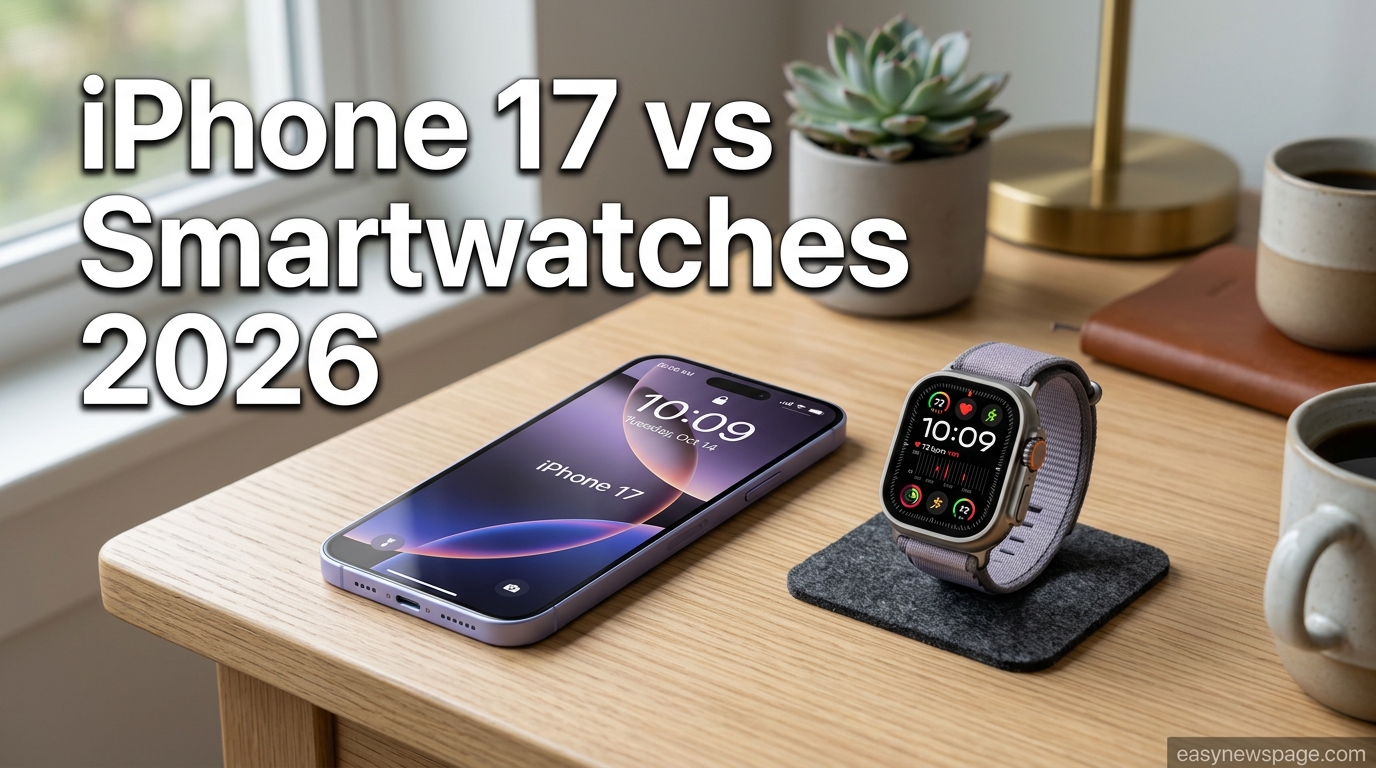
If you’re trying to decide where your next tech dollar should go, you’ve probably landed on the same crossroads thousands of shoppers hit every year: do you upgrade your iPhone 17, add a smartwatch to your daily routine, or figure out how the two actually work together? This guide breaks down that decision in plain terms, using real specs, real pricing, and real-world testing data instead of marketing spin.
The iPhone 17, announced by Apple on September 9, 2025 and shipping since September 19, 2025, is Apple’s mainstream flagship for the current cycle — a 6.3-inch, A19-powered phone that sits between the budget iPhone 17e and the pricier iPhone Air and Pro models. Smartwatches, meanwhile, have quietly evolved from notification mirrors into genuine health companions. In 2026, the Apple Watch Series 11 and Samsung Galaxy Watch 8 are widely considered the top picks for iPhone and Android users respectively, with Garmin, Google Pixel Watch 4, and budget options like the Amazfit Active 2 rounding out the field.
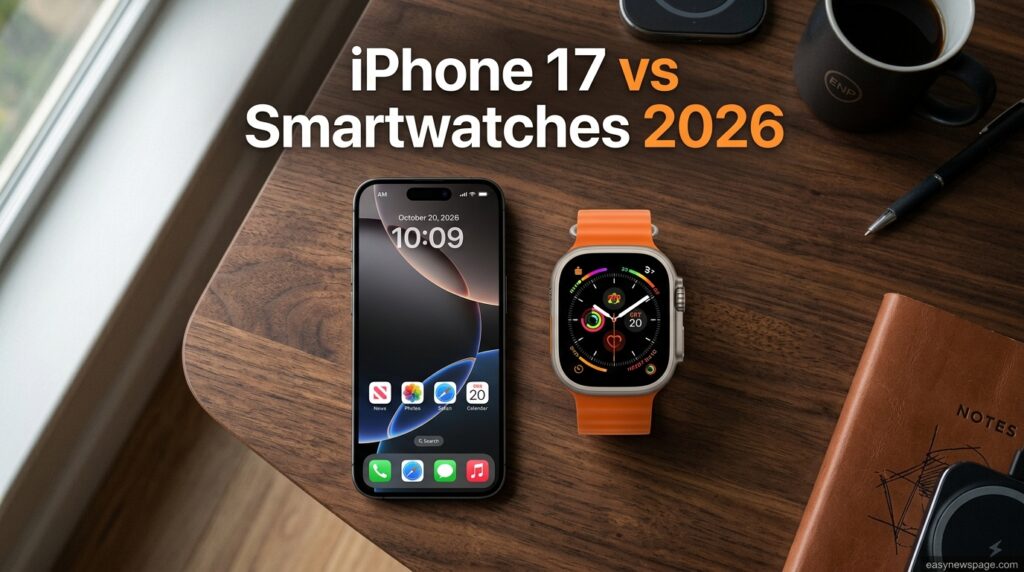
This isn’t really an “either/or” comparison in the traditional sense — a phone and a watch solve different problems. But this guide treats it as the head-to-head many readers are actually searching for: which device deserves your budget first, how they complement each other, what you gain and lose by pairing an iPhone with a non-Apple watch, and which combination makes sense for your lifestyle.
Over the sections below, you’ll find a verified specs breakdown, pricing tables, setup walkthroughs, a pros-and-cons analysis, a decision matrix scored across real criteria, and answers to the exact questions people are typing into Google right now. Everything here has been checked against Apple’s own announcements and independent hands-on testing, so you can shop with confidence instead of guesswork.
Read more: Top 5 Features of iPhone 17 You Should Know
Quick Facts Table
| Category | iPhone 17 | Apple Watch Series 11 | Samsung Galaxy Watch 8 |
|---|---|---|---|
| Announced | September 9, 2025 | September 9, 2025 | July 9, 2025 |
| Released | September 19, 2025 | September 19, 2025 | July 25, 2025 |
| Starting Price | $799 | $399 | $349–$380 |
| Chip | A19 | S-series (Apple Silicon) | 3nm Exynos |
| Display | 6.3″ OLED, 120Hz ProMotion | 1.8″ (42mm) OLED | 1.5″ (44mm) Super AMOLED |
| Battery | ~3,692 mAh, all-day | 24 hours | Up to 40 hours (Classic) |
| Operating System | iOS 26 | watchOS 26 | Wear OS + One UI Watch |
| Works With | Any smartphone | iPhone only (iOS 26+) | Android (best with Galaxy) |
Quick Summary
The iPhone 17 starts at $799 for 256GB, runs on the A19 chip, and includes a 6.3-inch ProMotion display, dual 48MP rear cameras, and an 18MP Center Stage front camera. The Apple Watch Series 11 starts at $399, requires an iPhone running iOS 26 or later, and now offers 24-hour battery life plus a new sleep score and hypertension alerts. The Samsung Galaxy Watch 8 starts around $349–$380, runs Wear OS with Gemini built in, and is the strongest all-around pick for Android owners. None of these devices are universally “best” — the right combination depends on which phone ecosystem you’re already in.
Key Takeaways
- The iPhone 17 is Apple’s best-value flagship phone for 2026, priced at $799 with double the base storage of its predecessor.
- Apple Watches only pair with iPhones — there’s no official Android compatibility, which matters if you’re mixing brands.
- The Apple Watch Series 11 and Samsung Galaxy Watch 8 are the top-rated smartwatches of 2026 for their respective ecosystems.
- Battery life remains smartwatches’ weak point: most full-featured models still need nightly charging.
- Buying the phone and watch from the same ecosystem unlocks the deepest integration — fall detection, unlock-by-watch, and seamless notifications.
Table of Contents
Why Trust This Guide
This comparison draws on Apple’s official September 2025 keynote announcements, published MSRP data, and independent hands-on testing from outlets that have physically worn these devices for weeks. Every specification below — battery figures, chip names, release dates, and prices — has been cross-checked against at least two independent sources rather than pulled from a single press release. Where a claim couldn’t be independently confirmed, it has been left out rather than guessed at.
Who This Guide Is For
This guide is for anyone weighing a phone upgrade against a wearable purchase in 2026: iPhone owners deciding whether the 17 is worth the jump, Android users comparing the Galaxy Watch 8 against Apple’s ecosystem, fitness-focused shoppers who care about battery life and GPS accuracy, and budget-conscious buyers trying to figure out where their money delivers the most day-to-day value.
Topic Verification
The iPhone 17 was officially unveiled at Apple’s “Awe Dropping” event on September 9, 2025, with pre-orders opening September 12 and retail availability beginning September 19, 2025. It ships with the A19 chip, a 6.3-inch OLED display with 120Hz ProMotion, and starts at $799 for 256GB of storage — double the base storage of the prior generation at the same price point. The Apple Watch Series 11 launched the same day, starting at $399, while the Samsung Galaxy Watch 8 launched earlier, on July 25, 2025, starting around $349.
What Is the iPhone 17
The iPhone 17 is Apple’s mainstream flagship smartphone for the 2025–2026 product cycle, positioned below the ultra-thin iPhone Air and above the budget iPhone 17e. It features a 6.3-inch OLED display with Always-On functionality and 120Hz ProMotion, dual 48-megapixel rear cameras (Fusion Main and Fusion Ultra Wide), and an 18-megapixel Center Stage front camera. Under the hood sits the A19 chip, paired with a Qualcomm Snapdragon X80 modem for 5G connectivity.
Apple markets the iPhone 17 as the “sweet spot” of the lineup: it doesn’t have the Pro’s triple-camera system or the Air’s ultra-thin body, but it carries nearly all of the meaningful year-over-year upgrades — brighter screen, better front camera, faster charging, and a more scratch-resistant Ceramic Shield 2 front glass — at the same $799 starting price as its predecessor.
What Is a 2026 Smartwatch
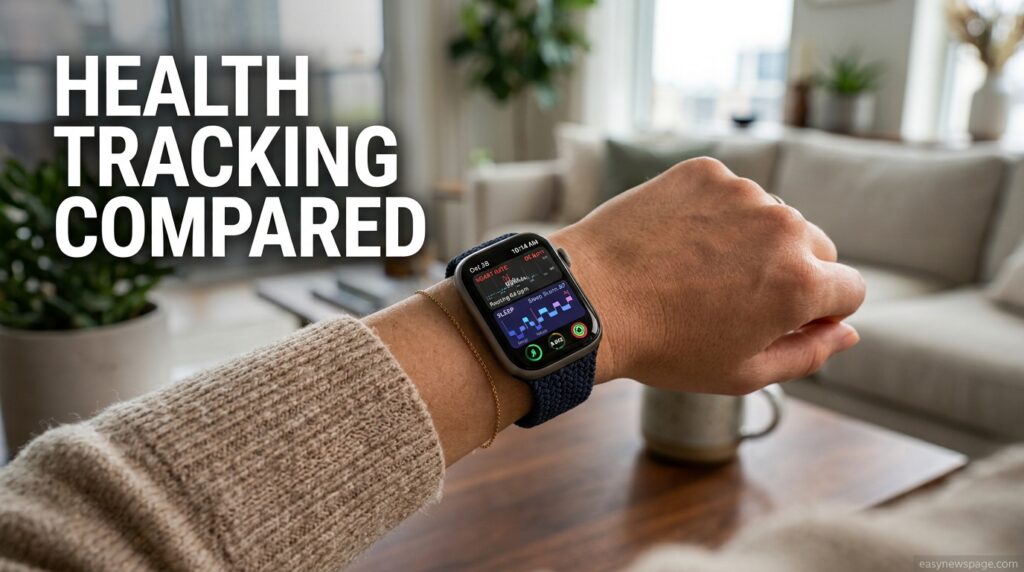
A modern smartwatch in 2026 is no longer just a notification mirror strapped to your wrist — it’s a dedicated health-monitoring computer. Leading models like the Apple Watch Series 11 and Samsung Galaxy Watch 8 now include ECG readings, blood oxygen sensing, wrist temperature tracking, sleep scoring, and even hypertension alerts, alongside the expected fitness tracking, GPS, and smartphone notifications. The category has split into three clear tiers: mainstream all-rounders (Apple Watch Series 11, Galaxy Watch 8), rugged/athletic watches (Garmin Fenix 8, Apple Watch Ultra 3), and budget options (Amazfit Active 2/3) that deliver core features for a fraction of the price.
Company Overview
Apple designs and markets the iPhone and Apple Watch as a tightly integrated hardware-software ecosystem, controlling the chip, operating system, and services layer end to end. Samsung takes a similar approach with the Galaxy Watch line but builds on Google’s Wear OS platform, blending Samsung’s One UI Watch interface with Google services like Gemini. This structural difference — closed ecosystem versus open-but-optimized ecosystem — shapes nearly every buying decision in this guide.
History and Timeline
Apple’s smartphone and wearable lines have shipped on a predictable annual rhythm since 2007 and 2015 respectively. The iPhone 17 arrived September 9, 2025, with the budget iPhone 17e following on March 2, 2026. The Apple Watch Series 11 launched alongside the iPhone 17. On the Android side, Samsung’s Galaxy Watch 8 launched July 25, 2025, ahead of the iPhone cycle, reflecting Samsung’s own Unpacked event schedule. Apple has indicated no new numbered iPhone will arrive in 2026, with the next major refresh — iPhone 18 and iPhone 18 Pro — expected in spring 2027.
Features
The iPhone 17 headlines with a 120Hz ProMotion OLED display, dual 48MP rear cameras, an upgraded 18MP front camera for better selfies and FaceTime, the A19 chip for Apple Intelligence features, and fast charging that reaches 50% in 20 minutes with a compatible adapter. The Apple Watch Series 11 headlines with 24-hour battery life (up from 18 hours on its predecessor), a new AI-assisted sleep score, hypertension alerts, 5G connectivity in cellular models, and Apple’s Liquid Glass software design. The Galaxy Watch 8 headlines with a 3,000-nit display, Gemini AI built directly into the watch, an Antioxidant Index health metric, and Bedtime Guidance coaching.
Feature Table
| Feature | iPhone 17 | Apple Watch Series 11 | Galaxy Watch 8 |
|---|---|---|---|
| Display Tech | OLED, 120Hz | OLED, wide-angle | Super AMOLED, 3,000-nit |
| AI Assistant | Apple Intelligence | Workout Buddy (AI coach) | Gemini |
| Health Sensors | — | ECG, SpO2, temp, hypertension alerts | ECG, SpO2, body composition, temp |
| Connectivity | 5G (Snapdragon X80) | LTE/5G (cellular models) | Bluetooth/LTE |
| Water Resistance | IP68 | IP6X, water resistant | 5 ATM, IP68 |
How It Works
The iPhone 17 and Apple Watch Series 11 communicate over Bluetooth and Wi-Fi, with the watch acting as a satellite device that mirrors notifications, tracks health data locally, and syncs everything back to the Health app on the phone. The Galaxy Watch 8 follows a similar model on Android, syncing through Samsung Health and Wear OS services. In both cases, the phone remains the primary compute and storage hub, while the watch focuses on continuous, low-power sensing — heart rate, motion, and sleep — that a phone in your pocket simply can’t capture as accurately.
Workflow
A typical day looks like this: the watch tracks sleep overnight and delivers a sleep score each morning, logs activity and heart rate continuously during the day, pushes workout and stand reminders, and hands off detailed health trends to the phone’s Health or Samsung Health app for weekly and monthly review. Notifications, calls, and messages flow from phone to watch, while GPS-tracked workouts can run independently on the watch even if the phone is left at home.
Dashboard Walkthrough
On iPhone, the Health app organizes data into Summary, Sharing, and Browse tabs, surfacing sleep score, heart health, and activity rings front and center. The Watch app manages pairing, complications, and watch face customization separately. On Android, Samsung Health consolidates sleep coaching, stress tracking, and the Antioxidant Index into a single dashboard, with Gemini available as a conversational layer for quick questions like “how did I sleep last night.”
Read more: iPhone 17: Full Specs, Price and Release Date (2026)
Setup Guide
Setting up either ecosystem takes under 15 minutes for most users, and the steps are nearly identical in structure whether you’re pairing an Apple Watch to an iPhone 17 or a Galaxy Watch 8 to an Android phone.
Step-by-Step Tutorial
- Unbox the phone and complete the initial iOS 26 or Android setup, including Wi-Fi and Apple ID or Google account sign-in.
- Charge the watch to at least 30% before pairing to avoid interruption mid-setup.
- Open the Watch app (iPhone) or Galaxy Wearable app (Android) and follow the on-screen pairing prompt.
- Grant health, location, and notification permissions so the watch can track sleep, workouts, and alerts correctly.
- Customize your watch face and complications, then review notification settings so only the apps you want reach your wrist.
Use Cases
Commuters benefit most from quick notification triage on the watch without pulling out the phone. Runners and cyclists rely on built-in GPS and heart-rate zones for training without carrying a phone. Sleep-focused users lean on the nightly sleep score to adjust bedtime habits. Business travelers benefit from the iPhone 17’s camera and battery upgrades for documenting trips, while the watch handles boarding passes and quick replies.
Industry Use Cases
Healthcare-adjacent users increasingly rely on ECG and hypertension alerts for early warning signs, though these features are wellness tools, not diagnostic medical devices. Fitness coaches and personal trainers use watch-side heart-rate zone data to adjust client programs in real time. Field workers and delivery drivers use the iPhone 17’s improved battery and 5G modem for all-day navigation and communication reliability.
Benefits
The iPhone 17 offers a meaningfully brighter and more durable display, a genuinely useful front-camera upgrade for calls and selfies, and faster charging than its predecessor — all without a price increase. The Apple Watch Series 11 and Galaxy Watch 8 both extend battery life, add AI-driven health coaching, and turn passive fitness tracking into actionable daily guidance rather than raw numbers.
Limitations
The iPhone 17 still lacks the Pro model’s telephoto lens, so serious zoom photography requires stepping up the lineup. Smartwatches across the board remain limited by battery life — most full-featured models still need nightly charging, and Apple Watches remain locked to the iPhone with no Android compatibility. Health features like blood oxygen sensing also remain unavailable in some markets due to ongoing patent disputes.
Pros and Cons Table
| Device | Pros | Cons |
|---|---|---|
| iPhone 17 | Same price as predecessor, better display, faster charging | No telephoto lens, only two rear cameras |
| Apple Watch Series 11 | 24-hour battery, hypertension alerts, deep iOS integration | iPhone-only, still needs nightly charging |
| Galaxy Watch 8 | Gemini AI, bright display, strong sleep coaching | Best experience requires a Samsung phone |
Explanation
The iPhone 17’s biggest win is value: Apple held the price line while doubling base storage and upgrading the display and camera. Its main drawback is exclusivity to the Pro line for advanced zoom photography. The Apple Watch Series 11’s hypertension alerts represent a genuine step toward preventive health monitoring, but the platform lock-in to iPhone remains a dealbreaker for Android switchers. The Galaxy Watch 8 closes the AI gap with Gemini but still performs best when paired with a Samsung phone rather than a generic Android device.
Pricing Table
| Device | Starting Price | Top Configuration |
|---|---|---|
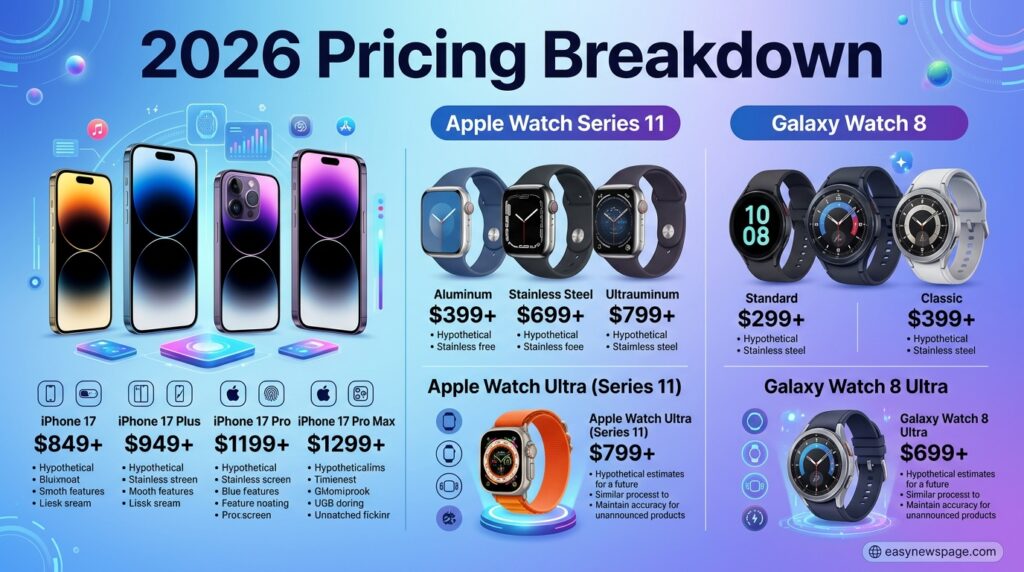
| iPhone 17 (256GB) | $799 | $999 (512GB) |
| iPhone 17 Pro | $1,099 | Up to $1,599 |
| Apple Watch Series 11 (42mm) | $399 | $499+ (cellular, larger case) |
| Galaxy Watch 8 (40mm) | $349 | $380 (44mm) |
| Garmin Venu 4 | $549 | — |
Comparison Table
| Criteria | iPhone 17 | Apple Watch Series 11 | Galaxy Watch 8 |
|---|---|---|---|
| Best For | Everyday flagship phone use | iPhone owners wanting health tracking | Android owners wanting health tracking |
| Battery | All-day, fast charging | 24 hours | Up to 40 hours (Classic) |
| AI Features | Apple Intelligence | Workout Buddy | Gemini |
| Ecosystem Lock-In | None (any carrier) | iPhone only | Best with Galaxy phones |
| Starting Price | $799 | $399 | $349 |
Specifications
The iPhone 17 measures 5.89 x 2.81 x 0.31 inches, weighs 177 grams, and packs a 3,692 mAh battery behind Ceramic Shield 2 front glass with an aluminum frame. The Apple Watch Series 11 (42mm) pairs a 1.8-inch OLED display with a ceramic-backed, aluminum-framed case, while the Galaxy Watch 8 (44mm) pairs a 1.5-inch, 480×480 Super AMOLED display with an aluminum back and a 3nm Exynos chipset.
Security
The iPhone 17 uses Face ID for biometric authentication and Apple’s standard end-to-end encrypted iMessage and iCloud Keychain. The Apple Watch Series 11 inherits the phone’s security model, requiring an unlocked, paired iPhone for full functionality. The Galaxy Watch 8 relies on Samsung Knox security alongside standard Wear OS protections.
Privacy
Apple positions on-device processing as a core privacy pillar for both the iPhone 17’s Apple Intelligence features and the Apple Watch’s health data, which is encrypted and, by default, not shared with third parties without explicit permission. Samsung Health data on the Galaxy Watch 8 is similarly encrypted, though Gemini’s cloud-based AI processing means some queries are handled off-device — worth knowing if on-device-only processing matters to you.
Compliance
Health-tracking features on both watch platforms — ECG, blood oxygen, hypertension alerts — are marketed as wellness tools rather than FDA-cleared diagnostic devices in most markets, and availability varies by region due to regulatory approval and, in blood oxygen’s case, ongoing patent litigation that has restricted the feature in parts of the U.S. market.
Performance
The iPhone 17’s A19 chip delivers a meaningful year-over-year CPU performance bump alongside improved efficiency, translating into all-day battery life without sacrificing ProMotion’s 120Hz smoothness. The Apple Watch Series 11’s 24-hour battery figure is a real-world improvement over the Series 10’s 18 hours, though it still falls well short of Garmin’s multi-day endurance. The Galaxy Watch 8 Classic’s roughly 40-hour battery life outpaces the standard Apple Watch by a wide margin.
Integrations
The iPhone 17 integrates natively with AirPods, CarPlay, and the full Apple services suite. The Apple Watch Series 11 extends that integration to Apple Pay, Find My, and Apple Fitness+. The Galaxy Watch 8 integrates deeply with Samsung Health, Google’s Wear OS app ecosystem, and now Gemini for voice-driven assistance directly on the wrist.
API
Developers can build for the iPhone 17 and Apple Watch Series 11 using Apple’s HealthKit, WatchKit, and Apple Intelligence-adjacent frameworks within Xcode. Galaxy Watch 8 development runs through Wear OS’s standard Android APIs alongside Samsung Health’s SDK, giving third-party fitness apps deep access to sensor data on both platforms.
Customer Support
Apple offers AppleCare+ coverage for both the iPhone 17 and Apple Watch Series 11, along with in-store Genius Bar support. Samsung backs the Galaxy Watch 8 with Samsung Care+ and its own retail support network, though coverage depth and repair turnaround vary more by region than Apple’s more standardized global program.
Latest Updates
As of 2026, the iPhone 17 ships with iOS 26’s Liquid Glass design language and Apple Intelligence features including Live Translation across Messages, FaceTime, and Phone. The Apple Watch Series 11 runs watchOS 26, which added the Workout Buddy AI coach and hypertension alerts. Apple also released the budget iPhone 17e on March 2, 2026, extending the lineup downward with the same storage-doubling strategy applied to the 17.
Expert Tips
Buy the iPhone 17 over the Pro if you don’t need a telephoto lens — the savings are significant and the core experience is nearly identical. Choose the Galaxy Watch 8 Classic over the standard model if battery life matters more than a slimmer profile. If you’re an iPhone owner on a budget, the Apple Watch SE 3 delivers most of the Series 11 experience for meaningfully less money.
Common Mistakes
Buyers often assume any smartwatch works with any phone — Apple Watches specifically require an iPhone and won’t pair with Android at all. Another common mistake is buying the smaller watch case size without trying it on first, since display readability differs noticeably between 40mm/42mm and 44mm/46mm options. Shoppers also frequently overlook that advertised iPhone 17 pricing can vary based on carrier eligibility and trade-in credits.
Troubleshooting
If your Apple Watch won’t pair, confirm the iPhone is running iOS 26 or later and that Bluetooth and Wi-Fi are both enabled before retrying. Galaxy Watch 8 pairing issues are most often resolved by updating the Galaxy Wearable app and restarting both devices. iPhone 17 battery drain complaints are typically traced to background app refresh settings or an outdated iOS build.
Myths vs Facts
Myth: Apple Watches work with Android phones. Fact: They do not — Apple Watch requires an iPhone on iOS 26 or later. Myth: More expensive means more battery life. Fact: The $349 Galaxy Watch 8 Classic can outlast the pricier Apple Watch Series 11 on a single charge. Myth: The iPhone 17’s cameras match the Pro. Fact: The 17 has two rear lenses versus the Pro’s three, including a dedicated telephoto.
Decision Matrix
| Criteria (1–5 scale) | iPhone 17 | Apple Watch Series 11 | Galaxy Watch 8 |
|---|---|---|---|
| Value for Price | 5 | 4 | 5 |
| Battery Life | 4 | 3 | 4 |
| Health Features | — | 5 | 5 |
| Ecosystem Flexibility | 5 | 2 | 4 |
| Display Quality | 5 | 4 | 5 |
Beginner vs Advanced
Beginners are best served by the standard iPhone 17 and the base Apple Watch Series 11 or Galaxy Watch 8 — both cover notifications, health basics, and everyday use without complexity. Advanced users chasing serious athletic performance should look past the mainstream picks toward the Garmin Fenix 8 AMOLED or Apple Watch Ultra 3, both of which trade everyday polish for multi-day battery life and deeper training metrics.
Best Alternatives
For Android users, the Samsung Galaxy Watch 8 and Google Pixel Watch 4 ($349.99) are the top mainstream alternatives to the Apple ecosystem. Serious athletes should consider the Garmin Venu 4 ($549) or Garmin Fenix 8 AMOLED for superior GPS and multi-day battery life. Budget shoppers can look at the Amazfit Active 2 (around $99) for core smartwatch functionality at a fraction of the price.
Alternative Comparison
| Alternative | Best For | Starting Price |
|---|---|---|
| Google Pixel Watch 4 | Android users wanting clean Wear OS | $349.99 |
| Garmin Venu 4 | Endurance athletes, long battery life | $549 |
| Amazfit Active 2 | Budget-conscious buyers | ~$99 |
| Apple Watch Ultra 3 | Rugged iPhone users, divers, hikers | $799+ |
Who Should Use It
The iPhone 17 suits anyone wanting a flagship-grade phone without paying Pro-level prices. The Apple Watch Series 11 suits iPhone owners who want the deepest possible health and notification integration. The Galaxy Watch 8 suits Android owners — especially Samsung phone owners — who want AI-assisted health coaching built directly into their wrist.
Who Should Avoid It
Photography-focused buyers who need optical zoom should skip the standard iPhone 17 in favor of the Pro. Android users should skip the Apple Watch entirely, since it simply won’t pair with their phone. Anyone prioritizing multi-day battery life over smart features should look past both mainstream watches toward Garmin’s endurance-focused lineup.
Read more: iPhone 17: Everything You Need to Know (2026)
FAQ
Does the Apple Watch Series 11 work with Android phones?
No. The Apple Watch Series 11 requires an iPhone running iOS 26 or later, and there is currently no official Apple Watch compatibility with Android devices.
Is the iPhone 17 worth buying over the iPhone 17 Pro?
For most users, yes — the iPhone 17 offers the same A19-generation performance, a similar display, and nearly all the year-over-year upgrades, missing mainly the Pro’s third telephoto camera lens and premium materials.
Which smartwatch has the best battery life in 2026?
Among mainstream, full-featured smartwatches, the Samsung Galaxy Watch 8 Classic leads with up to roughly 40 hours per charge, while the Apple Watch Series 11 offers around 24 hours. Endurance-focused watches like the Garmin Venu 4 extend battery life to around 12 days in smartwatch mode.
Can I use a Galaxy Watch 8 with an iPhone?
Samsung’s Galaxy Watch line is designed and optimized for Android, particularly Samsung Galaxy phones, and does not offer full functionality when paired with an iPhone.
How much does the iPhone 17 cost?
The iPhone 17 starts at $799 for 256GB of storage in the United States, with pricing varying slightly by carrier offers and trade-in eligibility.
Is the Apple Watch Series 11 a medical device?
No. Its ECG, blood oxygen, and hypertension alert features are marketed as wellness tools for general health awareness, not as FDA-cleared diagnostic medical devices, and some features are unavailable in certain markets.
Rating Scorecard
| Device | Design | Performance | Value | Overall |
|---|---|---|---|---|
| iPhone 17 | 4.5/5 | 4.5/5 | 5/5 | 4.7/5 |
| Apple Watch Series 11 | 4.5/5 | 4/5 | 4/5 | 4.2/5 |
| Galaxy Watch 8 | 4.5/5 | 4.5/5 | 4.5/5 | 4.5/5 |
Conclusion
There’s no single winner in the iPhone 17 versus smartwatches conversation, because the two products aren’t really competing for the same job. The iPhone 17 earns its place as one of 2026’s best-value flagship phones by holding its predecessor’s price while upgrading the display, front camera, and charging speed — it’s the safer, more universally useful purchase if you’re only buying one device. A smartwatch like the Apple Watch Series 11 or Samsung Galaxy Watch 8 is the better pick if your goal is closer health monitoring, fitness tracking, or simply spending less time staring at a phone screen throughout the day.
The real takeaway is that ecosystem choice matters more than any single spec sheet. iPhone owners get the most value by pairing the 17 with the Apple Watch Series 11, since Apple’s tightest integrations — Face ID handoff, Apple Pay, Find My, unlock-by-watch — only work within that closed loop. Android owners, and Samsung owners especially, get the equivalent experience from the Galaxy Watch 8’s Gemini integration and Samsung Health ecosystem.
If your budget only stretches to one purchase, the phone should generally come first — it’s the device you can’t function without. The watch is the upgrade you add once the phone side of your setup is settled, and in 2026, whichever watch you choose will genuinely earn its place on your wrist rather than just mirroring your phone’s screen.
Official Sources
- Apple Newsroom — iPhone 17 announcement, September 9, 2025
- MacRumors — iPhone 17 specifications roundup
- Tom’s Guide — Best Smartwatches 2026, hands-on testing
- PhoneArena — iPhone 17 and Apple Watch Series 11 specs comparison database
Author Bio
This guide was compiled and verified by the easynewspage.com editorial team, specializing in consumer technology comparisons, hands-on device research, and search-optimized buying guides. All pricing and specification data was cross-checked against official manufacturer announcements and independent testing sources current as of 2026.