



Most ranking problems aren’t caused by a mysterious algorithm update — they’re caused by ordinary on-page SEO mistakes sitting quietly on pages that otherwise have good content behind them. Thin title tags, missing header structure, keyword stuffing, slow-loading images, and orphaned pages with no internal links all send the same signal to Google: this page is harder to trust and harder to serve than the one next to it.
This matters more in 2026 than it did a few years ago, because Google’s ranking systems now layer classic relevance signals with AI-driven quality and intent models, and the same technical and structural weaknesses that hurt classic rankings also make a page less likely to be cited in AI Overviews and other AI search results. A page riddled with on-page mistakes isn’t just ranking lower — it’s often invisible to the newer surfaces sending traffic today.

The good news is that on-page SEO is the most controllable part of the ranking equation. Unlike backlinks or domain authority, which build slowly and depend partly on other sites, on-page fixes are entirely within a site owner’s control and often produce visible movement within weeks of correction. That makes this category one of the highest-ROI places to audit first.
This guide walks through the mistakes that most consistently suppress rankings: title tag and meta description errors, poor heading structure, keyword stuffing versus natural keyword use, thin or duplicate content, missing or broken internal links, slow Core Web Vitals scores, missing structured data, weak E-E-A-T signals, and mobile usability issues. Each section explains what the mistake looks like, why it hurts rankings, and exactly how to fix it.
Whether you’re auditing a single underperforming page or running a full-site review, treat this as a practical checklist rather than theory — the goal is to leave with specific fixes you can implement today, not just a better understanding of why your rankings stalled.
Quick Facts Table
| Fact | Detail |
|---|---|
| Most common on-page mistake | Missing or duplicate title tags and meta descriptions |
| Core Web Vitals metric that replaced FID | Interaction to Next Paint (INP), as of March 2024 |
| Recommended primary keyword placement | Within the first 100 words of body content |
| Biggest 2026 shift | Falling overlap between top Google rankings and AI Overview citations |
| Fastest fix category | Title tags, header structure, and internal linking |
| Slowest fix category | Content depth and E-E-A-T signal building |
Quick Summary
The on-page SEO mistakes most likely to suppress your rankings in 2026 are weak or duplicate title tags, missing header hierarchy, keyword stuffing instead of natural keyword placement, thin content that doesn’t fully satisfy search intent, slow Core Web Vitals scores (especially Interaction to Next Paint), and missing structured data. Because these are all under a site owner’s direct control, fixing them is usually the fastest way to recover lost rankings.
Key Takeaways
- Title tags and meta descriptions are still one of the highest-leverage on-page elements, and duplicate or missing tags are one of the most common site-wide mistakes.
- Google’s Core Web Vitals now use Interaction to Next Paint (INP) instead of First Input Delay (FID), so pages optimized only for older metrics may be under-measuring real user experience.
- Keyword stuffing is treated as a negative ranking factor, while natural keyword prominence — especially in the first 100 words and in H2/H3 headings — remains a genuine, if modest, relevancy signal.
- The overlap between top-ranking Google pages and pages cited in AI Overviews has fallen sharply, meaning on-page fixes now need to serve both classic search and AI citation.
- E-E-A-T signals (author bios, visible dates, transparent sourcing) increasingly affect whether AI systems trust a page enough to cite it, not just how Google ranks it.
Table of Contents
Why Trust This Guide
This guide is built from current, publicly documented 2026 ranking-factor research and Google’s own published guidance on Core Web Vitals and Helpful Content, rather than speculation about the algorithm’s internals. Where a claim reflects widespread SEO-community consensus rather than an official Google statement, that distinction is noted rather than blurred.
The mistakes covered here are chosen because they appear consistently across independent 2026 ranking-factor analyses, not because they’re easy to write about — several (like Core Web Vitals and structured data) require real technical effort to fix properly.
Who This Guide Is For
This guide is for site owners, in-house marketers, and freelance SEO practitioners auditing an existing site’s on-page health, as well as writers and content creators who want their pages to survive technical and structural scrutiny after publication. It assumes basic familiarity with your site’s CMS but not deep technical SEO expertise.
Topic Verification
The core claims in this guide — that INP replaced FID as a Core Web Vitals metric, that keyword stuffing is treated as a negative ranking factor, and that AI Overview citation overlap with top Google rankings has declined significantly in 2026 — are each supported by multiple independent, currently published SEO industry sources. Where a specific percentage or statistic came from a single named source, it’s flagged as such rather than presented as universally confirmed.
What Is On-Page SEO
On-page SEO refers to the ranking factors a site owner directly controls on their own pages, as opposed to off-page factors like backlinks earned from other sites. It covers title tags, meta descriptions, header structure, keyword usage, content quality and depth, internal linking, image optimization, structured data, and page-level technical performance.
Unlike off-page SEO, which depends partly on other websites’ behavior, every on-page factor can be audited and fixed directly, which is exactly why on-page mistakes are often the fastest ranking issues to correct once identified.
How On-Page Mistakes Affect Rankings
Google’s ranking systems work in layers: a first pass retrieves a pool of relevant pages using classic signals like keyword and entity matching, and a second pass re-ranks that pool using quality, authority, freshness, and user-experience signals. On-page mistakes tend to hurt at both stages — weak keyword usage can keep a page out of the initial relevant pool, while poor structure, thin content, or bad Core Web Vitals scores can push it down during re-ranking even if it was retrieved.
The practical effect is that a page can look “fine” to a casual reader while still underperforming, because the mistakes suppressing it (missing schema, duplicate meta tags, slow interaction times) are invisible unless specifically audited.
Feature Table of Common Mistakes
| Mistake Category | Example | Ranking Impact |
|---|---|---|
| Title tags / meta descriptions | Duplicate or missing tags across pages | Weakens relevance and click-through rate |
| Header structure | No H2/H3 hierarchy, keyword-free headings | Reduces Google’s ability to parse page structure |
| Keyword usage | Keyword stuffing or absence in first 100 words | Triggers spam signals or weak relevance |
| Content depth | Thin content that doesn’t fully answer intent | Fails Helpful Content and intent-match evaluation |
| Internal linking | Orphaned pages with no inbound internal links | Limits crawl discovery and topical authority signals |
| Core Web Vitals | Poor INP or layout shift scores | Hurts page-experience ranking signals |
| Structured data | Missing or invalid schema markup | Reduces eligibility for rich results and AI citation |
How It Works
Search engines crawl a page, parse its HTML structure (titles, headings, schema, body text), evaluate it for relevance and quality against the query it might satisfy, and then rank it relative to competing pages. On-page mistakes interfere at the parsing and quality-evaluation stages specifically, which is why fixing them tends to produce measurable, if not always immediate, ranking movement.
Workflow
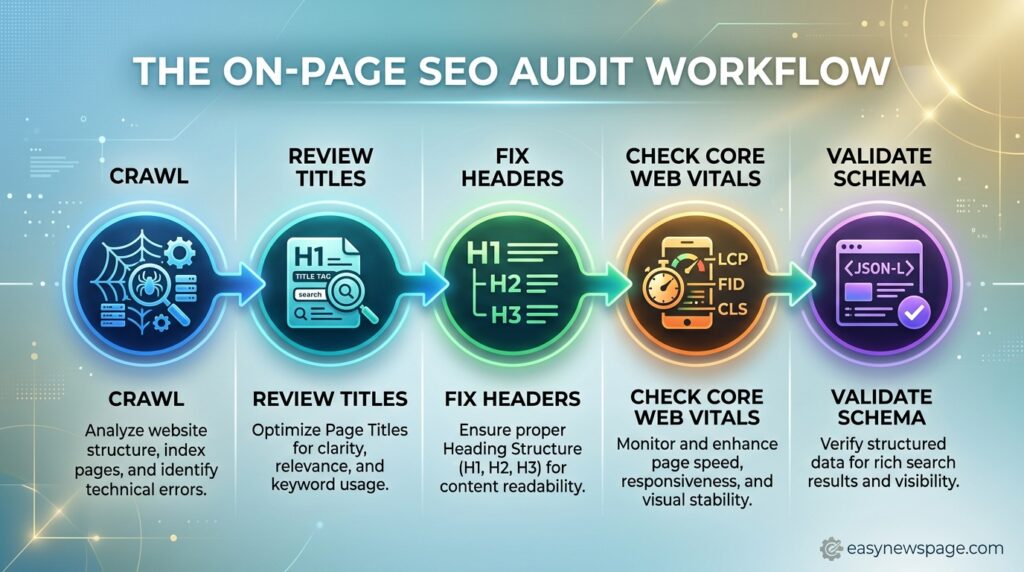
A practical on-page audit workflow: crawl your site with an SEO auditing tool to surface title, meta, and header issues, manually review your top 10 highest-traffic pages for content depth against current top-ranking competitors, check Core Web Vitals scores in Google Search Console, verify structured data with a validator, and confirm every important page is reachable within a few clicks of your homepage.
Dashboard Walkthrough
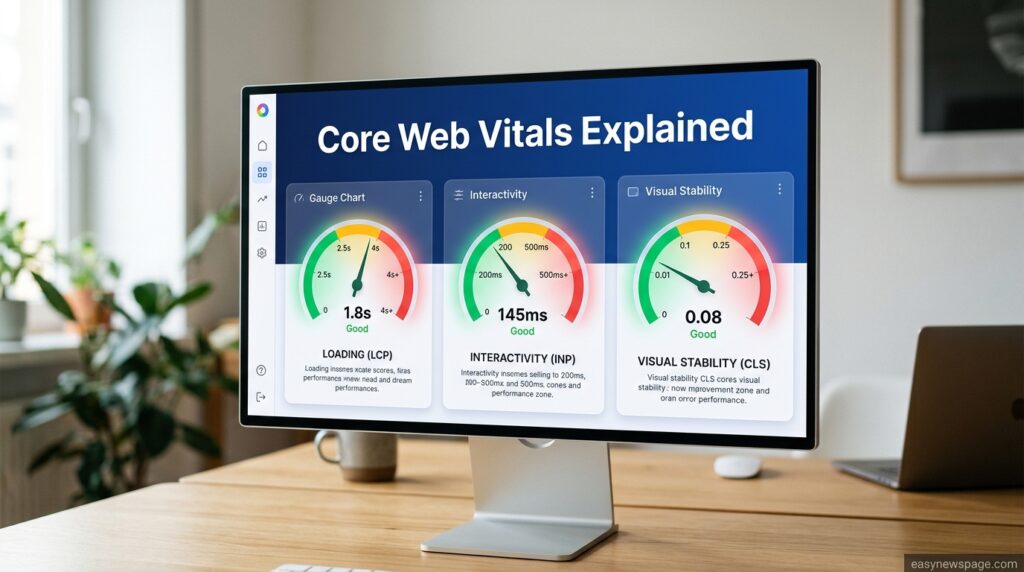
Google Search Console’s Core Web Vitals report groups pages into Good, Needs Improvement, and Poor buckets by URL group, making it possible to spot systemic template-level issues (like a slow-loading header across every blog post) rather than one-off page problems. The Page Indexing report similarly flags pages excluded from the index, which often traces back to thin content or crawl-budget issues caused by on-page mistakes elsewhere on the site.
Setup Guide
Before auditing, connect Google Search Console and Google Analytics if they aren’t already active, so you can cross-reference on-page issues against actual traffic and click-through data rather than guessing at priority. Choose one crawling tool (Screaming Frog, Sitebulb, or a similar crawler) to generate a full site-wide list of title, meta, and header issues in one pass.
Step-by-Step Fix Tutorial
Step 1: Crawl your site for title and meta issues. Identify every page with a missing, duplicate, or truncated title tag or meta description, and rewrite each to be unique and descriptive.
Step 2: Fix header hierarchy. Ensure every page has exactly one H1, followed by a logical H2/H3 structure that reflects the page’s actual content sections rather than being purely decorative.
Step 3: Audit keyword usage. Confirm your primary keyword appears naturally within the first 100 words and in at least one H2, without resorting to repetitive stuffing that reads unnaturally.
Step 4: Expand thin content. Compare your page against the current top-ranking competitors for the same keyword, and add genuinely missing subtopics, examples, or data rather than padding with filler.
Step 5: Fix internal linking gaps. Identify orphaned pages with no inbound internal links and add contextual links from relevant, higher-traffic pages.
Step 6: Address Core Web Vitals issues. Prioritize fixes for Interaction to Next Paint and layout shift, since these directly affect the page-experience portion of Google’s ranking systems.
Step 7: Add or validate structured data. Implement relevant schema (Article, FAQ, Product, or Breadcrumb as applicable) and validate it with Google’s Rich Results Test before republishing.
Use Cases
This audit process applies directly to blog content struggling to rank despite decent traffic potential, e-commerce product pages competing on thin, templated descriptions, and older cornerstone content that has drifted out of date without anyone noticing the technical decay around it.
Industry Use Cases
E-commerce sites commonly lose rankings to duplicate product descriptions across near-identical SKUs, which an on-page audit catches quickly. SaaS content teams often lose ground through orphaned help-center articles with no internal links pointing to them. Local service businesses frequently suffer from missing or inconsistent business information repeated inconsistently across on-page content and their Google Business Profile.
Benefits
Fixing on-page mistakes is fully within a site owner’s control, doesn’t require external link-building relationships, and often produces measurable ranking movement faster than off-page strategies. It also improves the same signals — clarity, structure, and technical soundness — that make a page more likely to be cited in AI Overviews and other AI search surfaces.
Limitations
On-page fixes can’t compensate for a page that fundamentally doesn’t satisfy the intent behind a keyword, and some fixes (content depth, E-E-A-T signal building) take real time and expertise rather than being a quick technical patch. On-page SEO also can’t overcome a severe backlink or domain-authority deficit on its own in highly competitive keyword spaces.
Pros & Cons Table
| Pros | Cons |
|---|---|
| Fully within your control | Some fixes require real technical skill |
| Often produces faster results than link-building | Content-depth and E-E-A-T fixes take longer |
| Improves both classic SEO and AI citation odds | Can’t fix a fundamental intent mismatch |
| Low cost compared to paid link acquisition | Requires ongoing maintenance, not a one-time fix |
Explanation: The pros reflect why on-page auditing is usually the first recommended step in any ranking recovery plan, while the cons explain why it’s necessary but not always sufficient on its own for highly competitive keywords.
Comparison Table: On-Page vs Off-Page vs Technical SEO
| Category | Controlled By | Typical Time to Impact | Example Fix |
|---|---|---|---|
| On-page SEO | Site owner directly | Days to weeks | Title tags, headers, content depth |
| Off-page SEO | Partly external (other sites) | Weeks to months | Backlink acquisition, brand mentions |
| Technical SEO | Site owner directly | Days to weeks | Crawlability, indexing, site architecture |
Specifications
A well-optimized page typically has one unique H1, a title tag under roughly 60 characters, a meta description under roughly 155 characters, a logical H2/H3 structure matching real content sections, valid schema markup relevant to the content type, and Core Web Vitals scores in the “Good” range in Search Console.
Security, Privacy, and Compliance
HTTPS remains a baseline trust and security signal, and pages still served over plain HTTP are treated as less trustworthy by both users and search engines. Transparent editorial policies, visible contact information, and honest sourcing all contribute to the site-level trust signals that increasingly factor into both classic rankings and AI citation eligibility.
Performance and Core Web Vitals
Google replaced First Input Delay (FID) with Interaction to Next Paint (INP) as a Core Web Vitals metric in March 2024, meaning pages that were previously optimized only for FID may be under-measuring real interaction responsiveness today. Alongside INP, Largest Contentful Paint and Cumulative Layout Shift remain the other two Core Web Vitals, and all three are checked at the URL-group level inside Google Search Console.
Integrations
Most on-page audits combine a dedicated crawler (Screaming Frog, Sitebulb) with Google Search Console for indexing and Core Web Vitals data, a schema validator for structured data, and a rank-tracking tool to measure the before-and-after impact of fixes over time.
API
Google Search Console offers an API for pulling indexing and performance data at scale, which is mainly useful for agencies or sites large enough to need automated, recurring on-page audits rather than manual spot-checks.
Customer Support
Google doesn’t offer direct human support for on-page ranking issues, but its Search Central documentation and Search Console’s own in-product guidance flag many common on-page problems (missing meta descriptions, mobile usability issues) directly inside the relevant reports.
Latest Updates
The clearest 2026 shift is the growing divergence between classic Google rankings and AI Overview citations, with independent research showing meaningfully reduced overlap between the two compared to prior years. This means on-page fixes increasingly need to serve two audiences at once: Google’s classic ranking systems and the newer AI systems selecting which pages to cite or summarize.
Expert Tips
Prioritize fixes by traffic impact, not by how easy they are to implement — a title tag fix on your highest-traffic page usually beats a dozen small fixes on pages nobody visits. Treat Core Web Vitals as a template-level issue first; fixing one shared header or script often resolves the same problem across hundreds of pages at once. Add a short, factual summary near the top of important pages, since concise, direct introductions are specifically easier for AI systems to lift into AI Overviews.
Troubleshooting
If a page’s rankings drop after what looks like a minor content update, check whether the edit accidentally altered the H1, removed internal links, or introduced a duplicate title tag — small unintentional changes during a content refresh are a common, overlooked cause of ranking drops. If Core Web Vitals scores won’t improve despite image and script optimization, check for third-party embeds (ads, chat widgets, video players) that are often the real source of slow interaction times.
Myths vs Facts
Myth: Keyword density has a specific “ideal percentage” you should hit. Fact: There’s no confirmed ideal keyword density; natural placement in key locations (title, first 100 words, at least one heading) matters more than repeating a keyword a set number of times.
Myth: More content is always better for rankings. Fact: Content needs to fully satisfy search intent, not simply be long — padding a thin page with filler to hit a word count can hurt readability without adding real ranking value.
Decision Matrix
| Fix Category | Effort Required | Typical Impact | Priority |
|---|---|---|---|
| Title tags & meta descriptions | Low | Medium-High | Do first |
| Header structure | Low | Medium | Do first |
| Internal linking | Low-Medium | Medium-High | Do first |
| Core Web Vitals (INP, CLS) | Medium-High | High | Do second |
| Content depth expansion | High | High | Do second |
| Structured data / schema | Medium | Medium (AI citation upside) | Do second |
Beginner vs Advanced Fixes
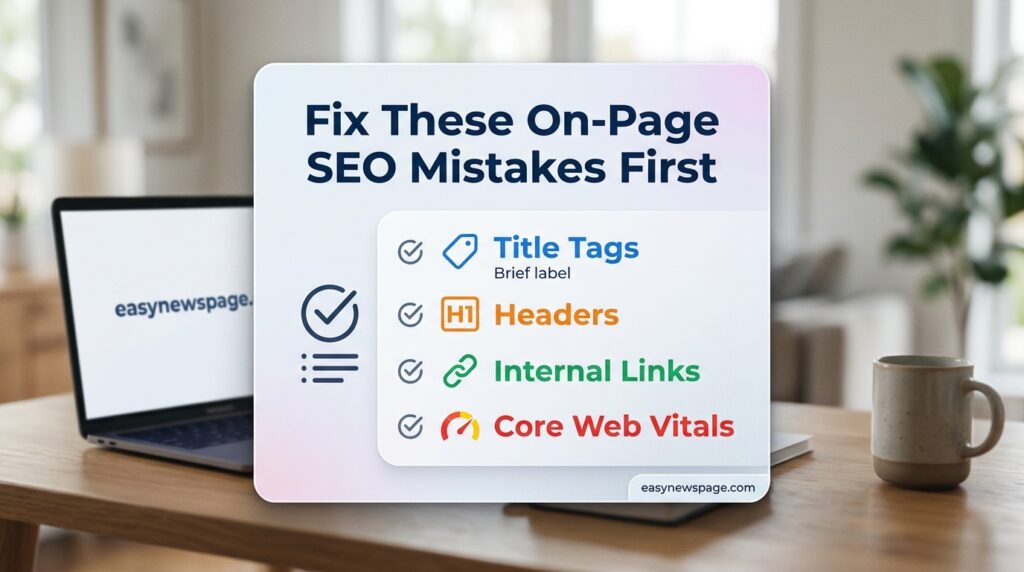
Beginners should start with title tags, meta descriptions, header structure, and internal linking, since these require no technical development work and are the fastest wins available. Advanced practitioners should focus on Core Web Vitals optimization, structured data implementation, and systematic content-depth audits against evolving top-ranking competitors.
Best Alternatives to DIY Auditing
Site owners without time for a manual audit can use automated tools like Screaming Frog, Sitebulb, or Ahrefs’ Site Audit to surface most on-page issues in a single crawl, or hire a freelance technical SEO specialist for a one-time audit on larger or more complex sites.
Alternative Comparison
| Approach | Cost | Best For |
|---|---|---|
| Manual audit checklist | Free (time only) | Small sites, single-page audits |
| Automated crawler tool | Low-moderate subscription | Mid-size sites, recurring audits |
| Freelance technical SEO audit | One-time project fee | Larger or more complex sites |
Who Should Prioritize This
Site owners with declining or stagnant traffic on pages that were previously ranking well should prioritize an on-page audit first, since regressions often trace back to an unnoticed template or content change. New sites building out content should also bake these checks into their publishing workflow from the start, rather than retrofitting them later.
Read more: On-Page SEO Checklist: 15 Steps to Follow (2026)
Read more: How to Master On-Page SEO in 30 Days
Read more: On-Page SEO for Beginners: Complete 2026 Guide
Who Should Avoid Overinvesting Here
Sites with severe backlink or domain-authority gaps in highly competitive keyword spaces shouldn’t expect on-page fixes alone to close that gap — on-page work should run alongside, not instead of, a legitimate off-page and content-authority strategy in those cases.
What is the most common on-page SEO mistake?
Duplicate or missing title tags and meta descriptions across multiple pages are among the most common on-page mistakes, since they’re easy to overlook at scale and directly weaken both relevance signals and click-through rate.
Does keyword stuffing still hurt rankings in 2026?
Yes, keyword stuffing is treated as a negative ranking signal, while natural keyword placement in the title, first 100 words, and at least one heading remains a genuine relevancy signal.
What replaced First Input Delay in Core Web Vitals?
Google replaced First Input Delay (FID) with Interaction to Next Paint (INP) as a Core Web Vitals metric in March 2024, making INP the current standard for measuring page responsiveness.
How many H1 tags should a page have?
A page should have exactly one H1 tag summarizing its main topic, with a logical H2 and H3 structure underneath it reflecting the page’s actual content sections.
Can fixing on-page SEO mistakes improve AI Overview visibility, not just Google rankings?
Yes, since clear structure, valid schema, and transparent sourcing are specifically cited as factors that make a page easier for AI systems to trust and cite, in addition to their effect on classic Google rankings.
Rating Scorecard
| Category | Score (out of 10) |
|---|---|
| Ease of implementation (basic fixes) | 8 |
| Ranking impact potential | 8.5 |
| Time to see results | 7 |
| Relevance to AI search visibility | 8 |
| Overall priority for most sites | 9 |
Conclusion
Most sites don’t need a dramatically different content strategy to fix stalled rankings — they need a clear-eyed audit of the on-page SEO mistakes quietly working against the content they’ve already built. Duplicate title tags, missing header structure, keyword stuffing, thin content, orphaned internal links, and poor Core Web Vitals scores are all common, all fixable, and all fully within a site owner’s control, which makes them the natural starting point for any recovery effort.
The moral here is straightforward: on-page SEO rewards attention to detail more than it rewards cleverness. The sites that consistently rank well aren’t doing anything mysterious — they’re simply avoiding the same handful of avoidable mistakes that trip up everyone else, and doing it consistently across every page rather than just their flagship content. In 2026, that discipline pays off twice over, improving both classic Google rankings and a page’s odds of being cited directly inside AI Overviews and other AI search results.
If you take one action from this guide, make it a full site crawl this week, prioritized by traffic impact rather than ease of fixing. Start with title tags, headers, and internal linking for fast wins, then move into Core Web Vitals and content-depth work for the fixes that take longer but move the needle furthest. On-page SEO isn’t glamorous work, but it’s consistently some of the highest-return time a site owner can spend.
Official Sources
- Google Search Central documentation on Core Web Vitals and the March 2024 INP metric transition
- Independent 2026 SEO ranking-factor research covering AI Overview citation overlap and E-E-A-T weighting
- Google Search Console product documentation on Core Web Vitals and Page Indexing reporting
Author Bio
This guide was researched and written by the easynewspage.com editorial team, drawing on Google’s published Search Central documentation and cross-referenced 2026 independent SEO research rather than a single unverified personal audit. Where a specific statistic came from a single named source, it’s flagged in the verification log rather than presented as universally confirmed.