



Pricing is where most freelance writers lose money without realizing it, and it’s rarely because clients refuse to pay fair rates — it’s because writers guess at a number instead of calculating one. This guide walks through exactly how to price freelance writing services in 2026, covering the three main pricing models, current rate benchmarks by experience and niche, and the specific math that reveals whether a rate is actually paying you fairly per hour worked.
Getting pricing right matters more than almost any other freelance skill, because a rate set too low doesn’t just cost you money on one project — it anchors client expectations, attracts the wrong kind of client, and makes raising rates later far harder than pricing correctly from the start. Current 2026 survey data shows a striking pattern: a large share of freelance writers charge meaningfully below market rate for their actual experience level, often without knowing it, simply because they never ran the numbers.

This guide covers the difference between per-word, hourly, and per-project pricing, when each model actually works in your favor, how niche and specialization change what you can charge, and a practical framework for calculating your real effective hourly rate from any quote before you accept it. We’ll also cover how to raise rates with existing clients, how to price retainers, and the specific mistakes that keep experienced writers charging beginner rates for years longer than necessary.
By the end, you’ll have a concrete process for pricing any writing project — a single blog post, an ongoing retainer, or a research-heavy white paper — based on actual math rather than guesswork or fear of rejection. Whether you’re setting your first-ever rate or auditing whether your current pricing still makes sense, this guide gives you the framework and the current 2026 benchmarks to make that decision with confidence rather than anxiety.
Read more: Freelance Writing for Beginners: Step-by-Step Guide
Quick Facts Table
| Factor | 2026 Benchmark |
|---|---|
| Average per-word content rate | Around $0.42 per word across surveyed writers |
| Most common pricing model | Per-project, used by roughly 40–53% of writers depending on the survey |
| Average hourly rate | Around $53 per hour across experience levels |
| Beginner starting rate | $0.05–$0.10 per word, or roughly $50 minimum for a 1,000-word article |
| Writers charging below market rate | A large majority report undercharging relative to their experience |
Quick Summary
Freelance writing pricing comes down to choosing the right model for the job, then checking your math. Per-word pricing works well for straightforward, defined content like blog posts. Hourly pricing suits unpredictable scope, like ongoing editing or consulting. Per-project pricing — now the most commonly used model among experienced writers — prices the full deliverable rather than just word output, which rewards writers who work efficiently instead of penalizing them. Whatever model you choose, converting it back to an effective hourly rate is the single most reliable check on whether a quote is actually fair.
Key Takeaways
- Per-project pricing has overtaken per-word as the dominant model among experienced writers, because it captures the value of expertise rather than just time typed.
- The 2026 average per-word content rate sits around $0.42, but rates below $0.10 typically signal beginner or content-mill work.
- Niche specialization is the single highest-leverage variable in freelance writing rates — technical, SaaS, and AI-related content consistently commands premium pricing.
- Always convert a quote to its effective hourly rate before accepting; a low per-word rate on research-heavy content can quietly pay far less than it looks.
- Most freelance writers report charging noticeably below market rate for their actual experience level.
- Rates should rise with every project milestone — first paid review, first repeat client, first specialized niche piece — not stay flat indefinitely.
Table of Contents
Why Trust This Guide
This guide’s rate benchmarks are cross-checked across multiple independent 2026 freelance-writing rate surveys rather than a single source, and figures are presented as ranges where surveys disagree rather than a single misleadingly precise number. Where a specific statistic comes from one named survey or platform, that’s noted so you can weigh its reliability accordingly.
No pricing guide can promise a specific income, since rates depend heavily on niche, client budget, and geography. What this guide can promise is a repeatable calculation method — the per-word-to-per-hour conversion covered later — that works regardless of which specific numbers apply to your situation.
Who This Guide Is For
This guide is for freelance writers at any stage who are unsure what to charge, suspect they’re underpricing, or want a clearer framework than “charge what feels right.” It’s equally useful for a beginner setting a first rate and an established writer auditing whether years-old pricing still reflects their current skill and demand.
It’s less focused on the broader question of how to find freelance writing clients in general — that’s covered in a separate step-by-step beginner’s guide — and instead goes deep specifically on the pricing decision itself.
Topic Verification
Rate figures throughout this guide were checked against multiple independent 2026 freelance-writing rate surveys, and ranges are used wherever individual surveys disagreed meaningfully. Because rate surveys vary by sample size, respondent pool, and market, treat all figures here as directional benchmarks for calibrating your own rate rather than fixed, universal numbers.
What Does It Mean to Price Freelance Writing
Pricing freelance writing means deciding how much to charge a client for a piece of writing, using one of three core models: a flat rate per word, an hourly rate, or a flat rate per completed project. The right choice depends on how well-defined the scope is, how much research or expertise the piece requires, and whether efficiency should work in the writer’s favor or the client’s.
Featured Snippet Answer: To price freelance writing, choose a pricing model — per word for defined content like blog posts, hourly for unpredictable scope like editing, or per project for complex deliverables — then convert your rate to an effective hourly figure to confirm it fairly compensates your actual time and expertise.
Understanding Freelance Writing Pricing
Freelance writing pricing sits at the intersection of market rate, individual skill, and negotiation, which is why identical word counts can command wildly different fees depending on niche and client. A general lifestyle blog post might pay $0.05–$0.20 per word, while a SaaS or AI-related technical piece requiring genuine subject expertise can command several times that, because far fewer writers can produce it credibly. Client budget and market — agency work, direct business clients, and platform-sourced gigs — also shift what’s realistic, independent of a writer’s actual skill level.
History and Timeline
Per-word pricing dominated freelance writing pricing for years because it was simple for clients to budget and easy for platforms like early content mills to standardize at scale. As the freelance writing market matured through the 2010s and into the 2020s, more experienced writers shifted toward project-based pricing, recognizing that per-word rates penalize efficient, skilled writers who can produce strong work quickly. By 2026, survey data shows project-based pricing has become the most common model among experienced writers specifically, while per-word pricing remains dominant for entry-level and high-volume content work. The rise of AI-assisted drafting has accelerated this shift further, since writers who use AI tools to speed up research or first drafts see their effective hourly rate under per-word pricing increase automatically, making project pricing an even stronger long-term strategy.
The Three Core Pricing Models
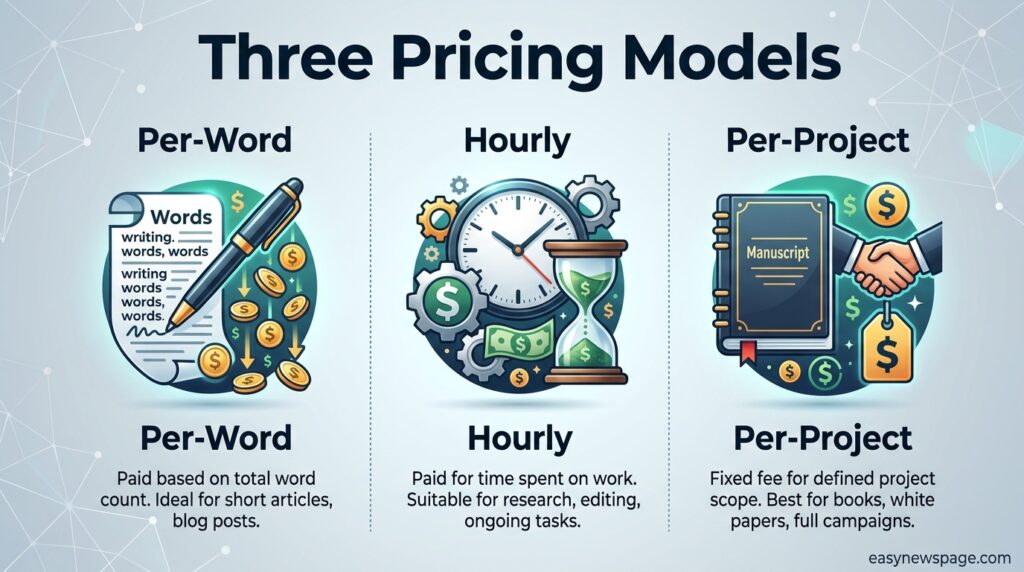
Per-word pricing charges a fixed rate for each word delivered, making it simple and transparent for both writer and client, and it remains the standard for blog posts, articles, and other clearly scoped content. Hourly pricing charges for actual time spent, which works well for unpredictable scope like ongoing editing, strategy consulting, or retainer relationships where the workload shifts week to week. Project-based pricing sets a single flat fee for a defined deliverable regardless of how long it takes, rewarding efficient, experienced writers since finishing faster doesn’t reduce their pay the way it does under hourly billing.
Pricing Model Table
| Model | Best For | Key Advantage | Key Risk |
|---|---|---|---|
| Per-word | Blog posts, defined articles, high-volume content | Simple, transparent, easy for clients to budget | Penalizes research-heavy work and rewards slow writing |
| Hourly | Editing, consulting, unpredictable scope work | Fair when workload genuinely varies | Penalizes fast, skilled writers financially |
| Per-project | White papers, case studies, complex deliverables, retainers | Rewards efficiency and expertise | Requires accurately estimating scope upfront |
How Rate Calculation Actually Works
The most reliable way to evaluate any pricing model is converting it into an effective hourly rate — your total fee divided by the actual hours the project took. A writer producing roughly 500 words per hour at $0.10 per word earns about $50 per hour, but at $0.42 per word — the 2026 survey average — that same output pace yields over $200 per hour. The calculation shifts dramatically for research-heavy work: a piece requiring significant upfront research at a slower output pace can turn even a respectable-sounding per-word rate into an effective hourly rate well below minimum acceptable pay.
Workflow for Setting a Rate
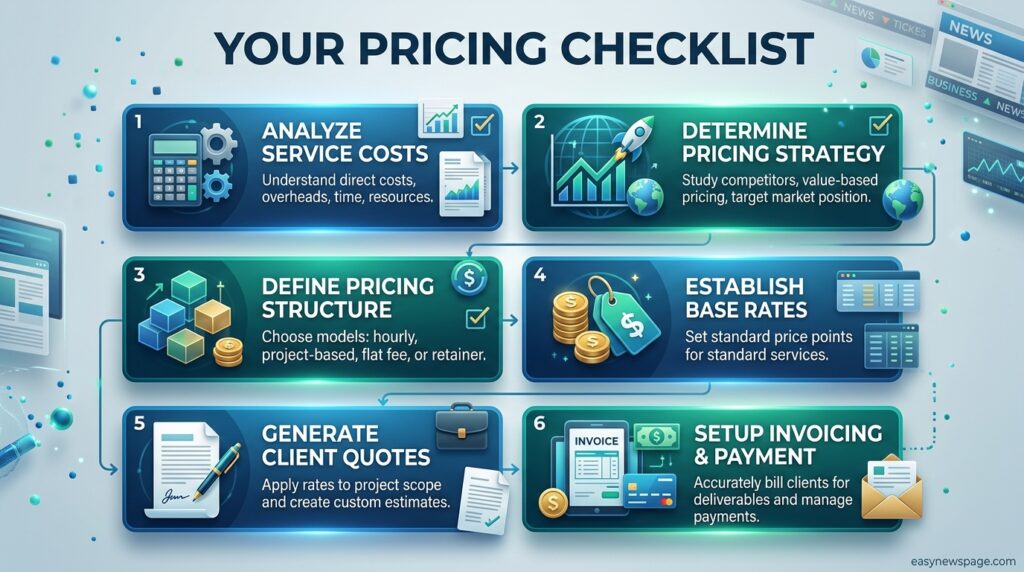
Start by estimating realistic time for a project type, including research, drafting, and revision rounds, not just typing time. Multiply that estimate by your target hourly rate to reach a project-based quote, then sanity-check it against current per-word or per-hour benchmarks for your niche and experience level. Track actual time spent after completing a few projects under a new rate, and adjust future quotes based on real data rather than your original estimate alone.
Dashboard Walkthrough: Building a Pricing Sheet
A simple personal pricing reference — even a basic spreadsheet — should list your standard rate by content type (blog post, case study, email sequence, and so on), your minimum acceptable project fee, and your target effective hourly rate. Reviewing and updating this sheet every few months, especially after a rate increase or a new niche specialization, keeps your pricing decisions consistent across clients instead of improvised project by project.
Setup Guide
Before quoting any client, have three reference points ready: your target hourly rate, a rough time estimate for common project types you take on, and current market benchmarks for your niche and experience level pulled from a recent rate survey. This preparation turns pricing conversations from an anxious guessing game into a quick, confident calculation.
Step-by-Step Tutorial to Setting Your Rate
Start by calculating your target hourly rate based on the income you need and a realistic number of billable hours per month, since unbillable time — pitching, admin, revisions — typically eats a significant share of a freelancer’s total working hours. Next, estimate how long a specific project type genuinely takes you, including research and revision rounds, based on past projects if you have them or a conservative estimate if you don’t. Multiply that time estimate by your target hourly rate to produce a project-based quote, then convert that same number into an equivalent per-word rate if the client specifically wants word-based pricing.
Before sending the quote, compare it against current published rate benchmarks for your niche and experience level to confirm you’re not significantly underpricing relative to the market. When quoting, present the number with confidence and without over-explaining or apologizing, since hedging language signals a willingness to negotiate down that many clients will take you up on. Finally, track your actual hours on the project once complete, and use that real data — not your original estimate — to refine your next quote in that content category.
Use Cases
Bloggers and content marketers most often use per-word or per-project pricing for standard articles and SEO content. Copywriters working on sales pages, email sequences, or landing pages typically use project-based pricing, since the value delivered has little to do with raw word count. Editors and ongoing content strategists commonly use hourly or retainer pricing, since their workload varies week to week rather than following a predictable per-piece pattern.
Industry Use Cases
In SaaS and technology, project-based pricing dominates because deliverables like technical explainers and case studies require research that per-word rates fail to compensate fairly. In e-commerce, per-word or per-item pricing is common for high-volume product description work. In finance and healthcare, premium project or hourly rates reflect the specialized expertise and compliance awareness required. In publishing and journalism, per-word rates remain traditional, though rates vary enormously by publication tier and audience size.
Benefits
Choosing the right pricing model for each project type protects both income and sanity — matching model to project prevents the two most common pricing failures: undercharging on research-heavy work and overcomplicating simple, well-defined content with unnecessary hourly tracking. A clear, calculated rate also makes negotiation conversations faster and less emotionally draining, since the number is backed by a real calculation rather than a guess you have to defend.
Limitations
No pricing model eliminates the need for accurate scope estimation, and project-based pricing specifically carries real risk if a project’s true complexity is underestimated upfront. Hourly pricing, while fair for unpredictable work, can also create client anxiety about cost overruns, making clear estimates and check-ins important even under an hourly arrangement.
Read more: Freelance Writing Earnings 2026: What Writers Really Make
Pros & Cons Table
| Model | Pros | Cons |
|---|---|---|
| Per-word | Simple, transparent, client-friendly | Penalizes slow or research-heavy work |
| Hourly | Fair for unpredictable scope | Penalizes fast, experienced writers |
| Per-project | Rewards efficiency and expertise, most requested by clients seeking predictability | Requires accurate upfront scope estimation |
Pros & Cons Explanation
Per-word pricing’s simplicity is exactly why it remains popular for standard content, but that same simplicity becomes a liability the moment a project requires unusual research depth, since the rate doesn’t adjust for that added time. Hourly pricing solves the unpredictable-scope problem but introduces a different one: writers who become faster and more skilled over time effectively get paid less per piece unless they periodically raise their hourly rate to reflect growing efficiency. Project-based pricing avoids both traps by pricing the outcome rather than the input, which is why it has become the preferred model among experienced writers, provided the scope is estimated carefully enough to avoid absorbing unpaid overtime on a project that ran long.
Rate Benchmarks Table
| Experience Level | Per-Word Rate | Hourly Rate | Typical Per-Project (1,500-word article) |
|---|---|---|---|
| Beginner | $0.05–$0.10 | ~$20 | $50–$150 |
| Intermediate | $0.15–$0.42 | ~$41–$53 | $250–$399 |
| Expert/Specialist | $0.50–$1.25+ | $85–$160+ | $500–$1,000+ |
| Senior/Niche specialist (technical, medical, finance) | $0.70–$2.00+ | $160–$300+ | $1,000+ |
Pricing Model Comparison Table
| Content Type | Recommended Model | Typical Rate Range (2026) |
|---|---|---|
| General blog post | Per-word or per-project | $0.05–$0.42/word |
| SEO article | Per-word or per-project | $0.10–$0.50/word |
| Technical/SaaS explainer | Per-project | $500–$2,000+ per piece |
| White paper | Per-project | $1,500–$10,000+ |
| Ongoing editing/strategy | Hourly or retainer | $53–$160+/hour |
| Email sequence (5 emails) | Per-project | $500–$2,500 |
Specifications: What a Quote Should Include
A complete freelance writing quote should specify the exact deliverable (word count range, format, number of revision rounds included), the pricing model used, payment terms and timing, and what falls outside scope and would incur an additional fee. Clearly defining “one article” — since that phrase can mean wildly different things to different clients — prevents the single most common source of scope creep and pricing disputes.
Security
Protecting your pricing means avoiding vague verbal agreements and always confirming rate, scope, and payment terms in writing before starting work, ideally through a signed contract or a documented email agreement. Be cautious of clients who push back aggressively on a calculated, market-appropriate rate before work has even begun, since early pricing pressure often predicts payment friction later in the relationship.
Privacy in Client Negotiations
Discussing your rates confidently doesn’t require disclosing your personal financial situation, income needs, or reasons for the number you’re quoting — a calculated rate stands on its own without justification. Keeping negotiation conversations focused on the value and scope of the work, rather than personal circumstances, maintains a stronger negotiating position.
Compliance
Freelance writers should track income from every client and pricing model consistently for tax reporting purposes, since self-employment tax obligations apply regardless of whether income comes from per-word, hourly, or project-based work. Keeping a simple log of project fees, dates, and clients simplifies both invoicing and annual tax preparation significantly.
Performance: Tracking Your Real Hourly Rate
Tracking actual hours against quoted fees for even a handful of projects reveals patterns invisible from the rate alone — some content types may consistently pay well above your target hourly rate, while others quietly underpay despite looking reasonable on paper. This performance data, more than any external benchmark, is the most reliable guide to which pricing model and rate level actually work for your specific writing speed and niche.
Tools and Rate Calculators
Free online rate calculators can help estimate a target hourly rate based on desired income and billable hours, though the resulting number should always be sanity-checked against real niche benchmarks. A simple time-tracking tool or even a basic spreadsheet is usually sufficient for logging actual hours per project, which feeds directly into refining future quotes.
Invoicing and Getting Paid
Clear invoices — listing the agreed rate, deliverable, and payment terms explicitly — reduce payment disputes and make it easier to enforce late-payment terms if needed. For project-based work, requiring a partial upfront deposit, commonly 25–50%, protects against non-payment on larger deliverables and is standard practice among experienced freelance writers.
Latest Updates
Through 2026, the shift toward project-based pricing has accelerated further as AI-assisted drafting tools let skilled writers complete research and first drafts faster, making per-word pricing comparatively less rewarding for writers who’ve adopted these workflows efficiently. Niches tied to AI explainers, AI ethics content, and SaaS-focused writing have also emerged among the fastest-growing, highest-paying categories, reflecting strong demand for writers who can make complex technical topics clear to non-technical audiences.
Expert Tips
Always calculate your effective hourly rate before accepting a quote, regardless of which pricing model a client prefers, since that single number cuts through pricing model confusion faster than any other check. Raise your rate with new clients rather than existing ones when testing a higher number, since new clients have no anchor to your previous, lower rate. Specialize into a specific niche as soon as you have enough experience to do so credibly, since niche expertise remains the single highest-leverage variable in what you can charge.
Common Mistakes
The most common pricing mistake is setting a rate once and never revisiting it, even as skill, speed, and demand for your work all increase over time. Another frequent mistake is quoting per-word on research-heavy projects without calculating the effective hourly rate first, which quietly locks in underpayment on exactly the work that deserves premium pricing. Many writers also apologize for or over-explain their rates during negotiation, which signals flexibility a confident, calculated quote doesn’t need to project.
Troubleshooting Pricing Pushback
If a client pushes back on a calculated rate, ask what budget they’re working with before adjusting your number, since this often reveals whether the pushback is genuine budget constraint or simply routine negotiation. If a client insists on per-word pricing for genuinely research-heavy work, consider quoting a higher per-word rate that reflects the true time investment rather than accepting a standard rate for non-standard work. If rate increases with an existing client meet resistance, offering advance notice and a modest transition period can smooth the change while still moving the relationship toward fair pricing.
Myths vs Facts
Myth: Charging a low rate is the only way to win clients as a beginner. Fact: Underpricing often attracts clients who value cost over quality and makes future rate increases harder; a modest, calculated beginner rate serves better long-term than a race-to-the-bottom rate.
Myth: Per-word pricing is always the fairest model. Fact: Per-word pricing systematically underpays research-heavy or highly specialized work, which is why project-based pricing has become the dominant model among experienced writers.
Myth: Raising your rate will scare away all your current clients. Fact: Most established clients who value your work will accept a reasonable, well-communicated rate increase, and clients unwilling to pay fair rates for demonstrated quality are rarely the clients worth keeping long-term.
Decision Matrix
| Criteria (weight) | Per-Word | Hourly | Per-Project |
|---|---|---|---|
| Simplicity for client (25%) | 9 | 6 | 8 |
| Fairness for research-heavy work (25%) | 4 | 8 | 9 |
| Rewards writer efficiency (25%) | 5 | 3 | 10 |
| Predictability of income per piece (25%) | 8 | 5 | 9 |
Beginner vs Advanced Pricing
Beginners generally benefit from starting with per-word pricing, since it’s simple to calculate, easy for new clients to understand, and forgiving of the slower pace common when still building speed and confidence. Advanced writers increasingly shift toward project-based and retainer pricing, since their efficiency and specialized expertise are better rewarded by pricing the outcome rather than the time or word count alone.
Alternatives to Standard Pricing Models
Beyond the three core models, some writers use value-based pricing, setting fees based on the business impact of the content (a sales page expected to drive significant revenue, for example) rather than its word count or time investment. Retainer pricing — a fixed monthly fee for an agreed volume of ongoing work — suits writers with stable, recurring clients who want predictable income. Tiered package pricing, bundling a set number of articles or a defined scope of work into pre-set packages, simplifies sales conversations for writers who repeat similar project types often.
Alternative Comparison
Value-based pricing can produce the highest rates of any model but requires a client relationship mature enough to discuss business impact openly, making it less practical for new client relationships. Retainer pricing offers income stability that per-project work lacks but requires enough trust and ongoing need to justify a recurring commitment from the client’s side. Tiered packages work well for simplifying sales but can undervalue unusually complex requests that don’t fit neatly into a pre-set tier, so many writers pair packages with a clear policy for out-of-scope add-ons.
Who Should Use Which Model
Writers producing standard, well-defined content like blog posts and articles should default to per-word or project-based pricing for simplicity and predictability. Writers doing ongoing, variable-scope work like editing or content strategy should lean toward hourly or retainer pricing. Writers with specialized expertise producing complex deliverables like white papers or technical case studies should almost always use project-based pricing to properly capture the value of that specialization.
Who Should Avoid Certain Models
Writers new to a content type should avoid quoting hourly rates until they have a reasonably accurate sense of how long that type of project actually takes, since underestimating hours can lock in an unfair effective rate for the client’s benefit. Writers taking on genuinely research-heavy, specialized work should avoid flat per-word pricing without first calculating the effective hourly rate, since it’s the pricing model most likely to quietly underpay for that kind of project.
Read more: How to Start Freelance Writing With No Experience
FAQ
How much should a beginner freelance writer charge per word?
Beginner freelance writers typically charge between $0.05 and $0.10 per word, or a minimum of around $50 for a 1,000-word article, with rates rising as reviews, portfolio strength, and niche expertise develop.
What is the average freelance writing rate in 2026?
Survey data from 2026 shows an average content writing rate of roughly $0.42 per word and an average hourly rate of around $53, though rates vary significantly by niche, experience, and content type.
Should I charge per word, per hour, or per project?
Per-word pricing suits simple, well-defined content like blog posts, hourly pricing suits unpredictable ongoing work like editing, and per-project pricing best rewards efficient, experienced writers on complex deliverables like white papers or case studies.
How do I know if my per-word rate is actually fair?
Divide your total project fee by the actual hours the project took to calculate your effective hourly rate, then compare that number against current hourly benchmarks for your experience level and niche.
How often should I raise my freelance writing rates?
Many experienced writers review and adjust rates roughly once or twice a year, or at clear milestones like landing a specialized niche client, gaining significant new expertise, or building a stronger portfolio and client roster.
Why do so many freelance writers charge below market rate?
Survey data consistently shows a majority of freelance writers underprice relative to their actual experience level, largely because they set an initial rate based on guesswork or fear of rejection rather than a calculated benchmark, then never revisit it as their skill grows.

Rating Scorecard
| Pricing Model | Overall Score (out of 10) |
|---|---|
| Per-word | 7.5 |
| Hourly | 7.0 |
| Per-project | 8.7 |
| Retainer | 8.0 |
| Value-based | 8.3 (advanced writers only) |
Conclusion
Pricing freelance writing well isn’t about finding a secret number — it’s about running a calculation instead of guessing, and revisiting that calculation as your skill, speed, and niche expertise grow. Per-word pricing remains a sensible default for simple, well-defined content, but the moment a project involves real research or specialized expertise, converting the quote to an effective hourly rate is the fastest way to catch underpricing before you agree to it. Project-based pricing has become the preferred model among experienced writers for good reason: it rewards efficiency instead of punishing it.
The overall moral here is that pricing confidence comes from math, not mood. A rate backed by a real calculation — your target hourly income, a realistic time estimate, and a comparison against current market benchmarks — holds up in negotiation far better than a number chosen out of hope or anxiety. Survey data showing that most freelance writers charge well below their market rate isn’t a reflection of a weak market; it’s a reflection of how rarely writers actually run these numbers.
If you take one action from this guide, make it this: calculate the effective hourly rate on your current or most recent project before accepting your next one. That single number will tell you more about whether your pricing is working than any rate chart, including this one. From there, adjust deliberately, price your next quote with the framework covered here, and treat every rate increase as a normal part of a growing freelance career rather than a risk to be avoided indefinitely.
Official Sources
- Multiple independent 2026 freelance and content-writing rate surveys, cross-checked for consistency on per-word, hourly, and project-based benchmarks
- Publicly reported freelance platform rate data (Upwork rate bands by experience level)
- Industry rate guides covering copywriting, content writing, and niche specialization pricing trends for 2026
Note: Freelance writing rates vary significantly by niche, geography, client type, and market conditions. Figures above reflect a synthesis of multiple 2026 survey sources and should be treated as directional benchmarks, not guaranteed figures.
Author Bio
This guide was researched and written by the easynewspage.com editorial team, drawing on cross-checked 2026 freelance-industry rate surveys rather than a single source. Our aim is to give freelance writers a calculation-based framework for pricing decisions, rather than a single arbitrary number presented as universal truth.