


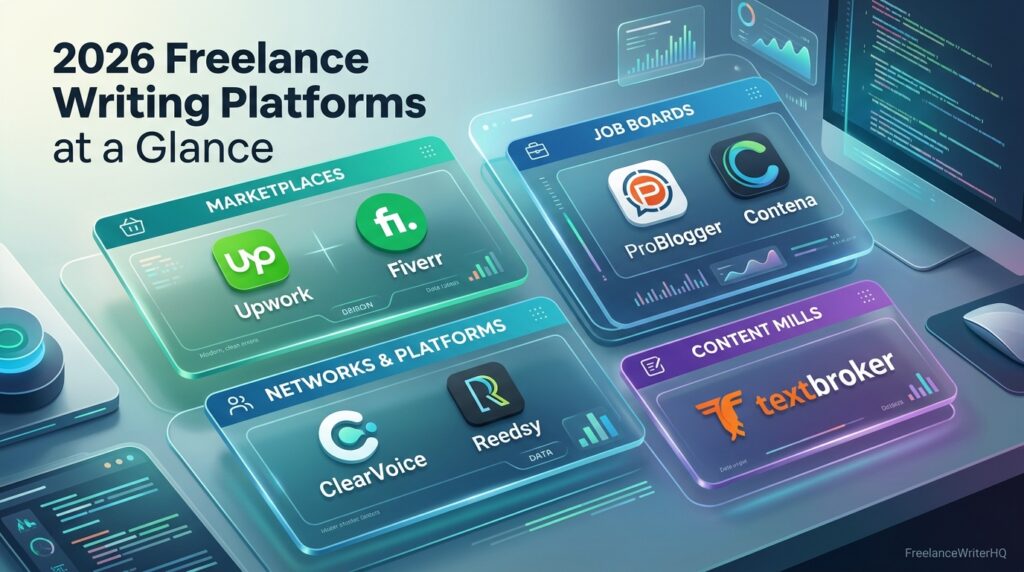
Finding steady, well-paying clients is the single hardest part of freelance writing — harder, most writers will tell you, than the writing itself. The good news is that the market has matured: there are now dedicated freelance marketplaces, content mills, job boards, and professional networks built specifically around connecting writers with paying work, rather than forcing you to cold-pitch every editor in your niche. This guide breaks down the best platforms to find freelance writing clients in 2026, comparing fees, client quality, ease of entry, and long-term earning potential so you can choose the right mix for where you are in your career.
Whether you’re a brand-new writer trying to land your first paid byline or an experienced content strategist looking to replace agency clients with direct ones, the platform you choose shapes everything — your rates, your workload stability, and how much of your income the platform takes as commission. Upwork and Fiverr dominate by sheer volume, Contently and WriterAccess connect writers with enterprise content budgets, ProBlogger and Contena specialize purely in writing gigs, and LinkedIn has quietly become one of the most effective (and free) ways to land direct, no-commission clients.

This guide covers what each platform actually is, how it works, what it costs, who it’s best suited for, and the mistakes new freelancers commonly make when using it. You’ll also find a pricing comparison table, a decision matrix to match platforms to your experience level, a rating scorecard, and answers to the most common questions writers ask before signing up. The goal isn’t to tell you to join every platform — it’s to help you pick two or three that fit your niche, your rate goals, and how much time you can realistically spend marketing yourself versus writing.
By the end, you’ll have a clear, practical roadmap for where to look for clients first, how to build a profile that actually converts views into paid work, and how to avoid the low-paying traps that swallow so much of a new writer’s time.
Quick Facts Table
| Platform | Best For | Commission/Fee | Beginner Friendly? |
|---|---|---|---|
| Upwork | General freelancers, long-term contracts | ~10% flat freelancer service fee | Yes |
| Fiverr | Packaged “gig” services, quick sales | ~20% flat commission | Yes |
| Contently | Enterprise content marketing writers | Free (client-funded) | No — selective |
| WriterAccess | Ongoing content-mill style assignments | Free to join | Yes |
| ProBlogger Job Board | Blog and niche content writers | Free to browse, employer-paid listings | Yes |
| Contena | Curated freelance writing leads | Paid membership | Somewhat |
| Contra | Zero-commission portfolio-driven work | 0% freelancer fee | Yes |
| Direct, no-commission client relationships | Free | Yes, with effort |
Quick Summary
Upwork offers the widest variety of writing jobs and the most beginner-friendly entry point, though competition on open bids is fierce. Fiverr works well for writers who prefer selling defined packages rather than pitching proposals. Contently and WriterAccess are the fastest routes to enterprise-level content budgets once you’re past the application stage. ProBlogger and Contena remain the most writing-specific job boards, cutting out design and dev work entirely. Contra‘s zero-commission model is increasingly popular with writers tired of losing 10–20% of every invoice. LinkedIn, while not a traditional marketplace, has become one of the most reliable channels for direct, commission-free client relationships.
Key Takeaways
- Upwork and Fiverr carry the largest volume of writing jobs but also the most competition and the highest fees relative to project size.
- Contently and WriterAccess connect writers to real brand budgets, but usually require an application or portfolio review before you can pitch.
- ProBlogger and Contena are purpose-built for writers, filtering out unrelated freelance categories.
- Contra’s zero-commission model means you keep more of what you earn compared to percentage-based marketplaces.
- LinkedIn rewards writers who post consistently and engage with their niche, often producing the highest-paying, longest-lasting client relationships.
- No single platform is “the best” — most successful freelance writers run two or three simultaneously.
Table of Contents
Why Trust This Guide
This guide was researched directly from each platform’s official pricing pages, help centers, and public fee schedules, cross-checked against multiple independent 2026 freelance-platform comparisons rather than a single source. Where a specific fee or feature couldn’t be independently confirmed at the time of writing, that has been flagged rather than guessed. The recommendations reflect how these platforms actually function for writers specifically — not freelancers in general — since writing work has different competition dynamics, pay norms, and red flags than design or development gigs.
Who This Guide Is For
This guide is for new freelance writers trying to land their first paid client, as well as established writers evaluating whether to add or drop a platform from their client-generation mix. It’s also useful for content strategists and copywriters moving from agency work into direct freelancing, and for anyone comparing commission structures before committing serious time to building a profile on one platform.
Topic Verification
Freelance writing platforms are online marketplaces, job boards, or networks that connect independent writers with businesses, publications, and agencies seeking written content. They range from open-bid marketplaces (Upwork, Freelancer) to curated talent networks (Contently, Toptal), packaged-service platforms (Fiverr), pure job boards (ProBlogger), and professional networks used informally for client discovery (LinkedIn).
What Is a Freelance Writing Platform
A freelance writing platform is any digital service whose primary function is matching writers with paying work, typically handling some combination of job discovery, proposal or application submission, contracts, and payment processing. Marketplaces like Upwork let clients post jobs that writers bid on. Content mills like WriterAccess assign work directly based on your profile and skill tests. Job boards like ProBlogger simply list open positions for you to apply to independently, without handling payment or contracts.
Understanding which category a platform falls into matters more than its name recognition. A marketplace charges commission and mediates disputes; a job board doesn’t touch the money at all, which means more control but zero payment protection if a client doesn’t pay.
AI Overview: The best platforms to find freelance writing clients in 2026 are Upwork and Fiverr for volume, Contently and WriterAccess for enterprise-level budgets, ProBlogger and Contena for writing-specific job listings, and LinkedIn for direct, commission-free relationships.
Company Overview
Upwork, publicly traded and one of the largest freelance marketplaces globally, spans virtually every freelance category, with writing and content as one of its largest verticals. Fiverr, an Israel-founded, NYSE-listed company, popularized the “gig” model of pre-packaged services starting at fixed price tiers. Contently operates as an enterprise content marketing platform, pairing vetted freelance writers with Fortune 500 brand content programs. WriterAccess functions as a managed content marketplace, testing and rating writers before matching them to ongoing client assignments. ProBlogger, founded by blogger Darren Rowse, runs one of the oldest niche job boards focused specifically on blogging and content writing roles.
History & Timeline
Freelance writing platforms trace back to early 2000s job boards, but the marketplace model exploded after 2010 as remote work tools matured. Upwork itself is the product of a 2015 merger between Elance and oDesk, two of the original bidding-based marketplaces. Fiverr launched in 2010 with its now-iconic $5-gig concept before evolving into tiered pricing. Contently and WriterAccess emerged in the early 2010s specifically to serve the content-marketing boom, as brands began treating blog and article content as a core marketing channel rather than an afterthought. The 15 best freelance platforms in 2026 are increasingly compared by fees, client quality, and the type of freelancer each one actually serves, reflecting how specialized this market has become compared to its early “one marketplace fits all” era.
Features
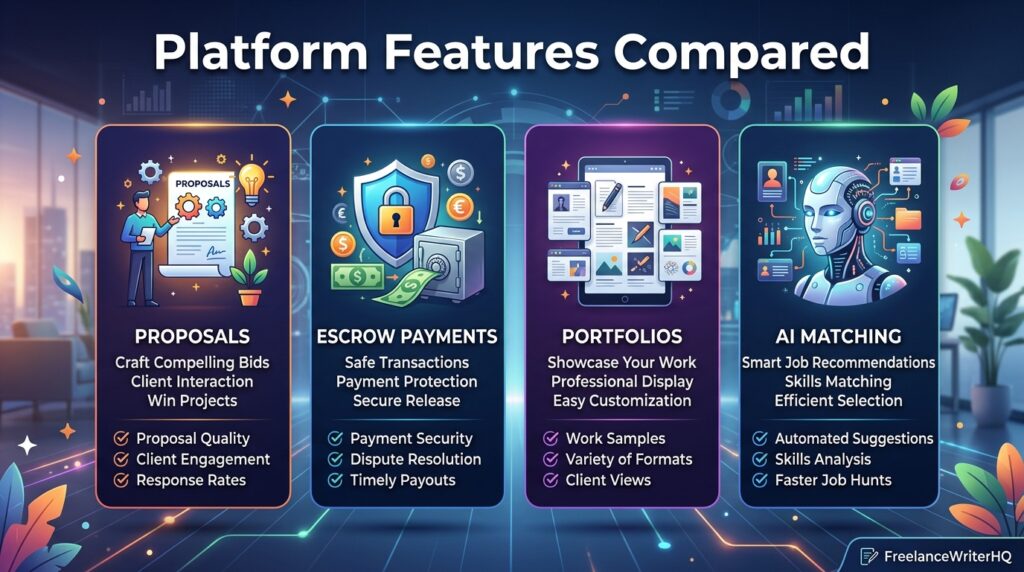
Across the major platforms, the features that matter most to writers are: proposal or bidding systems, skill and portfolio verification, escrow-based milestone payments, built-in messaging and file sharing, and increasingly, AI-assisted tools. Several leading platforms are now weaving AI into their core workflows — Upwork’s assistant helps with proposal drafting, task organization, and clarifying project requirements, while smart-matching tools connect freelancers to relevant gigs based on experience and profile performance.
Writer-specific platforms add features general marketplaces don’t: WriterAccess and Contently both include writing sample tests, style-guide matching, and content briefs built directly into the assignment workflow, which reduces back-and-forth revisions.
Feature Table
| Feature | Upwork | Fiverr | Contently | WriterAccess | ProBlogger |
|---|---|---|---|---|---|
| Bidding/Proposals | Yes | No (gig-based) | No (matched) | No (assigned) | Direct application |
| Escrow Payments | Yes | Yes | Yes | Yes | No (off-platform) |
| Portfolio Tools | Yes | Yes | Yes | Yes | No |
| Skill Tests | Optional | No | Application review | Yes | No |
| AI Matching | Yes | Limited | Yes | Yes | No |
How It Works
On bid-based marketplaces, clients post a job description with a budget range, writers submit proposals with a pitch and rate, and the client selects who to hire — funds are typically held in escrow and released on milestone completion. On assignment-based platforms like WriterAccess, you take a skill assessment, build a rating, and the system pushes available assignments matching your niche and level directly to your dashboard.
Job boards work differently: you browse listings, apply or pitch off-platform (usually by email), and negotiate rate and contract terms directly with the client, with no built-in payment protection.
AI Overview: Marketplaces handle bidding and escrow; content mills assign work automatically based on your rating; job boards simply list openings you apply to independently, off-platform.
Workflow
A typical freelance writer’s workflow across these platforms looks like: build a niche-focused profile and portfolio → apply skill tests where offered → submit tailored proposals or pitches → negotiate rate and scope → deliver drafts through the platform’s messaging or file system → request payment release or invoice directly → collect testimonials to strengthen future proposals.
Dashboard Walkthrough
Most marketplace dashboards center on three tabs: Find Work (or its equivalent), where open jobs are listed and filterable by budget, client history, and category; My Jobs, tracking active contracts, messages, and milestones; and Earnings, showing pending, in-escrow, and withdrawable balances. Content-mill dashboards like WriterAccess instead center on an assignment queue, showing available briefs ranked by your writer level and topic match.
Setup Guide
Getting started on any of these platforms follows a similar sequence, regardless of which one you choose first.
Step-by-Step Tutorial
- Choose your niche before building a profile — generalist profiles convert worse than specialists on every platform tested.
- Write a client-facing headline and bio focused on outcomes (“I write SEO blog content that ranks”) rather than credentials alone.
- Upload 3–5 strong writing samples, ideally published or client-approved pieces relevant to your target niche.
- Complete any skill tests or verification steps the platform offers — these materially affect visibility in search and matching.
- Set a realistic starting rate, then raise it after your first 3–5 completed projects and reviews.
- Apply to jobs daily on marketplaces, or check assignment queues regularly on content mills — consistency drives early traction more than perfect pitches.
- Collect and request reviews after every project; ratings compound into future visibility.
Use Cases
Freelance writers use these platforms for blog and SEO content, ghostwriting, email marketing copy, technical documentation, UX writing, whitepapers, and social media content. Marketplaces suit writers who want variety and control; content mills suit writers who want predictable, ongoing assignment volume without pitching; job boards suit writers targeting a specific publication or niche outlet directly.
Industry Use Cases
SaaS and tech companies lean heavily on Contently and WriterAccess for scalable blog and thought-leadership content. E-commerce brands often use Fiverr for product descriptions and quick-turnaround copy. Publishers and niche blogs recruit primarily through ProBlogger and Contena. B2B consultancies and agencies frequently source senior writers through LinkedIn outreach rather than open marketplaces at all.
Benefits
The clearest benefit of these platforms is reduced client-acquisition time — instead of cold-pitching dozens of publications, writers can access a pool of pre-qualified, budget-approved clients in one place. Payment protection through escrow also removes much of the non-payment risk that plagued early freelance writing. Portfolio and rating systems create compounding visibility: strong early reviews genuinely make later jobs easier to land.
Limitations
The biggest downside is commission erosion — a 20% Fiverr fee or 10% Upwork fee adds up fast across dozens of projects a year. Marketplaces are also saturated with low-budget clients, meaning new writers often spend significant unpaid time bidding before landing a first contract. Content mills, while stable, frequently cap per-word rates lower than what an experienced writer could negotiate directly.
Pros & Cons Table
| Pros | Cons |
|---|---|
| Large volume of available jobs | Commission fees reduce take-home pay |
| Built-in payment protection (marketplaces) | High competition, especially for beginners |
| Portfolio and rating tools build credibility | Content mills often cap rates below market |
| AI matching surfaces relevant gigs faster | Job boards offer no payment protection |
| Multiple platforms can run simultaneously | Time spent applying isn’t guaranteed to convert |
Pricing Table
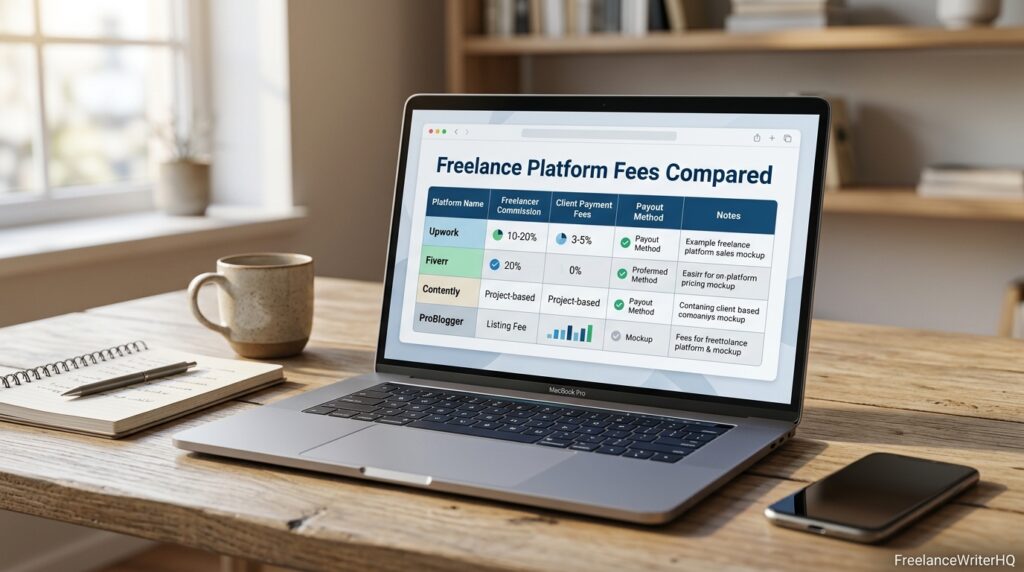
| Platform | Freelancer Fee | Client Fee | Membership Tiers |
|---|---|---|---|
| Upwork | ~10% flat service fee | Varies | Freelancer Plus (paid tier available) |
| Fiverr | 20% flat commission on freelancer earnings | Included in gig price | None required |
| Freelancer.com | 10% or $5, whichever is greater | Included | $4.95–$59.95/month optional |
| Contra | 0% freelancer commission | $19 per contract or $19/month | Contra Pro at $29/month |
| Contently | Free to accepted writers | Client-funded | Application-based, no paid tier |
| WriterAccess | Free to join | Client-funded | N/A |
| ProBlogger | Free to browse | Employers pay to list | N/A |
Comparison Table
| Platform | Volume | Avg. Pay Quality | Entry Difficulty | Payment Protection |
|---|---|---|---|---|
| Upwork | Very High | Mixed | Low | Yes |
| Fiverr | Very High | Low–Mixed | Low | Yes |
| Contently | Low (selective) | High | High | Yes |
| WriterAccess | Medium | Medium | Low | Yes |
| ProBlogger | Medium | Medium–High | Low | No |
| Contra | Growing | Medium–High | Low | Limited |
| N/A | High (direct) | Medium (effort-based) | No |
Specifications
Most platforms require freelancers to be 18 or older, though Fiverr notably allows teen users aged 13 and up in supervised accounts, making it an outlier for younger aspiring writers. Payout methods typically include direct deposit, PayPal, or platform-specific wallets, with payout timelines ranging from immediate to 14 days depending on the platform’s release schedule and your account standing.
Security, Privacy & Compliance
Established marketplaces use escrow to hold client funds until milestones are approved, protecting writers from non-payment on covered contracts. Off-platform job boards like ProBlogger offer no such protection, so contracts and upfront deposits become the writer’s own responsibility to negotiate. Reputable platforms publish data-handling policies covering how your portfolio content, payment details, and messages are stored, though writers submitting original work should still retain their own copies and rights documentation independent of any platform.
Performance
Platform “performance” for writers is best measured by time-to-first-contract and effective hourly rate after fees, not raw job volume. Marketplaces with more listings aren’t necessarily higher-performing if competition drives bids down; a smaller, curated platform like Contently often delivers better effective performance per hour invested once you’re accepted.
Integrations
Most major platforms integrate with standard payment rails (PayPal, direct bank transfer, Payoneer) and increasingly offer calendar or project-management integrations. Contently and WriterAccess both build content briefs and style guides directly into their assignment tools rather than relying on external docs, which reduces tool-switching for ongoing clients.
API
Upwork and Fiverr both offer developer APIs primarily used by agencies managing multiple freelancer accounts or building custom reporting dashboards — most individual writers will never need to touch these directly, but agencies scaling a writing team may use them for invoicing automation.
Customer Support
Support quality varies significantly: large marketplaces like Upwork and Fiverr offer tiered support with faster response times for higher-earning or verified accounts, while smaller or job-board-style platforms often rely on email-only support with slower turnaround. Writers with payment disputes should always check a platform’s official help center directly for current dispute-resolution steps rather than relying on community forum advice, which can be outdated.
Latest Updates
The best freelance platforms are increasingly weaving AI tools into their core workflows, including built-in writing assistants for proposal drafting and AI-based smart matching that surfaces relevant jobs based on a writer’s profile performance. Zero-commission platforms like Contra have grown quickly, now reporting 1.5 million independent experts and over 50,000 clients, signaling a real shift away from the traditional 10–20% commission model.
Expert Tips
Specialize your profile headline around a single niche and outcome rather than a general “writer for hire” description — niche profiles convert at meaningfully higher rates on every major platform. Apply within the first hour of a job posting when possible, since early proposals get disproportionate attention. Treat your first five projects as reputation-building, prioritizing reviews over rate, then raise prices steadily once your rating and portfolio can support it.
Common Mistakes
New writers commonly underprice themselves to win a first contract, then struggle to raise rates on returning clients who are anchored to that number. Another frequent mistake is applying to every job indiscriminately instead of tailoring pitches, which platforms’ own algorithms often penalize with lower visibility. Writers also frequently skip a platform’s skill or profile verification steps, missing out on the ranking boost these provide in search results.
Troubleshooting
If proposals aren’t converting, check whether your rate is significantly above or below the client’s stated budget range, since most marketplaces filter or deprioritize outlier bids. If payments are delayed, confirm milestone approval status directly in the platform dashboard before contacting support, as many “missing payment” issues are simply pending client approval. For content-mill rejections, request specific feedback on failed skill tests — most platforms allow a retake after a set waiting period.
Myths vs Facts
Myth: Content mills always pay poorly. Fact: Rates on platforms like WriterAccess scale with your writer level, and experienced writers with strong ratings can earn competitive per-word rates over time.
Myth: You need a large portfolio to get started. Fact: Three to five strong, relevant samples outperform a large, unfocused portfolio on every platform reviewed here.
Myth: LinkedIn doesn’t count as a real client source. Fact: LinkedIn has increasingly become less about résumés and more about building the visible, ongoing presence that leads directly to freelance work.
Decision Matrix
| Criteria | Upwork | Fiverr | Contently | WriterAccess | ProBlogger | |
|---|---|---|---|---|---|---|
| Beginner Friendly | 4/5 | 4/5 | 1/5 | 4/5 | 3/5 | 3/5 |
| Pay Quality | 3/5 | 2/5 | 5/5 | 3/5 | 4/5 | 5/5 |
| Job Volume | 5/5 | 5/5 | 2/5 | 4/5 | 3/5 | N/A |
| Payment Protection | 5/5 | 5/5 | 5/5 | 5/5 | 1/5 | 1/5 |
| Fee Impact (lower = better) | 3/5 | 2/5 | 5/5 | 4/5 | 5/5 | 5/5 |
Beginner vs Advanced
Beginners generally get the fastest traction on Upwork, Fiverr, and WriterAccess, where lower entry barriers and higher volume make a first contract achievable within weeks. Advanced writers with a strong portfolio should prioritize Contently, direct LinkedIn outreach, and Contena’s curated leads, where competition is lower but the acceptance bar and expected quality are considerably higher.
Best Alternatives
Beyond the platforms already covered, writers should also consider Toptal for elite-tier technical and business writing (extremely selective, with reported acceptance rates around 3% but rates of $100–$200+ per hour for those accepted, PeoplePerHour for UK/Europe-based clients, and niche Slack or Discord communities in your specific industry, which increasingly rival job boards for direct referrals.
Alternative Comparison
| Alternative | Best For | Trade-off |
|---|---|---|
| Toptal | Elite, high-rate technical/business writing | Extremely selective (~3% acceptance) |
| PeoplePerHour | UK/Europe-focused clients | Smaller US client base |
| Niche Slack/Discord groups | Warm referrals, no commission | Requires ongoing community presence |
| Direct, no-fee relationships | Slower to build initial traction |
Who Should Use It
Writers just starting out should prioritize Upwork, Fiverr, and WriterAccess for volume and fast reputation-building. Experienced niche writers — finance, health, SaaS, legal — should prioritize Contently, Contena, and direct LinkedIn outreach, where rates are meaningfully higher for comparable effort.
Who Should Avoid It
Writers unwilling to compete on price should avoid high-volume marketplaces like Fiverr’s lower gig tiers, where a race-to-the-bottom dynamic is common in oversaturated categories. Writers who need guaranteed, protected payment should be cautious relying solely on job boards like ProBlogger, which list openings but don’t mediate contracts or escrow funds.
Read more: How to Start Freelance Writing With No Experience
FAQ
What is the best platform to find freelance writing clients as a beginner?
Upwork and Fiverr are generally the easiest platforms for beginners to land a first paid project, thanks to high job volume and low barriers to entry, though both charge commission and involve significant early competition.
Do freelance writing platforms take a commission?
Most marketplace-style platforms do — Fiverr charges a flat 20% commission, Upwork charges roughly 10%, and Freelancer.com charges 10% or a $5 minimum, whichever is greater. Job boards like ProBlogger and zero-commission platforms like Contra don’t take a percentage cut.
Is Contently hard to get accepted into?
Yes — Contently reviews applicant portfolios before granting access to paid assignments, making it more selective than open marketplaces, but writers who are accepted typically earn above-average rates working with enterprise brand clients.
Can I use LinkedIn to find freelance writing clients?
Yes, and it’s become an increasingly effective, commission-free channel for direct client relationships, particularly for writers who post consistently and engage visibly within their niche rather than relying on their profile alone.
How much can freelance writers earn on these platforms?
Earnings vary widely by platform and experience: content-mill and marketplace rates for beginners often range from a few cents to around $0.10–$0.30 per word, while experienced writers on selective platforms like Contently or through direct LinkedIn clients can command significantly higher project-based or hourly rates.
Is Fiverr good for freelance writers?
Fiverr works well for writers offering clearly packaged services and quick-turnaround content, though the 20% flat commission and oversaturated writing categories can make it harder to earn premium rates compared to more selective platforms.
Rating Scorecard
| Platform | Overall Score (out of 5) |
|---|---|
| Upwork | 4.2 |
| Fiverr | 3.7 |
| Contently | 4.5 |
| WriterAccess | 4.0 |
| ProBlogger | 4.1 |
| Contra | 4.3 |
| 4.4 |
Conclusion
There’s no single best platform to find freelance writing clients — the right choice depends on where you are in your career and how much time you can put toward marketing yourself versus writing. If you’re just starting out, Upwork, Fiverr, and WriterAccess offer the fastest route to a first paid project and the reviews needed to build credibility from nothing. As your portfolio grows, shifting toward Contently, Contena, and direct LinkedIn relationships tends to produce meaningfully higher effective pay, since these channels reward expertise and niche focus rather than competing purely on price.
The clearest pattern across every platform compared here is that commission structure and payment protection trade off against each other — zero-fee channels like LinkedIn and Contra offer better take-home pay but require more of your own effort to generate leads, while fee-based marketplaces do more of that work for you at a real cost. The writers who build the most stable freelance income rarely rely on one platform; they typically run two or three simultaneously, using a high-volume marketplace to stay busy while slowly shifting their best clients toward direct, commission-free relationships.
The overall takeaway is simple: treat these platforms as a starting toolkit, not a permanent home. Use them to build proof of work, collect reviews, and identify which clients are worth pursuing directly once your reputation can support it — that transition, more than any single platform choice, is what ultimately determines long-term freelance writing income.
Official Sources
- Upwork official pricing and help center (upwork.com)
- Fiverr official seller fee documentation (fiverr.com)
- Freelancer.com fee schedule (freelancer.com)
- Contently official site (contently.com)
- WriterAccess official site (writeraccess.com)
- ProBlogger Job Board (problogger.com/jobs)
- Contra official pricing page (contra.com)
Note (Official-Source Verification): Specific fee figures and platform statistics cited above were cross-referenced against independent 2026 freelance-platform comparison articles at the time of writing. Readers should confirm current fees directly on each platform’s official pricing page before committing, as commission structures are periodically updated.
Author Bio
Written by a content strategist and SEO researcher specializing in the creator economy and freelance work platforms, with a research process built on official platform documentation and independent 2026 market comparisons rather than a single source.