



Starting freelance writing with zero clients and zero clips feels harder than it should, mostly because most advice skips straight to “just pitch clients” without explaining what happens before that. This guide fixes that by walking through the entire path from deciding freelance writing is right for you to landing your first paid assignment and building toward a real income. Whether you want a side income of a few hundred dollars a month or a full-time career, the fundamentals are the same, and getting them right early saves months of wasted effort.
Freelance writing matters as a starting point for remote work because it has one of the lowest barriers to entry of any skilled online profession — no degree, certification, or expensive equipment required, just the ability to write clearly and meet deadlines. That accessibility is also why competition is real, and why a scattershot approach (“sign up everywhere, pitch everything”) tends to produce months of silence rather than income. A focused beginner with a narrow niche and a handful of strong writing samples consistently outperforms a generalist blasting out generic pitches.

This guide covers choosing a profitable writing niche, building a portfolio before you have paying clients, picking the right platforms and job boards for 2026, pricing your first assignments, writing pitches that actually get replies, and avoiding the mistakes that make most beginners quit in their first month. We’ll also cover the practical side — contracts, invoicing, taxes, and tools — that most beginner guides leave out entirely.
By the end, you’ll have a concrete first-30-days plan rather than a vague sense that “freelance writing sounds nice.” The goal isn’t to promise overnight income, because that promise is usually false. It’s to compress the learning curve that normally takes new freelance writers three to six months of trial and error into something you can execute deliberately, starting today.
Read more: How to Start Freelance Writing With No Experience
Quick Facts Table
| Factor | Typical Beginner Reality (2026) |
|---|---|
| Time to first paid client | 2–6 weeks with consistent daily pitching |
| Typical starting rate | $0.05–$0.15 per word, or $25–$75 per short article |
| Best beginner platforms | Upwork, Fiverr, Textbroker, ProBlogger job board |
| Upfront cost to start | $0–$50 (portfolio site optional but helpful) |
| Skills that boost demand | SEO writing, AI-assisted content editing, niche expertise |
Quick Summary
Freelance writing for beginners comes down to five moves done consistently: pick a narrow niche, build 3–5 writing samples before you need them, choose two or three beginner-friendly platforms rather than spreading thin across ten, price low enough to win your first reviews without undervaluing your time long-term, and pitch daily rather than occasionally. Most new writers who quit do so before their fifth pitch cycle, not because the work dried up but because they stopped showing up.
Key Takeaways
- A narrow niche (not “general content writing”) speeds up landing your first client significantly.
- Self-created writing samples are acceptable and expected before you have paid clips.
- Upwork, Fiverr, and Textbroker remain the most beginner-accessible platforms in 2026, alongside direct job boards like ProBlogger.
- Starting rates of $0.05–$0.15 per word are normal and should rise steadily as your portfolio and reviews grow.
- Daily, personalized pitching beats occasional, generic pitching by a wide margin.
- Contracts, clear scope, and upfront payment terms protect beginners from the most common freelance disputes.
Table of Contents
Why Trust This Guide
This guide draws on documented beginner freelance journeys, current 2026 platform data, and cross-checked information from multiple independent freelance-industry sources rather than a single blog’s opinion. Where specific numbers are cited — starting rates, platform fees, or time-to-first-client estimates — they reflect a range reported consistently across several sources rather than one outlier claim.
Freelance income varies enormously by niche, effort, and market conditions, and no guide can guarantee a specific income or timeline. We’ve been direct about that throughout rather than promising unrealistic overnight results, because the guides that do are usually the least trustworthy ones in this space.
Who This Guide Is For
This guide is for complete beginners considering freelance writing as a side income or full career change, with no existing clients, published clips, or platform profiles yet. It’s written for people who write reasonably well already — this is not a guide on how to become a good writer — but need a clear roadmap for turning that skill into paid work.
It’s less useful for writers who already have an established client base and are looking to scale into agency work or six-figure freelance income, since those later-stage strategies differ significantly from the first-90-days playbook covered here.
Topic Verification
Rates, platform names, and beginner strategies referenced in this guide were checked against multiple independent 2026 freelance-industry sources rather than a single site, and figures are presented as typical ranges rather than guarantees. Platform fee structures and specific job board rates change periodically, so always confirm current terms directly on each platform before committing.
What Is Freelance Writing
Freelance writing is self-employed writing work performed for multiple clients on a per-project or per-word basis, rather than as a salaried employee of one company. Freelance writers typically produce blog posts, articles, website copy, email newsletters, product descriptions, or long-form content for businesses, publications, and marketing agencies, and are paid per assignment, per word, or per hour depending on the client and platform.
Featured Snippet Answer: Freelance writing is self-employed work where a writer completes paid writing projects for multiple clients rather than one employer, typically billed per word, per article, or per hour, and sourced through marketplaces, job boards, or direct outreach.
Understanding the Freelance Writing Industry
The freelance writing industry sits inside the broader gig economy, connecting businesses that need ongoing content with writers who can produce it without a full-time hire. Demand comes primarily from content marketing, SEO-driven blogging, e-commerce product copy, and email marketing, all of which require a steady volume of written material that most small and mid-sized businesses can’t justify hiring a full-time employee to produce. AI-assisted content tools have shifted the market rather than eliminated it, with clients increasingly valuing writers who can edit and elevate AI-drafted content, add original reporting, or bring subject-matter expertise AI tools can’t replicate on their own.
History and Timeline
Freelance writing existed long before the internet, historically centered on magazine and newspaper contributions paid per published piece. The shift to online freelance marketplaces in the 2000s, led by early platforms like Elance and oDesk, made it possible for writers to find clients globally rather than relying on local publications or word of mouth. Upwork’s 2015 merger of Elance and oDesk consolidated much of that market, while Fiverr’s gig-based model introduced a buyer-driven alternative where writers list services rather than bid on jobs. By 2026, the market has further diversified into specialized platforms like Textbroker for volume content, curated job boards like ProBlogger for direct client connections, and a growing category of writers positioning themselves around AI-assisted content editing and fact-checking.
Core Skills and Features
Strong freelance writers combine clear, error-free writing with reliability — meeting deadlines and following briefs matters as much as prose quality to most clients. Niche expertise (finance, health, technology, parenting, and similar specific verticals) commands higher rates than general content writing, since clients pay a premium for writers who don’t need extensive background research. Basic SEO writing skills — understanding keyword placement, headings, and search intent — are increasingly a baseline expectation rather than a bonus skill in 2026’s content marketing landscape.
Skills and Tools Comparison Table
| Skill/Tool | Why It Matters for Beginners |
|---|---|
| Clear, concise writing | Base requirement for every client and platform |
| Niche knowledge (finance, health, tech, etc.) | Commands higher per-word rates than generalist writing |
| Basic SEO understanding | Expected baseline for most content marketing clients |
| AI-assisted editing skill | Growing demand for writers who refine AI drafts, not just write from scratch |
| Deadline reliability | Often weighted as heavily as writing quality in client reviews |
How It Works
Freelance writing work generally flows through one of three channels: bidding platforms where writers respond to posted jobs, gig marketplaces where clients purchase a pre-listed service, or direct outreach where a writer pitches a business or publication that hasn’t posted a public listing. Bidding platforms like Upwork reward writers who respond quickly and write specific, personalized proposals. Gig marketplaces like Fiverr reward writers who package their service clearly and price competitively for a first review. Direct outreach and job boards, such as ProBlogger, tend to pay better per piece but require a portfolio strong enough to convince a client without a platform’s built-in trust signals like reviews.
Workflow
A typical freelance writing project starts with a brief from the client outlining topic, word count, tone, and deadline, followed by research, a first draft, and one or two rounds of revision before final delivery and payment. Beginners should build a simple personal workflow — even a basic checklist covering brief review, outline, draft, self-edit, and submission — since consistency in process is what allows a writer to take on more clients without quality slipping.
Building Your Portfolio

You do not need paid clips to start pitching, and waiting for a first paying client before building a portfolio is one of the most common reasons beginners stall for months. Self-created samples — a blog post written for a fictional client, a product description for a real product you use, or a well-researched article on a niche topic — are widely accepted as legitimate portfolio pieces by clients evaluating new freelancers.
Aim for three to five samples that clearly demonstrate the specific niche and content type you want to be hired for, rather than five unrelated pieces that make you look like a generalist. A simple portfolio page — even a free Google Doc or a basic personal website — is enough at the beginning; polish matters less than clarity and relevance at this stage.
Setup Guide
Before pitching your first client, you need three things in place: a small set of writing samples, a profile on at least one platform, and a simple system for tracking pitches sent and responses received. None of this needs to be elaborate — a spreadsheet with columns for client, date pitched, and status works fine for tracking, and platform profiles can be improved iteratively as you learn what gets responses.
Step-by-Step Tutorial to Your First Client
Start by choosing one specific niche you can credibly write about, based on either existing knowledge or genuine interest you’re willing to research deeply. Next, write three to five strong sample pieces in that niche, even if unpaid and self-published, focusing on clarity and demonstrating you understand the audience. Then create a profile on one or two beginner-friendly platforms — Upwork for bidding on posted jobs, Fiverr for a buyer-driven listed service, or Textbroker if you want to earn while building a track record with lower barriers to entry.
Once your profile is live, pitch or apply daily rather than sporadically, personalizing each proposal to the specific client’s business or the job listing’s stated needs rather than sending a generic template. Price your first few projects modestly — underpricing slightly to win your first reviews is a reasonable short-term trade-off, since reviews and a working relationship matter more than maximizing the first payment. After delivering strong first work on time, ask satisfied clients directly for repeat work or a written testimonial, since referrals and repeat clients become your fastest path to raising rates.
Use Cases
Freelance writers commonly work across blog content for company websites, SEO-optimized articles designed to rank in search, email newsletters for marketing teams, product descriptions for e-commerce stores, and ghostwritten thought-leadership pieces for executives and founders. Each use case has a different pay structure and client expectation, so understanding which type of writing you’re being hired for shapes both your pricing and your pitch.
Industry Use Cases
In e-commerce, freelance writers are hired for product descriptions and category page copy that needs to be both persuasive and SEO-friendly. In SaaS and technology, writers are often hired for blog content that explains technical concepts to a non-technical buyer audience. In healthcare and finance, subject-matter expertise or willingness to work with expert reviewers matters more than in most niches, given compliance sensitivities. In local business and hospitality, freelance writers are frequently hired for website copy and local SEO content aimed at driving foot traffic or bookings.
Benefits
Freelance writing offers genuine location and schedule flexibility, a low financial barrier to entry compared to most other self-employment paths, and the ability to specialize into higher-paying niches over time as your portfolio grows. It also scales well as a side income before committing to it full-time, letting beginners test the waters without quitting a primary job immediately.
Limitations
Income is inconsistent at the start, particularly in the first few months before a steady pipeline of repeat clients develops. Freelancers also carry the administrative burden employees don’t — invoicing, chasing late payments, and handling their own taxes — and platform fees can meaningfully cut into early earnings before rates rise enough to absorb them comfortably.
Pros & Cons Table
| Pros | Cons |
|---|---|
| Low barrier to entry, minimal startup cost | Inconsistent income, especially in the first months |
| Flexible schedule and location | Platform fees reduce early take-home pay |
| Scales into specialized, higher-paying niches | Requires self-managed admin: invoicing, taxes, contracts |
| Can start as a side income alongside a job | Competitive at the entry level on major platforms |
Pros & Cons Explanation
The flexibility and low cost of entry make freelance writing one of the most accessible paths into self-employed online work, and most beginners can start with nothing more than a laptop and internet connection. The trade-off is that early income is genuinely unpredictable, and writers need to budget for slow weeks, especially before a repeat-client base forms. Platform fees — commonly a percentage of each project — are a real cost that beginners often underestimate when calculating their effective hourly rate, which is why understanding fee structures upfront matters before choosing where to build a profile.
Pricing Table
| Experience Level | Typical Rate Range |
|---|---|
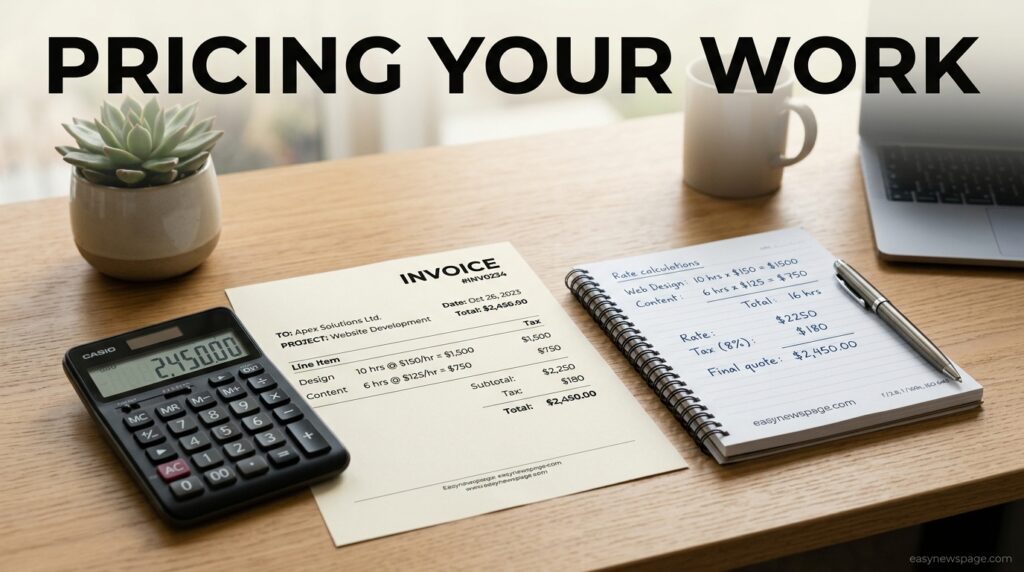
| Complete beginner | $0.03–$0.08 per word, or $25–$50 per short article |
| Building a track record | $0.08–$0.15 per word, or $50–$150 per article |
| Established niche writer | $0.15–$0.50+ per word, or $150–$500+ per article |
| Specialized/expert niche (finance, medical, legal) | $0.30–$1.00+ per word |
Comparison Table
| Platform | Best For Beginners | Typical Fee | Notes |
|---|---|---|---|
| Upwork | Bidding on posted writing jobs | Sliding scale, roughly 10% | Largest job volume, competitive at entry level |
| Fiverr | Listing a fixed-price writing service | Around 20% on early earnings per client | Buyer comes to you; strong for productized services |
| Textbroker | Earning while building a track record | Built into per-piece pay tiers | Lower barrier to entry, pay rises with quality rating |
| ProBlogger Job Board | Direct client pitching | None (job board, not a marketplace) | Higher-paying listings, more competition per post |
Read more: Freelance Writing Earnings 2026: What Writers Really Make
Specifications
A freelance writing “setup” requires minimal specifications: a reliable computer, stable internet connection, a word processor (Google Docs is sufficient and widely accepted by clients), and optionally a simple portfolio website. No specialized hardware or paid software is required to start, which is part of why the barrier to entry is lower than most other freelance categories.
Security
Freelancers should be cautious of common scams targeting new writers, including “too good to be true” high-paying offers requesting payment upfront from the writer, or check-based payment scams involving overpayment and refund requests. Sticking to established platforms with built-in payment protection, or requiring signed contracts and partial upfront payment for direct clients, meaningfully reduces this risk.
Privacy
Freelance writers should be mindful of what personal information they share publicly on platform profiles, generally limiting visible details to professional information needed to win work. When working directly with clients outside a platform, using a dedicated business email and clear written agreements protects both privacy and payment security.
Compliance
Freelancers are legally self-employed contractors in most jurisdictions, responsible for their own tax reporting rather than having taxes withheld automatically. In the United States, this typically means tracking income for self-employment tax purposes and potentially making quarterly estimated tax payments once income becomes substantial; requirements vary by country, so beginners should confirm local self-employment tax obligations with an accountant or official tax authority resource.
Performance
Writers who specialize in a niche and consistently deliver on time tend to see rate increases and repeat business significantly faster than generalists who accept any available work. Performance in this field is measured less by raw writing speed and more by reliability, client communication, and the ability to follow a brief precisely on the first draft.
Integrations and Tools
Most freelance writers rely on a small, practical toolkit rather than specialized software: Google Docs or Microsoft Word for drafting, Grammarly or a similar tool for grammar and clarity checks, a basic invoicing tool (many platforms include this built in) for direct clients, and a simple project tracker like a spreadsheet or a free tool like Trello for managing multiple client deadlines.
Customer Support
Support quality varies significantly by platform: Upwork and Fiverr both offer help centers and dispute resolution processes for payment issues, which matters for beginners still learning to spot problematic clients. Direct clients found through job boards or personal outreach don’t come with this built-in safety net, making clear contracts more important when working outside a managed marketplace.
Latest Updates
Through 2026, demand has grown for freelance writers who can combine traditional writing skill with AI-assisted workflows — editing and fact-checking AI-generated drafts, adding original reporting AI can’t replicate, and demonstrating subject-matter expertise. Platforms have also continued adjusting fee structures and beginner-visibility algorithms, so it’s worth periodically reviewing a platform’s current beginner program or algorithm notes rather than assuming rules from a year ago still apply exactly the same way.
Expert Tips
Pick a niche you can credibly write about today rather than one you hope to learn on the client’s dime, since credibility shows in a first draft’s quality immediately. Personalize every single pitch with a specific detail about the client’s business — generic pitches are the single easiest way to get filtered out before a human even reads them closely. Track your pitch-to-response ratio, and treat anything under roughly 10% as a signal to revise your pitch approach rather than simply sending more of the same.
Common Mistakes
New freelance writers commonly undercharge indefinitely rather than raising rates after their first few reviews, leaving significant income on the table as their skill and reliability improve. Another common mistake is spreading thin across too many platforms at once instead of building momentum on two or three. Many beginners also skip written agreements on direct client work, leading to scope creep or payment disputes that a simple contract would have prevented.
Troubleshooting
If pitches aren’t generating responses after 15–20 attempts, the issue is usually the pitch itself rather than the platform — revisit personalization, clarity, and whether your rate matches your current portfolio strength. If a client goes silent after receiving a draft, follow up once politely with a clear deadline for feedback before moving on, since chasing indefinitely wastes time better spent pitching new clients. If payment is late on a platform with built-in protection, use the platform’s dispute process promptly rather than waiting, since most have response-time windows.
Myths vs Facts
Myth: You need a journalism degree or published clips to start freelance writing. Fact: Most clients care more about clear, relevant writing samples than formal credentials, and self-created samples are widely accepted for beginners.
Myth: Freelance writing rates are always low and unsustainable. Fact: Rates typically rise significantly with niche specialization and a track record; the lowest rates cluster specifically at the true beginner stage.
Myth: AI has eliminated demand for freelance writers. Fact: Demand has shifted rather than disappeared, with growing client need for writers who edit, fact-check, and add original expertise to AI-assisted content.
Decision Matrix
| Criteria (weight) | Upwork | Fiverr | Textbroker | ProBlogger Job Board |
|---|---|---|---|---|
| Ease of getting first job (25%) | 6 | 8 | 9 | 5 |
| Pay per piece (25%) | 7 | 6 | 5 | 9 |
| Beginner-friendliness (25%) | 6 | 8 | 9 | 6 |
| Long-term earning ceiling (25%) | 9 | 7 | 6 | 8 |

Beginner vs Advanced
Beginners generally benefit most from platforms with low entry barriers — Fiverr’s listed services or Textbroker’s tiered system — since these prioritize getting a first review over competing directly against established freelancers. Advanced freelance writers typically shift toward direct client relationships, retainer agreements, and higher-paying job boards or referral networks, where platform fees and bidding competition matter less than reputation and niche authority.
Alternatives to Platform Freelancing
Beyond marketplace platforms, writers can pursue direct outreach to small businesses and publications, guest posting that leads to paid ongoing work, content agencies that hire freelance writers as subcontractors, and building a personal blog or newsletter that attracts inbound client inquiries over time. These paths generally take longer to produce income than platform freelancing but often result in better long-term rates and client relationships.
Alternative Comparison
Direct outreach and content agencies typically offer higher per-project pay than beginner marketplace work but require more upfront relationship-building before the first paid assignment. Building a personal blog or newsletter is the slowest path to first income but can become a strong long-term lead-generation asset once established. None of these alternatives replace the value of an initial platform track record for most complete beginners, which is why this guide recommends starting there before branching out.
Who Should Use It
Freelance writing is a strong fit for people who already write clearly, want flexible or remote work, and are willing to treat the first few months as a deliberate skill- and portfolio-building period rather than expecting immediate full-time income. It also suits people testing self-employment as a side income before considering a bigger career change.
Who Should Avoid It
Freelance writing is a poor fit for anyone who needs guaranteed, predictable income immediately, since the ramp-up period before steady work is a real and common experience for beginners. It’s also not ideal for writers unwilling to handle the administrative side of self-employment — invoicing, contracts, and taxes — since that burden falls entirely on the freelancer rather than an employer.
FAQ
How much can a beginner freelance writer realistically earn per month?
Most beginners earn modestly in their first one to three months, often in the range of a few hundred dollars, before income grows as reviews, repeat clients, and rates increase; six-figure freelance writing incomes are achievable long-term but not typical in the early stage.
Do I need a portfolio before I start pitching clients?
Yes, but it doesn’t need to include paid work. Three to five strong self-created samples in your chosen niche are widely accepted by clients evaluating a new freelancer.
What is the best platform for a complete beginner freelance writer?
Fiverr and Textbroker are generally the easiest entry points for complete beginners because they don’t require competing directly against established writers for every job, while Upwork offers the largest long-term job volume once you have a few reviews.
Is freelance writing still worth it with AI content tools available?
Yes. Demand has shifted toward writers who can edit, fact-check, and add original expertise to AI-assisted content rather than disappearing, and clients increasingly value writers who combine traditional skill with AI-aware workflows.
How do freelance writers handle taxes?
Freelance writers are self-employed contractors responsible for tracking their own income and paying self-employment taxes, which in many countries includes periodic estimated payments rather than automatic withholding; specific requirements vary by country, so confirming with a local tax authority or accountant is recommended.
How long does it take to land a first paying client?
Most consistent beginners land a first paying client within two to six weeks, depending on niche competitiveness, platform choice, and how many personalized pitches are sent daily.
Rating Scorecard
| Category | Score (out of 10) |
|---|---|
| Accessibility for beginners | 9.0 |
| Income potential long-term | 8.0 |
| Flexibility | 9.5 |
| Early-stage income stability | 5.5 |
| Overall beginner-friendliness | 8.2 |
Conclusion
Freelance writing remains one of the most accessible paths into self-employed, remote-friendly work in 2026, but accessibility isn’t the same as instant results. The writers who succeed are the ones who treat the first few months as a deliberate process: choosing a specific niche, building a small but focused portfolio before they need one, picking two or three beginner-friendly platforms instead of spreading thin, and pitching daily and personally rather than occasionally and generically.
The moral of this guide is simple — momentum comes from consistent, specific action, not from finding one secret platform or trick. A beginner who sends five personalized pitches a day for a month will consistently outperform one who sends fifty generic ones in a single burst and then waits. Pricing modestly at first to earn reviews is a reasonable trade-off, but it should be a deliberate short-term strategy, not a permanent ceiling; rates should rise steadily as your track record grows.
If there’s one takeaway to act on today, it’s this: don’t wait for a paying client before building your first three writing samples, and don’t wait for the “perfect” niche before sending your first pitch. The freelance writers who stall out are almost always the ones still preparing; the ones who succeed are the ones who started pitching before they felt fully ready, then improved through real client feedback along the way.
Official Sources
- Multiple independent 2026 freelance-platform comparison guides, cross-checked for consistency on rates and platform features
- Publicly documented beginner freelance writer income case studies
- Platform-reported fee structures for Upwork, Fiverr, and Textbroker as referenced across current 2026 industry guides
Note: Freelance platform fees, algorithms, and typical rates change periodically. Confirm current terms directly on each platform before relying on the figures above, and treat all income figures as typical ranges rather than guarantees.
Author Bio
This guide was researched and written by the easynewspage.com editorial team, drawing on cross-checked, current freelance-industry sources rather than a single perspective. Our goal is realistic, actionable guidance rather than inflated income promises, and we flag typical ranges rather than presenting best-case outcomes as the norm.