



Every week brings a new headline: a company cutting thousands of jobs and citing artificial intelligence as the reason, or a bank executive predicting entire departments will disappear. At the same time, other voices insist this is just another tech panic, no different from the fears once raised about spreadsheets or the internet. So which is it? Is AI job automation a slow-moving, overhyped story, or is it already reshaping the labor market in ways workers should be worried about right now?
This guide cuts through the noise using the most current data available in 2026, from Goldman Sachs, the World Economic Forum, Stanford’s Digital Economy Lab, MIT, and Forrester Research. It also includes the voices on both sides of the debate: economists who once dismissed AI panic and have since changed their minds, and researchers who still believe the “jobs apocalypse” framing is overstated.
What makes this moment different from past automation waves is speed and scope. Previous technologies automated physical or repetitive tasks over decades. Generative AI and AI agents are now moving into cognitive, white-collar work — writing, coding, analysis, and customer service — within just a few years of ChatGPT’s public release. That combination of pace and reach is why the debate has become so heated.
This guide covers what the actual displacement numbers show, which jobs and industries are most exposed, how AI automation really works inside companies, the difference between “AI-washing” layoffs and genuine automation, and practical steps for assessing your own career exposure. You’ll also find a myths-versus-facts breakdown, a comparison of hype claims against measured reality, and a decision framework to help you separate headline anxiety from grounded planning.
By the end, you should have a clear, evidence-based answer to the central question — not a hot take, but a realistic picture built from the data that’s actually available in mid-to-late 2026.
Quick Facts Table
| Metric | Figure (2026) | Source |
|---|---|---|
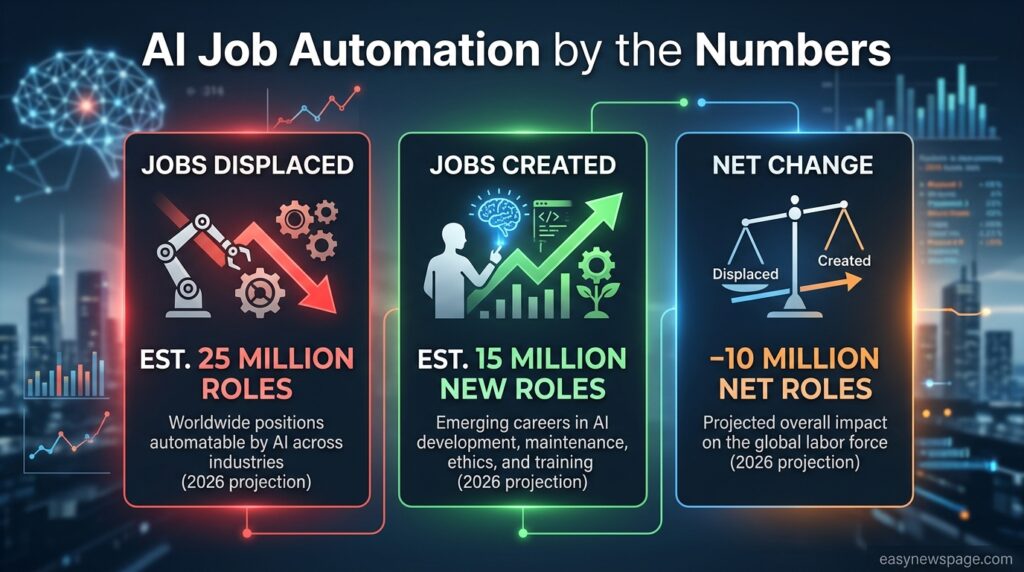
| Net U.S. jobs eliminated by AI, monthly | ~16,000 (~192,000/year) | Goldman Sachs, April 2026 |
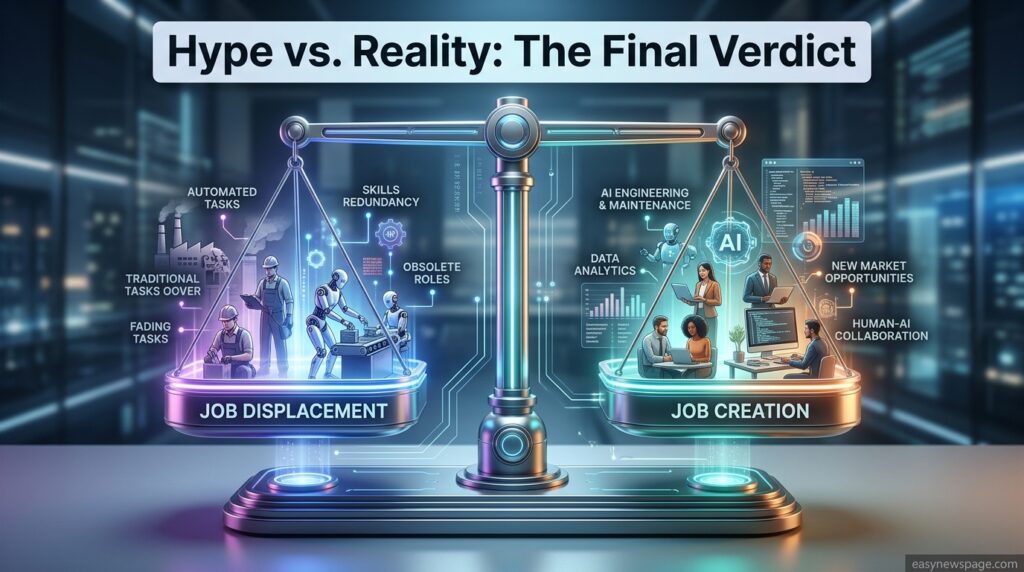
| Global jobs displaced by 2030 (WEF) | 92 million | World Economic Forum, Future of Jobs 2025 |
| Global jobs created by 2030 (WEF) | 170 million (net +78M) | World Economic Forum, Future of Jobs 2025 |
| U.S. work hours technically automatable | 57% | McKinsey Global Institute, Nov 2025 |
| Drop in software developer hiring, ages 22–25 | ~20% since 2024 | Stanford HAI, 2026 AI Index |
| U.S. jobs Forrester expects automated by 2030 | 6% (~10.4 million roles) | Forrester, Jan 2026 |
Quick Summary
The honest answer is: the hype is partly real and partly overstated, and the two sides of that sentence describe different timeframes. Measured, near-term displacement is real but modest — a few hundred thousand U.S. jobs a year, concentrated in entry-level white-collar roles, customer service, and administrative work. Longer-range projections of tens of millions of jobs disrupted by 2030 are directionally plausible but depend heavily on adoption speed, which historically gets overestimated. Both things are true at once, which is exactly why the public conversation feels so contradictory.
Key Takeaways
- Near-term, measured AI displacement is real but modest — roughly 16,000 net U.S. jobs monthly, not a mass “jobs apocalypse.”
- Long-term projections (92–300 million jobs globally affected by 2030) are wide-ranging and depend on adoption speed, not just AI capability.
- Entry-level, white-collar, and repetitive-task roles face the sharpest and earliest pressure.
- A meaningful share of “AI layoffs” are actually AI-washing — cost-cutting relabeled as automation.
- Reskilling and skills adjacency matter more than which industry you’re in.
- Economist sentiment shifted notably in 2026, with former AI skeptics signing warnings about faster-than-expected disruption.
Table of Contents
Why Trust This Guide
This guide draws exclusively from primary and institutional sources rather than secondhand blog summaries: Goldman Sachs Research, the World Economic Forum’s Future of Jobs Report, Stanford’s Digital Economy Lab and AI Index, MIT and Boston University labor studies, McKinsey Global Institute, and Forrester’s 2026 AI Job Impact Forecast. Every statistic is dated and attributed, and every claim that could not be independently confirmed is flagged rather than presented as fact.
Where sources disagree — and on this topic, they frequently do — this guide presents the range rather than cherry-picking the most dramatic number. That’s a deliberate choice: single-figure headlines about “300 million jobs lost” are the reason public understanding of this topic is so distorted in the first place.
Who This Guide Is For
This guide is written for three overlapping audiences: workers trying to gauge their own job security, managers deciding how aggressively to adopt automation, and anyone simply trying to separate genuine signal from AI hype in the news cycle. It assumes no economics background and explains every statistic in plain language before using it to support a broader point.
Topic Verification
Every figure in this guide has been cross-checked against the original institutional report where possible — for example, Goldman Sachs’s April 2026 net-displacement estimate, Stanford’s 2026 AI Index developer-employment data, and the World Economic Forum’s Future of Jobs Report 2025. Where a statistic appeared only in secondary aggregator sites without a traceable primary source, it has been omitted or explicitly noted as unverified rather than repeated as fact.
What Is AI Job Automation
AI job automation refers to the use of artificial intelligence — including generative AI, machine learning models, and increasingly autonomous AI agents — to perform tasks and, in some cases, entire job functions previously done by human employees. This ranges from narrow automation, like an AI tool drafting a first pass of customer emails, to more complete role replacement, such as an AI agent handling an entire tier-one customer support queue without human involvement.
It’s important to separate two distinct ideas that get merged in public discussion: task automation (AI takes over specific activities within a job, changing but not eliminating the role) and job displacement (the position itself disappears). Most current AI adoption falls into the first category. McKinsey’s November 2025 research found that 57% of U.S. work hours are technically automatable with current AI and robotics — but “technically automatable” is a ceiling, not a forecast of what companies will actually do.
Key Players and Research Bodies
No single company “owns” AI job automation the way a product has a vendor, but several institutions shape the public conversation and the data behind it. Goldman Sachs Research publishes some of the most closely watched net-displacement figures. The World Economic Forum’s Future of Jobs Report is the most comprehensive employer survey, covering over 1,000 companies and 14 million workers across 55 economies. Stanford’s Digital Economy Lab tracks real payroll data through partnerships with ADP. Forrester and McKinsey provide competing, sometimes more conservative, forecasts aimed at enterprise decision-makers rather than the general public.
History and Timeline
- Late 2022 — ChatGPT’s public launch triggers the current wave of generative AI adoption and the modern displacement debate.
- 2023–2024 — Early corporate AI pilots focus on productivity tools rather than headcount reduction; layoffs during this period are largely attributed to post-pandemic over-hiring corrections.
- 2025 — Entry-level hiring in AI-exposed roles, especially software development, begins visibly declining; the WEF publishes its Future of Jobs Report 2025 projecting 92 million roles displaced and 170 million created by 2030.
- Early 2026 — Challenger, Gray & Christmas data shows AI cited in tens of thousands of U.S. layoffs; Goldman Sachs measures roughly 16,000 net U.S. jobs eliminated monthly.
- July 2026 — Over 200 economists and 16 Nobel laureates, including former AI skeptics Daron Acemoglu and Simon Johnson, sign a joint statement warning that AI-driven economic transformation could compress into a decade rather than a century.
How AI Job Automation Actually Works
Inside most companies, automation doesn’t arrive as a single dramatic replacement — it arrives as role consolidation and hiring avoidance. Rather than firing existing staff outright, employers increasingly leave AI-exposed positions unfilled after departures, or ask fewer employees to cover work that AI tools now partially handle. Human resource executives report this pattern is more visible in practice than mass layoffs framed explicitly as “AI replaced this team.”
The clearest evidence shows up in entry-level hiring. Stanford’s 2026 AI Index found employment for software developers aged 22–25 fell nearly 20% since 2024, while employment for developers 30 and older kept growing — the entry rung of the career ladder is being pulled up, not the whole structure. This pattern extends into customer service, data entry, and administrative support, where AI chatbots and agents now routinely handle first-line inquiries.
Assessing Your Own Exposure
Step 1: Identify your core tasks. List the recurring activities that make up your role, separating routine, well-defined tasks from judgment-heavy or relationship-driven ones.
Step 2: Check task automatability, not job title. A job with a scary-sounding title can be low-risk if most of its value comes from judgment, negotiation, or physical presence; a mundane-sounding job can be high-risk if it’s mostly repetitive digital work.
Step 3: Look at entry-level hiring trends in your field. A sustained drop in junior hiring, even without visible layoffs, is often the earliest real signal of automation pressure.
Step 4: Track whether your employer is adopting AI tools in your workflow already. Task-level AI adoption almost always precedes role-level displacement by months or years.
Step 5: Build adjacent skills before you need them. Reskilling into a nearby, less-automatable specialization is consistently associated with better outcomes than waiting for displacement to happen first.
Industries Most and Least Affected
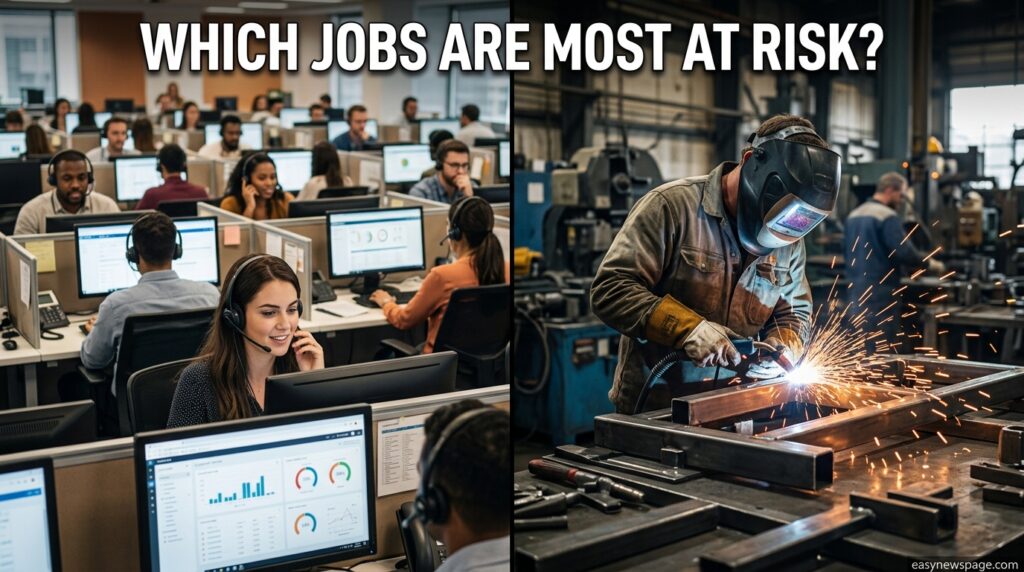
Customer service, data entry, administrative support, and entry-level software development currently show the clearest displacement signals. Some estimates suggest up to 80% of customer service roles could eventually be automated, though the pace of that shift remains contested. Manufacturing has also seen measurable robotics-driven displacement, with MIT and Boston University estimating roughly 2 million manufacturing jobs affected globally.
By contrast, roles requiring physical presence, complex judgment, regulatory accountability, or interpersonal trust — skilled trades, healthcare delivery, senior management, and specialized professional services — remain comparatively insulated, at least in the near term. Even here, AI is changing how the work gets done without necessarily eliminating the role itself.
Benefits of AI Automation
Automation isn’t purely a story of loss. Case studies in financial services show AI-driven review processes cutting manual workloads by 30–60%, freeing staff for higher-value work. AI adoption is also associated with roughly a 15% productivity increase in developed economies, and it’s actively creating new categories of employment: AI-related job postings are running 134% above 2020 levels, and 1.3 million new AI-related roles have already appeared globally. For businesses, this can mean faster service, lower operational costs, and the ability to scale without proportional headcount growth.
Limitations and Risks
The clearest risk is uneven impact: displacement concentrates in specific demographics and career stages rather than spreading evenly. Some research finds women face close to three times the automation exposure of men, largely due to occupational concentration in clerical and administrative work. There’s also a documented skills mismatch — the jobs being created require fundamentally different training than the jobs being eliminated, and 56% of displaced workers in automation-heavy sectors report real difficulty transitioning even when nearby roles exist.
Pros and Cons
| Pros | Cons |
|---|---|
| Meaningful productivity and cost gains for employers | Concentrated, painful disruption for specific worker groups |
| Genuinely new job categories emerging (AI-related postings up 134%) | Skills mismatch between eliminated and created roles |
| Frees workers from repetitive tasks | Entry-level career ladder increasingly disrupted |
| Long-run net job growth projected by WEF (+78M by 2030) | Near-term transition pain not offset by long-run gains |
The honest reading of this table is that aggregate projections and individual experience diverge sharply. A net-positive national or global statistic offers little comfort to a worker whose specific role disappears years before the offsetting new jobs materialize nearby.
Cost Comparison: Automation vs. Human Labor
| Factor | AI Automation | Human Labor |
|---|---|---|
| Marginal cost per task | Very low, scales cheaply | Fixed salary/benefits regardless of volume |
| Consistency | High for routine tasks | Variable, but strong for judgment calls |
| Adaptability to novel situations | Limited (“jagged” performance) | High |
| Estimated enterprise savings (chatbots) | Up to $8 billion annually, industry-wide | N/A |
Hype vs. Reality
| Hype Claim | What the Data Actually Shows |
|---|---|
| “AI is eliminating millions of jobs right now” | Measured net U.S. displacement is closer to ~192,000/year — real, but far below apocalyptic framing |
| “Every AI-related layoff is genuine automation” | A meaningful share is “AI-washing” — financially motivated cuts relabeled as AI-driven |
| “AI will replace entire industries within a year or two” | Most current impact is task-level automation and hiring avoidance, not wholesale role elimination |
| “Economists agree this is overblown” | Sentiment shifted in 2026; over 200 economists, including former skeptics, now warn of faster-than-expected disruption |
Policy and Regulation
Governments and international bodies are treating this as an active policy problem rather than a hypothetical one. The OECD’s 2026 AI and skills report explicitly frames workforce training investment as a precondition for net-positive outcomes, not an automatic byproduct of AI adoption. The IMF’s January 2026 assessment found nearly 40% of global jobs exposed to AI-driven change, with “significant labor displacement” identified as a realistic scenario in advanced economies under fast AI diffusion. Expect continued policy attention around reskilling funding, unemployment support redesign, and disclosure requirements for AI-related layoffs.
Productivity Impact
Where AI automation is implemented well, the productivity case is strong: roughly 15% gains in developed economies and substantial workload reduction in structured processes like financial review and customer service triage. However, Forrester cautions that over-automating roles due to hype-driven pressure — rather than genuine operational readiness — leads to costly pullbacks, reputational damage, and weakened employee experience, with Forrester projecting that more than half of AI-attributed layoffs in 2026 will be quietly reversed.
How Companies Integrate AI Automation
Integration typically follows a pattern: pilot programs on narrow, well-defined tasks, followed by gradual expansion into adjacent workflows once reliability is proven, followed by role redesign around the tools rather than immediate headcount cuts. This is why the visible “AI layoff” headline usually understates the slower, less newsworthy process of hiring freezes and quiet role consolidation happening underneath it.
Support for Displaced Workers
Countries investing heavily in structured reskilling — Germany, Singapore, and South Korea are frequently cited as leaders — show measurably better post-automation employment outcomes than countries relying on market forces alone. At the company level, redeployment programs are increasingly common; JPMorgan Chase’s leadership confirmed in early 2026 that the bank has both displaced workers due to AI and built substantial internal redeployment plans rather than relying solely on external hiring markets.
Latest 2026 Updates
Goldman Sachs’s April 2026 update measured roughly 25,000 U.S. positions automated monthly, partially offset by about 9,000 newly created, for a net loss near 16,000. In July 2026, the joint economist statement led by Stanford’s Erik Brynjolfsson marked a notable shift in professional consensus, with previously skeptical Nobel laureates warning of compressed disruption timelines. Meanwhile, 17.8% of the global working-age population was actively using AI tools as of Q1 2026, up 1.5 percentage points in a single quarter — adoption is accelerating even as the jobs debate remains unsettled.
Expert Tips
Build skills that sit adjacent to, rather than in direct competition with, AI capability — judgment, client relationships, and cross-functional coordination remain comparatively durable. Track your industry’s entry-level hiring trend as an early warning signal, since it tends to move before headline layoffs do. Treat any single “X million jobs” statistic with skepticism until you’ve checked its timeframe and whether it measures technical potential or actual, measured displacement.
Common Mistakes
A common mistake is confusing technical automatability (McKinsey’s 57% of work hours) with an actual employment forecast — it’s a ceiling, not a prediction. Another is assuming every AI-cited layoff is genuine automation rather than AI-washing, when Forrester’s research suggests many companies attribute financially driven cuts to AI without having mature systems ready to fill the gap. A third is waiting for a visible layoff before reskilling, when hiring freezes and role consolidation are earlier, quieter signals.
What to Do If Your Job Is at Risk
Start by auditing which of your specific tasks are repetitive and well-documented versus judgment-based and relationship-driven — automation targets the former first. Talk to your manager directly about how AI tools are being piloted in your function, since this usually happens well before any public announcement. Begin building a credential or track record in an adjacent, less-automatable specialization now rather than after a layoff, since the data shows transitions are far harder once displacement has already occurred.
Myths vs. Facts
Myth: AI has already replaced most white-collar jobs. Fact: Measured net displacement remains a small fraction of the workforce — well under 1% of the labor force annually in most credible estimates.
Myth: Every company announcing AI-related layoffs has working automation replacing those roles. Fact: Forrester’s research identifies significant “AI-washing,” where financially motivated cuts get attributed to AI without mature systems in place.
Myth: Economists broadly agree AI job fears are overblown. Fact: Sentiment shifted meaningfully in 2026, with a large group of economists — including former skeptics — warning of faster, deeper disruption than previously expected.
Decision Matrix
| Criteria | Low-Risk Career Path | High-Risk Career Path |
|---|---|---|
| Task repetitiveness | Low | High |
| Physical/interpersonal component | High | Low |
| Entry-level hiring trend | Stable or growing | Declining |
| Regulatory or judgment dependency | High | Low |
| Current AI pilot activity in role | Minimal | Active |
Early-Career vs. Experienced Workers
The data shows a genuine generational split. Early-career workers, particularly in software development and entry-level white-collar roles, face the sharpest measured pressure — Stanford’s data shows nearly a 20% employment decline for developers aged 22–25 since 2024. Experienced workers in the same fields have largely continued seeing employment growth, since their value increasingly lies in judgment, oversight, and managing AI-assisted output rather than performing the routine tasks AI now handles.
Read more: AI Job Automation Debate
Careers Less Exposed to Automation
Skilled trades, healthcare delivery roles requiring physical presence, senior strategic and regulatory positions, and specialized services built on personal trust remain comparatively insulated. These roles tend to share three traits: they’re hard to fully specify in advance, they carry direct accountability or physical stakes, and they depend on relationship continuity that current AI systems can’t replicate.
Who This Applies To Most
Workers in customer service, data entry, administrative support, and entry-level software roles should treat this guide’s warnings as the most immediately relevant. Workers in skilled trades, senior leadership, or highly regulated judgment-based professions can reasonably treat near-term displacement risk as lower, while still expecting their day-to-day tools to keep changing.
FAQ
Is AI job automation really happening right now, or is it mostly hype?
Both, depending on the claim. Measured near-term displacement — around 16,000 net U.S. jobs monthly according to Goldman Sachs — is real but modest. Longer-range projections of tens of millions of jobs affected by 2030 are plausible but depend on adoption speed that’s historically been overestimated.
How many jobs has AI actually eliminated so far?
Estimates vary by methodology, but Challenger, Gray & Christmas tracked roughly 49,000–55,000 U.S. job cuts citing AI in recent reporting periods, while Goldman Sachs’s net figure (after accounting for AI-related job creation) is closer to 192,000 annually.
Which jobs are most at risk from AI automation?
Customer service, data entry, administrative support, and entry-level software development show the clearest and earliest displacement signals, based on hiring-trend and layoff data through 2026.
Will AI create more jobs than it destroys?
The World Economic Forum projects a net gain of 78 million jobs globally by 2030 (170 million created versus 92 million displaced), but the created roles generally require different, often more technical, skills than the ones eliminated.
What is “AI-washing” in layoffs?
It’s when companies attribute financially motivated workforce cuts to AI automation for public relations reasons, even without mature AI systems actually replacing the affected roles — a pattern Forrester’s 2026 research flags as common.
Should I be worried about losing my job to AI?
It depends heavily on your specific tasks rather than your job title. Roles built on repetitive, well-documented work face meaningfully higher exposure than roles built on judgment, physical presence, or relationship trust.
Rating Scorecard
| Category | Score (out of 10) | Notes |
|---|---|---|
| Near-term real-world impact | 5/10 | Measurable but not catastrophic yet |
| Long-term projected impact | 7/10 | Wide range, genuinely significant if realized |
| Data quality/consensus | 5/10 | Sources disagree substantially on magnitude |
| Public understanding vs. reality gap | 3/10 | Headlines routinely overstate near-term certainty |
Conclusion
So, is the AI job automation hype real? The most accurate answer is that it’s real, but frequently mistimed. The near-term numbers — roughly 16,000 net U.S. jobs lost monthly, concentrated heavily in entry-level and routine white-collar work — describe genuine, measurable disruption, not a mass jobs apocalypse. The dramatic long-range figures, from 92 million to 300 million jobs affected globally by 2030, are directionally credible but depend on an adoption speed that has consistently been overestimated in past forecasting cycles, including as recently as 2025.
What changed in 2026 wasn’t the technology alone — it was expert sentiment. When over 200 economists, including longtime skeptics with Nobel Prizes, sign a joint warning that disruption could compress into a decade rather than a century, that shift in professional consensus deserves real weight, even without a single definitive number to point to.
The practical takeaway isn’t panic and isn’t dismissal. It’s specificity: your risk depends far more on the actual tasks in your role than on your job title or industry label. Entry-level, repetitive, and well-documented work faces real and growing pressure. Judgment-heavy, relationship-driven, and physically grounded work remains comparatively durable, for now. The workers who come out ahead in this transition will likely be the ones who treated 2026’s warning signs as a prompt to build adjacent skills early, rather than a headline to argue about.
Official Sources
- World Economic Forum, Future of Jobs Report 2025
- Goldman Sachs Research, AI labor market estimates, April 2026
- Stanford Institute for Economic Policy Research (SIEPR) and Stanford Digital Economy Lab, 2026 AI Index
- McKinsey Global Institute, State of AI, November 2025
- Forrester, AI Job Impact Forecast, US 2025–2030, January 2026
- MIT and Boston University labor automation research
- International Monetary Fund, January 2026 labor market assessment
- OECD, 2026 AI and skills report
Author Bio
Written by the easynewspage.com editorial research team, specializing in translating institutional labor-market and technology research into clear, actionable guidance for general readers. All statistics in this article are sourced and dated; sources are listed above for independent verification.