



The choice between freelance writing and a traditional 9-to-5 job isn’t really a question with one universal answer, though most articles on the topic try to pretend it is. This guide takes a more honest approach: laying out exactly how income, schedule, stability, growth, and daily life differ between the two paths, so you can match the decision to your actual financial situation and risk tolerance rather than someone else’s lifestyle preference.
This comparison matters right now because remote work, global freelance platforms, and shifting employer benefit structures have changed both sides of this decision significantly over the past few years. A traditional job in 2026 doesn’t guarantee the stability it once implied, and freelance writing doesn’t require the years of slow, uncertain ramp-up it used to. Both paths have moved closer together in some ways and further apart in others, which makes a genuinely current comparison more useful than an outdated “grass is greener” take.

This guide covers income potential and stability for both paths, how schedule flexibility actually plays out day to day, benefits and financial protections you gain or lose, career growth patterns, and the psychological reality of each — including the parts most guides leave out, like decision fatigue, isolation, and the specific stress patterns unique to freelance income versus salaried work. We’ll also cover the increasingly popular hybrid approach that lets you test freelance writing without fully walking away from employment.
By the end, you’ll have a clear framework for evaluating this decision against your own numbers and priorities rather than a generic verdict. There is a real, data-backed answer to “which is better,” but it depends entirely on what you’re optimizing for — predictable income and structure, or autonomy and upside — and this guide will help you figure out which one that actually is for you.
Read more: Best Platforms to Find Freelance Writing Clients in 2026 (Ranked & Compared)
Quick Facts Table
| Factor | Freelance Writing | 9-to-5 Job |
|---|---|---|
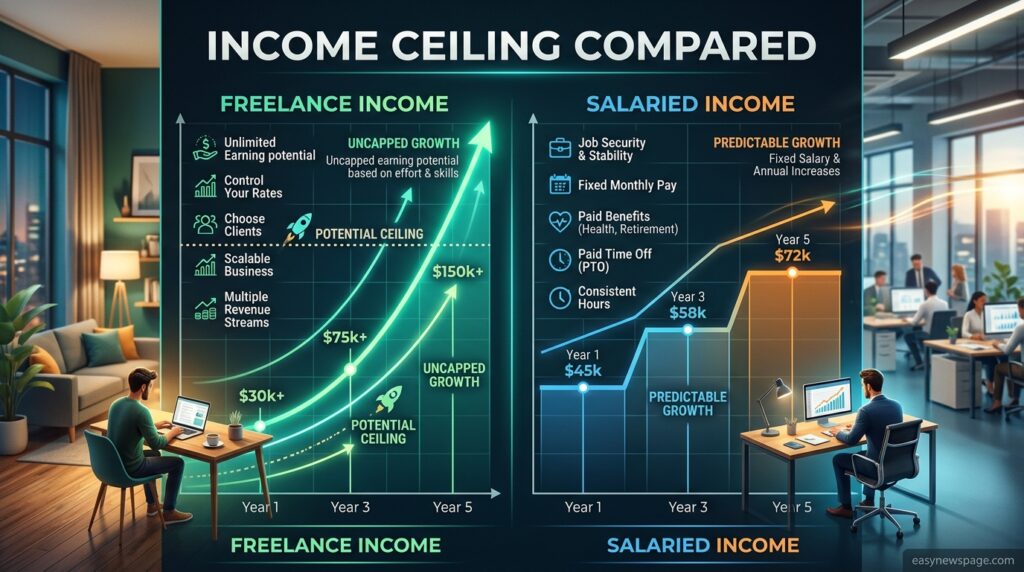
| Income ceiling | Uncapped, scales with rate and client volume | Capped by salary band and raise cycles |
| Income predictability | Variable, especially in the first year | Fixed and predictable |
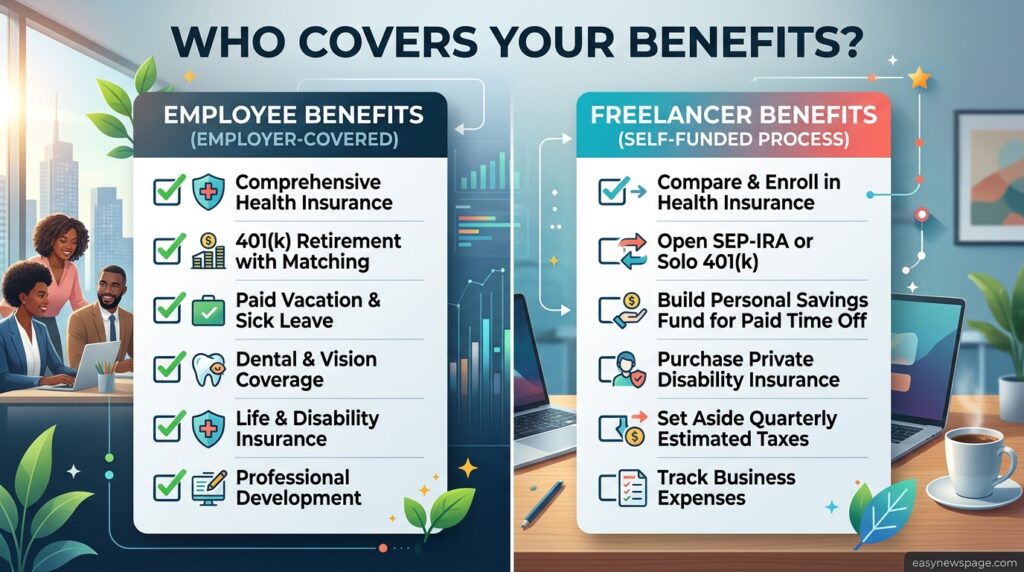
| Benefits (health insurance, retirement match, PTO) | Self-funded | Typically employer-provided |
| Schedule control | High, self-imposed structure | Low to moderate, externally set |
| Career growth pattern | Reputation- and portfolio-driven | Promotion- and tenure-driven |
| Startup cost | Low (a laptop and internet connection) | None (paid to start) |
Quick Summary
Neither freelance writing nor a 9-to-5 job is objectively better — they optimize for different things. A 9-to-5 job offers predictable income, employer-funded benefits, and externally imposed structure, which suits people who value stability and don’t want to manage the business side of their own income. Freelance writing offers an uncapped income ceiling, full schedule control, and location independence, which suits people comfortable with income variability and who want to build something of their own. A growing number of people in 2026 are choosing a hybrid path — part-time or contract employment plus freelance writing on the side — rather than picking one exclusively.
Key Takeaways
- Income potential is uncapped in freelance writing but variable, especially in the first year, while a 9-to-5 job offers a fixed, predictable salary with a defined ceiling.
- Benefits like health insurance and retirement contributions come built-in with most full-time jobs, while freelancers must budget and arrange these independently.
- Schedule flexibility is significantly higher in freelance writing, though that freedom comes with the burden of self-imposed structure rather than externally set routine.
- Career growth looks different in each path: promotions and raises in a job, versus reputation, rate increases, and repeat clients in freelancing.
- A hybrid approach — part-time employment plus freelance writing — is the fastest-growing work arrangement in 2026, letting people test freelancing without full financial risk.
- The right choice depends on your financial runway, risk tolerance, and how in-demand your specific writing skills are, not on which path is inherently superior.
Table of Contents
Why Trust This Guide
This comparison draws on multiple independent 2026 sources covering freelance and full-time work trends, cross-checked for consistency rather than relying on a single perspective. Where a specific statistic — freelancer earnings, working hours, or growth trends — comes from one named source, that’s noted rather than presented as a universal figure.
This guide deliberately avoids declaring one path universally “better,” because the honest answer depends on individual financial circumstances, risk tolerance, and skill demand. Guides that promise a single definitive winner are usually oversimplifying a genuinely personal decision.
Who This Guide Is For
This guide is for anyone weighing whether to leave a traditional job for freelance writing, considering freelance writing as a first career choice instead of traditional employment, or currently freelancing and wondering whether returning to a 9-to-5 job might better suit their current life stage. It’s written to be useful regardless of which direction you’re leaning, since a genuinely balanced comparison serves both audiences.
It’s less useful for readers who have already firmly decided and want tactical execution advice — those readers are better served by a dedicated step-by-step freelance writing beginner’s guide or job-search resource instead of this comparison piece.
Topic Verification
Statistics referenced in this guide — freelancer working hours, income patterns, and hybrid work growth trends — were cross-checked across multiple independent 2026 sources, and figures are presented as reported trends rather than universal guarantees. Individual results vary significantly based on niche, location, experience, and effort, which this guide notes explicitly wherever a figure could be misread as a promise.
What This Comparison Actually Means
Comparing freelance writing to a 9-to-5 job means weighing two fundamentally different structures for earning income from writing skills: self-employed, client-based work with variable income and full autonomy, versus salaried employment with fixed income, employer-provided structure, and typically less schedule control. Neither structure is inherently more financially rewarding or more stable in every case — the outcome depends heavily on the specific role, employer, niche, and individual’s business skills.
Featured Snippet Answer: Freelance writing offers uncapped income potential, full schedule control, and no salary ceiling, but comes with variable income and self-funded benefits, while a 9-to-5 writing job offers predictable pay, employer benefits, and structure, but caps income growth to raise and promotion cycles.
Understanding Both Career Paths
A 9-to-5 writing job — think in-house content writer, corporate communications role, or editorial staff position — provides a fixed salary, typically employer-sponsored health insurance and retirement contributions, and a defined career ladder tied to tenure and performance reviews. Freelance writing replaces that fixed structure with direct client relationships, self-set rates, and full control over workload and schedule, in exchange for taking on the administrative and financial responsibilities an employer would otherwise handle. Both paths can lead to strong long-term outcomes, but they reward different skills: a 9-to-5 role rewards consistency and internal relationship-building, while freelancing rewards business development, self-marketing, and financial self-discipline.
How the Landscape Has Shifted
Remote work adoption accelerated significantly in recent years, and by 2026 flexibility has become a normal negotiating factor for full-time roles rather than a rare perk, narrowing one of freelancing’s traditional advantages. At the same time, digital tools have made it far easier for companies to hire freelancers across locations with minimal friction, expanding freelance opportunity alongside that shift. Employers have also generally tightened performance expectations and, in some sectors, scaled back traditional benefit structures, meaning the “safety” of a 9-to-5 role isn’t as absolute as it once was. The net effect is that both paths have become more similar in flexibility while remaining genuinely different in income structure, risk, and administrative burden.
Core Differences at a Glance
The clearest dividing lines between freelance writing and a 9-to-5 job are income structure (variable and uncapped versus fixed and capped), benefits (self-funded versus employer-provided), and schedule (self-imposed versus externally set). A secondary but equally important difference is decision load — freelancers make constant business decisions (pricing, client selection, scheduling) that employees simply don’t have to make, which can be either energizing or exhausting depending on personal temperament.
Difference Comparison Table
| Dimension | Freelance Writing | 9-to-5 Job |
|---|---|---|
| Income structure | Variable, uncapped | Fixed, capped by role/band |
| Benefits | Self-funded | Employer-provided (typical) |
| Schedule | Self-set | Externally set |
| Career growth | Reputation and rate increases | Promotion and raise cycles |
| Job security | Multiple smaller income sources | Single income source, one employer |
| Admin burden | High (invoicing, taxes, client management) | Low (employer handles most) |
How Each Path Actually Works Day to Day
A 9-to-5 employee typically follows an externally structured day: set start time, scheduled meetings, defined lunch break, and a predictable end time, with the rhythm largely set by the employer’s calendar. A freelance writer’s day is self-structured: checking client communications first, blocking focused writing time, fitting in calls with prospective clients, and often working later or earlier depending on deadlines rather than a fixed clock. Neither rhythm is inherently better — the employee has structure without needing to create it, while the freelancer has flexibility but must build and maintain that structure themselves.
A Day in the Life Comparison
A typical 9-to-5 writer’s day might include a morning standup, several hours of assigned writing or editing work, internal meetings, and a clear end-of-day cutoff, though after-hours messages sometimes creep in depending on the employer’s culture. A typical freelance writer’s day might start with reviewing overnight client messages, a few focused hours on the highest-priority project, a discovery call with a potential new client, and flexible breaks scheduled around personal energy rather than a fixed clock, ending whenever the day’s deliverables are complete.
Setup and Getting Started
Starting a 9-to-5 writing job requires a standard job search process: resume, portfolio or writing samples, interviews, and negotiation, typically resulting in a start date and immediate, predictable income. Starting freelance writing requires building a small portfolio, choosing initial platforms or outreach targets, and accepting that the first few months will likely produce inconsistent income while a client base develops.
Step-by-Step Decision Framework
Start by calculating your financial runway — how many months of expenses you could cover without steady income — since this single number often determines whether freelancing is currently feasible or premature. Next, honestly assess your tolerance for income variability, since even experienced freelancers face slower months, and this variability affects some people far more than others psychologically, regardless of the eventual average income. Then evaluate your niche’s current demand as a freelancer specifically, since some specialties (technical writing, SaaS content, AI-related writing) currently command strong freelance rates while others may be more reliably compensated through employment.
If you’re currently employed, consider testing freelance writing on the side before making a full transition, since this reveals real demand for your specific skills without abandoning your income safety net. If you’re already freelancing and considering a return to employment, be honest about whether the pull is genuine preference for structure and benefits, or a temporary reaction to a difficult stretch of inconsistent income that a stronger client base could resolve. Whichever direction you’re facing, revisit this decision periodically rather than treating it as permanent — many people move between these paths more than once across a career.
Use Cases
Freelance writing suits people who want to specialize deeply in a niche, control their schedule around other life priorities like caregiving or travel, or scale their income beyond what a single employer’s pay band allows. A 9-to-5 writing job suits people who want structured mentorship, team collaboration, predictable benefits, and a clear promotion path without the added responsibility of running a small business alongside the writing itself.
Industry and Life-Stage Considerations
Early-career writers often benefit from a 9-to-5 role first, since employer-provided mentorship and structured feedback can accelerate skill development faster than freelancing alone. Writers with dependents or significant financial obligations may prioritize the predictable income and benefits of employment, at least until freelance income proves consistently reliable. Writers in high-demand technical or specialized niches — SaaS content, healthcare writing, financial writing — often find freelancing financially competitive with or superior to employment, given the premium rates those niches command. Writers seeking geographic flexibility, whether for travel or relocation, often find freelancing better suited to that specific priority than most traditional employment.
Benefits
Freelance writing’s core benefits are an uncapped income ceiling, full schedule control, and the ability to build a personal brand and client base that belongs to you rather than an employer. A 9-to-5 job’s core benefits are predictable income, employer-funded benefits, built-in colleagues and mentorship, and a clear structure that doesn’t require constant self-management.
Limitations
Freelance writing’s core limitations are income unpredictability, the administrative burden of running a small business, and the isolation that can come from working without built-in colleagues. A 9-to-5 job’s core limitations are a capped income ceiling, less schedule control, and career growth that depends on factors partly outside your control, like company performance and internal politics.
Read more: How to Price Your Freelance Writing Services
Pros & Cons Table
| Path | Pros | Cons |
|---|---|---|
| Freelance Writing | Uncapped income, full schedule control, location independence | Variable income, self-funded benefits, isolation risk |
| 9-to-5 Job | Predictable income, employer benefits, built-in structure and colleagues | Capped income, less schedule control, growth tied to company factors |
Pros & Cons Explanation
Freelance writing’s uncapped income potential is real but not automatic — it requires developing business skills (pricing, client acquisition, negotiation) that a 9-to-5 role never asks of you, and the freedom of schedule control comes paired with the responsibility of creating your own structure from scratch. A 9-to-5 job’s predictability is genuinely valuable for financial planning and mental load, but that same structure caps how quickly your income can grow, since raises and promotions typically move slower than a freelancer can raise rates with a strong portfolio and track record. Neither trade-off is universally better; it depends on whether you personally find structure relieving or constraining, and whether you have the financial runway to absorb income variability while building a freelance client base.
Income Comparison Table
| Scenario | Freelance Writing | 9-to-5 Writing Job |
|---|---|---|
| Entry-level / Year 1 | Often lower and inconsistent while building a client base | Predictable, typically modest starting salary |
| 3–5 years experience, niche specialist | Can exceed comparable salaried roles, especially in premium niches | Moderate, steady growth via raises and promotions |
| Established / senior level | High ceiling, especially with retainer clients or productized services | Capped by role band, senior titles required for further growth |
| Income stability | Variable month to month, smooths out with repeat clients | Stable, fixed pay schedule |
Full Comparison Table
| Criteria | Freelance Writing | 9-to-5 Job |
|---|---|---|
| Income ceiling | High | Moderate, capped by role |
| Income stability | Lower, especially early on | High |
| Schedule flexibility | High | Low to moderate |
| Benefits | Self-funded | Employer-provided |
| Career growth mechanism | Reputation, rate increases, repeat clients | Promotions, raises, tenure |
| Admin/business burden | High | Low |
| Social/collaborative structure | Self-built | Built-in |
Specifications
A realistic freelance writing setup requires enough financial runway to cover several months of expenses during the income ramp-up period, a system for tracking invoices and income for tax purposes, and a plan for self-funding benefits like health insurance. A 9-to-5 writing role requires standard job-search readiness — an updated resume, portfolio, and interview preparation — with far less upfront financial planning required before the first paycheck arrives.
Security
Freelance writers manage income security by diversifying across multiple clients rather than depending on a single source, since losing one client in freelancing is a income reduction rather than a total income loss, unlike losing a single employer in traditional employment. 9-to-5 employees, by contrast, depend entirely on one employer’s stability, meaning layoffs or company downturns represent a complete income interruption rather than a partial one.
Privacy
Freelancers generally have more control over what personal and professional information they share, since they aren’t bound by a single employer’s internal policies, though they do need to manage their own professional online presence carefully when marketing directly to clients. Employees typically operate under an employer’s data and communication policies, which can offer more structure but less personal control over professional visibility.
Compliance
Freelance writers are legally self-employed and responsible for their own tax reporting, including self-employment tax obligations that vary by country and often require periodic estimated payments. Employees have taxes withheld automatically by their employer and are covered by labor protections — minimum wage laws, overtime rules, and unemployment insurance in many jurisdictions — that generally do not extend to independent contractors in the same way.
Performance
Performance in a 9-to-5 role is typically measured through formal reviews tied to a company’s internal criteria, with growth largely following a structured promotion timeline. Performance in freelance writing is measured more directly through client retention, referral rate, and the ability to consistently raise rates, with growth following the writer’s own reputation-building pace rather than an external review cycle.
Tools and Support Systems
Freelance writers typically rely on their own toolkit — invoicing software, a portfolio website, project-tracking tools, and professional communities for support and referrals that an employer would otherwise provide informally through colleagues. 9-to-5 employees benefit from employer-provided tools, IT support, and built-in professional relationships that develop naturally through daily team interaction.
Client and Employer Relationships
Freelance writers manage multiple client relationships simultaneously, each requiring its own communication style, expectations, and negotiation, which builds strong business skills over time but also adds relationship management overhead a single-employer relationship doesn’t require. 9-to-5 employees manage one primary professional relationship with an employer, which simplifies day-to-day relationship management but concentrates all professional risk and reward in a single source.
Latest Trends
Through 2026, the fastest-growing work arrangement isn’t full-time employment or full-time freelancing exclusively — it’s a hybrid model combining part-time or contract employment with freelance work on the side, letting people retain partial income stability and benefits while building freelance income and client relationships. Fractional and part-time senior roles have also expanded, particularly in tech and creative fields, offering another middle path between traditional full-time employment and full independence. Demand for freelance writers with AI-related, technical, and niche expertise has grown notably, often commanding premium rates that narrow or exceed the income gap with comparable salaried roles.
Expert Tips
Calculate your actual financial runway honestly before transitioning fully to freelance writing, since underestimating the ramp-up period is one of the most common reasons transitions feel riskier than they needed to. If you’re unsure which path fits, test freelance writing part-time alongside current employment before fully committing either direction, since real client demand for your specific skills is more informative than any general comparison article. Revisit this decision periodically rather than treating it as permanent, since priorities around stability, flexibility, and income potential commonly shift across different life stages.
Common Mistakes
A common mistake is transitioning to full-time freelancing without adequate financial runway, turning what should be a strategic decision into a stressful scramble for immediate income. Another common mistake is undervaluing employer benefits when comparing take-home numbers, since health insurance, retirement matching, and paid time off carry real financial value that a simple salary-versus-freelance-income comparison often overlooks. Some freelancers also isolate themselves entirely from professional community, missing the collaborative support a 9-to-5 role provides more naturally.
Troubleshooting a Difficult Transition
If a transition to freelance writing feels financially unstable sooner than expected, revisit your niche and rate strategy before assuming freelancing itself isn’t viable, since underpricing or an overly broad niche often explains slow income growth more than the model itself. If a 9-to-5 job feels increasingly limiting, consider testing freelance writing part-time before resigning outright, since this reveals real market demand without eliminating your income safety net. If isolation becomes a genuine problem while freelancing full-time, seeking out freelancer communities or co-working spaces can address the collaborative gap without requiring a return to traditional employment.
Myths vs Facts
Myth: Freelance writing is always less stable than a 9-to-5 job. Fact: Freelancers with multiple diversified clients can be more resilient to a single income disruption than an employee who loses their one employer, though early-stage freelancing is genuinely less predictable.
Myth: A 9-to-5 job always pays better than freelance writing. Fact: Experienced freelance writers in premium niches frequently out-earn comparable salaried roles, though this typically takes time and specialization to achieve.
Myth: You have to choose one path permanently. Fact: Hybrid arrangements — part-time employment plus freelance work — are the fastest-growing work pattern in 2026, and many people move between full employment and freelancing more than once across a career.
Decision Matrix
| Criteria (weight) | Freelance Writing | 9-to-5 Job |
|---|---|---|
| Income ceiling (20%) | 9 | 6 |
| Income stability (20%) | 5 | 9 |
| Schedule flexibility (20%) | 9 | 5 |
| Benefits and financial protection (20%) | 4 | 9 |
| Career growth control (20%) | 8 | 6 |
Beginner vs Experienced Considerations
Early-career writers often benefit more from a 9-to-5 role first, since structured mentorship and consistent feedback tend to accelerate skill-building faster than freelancing alone, while also providing an income foundation to later fund a freelance transition. Experienced writers with an established niche and portfolio are better positioned to freelance successfully, since much of freelancing’s early-stage risk comes specifically from the time it takes to build reputation and client relationships that an experienced writer may already partially have.
The Hybrid Alternative
A hybrid approach — working 20 to 30 hours a week as an employee while freelancing during remaining hours — has become increasingly common and offers a genuine middle path rather than a compromise. This model retains partial income stability and, depending on the employer, partial benefits, while still allowing a writer to build freelance clients, test niche demand, and grow toward eventual full independence if desired. It’s particularly viable in fields like tech, creative writing, and consulting, where part-time and contract roles are increasingly normalized rather than seen as a step down from full-time employment.
Alternative Comparison
Compared to a full commitment to either path, the hybrid model reduces both freelancing’s income risk and a 9-to-5 job’s income ceiling limitation simultaneously, though it also demands managing two sets of responsibilities at once, which can be genuinely demanding on time and energy. Fractional or part-time senior roles offer another alternative specifically for experienced writers, combining higher per-hour compensation with more schedule flexibility than a traditional full-time position, though these roles typically require an established reputation to access. Neither alternative eliminates the fundamental trade-off between stability and upside — they simply redistribute it differently than a pure freelance or pure employment path would.
Who Should Choose Freelance Writing
Freelance writing suits people with enough financial runway to absorb income variability, a genuine tolerance for managing their own schedule and business decisions, and either an established niche or strong motivation to build one. It also suits people whose top priority is location and schedule independence, or who want direct control over their income ceiling rather than accepting a fixed salary band.
Who Should Choose a 9-to-5 Job
A 9-to-5 writing job suits people who value predictable income and employer-funded benefits highly, especially those with financial obligations that make income variability genuinely risky rather than just uncomfortable. It also suits early-career writers who would benefit from structured mentorship, and people who find the administrative and business responsibilities of freelancing more draining than freeing.
Read more: Freelance Writing for Beginners: Step-by-Step Guide
FAQ
Is freelance writing more financially risky than a 9-to-5 job?
Yes, especially in the first year, since freelance income is variable and unguaranteed compared to a fixed salary; however, experienced freelancers with diversified clients can achieve comparable or greater income stability over time as their client base grows.
Can freelance writers earn more than salaried writers?
Yes, particularly in premium niches like technical, SaaS, and specialized industry writing, where experienced freelancers frequently out-earn comparable salaried positions, though this typically requires time to build a strong portfolio and client base.
Do freelance writers get benefits like health insurance?
Not automatically. Freelance writers are responsible for arranging and funding their own health insurance, retirement savings, and paid time off, unlike most full-time employees who receive these as part of an employment package.
Is it possible to do both freelance writing and a full-time job?
Yes. A hybrid approach combining part-time or full-time employment with freelance work on the side has become one of the fastest-growing work arrangements in 2026, letting people test freelance demand without giving up income stability.
How do I know if I should switch from a 9-to-5 job to freelance writing?
Consider your financial runway, tolerance for income variability, and current demand for your specific writing niche as a freelancer; testing freelance work part-time before fully transitioning is a lower-risk way to gather real evidence before deciding.
Which is better for work-life balance, freelance writing or a 9-to-5 job?
It depends on the individual — freelance writing offers more schedule control but requires self-imposed structure, while a 9-to-5 job offers built-in structure but less flexibility, so the better option depends on whether you find structure relieving or constraining.
Rating Scorecard
| Category | Freelance Writing | 9-to-5 Job |
|---|---|---|
| Income ceiling | 9.0 | 6.0 |
| Stability | 5.0 | 9.0 |
| Flexibility | 9.0 | 5.5 |
| Benefits | 4.0 | 9.0 |
| Overall (depends on priorities) | 7.0 | 7.5 |
Conclusion
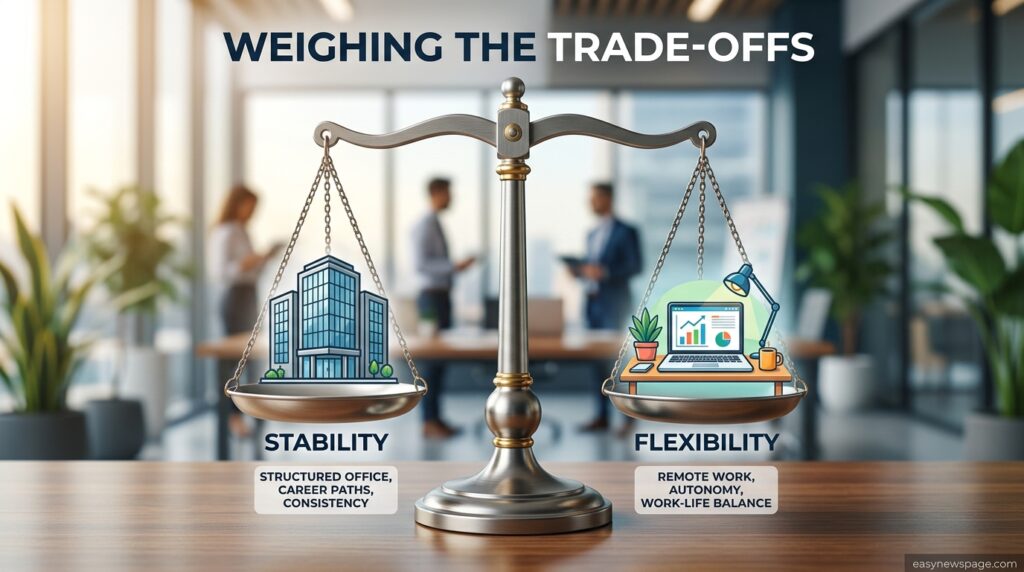
There is no universal winner between freelance writing and a 9-to-5 job, and the guides that claim otherwise are oversimplifying a decision that genuinely depends on your financial situation, risk tolerance, and priorities. A 9-to-5 job wins clearly on predictability, employer-funded benefits, and structure that doesn’t require constant self-management. Freelance writing wins clearly on income ceiling, schedule control, and the ability to build something entirely your own, provided you have the financial runway and temperament to handle the variability that comes with it.
The moral of this comparison is that “which is better” is the wrong question — the right question is which trade-offs you’re actually willing to make. Someone with significant financial obligations and low tolerance for uncertainty will likely find more genuine well-being in a stable 9-to-5 role, even one with a lower income ceiling. Someone with strong financial runway, a specialized niche, and a real appetite for autonomy may find freelance writing both more lucrative and more satisfying long-term, despite the rockier early months.
If you’re genuinely unsure, the hybrid path — testing freelance writing alongside continued employment — remains the lowest-risk way to gather real evidence about which model actually fits your life, rather than guessing based on a comparison article, including this one. Whatever you choose, treat it as a decision you can revisit rather than a permanent identity, since many successful writers move between these paths more than once across a career.
Official Sources
- Multiple independent 2026 freelance-vs-employment comparison guides, cross-checked for consistency on trends and statistics
- Freelance economy statistics reports covering working hours, income patterns, and market growth for 2026
- Hybrid work arrangement trend data from 2026 career and workforce guides
Note: Individual income and career outcomes vary significantly by niche, location, experience, and effort. Figures above reflect a synthesis of multiple 2026 sources and should be treated as directional trends, not guaranteed outcomes for any individual.
Author Bio
This guide was researched and written by the easynewspage.com editorial team, drawing on cross-checked 2026 sources covering both freelance and traditional employment trends. Our goal is a genuinely balanced comparison rather than an advocacy piece for either path, since the right choice depends entirely on the individual reader’s circumstances.