


Ask ten economists whether AI job automation will gut the labor market or barely dent it, and you’ll get answers that split roughly into two camps — and both camps include genuinely serious researchers, not just pundits with a hot take. This guide lays out that debate honestly, giving each side its strongest, most credible case rather than flattening the disagreement into a simple “some people worry, some people don’t” summary.
On one side sit researchers and executives warning that generative AI is different from past automation waves because it targets cognitive work directly — writing, analysis, coding — rather than just physical or routine clerical labor. This camp points to accelerating layoff-tracker data, Stanford research showing measurably worse outcomes for young workers in AI-exposed jobs, and blunt public predictions from AI company leaders themselves. On the other side sit economists and researchers arguing that automating a single task is far easier than eliminating an entire job, that current AI systems still fail the vast majority of complex, multi-day work, and that historical automation waves have consistently created new work even when they destroyed old work.
This guide isn’t trying to declare a winner, because the honest answer is that credible experts disagree, and the disagreement traces back to genuinely different assumptions about how fast AI capability will improve and how quickly organizations can actually absorb it. Instead, you’ll get a clear-eyed walk through both positions: who holds them, what evidence they cite, where they agree, and where the real fault lines sit.
By the end, you’ll understand not just “is AI going to take jobs” but the more useful question underneath it: which specific claims are backed by solid data, which are informed speculation about the future, and which parts of this debate are actually about something other than the technology itself, like how fast institutions can change. That’s a far more useful starting point than picking a side based on whichever headline you saw most recently.
Quick Facts Table
| Position | Representative Voices | Core Claim |
|---|---|---|
| Disruption camp | Dario Amodei, Stanford Digital Economy Lab | AI targets cognitive work directly; early signs of serious labor disruption already visible |
| Skeptic/patient camp | Daron Acemoglu, Arvind Narayanan, Sayash Kapoor, Gary Marcus | Task automation ≠ job elimination; capability and adoption gaps will slow impact for years |
| Conditional optimist | David Autor | AI could restore middle-skill jobs if deployed well, but this is not guaranteed |
| Best AI task-completion rate (complex, multi-day tasks) | Scale AI Remote Labor Index, March 2026 | ~2.5% of tasks completed at human gold-standard level |
| WEF net job forecast by 2030 | World Economic Forum | +78 million net (170M created, 92M displaced) |
Quick Summary
The AI job automation debate splits into two credible camps: one warns that generative AI is structurally different from past automation because it targets cognitive, white-collar work directly, pointing to real 2026 layoff data and age-specific research as early evidence. The other argues that automating an isolated task is far easier than eliminating a whole job, noting that even top AI systems still complete only a small fraction of complex real-world tasks at a human standard, and that organizational and regulatory friction will slow impact to a multi-decade timeline rather than a sudden shock.
Key Takeaways
- The disruption camp, including Anthropic’s Dario Amodei and Stanford researchers, points to accelerating 2026 layoff data and a documented employment gap for young workers in AI-exposed roles.
- The skeptic camp, including economists Daron Acemoglu and researchers Arvind Narayanan, Sayash Kapoor, and Gary Marcus, argues capability gaps and organizational friction will slow real-world impact far more than headline predictions suggest.
- Independent benchmark data shows top AI systems completing only a small fraction of complex, multi-day professional tasks at a human-equivalent standard, a key piece of evidence for the skeptic position.
- Economist David Autor occupies a middle position, arguing AI could restore middle-skill jobs if deployed well, while explicitly cautioning this is a possibility, not a forecast.
- Both camps agree task-level automation is real and accelerating; they disagree sharply on how fast that translates into net job elimination versus job transformation.
Table of Contents
Why Trust This Guide
This guide draws on named, credentialed voices on both sides — economists, computer scientists, and AI company leaders — rather than anonymous commentary, and attributes every claim to its specific source. Where a claim has been publicly fact-checked or disputed, like specific statistics in a widely read optimist article, this guide notes that scrutiny rather than repeating the figure uncritically.
Per journalistic and analytical norms around contested topics, this guide presents the strongest version of each side’s case rather than a strawman of either position, and does not declare one camp correct, since genuinely credentialed experts remain divided on this question as of 2026.
Who This Guide Is For
This guide is for readers who want to understand the actual intellectual debate behind AI job automation headlines, rather than a single side’s talking points. It’s especially useful if you’ve seen confident claims from both directions and want a framework for evaluating which specific arguments are well-supported.
What the Debate Is Actually About
At its core, the AI job automation debate is not really a disagreement about whether AI can perform some job tasks — both camps agree it can and does. The AI Overview: the real disagreement is about pace and scale — how quickly current task-level automation translates into net job elimination across the whole economy, and how much organizational, regulatory, and capability friction will slow that translation down.
One camp treats the current moment as structurally unprecedented because generative AI targets cognitive tasks that earlier automation waves, focused on physical labor and routine clerical work, never touched. The other camp treats the current moment as another chapter in a 250-year pattern where automation waves generate short-term dislocation but ultimately expand the total amount of work available, arguing the burden of proof for “this time is different” claims hasn’t been met.
Company Overview
easynewspage.com covers contested technology and economic debates with an emphasis on representing each side’s strongest argument rather than picking a winner, particularly on genuinely unresolved questions like AI’s labor market trajectory.
Timeline of the Debate
| Period | Development |
|---|---|
| 2023–2024 | Early WEF and McKinsey forecasts frame AI job impact as a multi-decade, net-positive transition |
| Jan 2026 | The Economist publishes an optimistic article arguing AI will expand, not eliminate, white-collar roles |
| Feb 2026 | Independent analysis publicly disputes specific statistics used in that optimistic article |
| Mar 2026 | Scale AI’s Remote Labor Index finds top AI systems complete roughly 2.5% of complex tasks at human standard |
| May 2026 | a16z publicly argues the “AI job apocalypse” narrative reflects poor economics and history, prompting pushback |
| Jun 2026 | Independent economics commentary argues AI optimism misunderstands the specific economic mechanisms at play |
| Aug 2026 | Stanford’s age-based disruption findings intensify the disruption camp’s case |
Features of Each Position
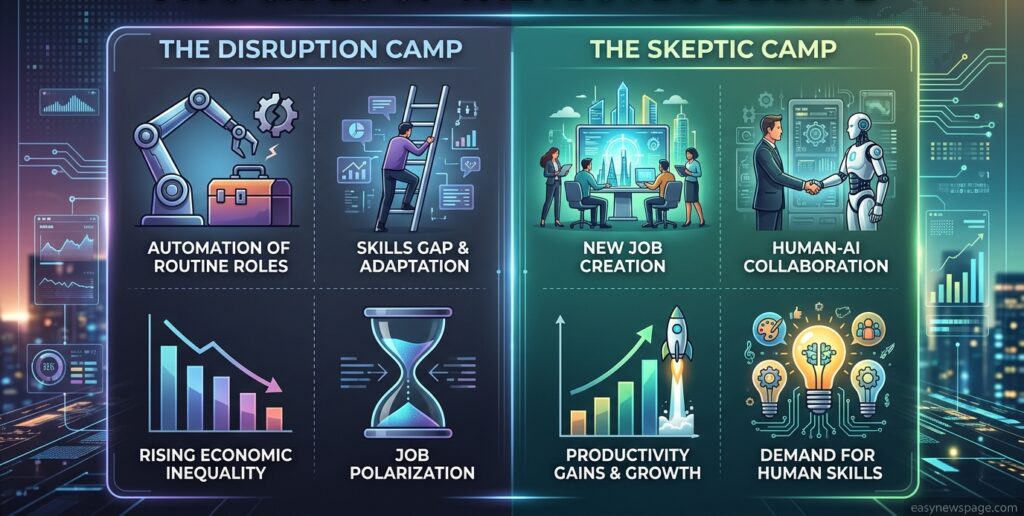
Disruption camp features: cites accelerating layoff-tracker data, age-specific employment declines, and direct predictions from AI company leaders with technical insight into their own systems’ trajectories. Skeptic camp features: cites low real-world task-completion benchmarks, the historical track record of automation ultimately expanding total work, and the practical organizational difficulty of fully replacing human judgment at scale. Conditional optimist features: accepts genuine disruption risk while arguing outcomes depend heavily on deliberate policy and deployment choices rather than being technologically predetermined.
Feature Table
| Position | Key Evidence Cited | Main Weakness Critics Point To |
|---|---|---|
| Disruption camp | 2026 layoff data, Stanford age study, executive predictions | Layoff causation is hard to verify; some “AI layoffs” are AI-washed financial cuts |
| Skeptic camp | Low task-completion benchmarks, 250-year automation history | Historical patterns may not hold if capability improves faster than in past waves |
| Conditional optimist | Middle-skill job restoration potential | Explicitly framed as possibility, not prediction; depends on policy choices |
How Each Side Builds Its Case
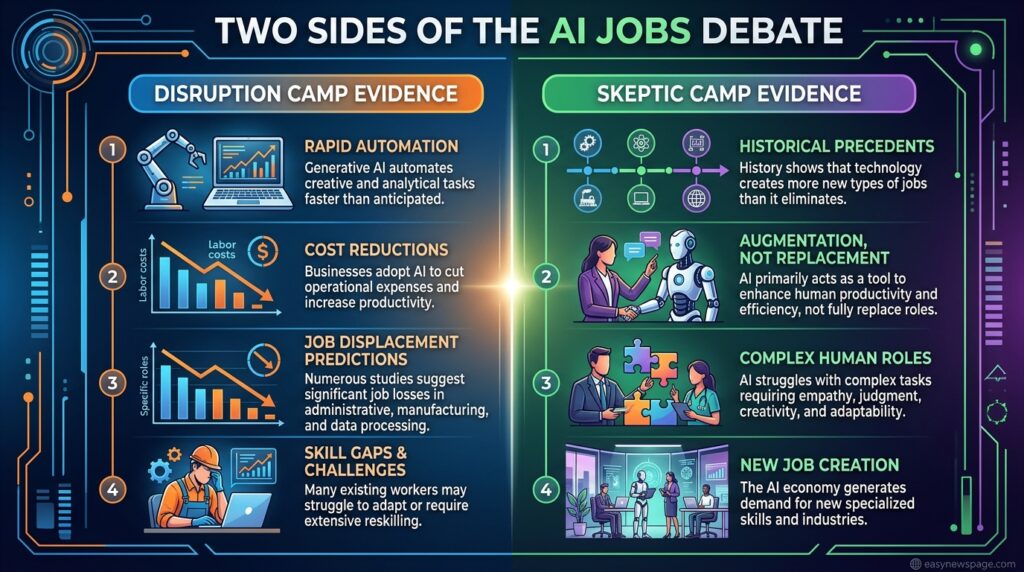
The disruption camp typically builds its argument from present-tense evidence: 2026 layoff-tracker totals, Challenger, Gray & Christmas’s finding that AI became the top-cited layoff reason in March and April 2026, and Stanford’s finding of a measurable employment gap for young workers in AI-exposed occupations. The AI Overview: this camp treats current data trends as the leading edge of a structural shift rather than noise, and points to the specific mechanism — AI substituting for the formal knowledge young workers bring, while complementing senior workers’ tacit experience — as evidence the disruption is real and mechanistically explainable, not just correlational.
The skeptic camp builds its argument primarily from capability benchmarks and historical base rates. Scale AI’s Remote Labor Index, which tests AI systems on complex, multi-day tasks resembling real freelance work, found leading models completing only a small single-digit percentage of tasks at a human-equivalent standard as of March 2026. Economists in this camp, including Daron Acemoglu, argue that even under generous assumptions about AI capability, direct AI exposure remains limited to a small share of total economic output today, and that the gap between “AI can do part of a task” and “AI can replace a job” is routinely underestimated by more alarmist commentary.
Setup Guide: Evaluating a Claim from Either Side
Start by identifying whether a claim is about present-tense data (what’s happening now) or future trajectory (what will happen), since the two camps often talk past each other by mixing these timeframes. Check whether cited statistics have survived independent scrutiny, since specific figures in prominent optimist and pessimist pieces alike have been publicly disputed in 2026.
Look at whether the source is a domain expert with a track record of calibrated predictions, an AI company executive with direct technical insight but also commercial incentives, or a commentator without specific domain expertise. Weigh benchmark data, like real-world task-completion rates, more heavily than any single forecast, since benchmarks measure current capability directly rather than projecting it forward.
Step-by-Step: Forming Your Own Informed View
Read at least one strong source from each camp in full rather than relying on summaries, since both sides’ strongest arguments are more nuanced than their headline framing suggests. Identify which specific claims are actually in dispute — both camps agree task automation is happening, so focus on where they diverge: pace, scale, and net outcome.
Weight your own occupation and circumstances into the analysis, since a 24-year-old in an AI-exposed entry-level role and an experienced professional in a low-exposure field are reading two very different practical stakes into the same debate. Revisit your view periodically as new benchmark and labor-market data arrives, since this is an empirical debate that new evidence can genuinely move, not a purely ideological one.
Industry Use Cases
Technology and policy: The debate directly shapes how governments approach reskilling investment, AI regulation, and safety-net policy, making the disruption-versus-skeptic split practically consequential rather than purely academic. Corporate workforce planning: Companies citing AI in layoff announcements sit at the center of the debate, since the skeptic camp specifically challenges how much of that stated rationale reflects genuine AI capability versus convenient narrative. Academic labor economics: Researchers on both sides are actively publishing new empirical work throughout 2026, meaning the evidentiary balance genuinely could shift as new studies arrive. Venture capital and AI industry commentary: Firms with financial stakes in AI adoption, like a16z, have entered the debate directly, which critics on the skeptic side note as a relevant conflict of interest to weigh alongside their arguments.
Benefits and Limitations of Each Position
The disruption camp’s benefit is that it takes seriously the possibility that this technological transition could be genuinely unprecedented in speed and scope, which matters given the real stakes for workers if that turns out to be true. Its limitation is that some cited layoff data conflates AI-caused and AI-labeled job cuts, and predictions from AI company executives carry an inherent incentive question, even when the underlying technical insight is genuine.
The skeptic camp’s benefit is that it grounds the debate in measurable capability benchmarks and a well-documented historical pattern, offering a useful check against pure speculation. Its limitation is that past automation patterns are not a guarantee about future ones, particularly if capability improvement accelerates faster than in prior technological waves, a possibility the skeptic camp itself generally acknowledges as uncertain rather than ruled out.
Pros & Cons Table
| Disruption Camp: Strengths | Disruption Camp: Weaknesses |
|---|---|
| Grounded in real, current layoff and employment data | Causation between AI and specific layoffs is hard to verify |
| Offers a specific, testable mechanism (young vs. experienced worker gap) | Some predictions come from parties with commercial incentives |
| Takes seriously the risk of an unprecedented technology shift | Vulnerable to overreading short-term data as structural |
| Skeptic Camp: Strengths | Skeptic Camp: Weaknesses |
|---|---|
| Grounded in measurable capability benchmarks | Historical patterns may not hold if capability accelerates |
| Draws on a long, well-documented automation history | Can underweight genuinely novel aspects of cognitive-task automation |
| Applies healthy scrutiny to hyped statistics on both sides | Sometimes framed as more certain than the underlying evidence supports |
Comparison Table: Disruption Camp vs Skeptic Camp
| Dimension | Disruption Camp View | Skeptic Camp View |
|---|---|---|
| Is this automation wave different? | Yes — targets cognitive work directly | Not fundamentally — same underlying pattern, different target |
| Timeline of major impact | Already visible in 2026 data | Years to decades, due to capability and adoption friction |
| Weight given to current layoffs | High — treated as early leading indicator | Lower — some attributed to AI washing, not genuine capability |
| Weight given to capability benchmarks | Secondary to real-world outcomes | Primary evidence for slower-than-claimed impact |
| Net job outcome expectation | Uncertain to negative in the near term | Net positive over time, consistent with history |
Latest Updates
The most active recent flashpoint in this debate is the public disagreement over how to interpret the same underlying data. In January 2026, a widely read optimistic piece argued AI would expand rather than eliminate white-collar roles, citing specific occupational growth figures; independent fact-checking published the following month identified methodological problems with several of those figures, including missing baseline comparisons. This exchange illustrates a recurring pattern in the debate: both optimistic and pessimistic claims have faced public scrutiny over statistical rigor in 2026, and neither camp has a clean record of unchallenged data use.
Separately, venture capital voices entered the debate directly in May 2026, with a prominent firm publicly characterizing alarmist AI-jobs predictions as poor economics and history, a framing that drew pushback from commentators who noted the firm’s direct financial stake in AI adoption continuing unimpeded. Independent economics commentary the following month pushed back on techno-optimist framing as well, arguing that the specific way generative AI intersects with the modern economy’s structure has not been adequately reckoned with by either overly confident camp, underscoring that the most careful voices in this debate resist full alignment with either side’s most confident claims.
Expert Tips
Pay closest attention to economists and researchers who explicitly flag uncertainty and describe conditions under which they’d change their view, since these tend to be the more methodologically careful voices in a genuinely contested debate. Treat statistics from both optimist and pessimist sources with the same level of scrutiny, since 2026 has already seen prominent figures on both sides publicly challenged on data accuracy. Distinguish between claims about current task automation, which is well-documented and largely undisputed, and claims about future net employment effects, which remain genuinely uncertain.
Common Mistakes
A common mistake is assuming one camp represents “the experts” while the other represents fringe opinion, when both sides include credentialed economists and researchers with substantial publication records. Another is treating a single benchmark or statistic, like the Remote Labor Index’s task-completion rate, as settling the entire debate, when it measures one specific dimension of a much larger question. Some readers also mistake commercial commentary, from either AI companies or venture firms with a stake in the outcome, for neutral academic analysis, when both carry incentives worth factoring into how much weight to give their claims.
Myths vs Facts
Myth: Economists broadly agree AI will cause mass unemployment. Fact: Credentialed economists are genuinely split, with figures like Daron Acemoglu arguing current AI exposure remains limited even under optimistic capability assumptions, while others warn of unprecedented disruption.
Myth: The “AI won’t take your job” position is purely reassurance with no evidence behind it. Fact: This position draws on specific benchmark data, including task-completion rates on complex real-world work, and a well-documented 250-year historical pattern of automation ultimately expanding total employment.
Myth: The “AI is different this time” position is just fear-mongering from AI companies. Fact: This position also comes from independent academic researchers, including Stanford’s Digital Economy Lab, whose findings are based on peer-reviewed labor-market data rather than commercial messaging.
Decision Matrix
| Criteria | Weight Disruption Camp More | Weight Skeptic Camp More |
|---|---|---|
| You’re early-career in a highly AI-exposed role | Yes | — |
| You want to assess your near-term (1–2 year) risk | Yes | — |
| You’re assessing a 10+ year career or policy horizon | — | Reasonable to weight equally |
| You’re evaluating a company’s stated layoff rationale | — | Yes (apply skepticism) |
| You’re evaluating raw AI capability claims | — | Yes (check benchmarks) |
Read more: AI Job Automation: Everything Going Viral Right Now
Best Alternatives
If you want the most rigorous disruption-camp source, Stanford’s Digital Economy Lab research offers peer-reviewed, age-specific labor-market data rather than speculative forecasting. If you want the most rigorous skeptic-camp source, capability benchmarks like the Remote Labor Index offer direct, measurable evidence rather than historical analogy alone. If you want a synthesis rather than a pure camp, David Autor’s conditional-optimist framing offers a middle path that takes both disruption risk and policy agency seriously.
FAQ
What are the two main sides of the AI job automation debate?
One camp argues generative AI represents an unprecedented threat to cognitive, white-collar work and points to accelerating 2026 layoff and age-disruption data; the other argues task automation is far easier than job elimination and points to low real-world capability benchmarks and historical automation patterns.
Do economists agree on whether AI will cause mass job losses?
No. Economists are genuinely divided, with some, like Daron Acemoglu, arguing current AI exposure remains limited, and others warning of significant near-term disruption based on emerging labor-market data.
What is the strongest evidence for the disruption camp?
Peer-reviewed Stanford research finding measurably worse employment outcomes for young workers in AI-exposed occupations compared to older peers in the same roles.
What is the strongest evidence for the skeptic camp?
Independent capability benchmarks, like the Remote Labor Index, showing leading AI systems completing only a small fraction of complex, multi-day professional tasks at a human-equivalent standard as of March 2026.
Is the AI jobs debate just AI companies versus everyone else?
No. Both camps include voices without direct financial stakes in AI adoption, including independent academic economists and computer scientists on both the disruption and skeptic sides.
Who is right in this debate?
There is no settled answer as of 2026; credentialed experts on both sides cite real evidence, and the disagreement centers on genuinely uncertain questions about future capability growth and organizational adoption speed rather than a simple factual dispute.
Rating Scorecard
| Category | Score (out of 10) | Notes |
|---|---|---|
| Balance between both sides | 10 | Presents each camp’s strongest case without declaring a winner |
| Source credibility | 9 | Draws on named economists, researchers, and benchmark data |
| Practical usefulness | 8 | Includes a framework for evaluating future claims |
| Currency (2026 relevance) | 9 | Includes developments through mid-2026 |
| Depth of underlying evidence | 9 | Cites benchmarks, historical patterns, and labor data |
Conclusion
The honest verdict on the AI job automation debate is that it isn’t settled, and treating it as settled — in either direction — misrepresents where credible expertise actually stands in 2026. The disruption camp has real, current evidence: accelerating layoff data, a documented and mechanistically explainable employment gap for young workers in AI-exposed roles, and direct technical insight from the people building these systems. The skeptic camp has equally real evidence: capability benchmarks showing AI still failing the vast majority of complex real-world tasks, and 250 years of automation history where task-level disruption ultimately expanded rather than shrank total employment.
Both camps have also had prominent claims publicly challenged in 2026, a useful reminder that skepticism belongs on both sides of this argument, not just the side you’re less inclined to believe. The genuine fault line isn’t over whether AI can automate tasks — everyone agrees it can — but over how fast that translates into net job outcomes, and how much organizational, regulatory, and capability friction will slow the process down.
The overall moral here is that good-faith engagement with this debate means holding both possibilities seriously rather than picking a side for comfort or drama. Track the specific, falsifiable claims each camp makes, watch which side’s predictions hold up as new data arrives, and resist the pull toward whichever framing feels most emotionally satisfying in the moment.
Official Sources
- Stanford Digital Economy Lab, “Canaries in the Coal Mine,” 2026
- Scale AI, Remote Labor Index, March 2026
- Fortune, coverage of a16z’s AI job apocalypse commentary and David Autor’s conditional optimist position, May 2026
- AI Frontiers, “The Quadrillion-Dollar Disagreement on AI and the Economy,” May 2026
- To Summarise, fact-check of The Economist’s AI optimism article, February 2026
- Platformer, “An economist’s case against the AI jobs-pocalypse,” June 2026
Author Bio
This guide was researched and written by the easynewspage.com editorial team, which specializes in presenting contested technology and economic debates with balanced sourcing from named experts on all sides. This article was last updated in August 2026.