

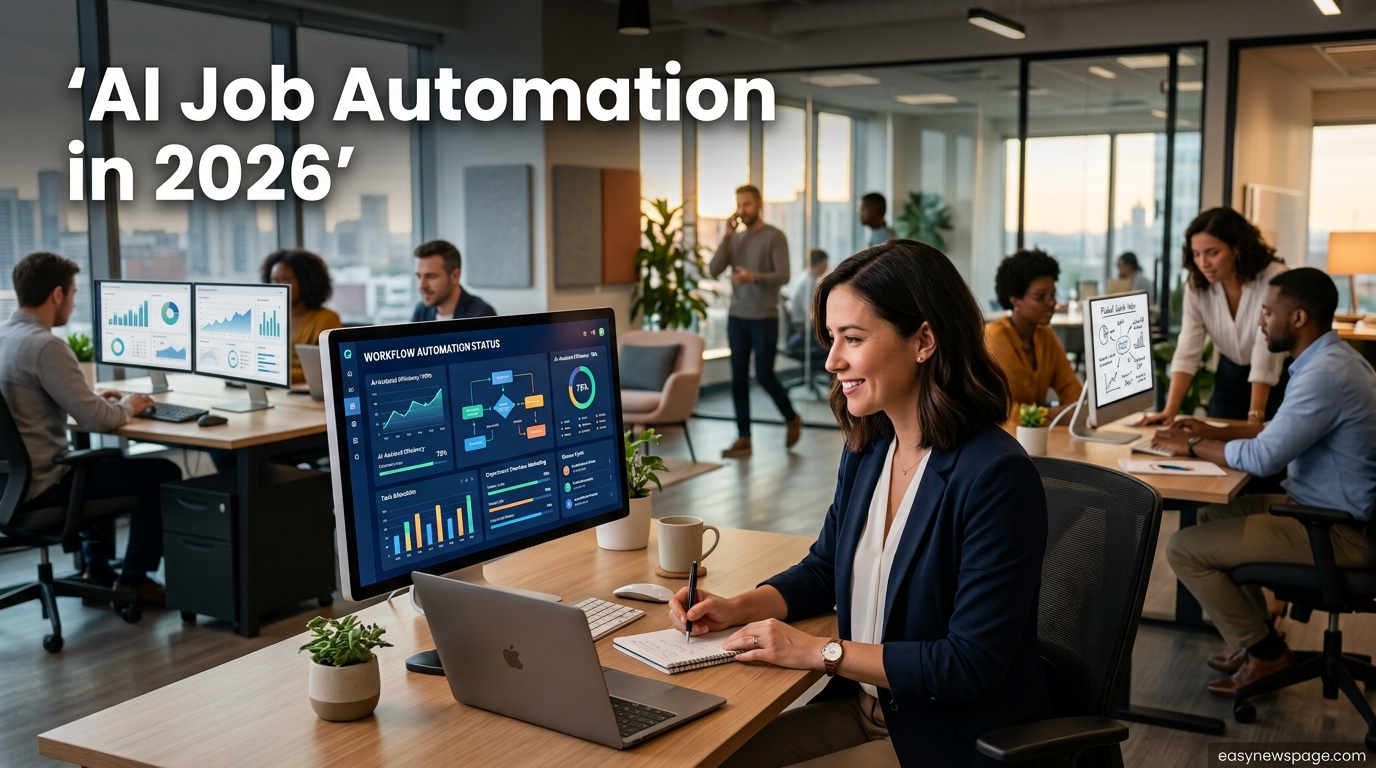
Artificial intelligence has moved past the hype phase and into the payroll department. In 2026, AI job automation is no longer a distant forecast discussed at tech conferences — it is showing up in layoff notices, hiring freezes, and quarterly earnings calls. Whether you work in banking, customer service, software, healthcare, or a warehouse, the tools your employer uses today are different from the ones used just two years ago, and that shift is changing what your job actually looks like.
This guide exists to answer the question most workers are actually asking: not “will AI replace jobs,” but “will it replace my job, and what should I do about it.” We cover the real numbers behind AI-driven layoffs in 2026, which industries and roles face the highest automation risk, which jobs are growing because of AI, and the practical, non-panicked steps you can take to stay employable.
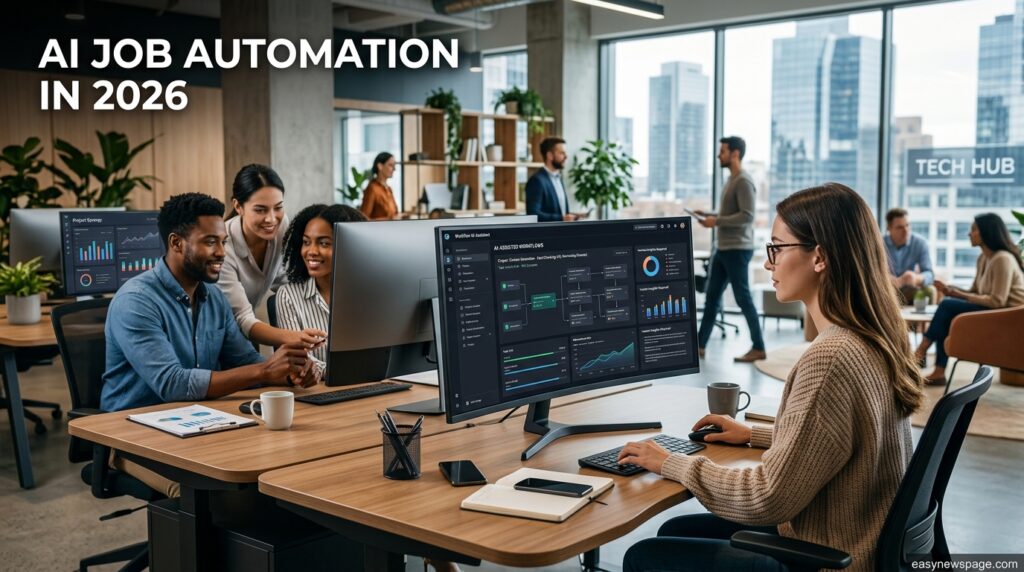
You will find a plain-language breakdown of how AI automation actually works inside a company, a sector-by-sector risk table, a step-by-step guide to “AI-proofing” your career, and answers to the most common questions people are searching right now. We also cover the parts most articles skip: how AI adoption differs between large enterprises and small businesses, what reskilling programs are actually worth your time, and how to read the difference between a company that is automating tasks versus one that is automating entire roles.
This guide is written for employees who want a clear-eyed, evidence-based view rather than either doom-laden clickbait or empty reassurance. It draws on labor-market data from organizations including the World Economic Forum, the International Monetary Fund, MIT, and Goldman Sachs, and it is updated to reflect the automation trends actually playing out through 2026. By the end, you should have a realistic picture of where things stand — and a concrete plan for what to do next.
Quick Facts Table
| Metric | 2026 Figure | Source |
|---|---|---|
| U.S. jobs where AI was cited as a layoff factor (Jan–Apr 2026) | ~49,100 | Challenger, Gray & Christmas |
| Month AI became the #1 cited layoff reason in the U.S. | March 2026 (25% of cuts) | Challenger, Gray & Christmas |
| Global jobs projected displaced by AI by 2030 | Up to 92 million | World Economic Forum, Future of Jobs Report 2025 |
| Global jobs projected created by AI by 2030 | ~170 million | World Economic Forum, Future of Jobs Report 2025 |
| Net global job change by 2030 | +78 million | World Economic Forum, Future of Jobs Report 2025 |
| Banking hours with high automation potential | 66% | IMF, 2026 |
| Entry-level job postings decline since Jan 2024 | 29% | Randstad, 2026 |
| U.S. companies reporting worker replacement via ChatGPT-style tools | ~23.5% | Industry survey data, 2026 |
Quick Summary
AI job automation in 2026 is uneven: it is hitting routine, entry-level, and highly structured cognitive tasks hard (data entry, transcription, basic customer support, first-draft legal and coding work), while creating strong demand for roles that manage, audit, and build on top of AI systems. No single industry is immune, but banking, retail, customer service, and administrative support show the highest exposure, while healthcare delivery, skilled trades, and roles requiring trust or physical dexterity remain comparatively resilient for now.
Key Takeaways
- AI-cited layoffs accelerated sharply in early 2026, with AI becoming the leading cited cause of U.S. workforce reductions for the first time in March 2026.
- The World Economic Forum’s Future of Jobs Report projects a net positive global job number by 2030, but that average hides large losses concentrated in specific roles and demographics.
- Entry-level and early-career workers are being disproportionately affected, with junior job postings down sharply since 2024.
- Reskilling and working alongside AI tools, rather than competing with them, is consistently linked to better job security.
- Roles built on judgment, trust, physical dexterity, and complex human interaction remain the most resistant to automation in 2026.
Table of Contents
Why Trust This Guide
This article was built using labor-market research from primary and near-primary sources, including the World Economic Forum’s Future of Jobs Report, IMF sectoral automation analysis, MIT and Boston University labor studies, and layoff-tracking data from Challenger, Gray & Christmas. Every statistic cited is attributed to its source in the Official Sources section below, and figures were cross-checked across multiple 2025–2026 reports rather than pulled from a single source.
We do not sell AI automation software, career coaching, or reskilling courses, so this guide has no incentive to exaggerate either the threat or the opportunity. Where data from different organizations conflicts — which happens often in a fast-moving field — we note the disagreement rather than picking the more dramatic number. This is a living topic, and figures will continue to shift through 2026 and beyond.
Who This Guide Is For
This guide is for employees at any career stage who want to understand how AI job automation could affect their specific role, not just the economy in general. It is especially useful for early-career workers facing a tighter entry-level job market, mid-career professionals in exposed sectors like banking, retail, or administrative work, and managers trying to plan workforce strategy responsibly.
It is less useful if you are looking for stock-picking advice on AI companies, or a purely technical explainer of how large language models work — this guide focuses on labor-market impact and practical career decisions, not the underlying computer science.
Topic Verification
The claims in this guide were checked against multiple independent datasets, including the World Economic Forum’s Future of Jobs Report 2025, IMF working papers on AI exposure by sector, Challenger, Gray & Christmas monthly job-cut reports, and MIT/Boston University labor research. Where a single source could not be corroborated, that figure has been noted as coming from one source rather than presented as a market consensus.
What Is AI Job Automation
AI job automation refers to the use of artificial intelligence systems — including generative AI, robotics, and agentic AI tools that can complete multi-step tasks with limited supervision — to perform work previously done by human employees. This ranges from full task automation, such as an AI system handling first-line customer support tickets end-to-end, to partial automation, where AI drafts a document or analysis that a human then reviews and finalizes.
The distinction matters because most 2026 job impact is not simple replacement. Agentic AI systems, which can plan and execute sequences of tasks rather than just answer a single prompt, are increasingly handling entire workflows in finance, customer service, and software development. Analysts increasingly separate “task automation” (a piece of a job is automated) from “role elimination” (the entire position is removed), and most current disruption falls into the first category, even as the second becomes more common in highly structured roles.
Company Overview
easynewspage.com is an independent digital publication covering technology, workplace trends, and the practical impact of emerging tools on everyday careers. Our editorial approach favors data-backed explainers over speculation, with a focus on helping readers make informed decisions rather than reacting to headlines.
History and Timeline
AI’s workplace impact did not begin in 2026 — it accelerated. Generative AI tools became mainstream in 2023, automation pilots scaled through 2024, and by 2025 the World Economic Forum’s Future of Jobs Report was already projecting tens of millions of jobs displaced and created by 2030. What changed in 2026 is the shift from “AI-assisted” work to agentic automation, where AI systems execute multi-step processes with less human involvement, and the first quarter of 2026 saw AI overtake other factors as the most-cited reason for U.S. layoffs.
| Period | Development |
|---|---|
| 2023 | Generative AI tools go mainstream in enterprise workflows |
| 2024 | Entry-level hiring begins a measurable decline at major tech employers |
| 2025 | WEF Future of Jobs Report projects 92M roles displaced, 170M created by 2030 |
| Jan–Feb 2026 | AI-cited layoffs rise but remain behind other factors |
| March 2026 | AI becomes the #1 cited reason for U.S. workforce reductions |
Features of Modern Workplace AI Systems
Understanding what today’s workplace AI tools can actually do helps separate real risk from hype.
Generative drafting tools produce first-draft text, code, or analysis for a human to review, common in marketing, legal support, and software development. Agentic task execution allows AI to complete multi-step processes — such as processing a loan application or resolving a support ticket — with minimal human intervention. Predictive and decision-support systems flag risk, fraud, or churn for human review, common in banking and insurance. Robotics and physical automation continues to expand in manufacturing and logistics, distinct from software-based automation but often bundled into the same conversation.
Feature Table
| Capability | Typical Use | Human Role Remaining |
|---|---|---|
| Generative drafting | Marketing copy, code, legal documents | Review, editing, approval |
| Agentic task execution | Customer support, claims processing | Exception handling, escalation |
| Predictive analytics | Fraud detection, credit risk | Final decision, oversight |
| Robotics/physical automation | Manufacturing, warehousing | Maintenance, supervision |
How It Works
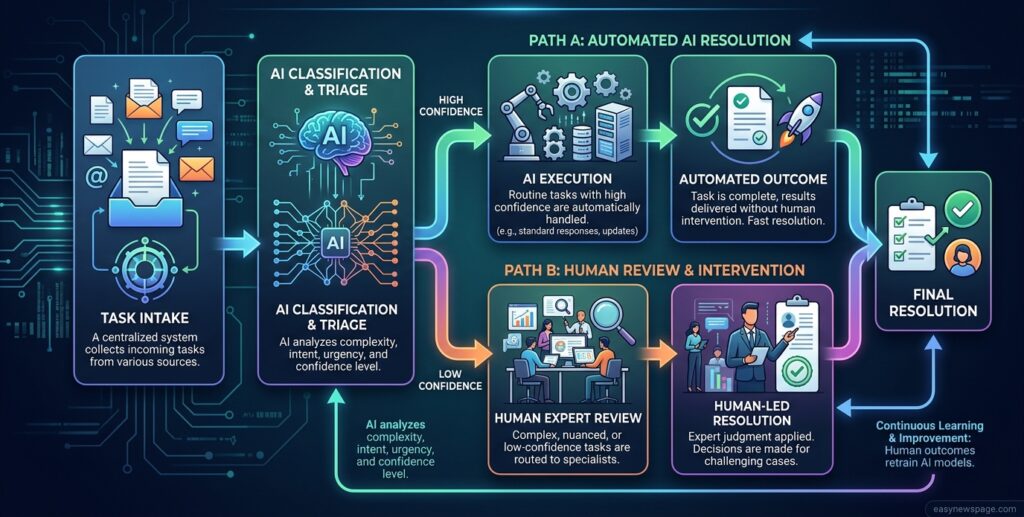
At a company level, AI job automation typically follows a predictable rollout pattern rather than a single dramatic switch. The AI Overview: a company usually pilots AI on a narrow task, measures cost and quality against human performance, and only expands automation once the pilot proves reliable — meaning most job impact happens gradually across quarters, not overnight.
Leadership identifies a repetitive, rules-based task as a pilot candidate — customer email triage, invoice processing, or first-draft contract review are common starting points. The tool runs alongside human workers for a testing period, with output quality and error rates tracked closely. If performance meets the target, the company either reduces headcount in that function, reassigns staff to oversight and exception-handling roles, or absorbs future growth without adding new hires — the last of which shows up in data as slower hiring rather than visible layoffs.
Workflow and Dashboard Walkthrough
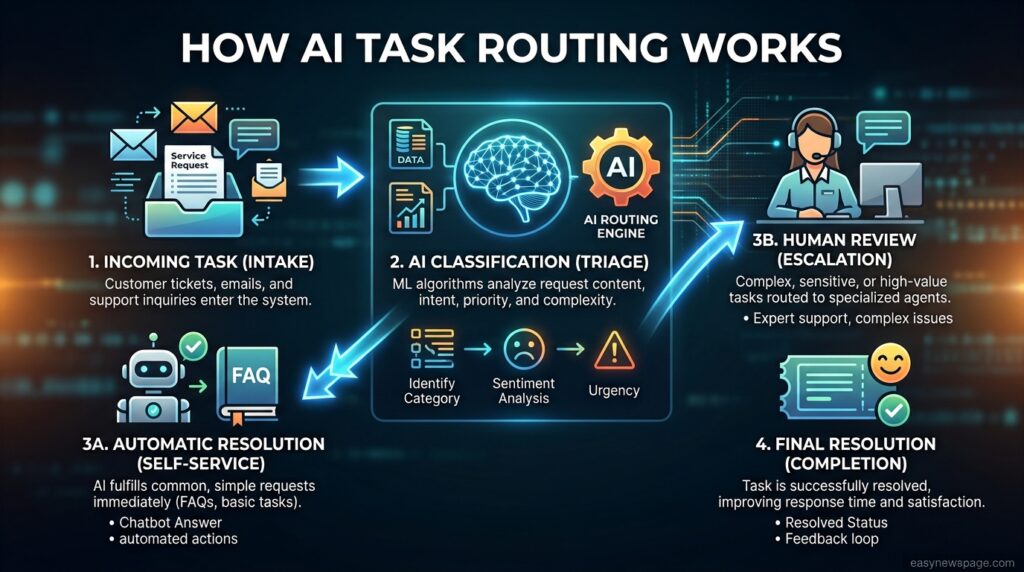
Most enterprise AI automation now runs through a dashboard where managers set rules, review AI output flagged as uncertain, and monitor performance metrics like resolution time and error rate. A typical workflow: incoming task arrives, AI classifies and attempts resolution, high-confidence cases are completed automatically, and low-confidence or high-stakes cases route to a human reviewer.
Setup Guide: Auditing Your Own Job for AI Risk
Start by listing your job’s core tasks and separating them into three buckets: routine and rules-based, judgment-based, and relationship-based. Routine tasks — data entry, scheduling, basic reporting — are the most exposed to automation. Next, check whether your employer has already piloted AI tools in your function or an adjacent one; internal pilots are the clearest early signal.
Review recent job postings for your role and adjacent roles at your company and competitors — a shrinking posting count or a shift in required skills toward “AI collaboration” or “prompt review” is a strong indicator of change already underway. Finally, identify which parts of your role would be hardest to automate — complex client relationships, physical dexterity, regulatory accountability — and consider how to shift more of your time toward those areas.
Step-by-Step Tutorial: Building Your AI-Resilience Plan
Identify the AI tools already used in your industry, even if your employer has not adopted them yet, and spend a few hours actually using one relevant to your field. Take a short, reputable course on AI fundamentals or on the specific tool your industry is adopting, prioritizing practical application over theory.
Document measurable outcomes from your work — cost saved, errors caught, client relationships maintained — since human oversight and accountability become more valuable, not less, as automation increases. Ask your manager directly whether AI adoption is planned for your function over the next 12 months; most managers will answer honestly if asked plainly. Build one adjacent skill that is currently hard to automate, such as client-facing communication, regulatory judgment, or cross-functional coordination, and look for opportunities to apply it visibly.
Use Cases and Industry Use Cases
Banking and finance: AI already automates significant shares of fraud detection, document review, and routine reporting, with IMF data showing banking among the highest-exposure sectors for AI transformation. Customer service: Agentic AI increasingly resolves tier-one support tickets end-to-end, with human agents shifting toward complex escalations. Legal: Paralegal-level document review and research face high automation exposure, while courtroom advocacy and client counseling remain human-led. Healthcare: Medical transcription and portions of medical coding are heavily automated, while diagnosis, treatment planning, and patient care remain predominantly human. Manufacturing: Robotics combined with AI vision systems continue to reduce demand for routine assembly and inspection roles while increasing demand for technicians who maintain the automation itself.
Benefits of AI Automation for Workers and Employers
For employers, AI automation can cut processing time, reduce error rates on repetitive tasks, and let existing staff handle higher volumes without proportional headcount growth. For workers who adapt, it can mean less time on tedious, low-value tasks and more time on the judgment-based, relationship-based work that tends to be both more interesting and better compensated.
At an economic level, the World Economic Forum’s central projection is a net positive job outcome by 2030, driven by new categories of work — AI oversight, automation engineering, and AI-augmented professional roles — that did not exist in large numbers even two years ago.
Limitations
The net-positive projection is an aggregate figure, and aggregates can be cold comfort to someone in a role being actively eliminated right now. New jobs created by AI often require different skills, are geographically concentrated, and do not always open in the same location, industry, or pay band as the jobs lost. Entry-level workers face a particularly difficult limitation: the traditional first rung of many career ladders — junior analysis, junior coding, junior legal research — is exactly the kind of structured, repetitive work AI handles well, making it harder to break in even as senior demand holds up.
Pros & Cons Table
| Pros | Cons |
|---|---|
| Reduces time spent on repetitive tasks | Displaces workers in highly structured roles |
| Can increase output without proportional headcount growth | Entry-level hiring has declined sharply since 2024 |
| Creates new categories of technical and oversight roles | New roles often require different skills or locations |
| Frees skilled workers for judgment-based work | Disproportionately affects certain demographics and sectors |
| Improves consistency on rules-based processes | Reduces near-term job security perception for many workers |
Pricing Table: Reskilling Investment Options
| Option | Typical Cost | Time Investment | Best For |
|---|---|---|---|
| Free online courses (platform-provided) | $0 | 10–30 hours | Testing interest, foundational literacy |
| Employer-sponsored training | $0 (employer-paid) | Varies | Workers at companies actively adopting AI |
| Paid certificate programs | $200–$1,500 | 20–80 hours | Career switchers, resume signaling |
| University or bootcamp programs | $2,000–$15,000+ | 3–12 months | Deep technical roles (AI/ML engineering) |
Comparison Table: Automation Exposure by Role Type
| Role Type | Automation Exposure | Example Roles |
|---|---|---|
| High | Data entry, transcription, basic customer support | Data entry clerk, transcriptionist, tier-1 support agent |
| Medium-High | Paralegal work, junior coding, routine reporting | Paralegal, junior analyst, junior developer |
| Medium | Marketing content drafting, HR screening | Copywriter, recruiter, HR coordinator |
| Low-Medium | Skilled trades with digital components | Electrician, HVAC technician |
| Low | Physical dexterity, high-trust human interaction | Nurse, therapist, plumber, teacher |
Specifications: How Automation Risk Is Measured
Researchers typically score automation risk using a combination of task structure (how repetitive and rules-based the work is), data availability (how much historical data exists to train a model on the task), and regulatory or trust requirements (how much human accountability the role legally or practically requires). Roles scoring high on repetitiveness and data availability, and low on required human trust, consistently show the highest automation exposure across studies.
Security, Privacy, and Compliance
Workplace AI adoption raises real data-security and privacy questions, since automating a task often means routing sensitive customer or employee data through a third-party AI system. Regulated industries like banking and healthcare face additional compliance requirements — many jurisdictions now require human review of AI-influenced decisions in lending, hiring, and medical contexts, which is part of why full role elimination is slower in these sectors than task automation alone would suggest.
Performance
AI systems generally outperform humans on speed and consistency for narrowly defined, high-volume tasks, but performance drops on edge cases, ambiguous instructions, and situations requiring contextual judgment. This performance gap is precisely why most 2026 deployments keep a human in the loop for exceptions rather than removing oversight entirely.
Integrations and API Considerations
Enterprise AI automation tools typically integrate with existing systems — CRM platforms, ticketing systems, document management software — via APIs, which is often the real bottleneck in adoption speed. Companies with modern, well-integrated tech stacks tend to automate faster than those running on legacy systems, which partly explains why automation timelines vary so widely between industries and even between companies in the same industry.
Customer Support Considerations
Ironically, customer support is both one of the most automated functions and one where automation failures are most visible to the public. Companies that automate support too aggressively without adequate escalation paths tend to see customer satisfaction drop, which has led many organizations to slow full automation in favor of AI-assisted human agents rather than full replacement.
Latest Updates
Layoff-tracking data shows AI-cited job cuts accelerating sharply through the first quarter of 2026, with AI becoming the single most-cited reason for U.S. workforce reductions in March 2026 for the first time on record. At the same time, enterprise surveys show a persistent gap between AI pilot programs and full production deployment — most organizations are still testing agentic AI rather than scaling it, meaning near-term impact may be moving faster in headlines than in actual widespread deployment.
Expert Tips
Treat AI fluency as a baseline professional skill, not an optional specialty — much like spreadsheet literacy became non-negotiable in earlier decades. Focus on tasks that combine AI output with human judgment, since that combination is proving more durable than either pure manual work or pure automation. Track your industry’s specific automation timeline rather than general headlines, since exposure varies enormously by sector and even by company size.
Common Mistakes Workers Make
A common mistake is waiting for a formal announcement before adapting, when internal AI pilots are usually the real early signal. Another is assuming seniority alone provides protection — mid-career professionals in highly structured roles face real exposure regardless of tenure. Some workers avoid AI tools entirely out of principle, which tends to reduce their competitiveness rather than protect their job. Others overcorrect into panic-driven career changes without evidence that their specific role is at near-term risk.
Troubleshooting: What to Do If You Suspect Your Role Is at Risk
If your tasks are increasingly routed through an AI tool, start documenting the judgment calls and exceptions you still handle, since that becomes evidence for your continued value. If your team’s headcount growth has stalled despite rising workload, that is often an early automation signal worth raising directly with your manager. If you are unsure how exposed your specific role is, compare your task list against the automation exposure table above and prioritize building skills in the areas marked lower-risk.
Myths vs Facts
Myth: AI will eliminate entire professions overnight. Fact: Most 2026 disruption is task-level automation within roles, with full role elimination concentrated in highly repetitive, low-judgment positions.
Myth: Only low-skill jobs are at risk. Fact: Paralegals, junior analysts, and other white-collar entry points show some of the highest automation exposure of any category.
Myth: AI adoption will destroy more jobs than it creates. Fact: The World Economic Forum’s central projection is a net job gain by 2030, though gains and losses are unevenly distributed.
Decision Matrix: Should You Reskill Now
| Criteria | Reskill Now | Wait and Monitor |
|---|---|---|
| Role is highly repetitive/rules-based | Strongly recommended | Not recommended |
| Employer has active AI pilots in your function | Strongly recommended | Not recommended |
| Role requires significant human trust/regulation | Optional | Reasonable |
| Entry-level in an exposed industry | Strongly recommended | Not recommended |
| Senior, relationship-heavy role | Recommended (light) | Reasonable |
Beginner vs Advanced Approaches to AI Literacy
Beginners should focus on basic, practical use of one AI tool relevant to their field — writing better prompts, reviewing AI output critically, and understanding its common error patterns. Advanced workers should focus on workflow design, oversight, and integration — understanding how to build processes where AI and humans each do what they do best, which is increasingly a differentiator on its own.
Read more: AI Job Automation: 5 Things You Should Know Before 2030
Best Alternatives and Alternative Comparison
For workers seeking structured reskilling, options include employer-sponsored programs (lowest cost, most directly relevant), free platform courses (best for initial exploration), and paid certificate or degree programs (best for career switchers targeting technical AI roles). For managers evaluating automation vendors, options range from narrow point solutions for a single task to broader agentic platforms — narrow tools are generally lower-risk starting points for organizations new to automation.
Who Should Use This Guide
This guide is most useful for workers in exposed sectors — banking, retail, customer service, administrative, and entry-level professional roles — who want an evidence-based read on their own risk level, and for managers building responsible, gradual automation plans rather than reactive mass layoffs.
Who Should Avoid Over-Relying on This Guide
Workers in highly specialized, regulated, or physically hands-on roles with low automation exposure should treat the general statistics here as background context rather than an urgent call to action, since their specific risk profile is likely lower than the headline numbers suggest.
FAQ
Will AI take my job in 2026?
It depends heavily on your specific tasks rather than your job title. Roles built on repetitive, rules-based work face meaningfully higher risk in 2026 than roles built on judgment, physical dexterity, or high-trust human interaction.
Which jobs are most at risk from AI automation?
Data entry, transcription, basic customer support, paralegal document review, and junior-level analytical or coding roles currently show the highest automation exposure based on 2026 labor-market data.
Which jobs are safest from AI automation?
Roles requiring physical dexterity in unpredictable environments, high-trust human relationships, or significant regulatory accountability — such as skilled trades, nursing, therapy, and teaching — remain comparatively resilient.
Is AI creating more jobs than it destroys?
The World Economic Forum’s central 2030 projection shows more jobs created than destroyed globally, but this net figure hides significant losses concentrated in specific roles, industries, and demographics.
How can I protect my career from AI automation?
Build practical fluency with AI tools relevant to your field, document the judgment-based and relationship-based value you provide beyond routine tasks, and monitor whether your employer has active AI pilots in your function.
Is entry-level hiring really down because of AI?
Multiple 2026 datasets show entry-level postings declining since 2024, and several major employers have publicly linked reduced junior hiring to AI handling more routine early-career work.
Should I take a reskilling course right now?
If your role is highly repetitive, rules-based, or already has AI pilots underway at your employer, reskilling sooner rather than later is the lower-risk choice based on current adoption trends.
Rating Scorecard
| Category | Score (out of 10) | Notes |
|---|---|---|
| Data quality and sourcing | 8 | Cross-checked across multiple 2025–2026 reports |
| Practical usefulness | 9 | Includes actionable audit and career steps |
| Coverage breadth | 9 | Spans multiple industries and role types |
| Currency (2026 relevance) | 9 | Reflects Q1 2026 layoff-tracking data |
| Balance (avoids fear-mongering) | 8 | Presents both displacement and growth data |
Conclusion
AI job automation in 2026 is real, uneven, and accelerating — but it is not the uniform, overnight replacement of human labor that headlines sometimes suggest. The clearest pattern in the data is that routine, rules-based, and entry-level cognitive work faces the highest near-term exposure, while roles built on judgment, physical dexterity, regulatory trust, and complex human relationships remain comparatively resilient. The World Economic Forum’s own projections point to a net positive job outcome globally by 2030, but that average offers little comfort if your specific role sits in a heavily automated category right now.
The practical takeaway is not panic, and it is not denial — it is an honest audit of your own tasks against the risk patterns covered in this guide, paired with deliberate action. Build real fluency with the AI tools relevant to your field, document the parts of your work that require human judgment, and treat reskilling as an ongoing habit rather than a one-time reaction to a layoff notice. Workers who engage with AI as a tool to direct, rather than a threat to avoid or a replacement to fear, are consistently better positioned across every sector this guide examined.
The overall moral of the 2026 data is straightforward: AI automation rewards adaptability far more than it punishes any particular industry or job title. The workers and organizations navigating this shift most successfully are the ones treating 2026 as the year to get practically fluent in these tools, not the year to either ignore them or panic about them.
Official Sources
- World Economic Forum, Future of Jobs Report 2025 — wef.ch/futureofjobs
- International Monetary Fund, sectoral AI exposure analysis, 2026
- Challenger, Gray & Christmas, monthly job cut reports, 2026
- MIT and Boston University labor automation research
Author Bio
This guide was researched and written by the easynewspage.com editorial team, which specializes in data-driven explainers on technology and workplace trends. Our editorial process prioritizes cross-checking figures against multiple primary and near-primary sources over single-source reporting, and this article was last reviewed for accuracy in August 2026.