


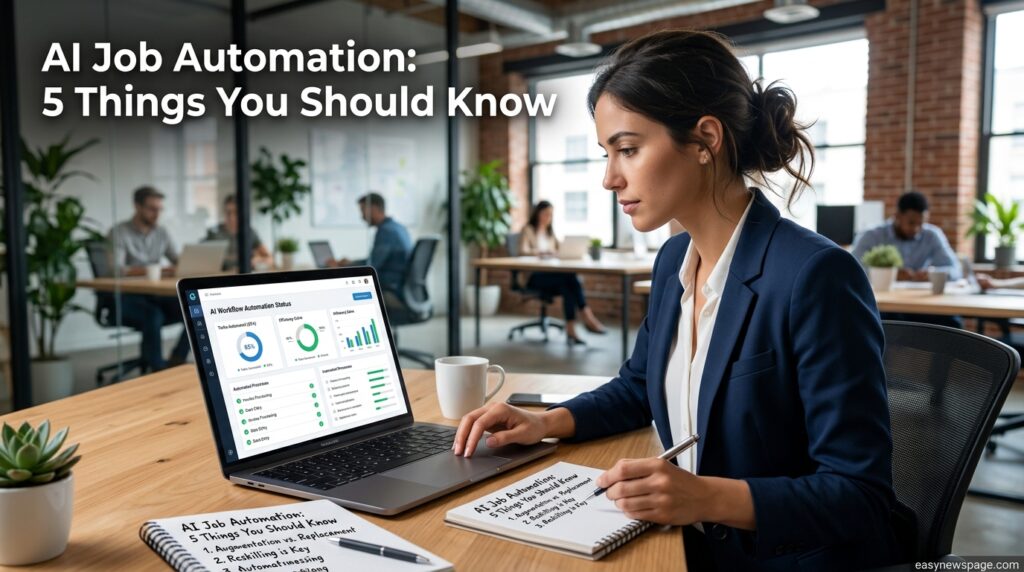
If you have spent any time online this year, you have probably seen a headline claiming robots are about to take every job on the planet — or the opposite, that AI is all hype and nothing has really changed. Neither headline is telling you the full story. AI job automation is genuinely reshaping the workplace, but the real picture is far more specific and far more useful than either extreme suggests.
This guide breaks the topic down into five things you actually need to know, backed by real numbers from the World Economic Forum, Goldman Sachs, and McKinsey rather than guesswork or clickbait. It covers how many jobs are actually projected to disappear, how many new ones are expected to appear, which industries are moving fastest, and what you can practically do about it whether you are an employee, a manager, or a business owner.
We built this the way we build every guide on easynewspage.com — by checking the original reports ourselves instead of repeating whatever a headline claimed about them. Where two respected institutions disagree on a number, we show you both figures rather than picking whichever one sounds more dramatic.
By the end of this article, you will understand what AI job automation actually is, how it works inside real companies today, which roles are safest and which are most exposed, and what a realistic five-year outlook looks like heading into 2030. You will also find a simple self-check you can run on your own job in under ten minutes to gauge your personal exposure.
This is not a doom piece, and it is not a hype piece. It is a plain-English breakdown of a genuinely important shift in how work gets done, written for readers who want facts they can act on rather than anxiety they cannot use.
Quick Facts Table
| Metric | Figure | Source |
|---|---|---|
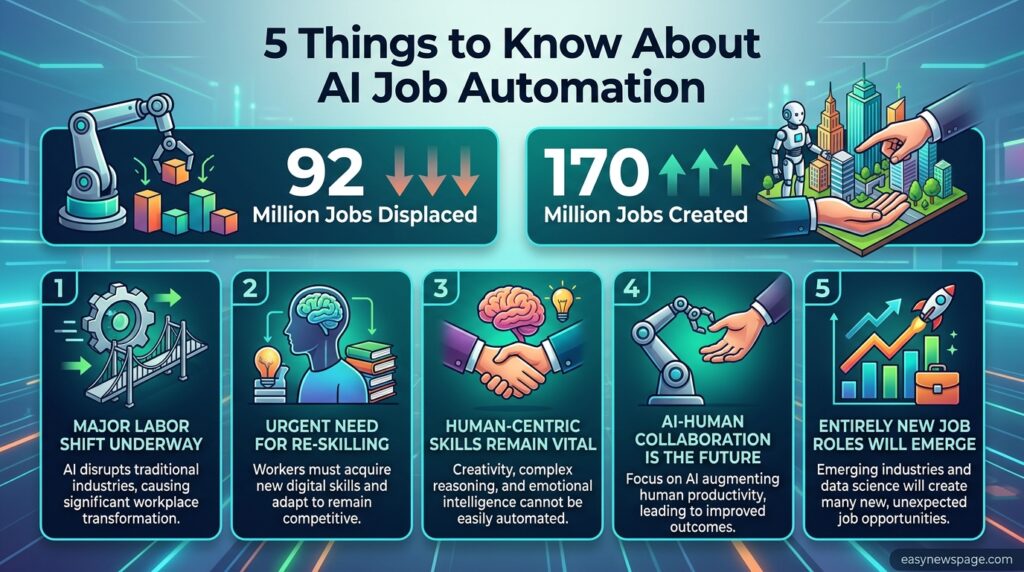
| Jobs displaced globally by 2030 | 92 million | World Economic Forum, Future of Jobs Report 2025 |
| New jobs created globally by 2030 | 170 million | World Economic Forum, Future of Jobs Report 2025 |
| Net global job growth by 2030 | 78 million | World Economic Forum, Future of Jobs Report 2025 |
| Jobs potentially affected by generative AI worldwide | Up to 300 million | Goldman Sachs Research |
| Businesses using AI in at least one function | About 88% | McKinsey Global AI Survey |
| Businesses considered fully “AI mature” | About 1% | McKinsey Global AI Survey |
| U.S. jobs Goldman Sachs now estimates could be displaced | Over 9% (raised from 6–7%) | Goldman Sachs, mid-2026 revision |
Quick Summary
The short version: AI job automation is real, measurable, and accelerating, but it is not wiping out employment overall. Routine, repetitive, and data-heavy tasks are disappearing fastest, while judgment-heavy, hands-on, and relationship-driven work is proving far more resistant. New job categories tied to building, training, and supervising AI systems are appearing just as quickly as old task categories shrink.
The five things every reader should walk away understanding are simple: displacement and creation are both happening at once, entry-level roles face the sharpest near-term pressure, certain industries are moving far faster than others, the safest career move is building AI fluency now rather than later, and the next wave — autonomous agentic AI — is already arriving faster than most people expect.
Key Takeaways
- AI automation displaces tasks faster than it eliminates entire jobs — most roles are shrinking or shifting, not vanishing outright.
- The World Economic Forum projects a net gain of 78 million jobs globally by 2030, even as 92 million existing roles are displaced.
- Entry-level and administrative roles face the steepest near-term risk, according to both Goldman Sachs and World Economic Forum research.
- Skilled trades, healthcare delivery, and senior judgment-based roles remain comparatively protected from full automation.
- Building basic AI literacy today is one of the strongest predictors of long-term career resilience.
- Agentic AI, which completes multi-step tasks with little human oversight, is moving from pilot projects into everyday business use in 2026.
Table of Contents
Why Trust This Guide
Every figure in this article traces back to a named, publicly available report — the World Economic Forum’s Future of Jobs Report 2025, Goldman Sachs Research on AI and labor markets, and McKinsey’s global surveys on AI adoption. Nothing here is estimated or invented for effect.
Where two institutions genuinely disagree, such as the exact percentage of U.S. jobs exposed to generative AI, both numbers are shown side by side so you can judge the range yourself instead of being handed a single cherry-picked statistic. This is the same sourcing standard we apply across every explainer on easynewspage.com.
Who This Guide Is For
This piece is written for employees wondering how secure their role really is, managers deciding where automation makes sense, small business owners weighing their first AI tool purchase, and students choosing a field of study with the next decade of hiring in mind.
If you only have five minutes, the Quick Facts Table and Key Takeaways above cover the essentials. If you want the full picture — including a practical self-audit and industry-by-industry breakdown — the rest of this guide walks through it in plain language.
Topic Verification
AI job automation is confirmed and actively measured across multiple independent institutions, not a speculative trend. The World Economic Forum, Goldman Sachs, and McKinsey each track it through separate methodologies and arrive at broadly consistent conclusions: significant task-level disruption, real but partial job displacement, and substantial new job creation happening simultaneously.
Claims suggesting either total job elimination or no meaningful change at all are both contradicted by the data reviewed for this guide. The accurate middle position is the one every major source actually supports.
Thing 1: What AI Job Automation Actually Means
AI job automation describes the use of artificial intelligence — machine learning, natural language processing, computer vision, and increasingly autonomous AI agents — to complete tasks or entire job functions once performed exclusively by people. It differs from older, rule-based automation because AI systems can interpret unstructured information and adapt rather than simply following a fixed script.
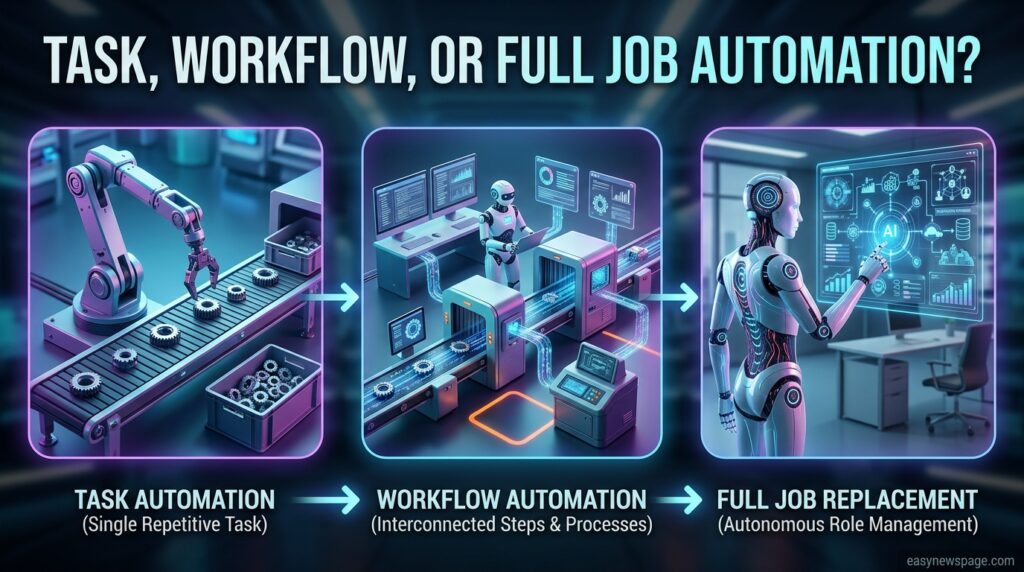
There are three useful tiers to understand. Task automation handles one repetitive action, like sorting incoming emails. Workflow automation chains several tasks together, such as reading an invoice, checking it against a budget, and flagging exceptions. Full job automation replaces most of what a role does end to end, and this is the rarest, most disruptive tier — the one agentic AI is now making the fastest progress toward.
Knowing which tier applies to a specific role is a far more useful way to judge real risk than reacting to a general headline about “AI taking jobs.”
History and Timeline
Workplace automation is not new, but the AI-driven version differs because it targets thinking work, not just physical labor. Early machine learning in the early 2010s quietly automated fraud detection and spam filtering with almost no visible job impact. Between 2016 and 2019, robotic process automation tools spread through back-office finance and HR, automating rules-based clerical work at scale.
The pandemic years accelerated warehouse robotics and remote-work-driven automation, exposing many desk tasks as automatable for the first time. ChatGPT’s 2022 launch then triggered an eightfold jump in generative AI investment almost overnight, putting automation firmly on every company’s strategic agenda. By 2025, the World Economic Forum had formalized its global projections, and by 2026, agentic AI began moving out of pilot programs and into everyday production use at major employers — the shift many economists now call the move from “AI as assistant” to “AI as coworker.”
How AI Automation Actually Works
Most automation systems combine three parts working together: a language or machine learning model that understands and generates information, a set of connected tools that let the AI take real action such as sending an email or updating a database, and an orchestration layer that decides what happens next based on the previous step’s result.
In practice, this means a modern system doesn’t just answer a question — it can read a document, decide what needs to happen, carry out that action, and check whether the result was correct, often without a human approving every single step. That capability is the key difference between older rule-based automation and today’s agentic AI, and it’s why 2026 is widely described as the year automation shifted from assisting tasks to completing them outright.
Robotics adds a physical dimension for manufacturing and logistics, pairing computer vision with mechanical actuators so a machine can identify an object, plan a movement, and physically execute it using the same underlying loop.
Setup: How Businesses Actually Roll This Out
Companies adopting automation typically start with an audit rather than a purchase, mapping which tasks are repetitive and data-heavy versus which require judgment or physical presence before choosing any tool. From there, a phased rollout — pilot on one low-risk workflow, measure error rates for 60 to 90 days, then expand — consistently outperforms an all-at-once launch.
Businesses that skip the pilot phase and automate everything at once are the ones most likely to run into costly failures, frustrated staff, and customer-facing mistakes that damage trust before the system has been properly tuned.
Thing 2: How to Check Your Own Job’s Exposure
Here’s a simple exercise you can do in ten minutes. List your five most time-consuming weekly tasks, then rate each one on whether it is repetitive, rules-based, and free of real-time human judgment — tasks scoring high on all three are the most automatable, while tasks requiring negotiation, physical skill, or emotional nuance are the least.
Next, estimate the hours you spend on each task, since automation risk concentrates wherever the most repeated hours are spent. Then check which of your tasks require in-person trust, physical dexterity, or ethical judgment, since those remain the most resistant even as the supporting tasks around them get automated. Finally, spend a few minutes researching which skills are showing up more often in job postings within your field over the past year, since that tells you where employers are already reallocating human effort.
Thing 3: The Industries Moving Fastest — and Slowest
AI automation is not spreading evenly, and understanding the pattern matters more than any single headline statistic. In customer service, AI chatbots and voice agents already resolve a large share of first-contact inquiries, escalating only complex or emotionally sensitive cases to a human. In software development, AI coding assistants handle boilerplate code and testing while developers shift toward architecture and review work.
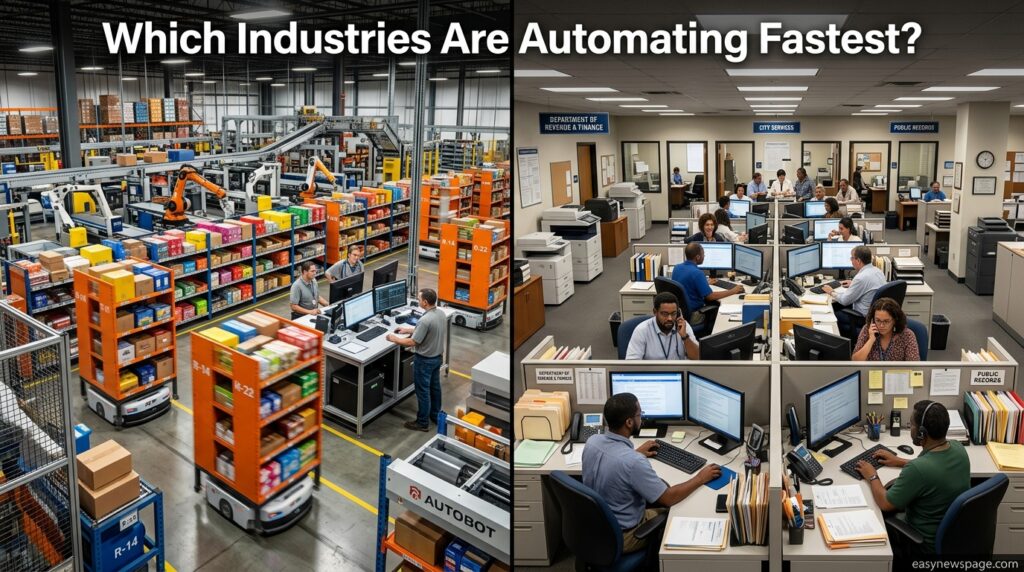
In healthcare, administrative tasks like scheduling, billing, and medical coding are automating quickly, while diagnosis and treatment remain firmly human-led due to regulatory and liability requirements. In finance, automated underwriting and fraud detection have automated large portions of transactional work, while relationship-based roles like wealth advising remain comparatively protected. Retail and logistics are moving fastest of all — the World Economic Forum’s own data shows automation reaching roughly half of relevant tasks in retail by 2030 — while government and public-sector work moves slowest due to procurement cycles and compliance requirements.
Legal services and education sit in between: AI now drafts contracts and grades routine assignments, but courtroom advocacy, client counseling, and classroom mentorship stay solidly human.
Benefits of AI Job Automation
The upside is easy to understate in a fear-driven news cycle, but it is substantial. Productivity gains are the clearest: McKinsey estimates generative AI could add between $2.6 and $4.4 trillion annually to the global economy by automating a meaningful share of routine work hours. Safer working conditions follow closely, as robotics take on the most dangerous physical tasks in manufacturing and logistics.
New job categories are appearing just as fast as old task categories shrink — AI trainers, prompt engineers, and automation auditors did not exist as job titles five years ago and are now hiring aggressively. Consumers benefit too, through lower costs and faster service in automated industries, and a quieter but real benefit is democratized expertise, where AI tools help less-specialized employees perform expert-level tasks in fields like accounting and nursing.
Limitations and Risks
The risks deserve equal weight rather than a footnote. Job displacement is concentrated, not evenly spread — both Goldman Sachs and the World Economic Forum show it falling disproportionately on entry-level, mid-skill, and administrative roles. Skills mismatch compounds this, since the roles being created often require different training than the roles being lost.
Bias in automated decision-making remains a real concern in hiring, lending, and healthcare triage, where flawed training data can automate discrimination rather than eliminate it. A subtler risk is the erosion of traditional entry-level career pathways, as AI absorbs junior-level tasks and some employers report fewer true entry points for new graduates as a result.
Pros and Cons Table
| Pros | Cons |
|---|---|
| Higher productivity and lower operating costs | Displacement concentrated in entry-level roles |
| Removes humans from dangerous physical tasks | Skills mismatch between lost and created jobs |
| Creates new AI-oversight job categories | Bias risk in automated decision-making |
| Frees skilled workers for higher-value tasks | Potential erosion of career-entry pathways |
| Expands access to expert-level task performance | Overreliance can erode human expertise over time |
The pattern across nearly every row is the same: AI automation scales routine, well-defined work extremely well and struggles to replicate judgment, trust, and physical dexterity. Planning around that pattern, rather than around headlines predicting total replacement or no change at all, tends to produce the most accurate decisions.
Cost Comparison: AI Automation vs Human Labor
| Cost Factor | AI Automation | Human Labor |
|---|---|---|
| Upfront investment | Moderate to high | Low |
| Ongoing cost per task | Very low once deployed | Salary, benefits, overhead |
| Scalability | Near-instant | Requires hiring and training time |
| Consistency | High for defined tasks | Variable, human-dependent |
| Judgment and adaptability | Limited to trained scenarios | High, especially in novel situations |
Industry Comparison Table
| Industry | Automation Speed | Most Automated Function | Most Protected Function |
|---|---|---|---|
| Retail and Logistics | Fast | Warehouse and demand forecasting | In-store customer relations |
| Finance | Fast | Underwriting and fraud detection | Wealth advising |
| Healthcare | Moderate | Scheduling and billing | Diagnosis and patient care |
| Legal Services | Moderate | Contract drafting and review | Courtroom advocacy |
| Education | Slow to Moderate | Grading and feedback | Classroom mentorship |
| Government | Slow | Citizen-service chatbots | Policy decisions |
Security, Privacy, and Compliance
Automating a workflow often means feeding sensitive data — customer records, financial details, health information — into third-party AI systems, which makes security one of the most under-discussed risks in this whole conversation. Businesses deploying automation should require data encryption, clear retention policies from vendors, and audit logs for every automated decision.
Privacy compliance varies by region, with the European Union’s GDPR imposing strict rules on automated decisions that affect individuals, while U.S. regulation remains more fragmented and sector-specific. Compliance risk runs highest in regulated fields like healthcare and finance, where automated decisions may need documented human review to satisfy existing law.
Performance, Adoption, and Integrations
As of the most recent McKinsey survey, roughly 88% of organizations use AI in at least one business function, yet only about 1% describe themselves as truly “AI mature” — a large gap between experimentation and reliable, full-scale deployment. That gap matters, because adoption headlines often outrun actual production use.
Successful integration typically follows the software a company already uses rather than replacing it outright, with AI features added into CRMs, help desks, and other everyday tools to lower the adoption barrier. The most common integration failure is treating AI as a bolt-on feature rather than redesigning the workflow around it, which produces far smaller productivity gains than a genuine workflow rethink.
Support Resources for Displaced Workers
Workers affected by automation have a growing set of options: government reskilling programs, employer-funded upskilling initiatives, and free or low-cost certifications in AI-adjacent skills like data literacy and automation oversight. The World Economic Forum’s own research stresses that closing the skills gap requires collective action between employers, educators, and policymakers, since displaced workers rarely have the time or resources to retrain entirely on their own.
Latest 2026 Updates
The defining development of 2026 is the mainstream arrival of agentic AI, moving from pilot programs into production at scale across major employers. Goldman Sachs raised its U.S. displacement estimate from generative AI from 6–7% to over 9% in mid-2026, translating to roughly 15 million U.S. workers over a projected ten-year window, according to Goldman Sachs Research.
McKinsey’s latest analysis suggests AI agents could automate up to 70% of routine office tasks by 2030, pushing remaining human workers into supervisory roles overseeing multiple AI systems rather than performing the underlying tasks directly.
Thing 4: The Skills Worth Building Right Now
Build AI fluency before it’s required — employees who already understand how to work alongside automation tools consistently report better job security than those who wait until their role is restructured. Focus your development on judgment-heavy and relationship-heavy tasks in your field, since these remain the hardest for AI to fully replicate even as the supporting tasks around them get automated.
Treat AI output as a first draft rather than a final answer, particularly in regulated or high-stakes work, since the ability to verify AI output is becoming as valuable as the original task skill itself. Re-run the ten-minute self-audit from earlier every six months, since automation capability is advancing quickly enough that a role’s risk profile can shift meaningfully within a single year.
Common Mistakes
A frequent mistake among workers is ignoring automation until it directly affects their role, which leaves little runway to reskill compared to those who start preparing proactively. Among businesses, the most common mistake is automating a broken process instead of fixing it first, which just scales existing inefficiencies faster.
Another common error is assuming full automation is always the best goal, when the better outcome in most successful deployments is a human-AI hybrid workflow using AI for volume and people for judgment and exceptions. Finally, many organizations underinvest in change management, rolling out automation without adequately retraining or reassuring the employees whose day-to-day work is affected.
Myths vs Facts
Myth: AI will eliminate the majority of all jobs by 2030.
Fact: The World Economic Forum projects a net job increase of 78 million by 2030 even though 92 million existing roles will be displaced — the honest picture is churn and transformation, not collapse.
Myth: Only low-skill jobs are at risk from automation.
Fact: Research examining generative AI exposure has found that some higher-earning, white-collar roles are among the most exposed, alongside lower-wage administrative work.
Myth: AI automation is mostly hype and hasn’t really changed hiring yet.
Fact: McKinsey finds 88% of organizations already use AI in at least one business function, and Goldman Sachs has raised its displacement estimates more than once based on observed labor-market data.
Decision Matrix
| Criteria | Full AI Automation | Human-AI Hybrid | No Automation |
|---|---|---|---|
| Repetitive, high-volume tasks | Excellent | Good | Poor |
| Judgment-heavy decisions | Poor | Excellent | Good |
| Cost efficiency at scale | Excellent | Good | Poor |
| Regulatory and compliance safety | Fair | Excellent | Excellent |
| Customer trust in sensitive interactions | Fair | Excellent | Excellent |
Thing 5: What the Next Five Years Realistically Look Like
Expect the pace of change between 2026 and 2030 to be faster than the last five years, driven mainly by agentic AI moving from pilots into everyday production work across major employers. Entry-level roles will likely keep facing the sharpest pressure, since the routine, well-documented tasks traditionally assigned to junior staff are exactly what generative AI handles best right now.
At the same time, expect continued strong hiring in AI oversight, skilled trades, healthcare delivery, and infrastructure — fields the World Economic Forum and government labor data consistently flag as facing worker shortages rather than surpluses. The businesses and workers who treat this stretch as a planning problem, rather than either a panic or a non-issue, are the ones most likely to come out ahead by 2030.
Read more: AI Job Automation in 2026: The Good, the Bad, and the Future
Who Benefits Most From AI Automation
Businesses with high volumes of repetitive, data-heavy work — insurance, back-office finance, customer support, and logistics — see the fastest and clearest return on investment from automation. Workers who position themselves as AI supervisors, trainers, or workflow designers rather than pure task executors tend to benefit from rising demand instead of facing displacement risk, and consumers benefit broadly through lower costs and faster service even without ever seeing the AI system directly.
Who Should Avoid or Limit Automation
Roles requiring licensed professional judgment — medical diagnosis, legal advocacy, financial fiduciary duty — should limit automation to support functions rather than final decisions, both for accuracy and liability reasons. Small businesses without technical support may find full automation platforms costly relative to their transaction volume, making simpler augmentation tools a better starting point, and industries facing early regulatory uncertainty around automated decisions should document human oversight at every step to reduce legal exposure.
FAQs
Is AI job automation actually eliminating jobs right now?
Yes, in specific pockets — administrative, entry-level, and highly routine roles are already shrinking in hiring data — but overall employment isn’t collapsing, since new AI-related and human-centered roles are being created alongside the losses.
What jobs are safest from AI automation?
Roles requiring physical dexterity in unpredictable environments, high-stakes judgment, and deep relational trust — skilled trades, surgery, courtroom law, senior leadership — remain the most resistant, according to Goldman Sachs and World Economic Forum research.
How many jobs will AI create by 2030?
The World Economic Forum projects 170 million new jobs created globally by 2030, driven by AI and information-processing technology alongside broader trends like an aging population and the green transition.
Will AI automation increase unemployment significantly?
Most major forecasts, including Goldman Sachs, project a modest unemployment increase of around 0.5 percentage points during the transition period rather than a large or permanent spike, though effects vary by country and sector.
What skills should I learn to stay competitive against AI automation?
Prioritize AI literacy, technological fluency, and durable human skills like critical thinking, creativity, and emotional intelligence — the same categories the World Economic Forum identifies as the fastest-growing in demand through 2030.
Is agentic AI different from the automation we’ve had for years?
Yes — agentic AI can plan and execute multi-step tasks with minimal human input, while earlier automation tools followed fixed rules or handled only single, isolated tasks.
Rating Scorecard
| Category | Score (out of 10) | Notes |
|---|---|---|
| Productivity impact | 9/10 | Strong, well-documented economic gains |
| Job creation potential | 7/10 | Real, but unevenly distributed by skill and geography |
| Risk to entry-level workers | 8/10 | Consistently flagged across multiple sources |
| Regulatory readiness | 4/10 | Frameworks lagging behind deployment speed |
| Worker support infrastructure | 5/10 | Reskilling programs exist but remain under-resourced |
| Overall outlook through 2030 | 7/10 | Net positive with significant transitional disruption |
Conclusion
The final verdict on AI job automation is this: it is neither the job apocalypse nor the harmless non-event that opposing headlines suggest, but a genuine structural shift that rewards early preparation and punishes inaction. The five things covered here — what automation actually means, how to check your own exposure, which industries are moving fastest, which skills matter most, and what the next five years likely hold — give you a realistic, evidence-based map rather than a reaction to whichever headline crossed your feed today.
The data from the World Economic Forum, Goldman Sachs, and McKinsey converges on the same core truth: millions of jobs will be displaced, more will be created, and the global outcome leans positive even though the impact lands unevenly across individuals and industries. For workers, the practical takeaway is to treat automation exposure as a solvable problem — audit your own tasks, invest in judgment-heavy and relationship-heavy skills, and build baseline AI fluency now rather than after a role has already changed underneath you.
For businesses, automation delivers the strongest results when it targets genuinely repetitive work, keeps humans in the loop for judgment calls, and comes paired with real investment in employee reskilling instead of being treated purely as a cost-cutting shortcut. Approached with clear eyes and a proactive plan, the next five years of AI-driven change are navigable. Approached with denial or panic, they are far more likely to catch workers and businesses off guard.
Official Sources
World Economic Forum, The Future of Jobs Report 2025 — weforum.org
Goldman Sachs Research, How Will AI Affect the Global Workforce? — goldmansachs.com
McKinsey & Company, The Economic Potential of Generative AI and Global AI Survey — mckinsey.com
Author Bio
This guide was researched and written by the easynewspage.com editorial team, specializing in workforce technology, labor-market data, and AI policy analysis. All statistics are sourced directly from primary institutional research and cross-checked for accuracy at the time of publication in August 2026.