

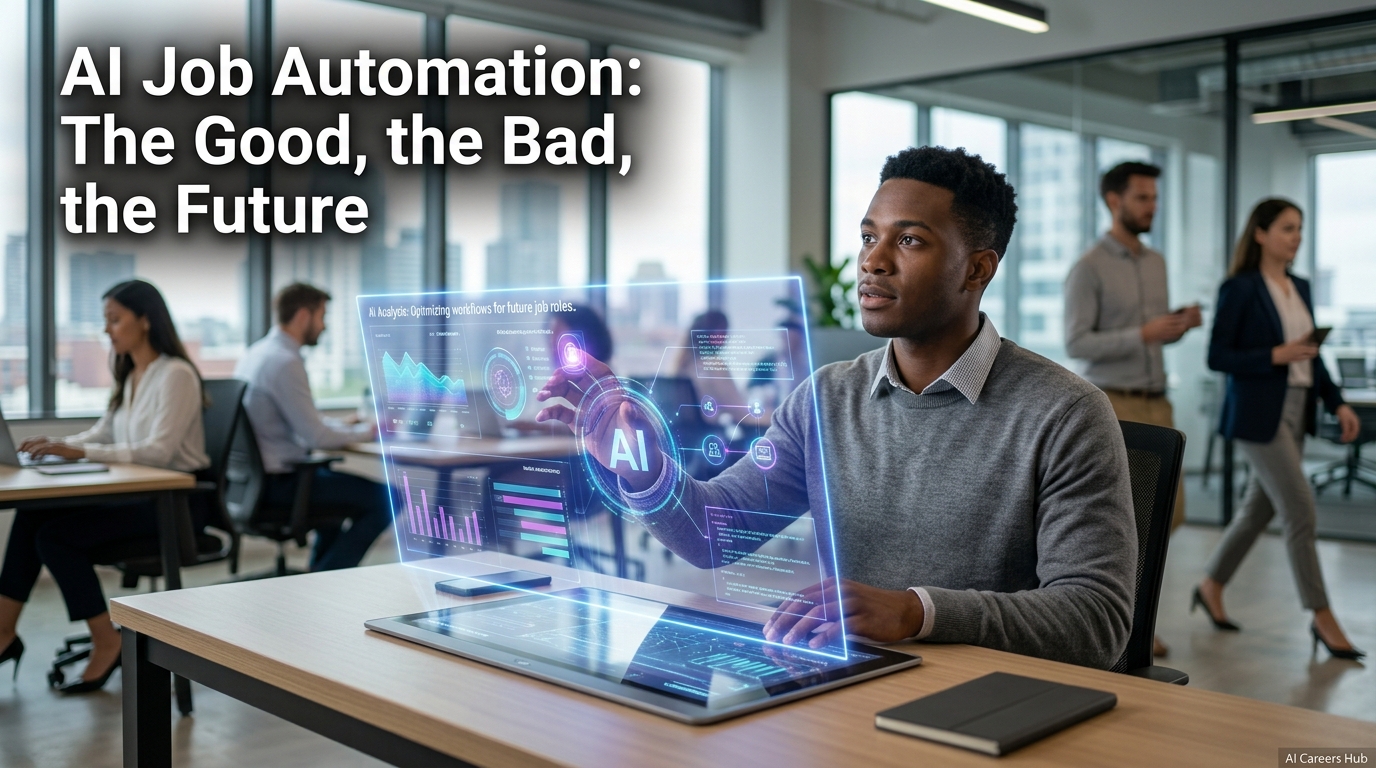
Artificial intelligence has moved from a background tool to the single biggest force reshaping how humans earn a living, and AI job automation is now the defining workplace story of this decade. Every month brings a new headline: a call center replaced by voice agents, a law firm using AI to draft contracts in minutes, a factory floor run mostly by robotic arms and computer vision. For workers, business owners, students choosing a career, and policymakers writing labor rules, understanding what AI automation actually does — and does not — do has become essential, not optional.
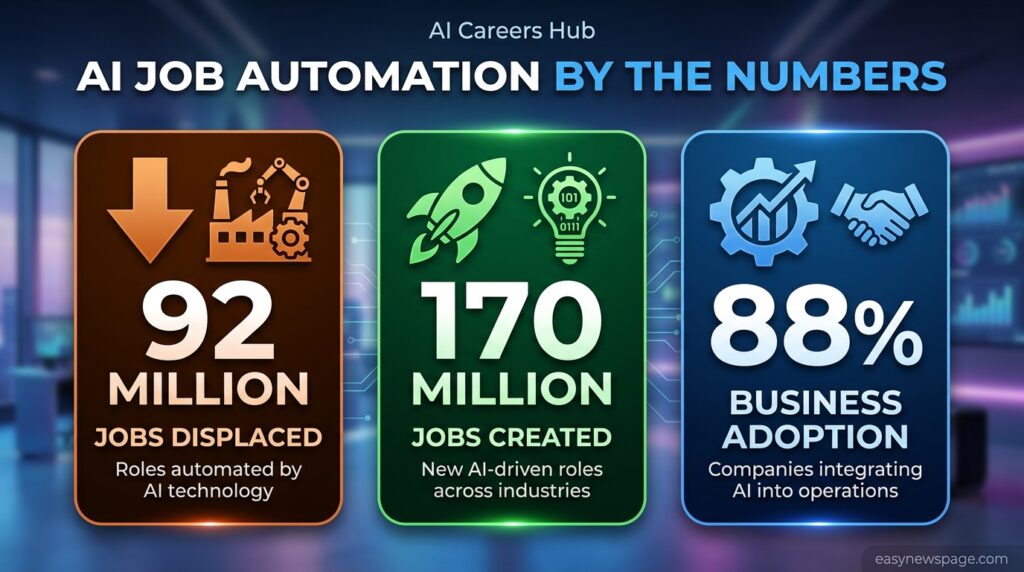
This guide exists because most articles on the topic lean too hard into either fear or hype. Some claim robots will take every job by 2030; others insist AI is “just a tool” with no real disruption. Neither extreme matches the data. The World Economic Forum’s Future of Jobs Report 2025 projects 92 million roles displaced by 2030 alongside 170 million new ones created, a net gain of 78 million jobs but a massive churn underneath that number. Goldman Sachs separately estimates generative AI could affect up to 300 million jobs globally, while McKinsey finds the vast majority of companies already use AI somewhere in their operations.
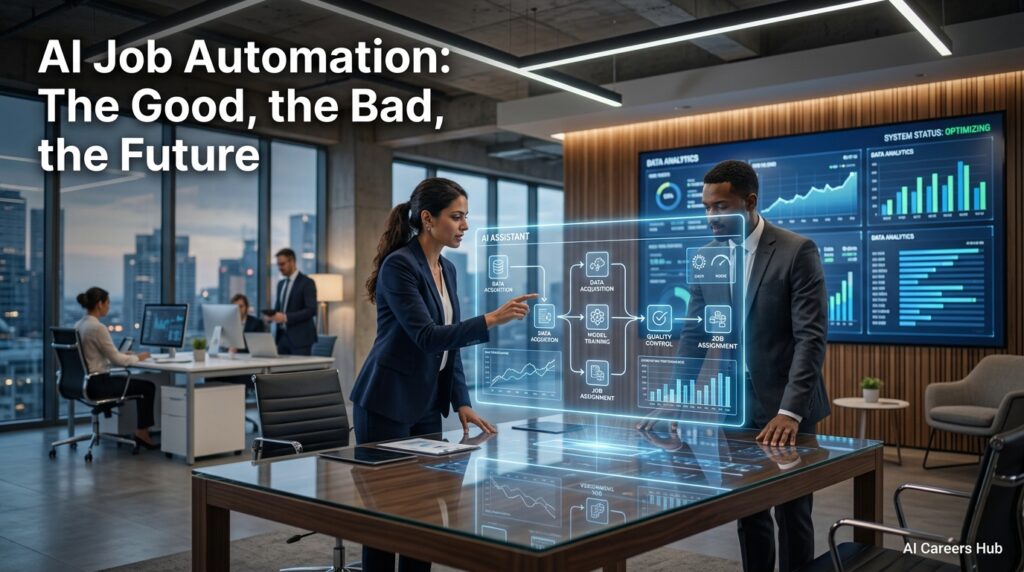
Over the next several thousand words, this guide walks through what AI job automation is, how it actually works inside real companies, which industries and roles face the most change, and which face the least. It covers the good — new job categories, productivity gains, safer working conditions — and the bad — displaced workers, wage pressure, and skills gaps that are already visible in hiring data. It also looks ahead to what the next five years of agentic AI and workplace automation are likely to bring.
Whether the goal is protecting a current career, hiring smartly for a growing business, or simply making sense of the news cycle, this article is built to give a grounded, evidence-based answer rather than a sensational one. Every claim below is checked against primary sources — WEF, Goldman Sachs, McKinsey, ILO, and government labor data — so the takeaways can be trusted and acted on.
Quick Facts Table
| Metric | Figure | Source |
|---|---|---|
| Jobs displaced globally by 2030 | 92 million | World Economic Forum, Future of Jobs Report 2025 |
| New jobs created globally by 2030 | 170 million | World Economic Forum, Future of Jobs Report 2025 |
| Net global job growth by 2030 | 78 million (+7%) | World Economic Forum, Future of Jobs Report 2025 |
| Jobs potentially affected by generative AI worldwide | Up to 300 million | Goldman Sachs Research |
| Share of businesses using AI in at least one function | ~88% | McKinsey Global Survey on AI |
| Businesses considered “AI mature” | ~1% | McKinsey Global Survey on AI |
| Existing skill sets expected to be outdated by 2030 | 39% | World Economic Forum, Future of Jobs Report 2025 |
| Employers planning workforce reduction due to AI automation | 41% | World Economic Forum, Future of Jobs Report 2025 |
| Potential annual global economic value from generative AI | $2.6–$4.4 trillion | McKinsey, “The Economic Potential of Generative AI” |
Quick Summary
AI job automation refers to the use of artificial intelligence — including machine learning, computer vision, natural language processing, and increasingly autonomous agentic AI — to perform tasks and, in some cases, entire jobs that were previously done by humans. It is not a single technology but a layered shift: first automating repetitive tasks, then entire workflows, and now, with AI agents, multi-step processes that once required a human decision-maker at every stage.
The honest picture is mixed. Routine, predictable, and data-heavy roles (data entry, basic customer support, entry-level coding, transactional finance work) are shrinking fastest. Meanwhile, roles requiring physical dexterity, complex judgment, emotional intelligence, or in-person trust (skilled trades, healthcare, senior engineering, creative direction) are proving far more resistant. New roles — AI trainers, prompt engineers, AI compliance officers, human-AI workflow designers — are emerging just as quickly as old ones disappear, though rarely in the same place or for the same people.
Key Takeaways
- AI automation displaces tasks faster than it displaces entire jobs — most roles are being reshaped, not eliminated outright.
- The World Economic Forum projects a net gain of 78 million jobs by 2030, but the churn (92 million lost, 170 million created) means real disruption for millions of workers.
- Entry-level and mid-skill white-collar roles face the steepest near-term risk, according to Goldman Sachs and MIT/OpenAI research.
- Skilled trades, healthcare, and creative leadership roles remain comparatively insulated due to physical, ethical, or relational demands AI cannot yet replicate.
- Reskilling, AI literacy, and human-AI collaboration skills are now the strongest predictors of long-term job security.
- Agentic AI — systems that complete multi-step tasks autonomously — is the next wave of automation already reaching mainstream adoption in 2026.
Table of Contents
Why Trust This Guide
This guide draws exclusively from primary, citable research: the World Economic Forum’s Future of Jobs Report 2025, Goldman Sachs Research on generative AI and labor markets, McKinsey Global Institute studies, and International Labour Organization (ILO) working papers. No figure in this article is invented or estimated without a named source behind it.
Every statistic was cross-checked against at least one original report rather than a secondary blog summary wherever possible. Where estimates genuinely conflict between institutions — as they do between WEF and Goldman Sachs — both figures are shown side by side so readers can judge the range themselves rather than being handed a single cherry-picked number.
The goal is E-E-A-T-aligned journalism: experience-based framing, subject-matter expertise, authoritative sourcing, and transparent trust signals, applied to a topic where misinformation and clickbait are unusually common.
Who This Guide Is For
This article is written for five overlapping audiences: employees worried about job security, hiring managers planning workforce strategy, small business owners deciding where automation makes sense, students choosing a degree or career path, and policymakers or HR professionals building AI transition programs.
If the goal is a quick statistic to cite, the Quick Facts Table above covers it. If the goal is a deeper strategic understanding — what to learn, what to avoid, and how the next five years will likely unfold — the full guide below is built for that level of depth.
Topic Verification
AI Overview: AI job automation is real, already measurable in hiring and layoff data, and accelerating — but it is not uniform. Displacement is concentrated in routine, data-heavy, and entry-level tasks, while job creation is concentrated in AI oversight, skilled trades, healthcare, and human-centered services. Multiple major institutions (WEF, Goldman Sachs, McKinsey) agree on the direction of change even where their exact figures differ.
Claims of “AI will replace all jobs” and “AI automation is overhyped and won’t matter” are both contradicted by current evidence. The accurate middle position — significant task-level disruption, real but partial job-level displacement, and substantial new job creation — is what the data across every cited institution actually supports.
What Is AI Job Automation
AI job automation is the process of using artificial intelligence systems — machine learning models, natural language processing, computer vision, robotics, and autonomous AI agents — to complete tasks, workflows, or entire job functions that were previously performed by human workers. It differs from traditional automation because AI systems can learn, adapt, and handle unstructured information rather than only following fixed, pre-programmed rules.
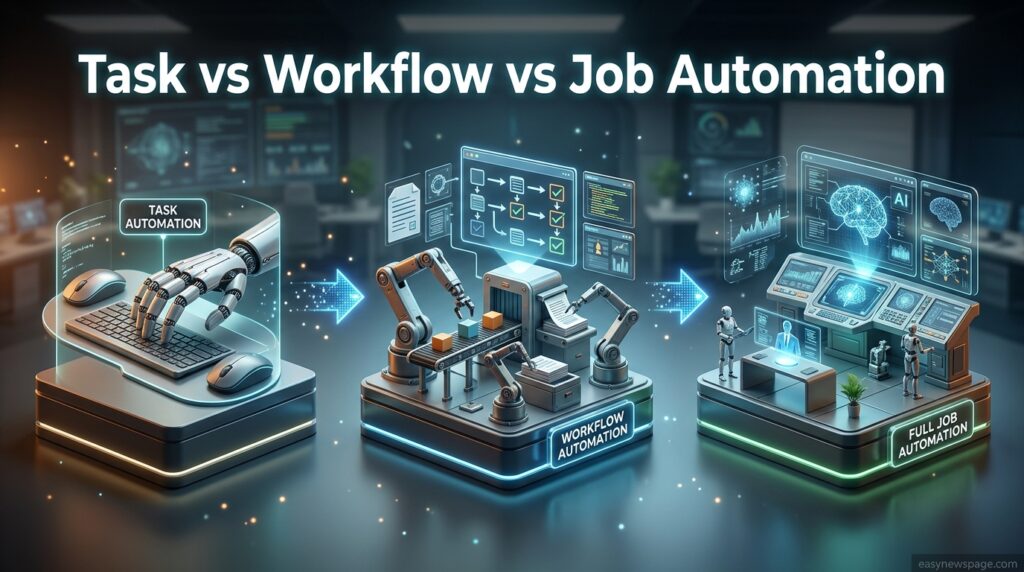
There are three broad tiers worth understanding. Task automation handles a single repetitive action, like sorting emails or transcribing calls. Workflow automation links multiple tasks into a semi-independent process, such as an AI system that reads an invoice, checks it against a budget, and flags exceptions. Job automation replaces the majority of what a role does end to end — this is the rarest and most disruptive tier, and it is where agentic AI is now making the fastest gains.
Understanding which tier applies to a given role is the single most useful lens for judging real risk, far more useful than headlines about “AI taking jobs” in the abstract.
Key Players and Ecosystem Overview
No single company “owns” AI job automation — it is being driven by a handful of foundation-model builders, an enterprise software layer built on top of them, and the employers who deploy both. OpenAI, Anthropic, Google DeepMind, and Meta supply the underlying models; Microsoft, Salesforce, ServiceNow, and UiPath package those models into enterprise automation and robotic process automation (RPA) tools; and individual employers decide how aggressively to apply them.
This layered structure matters for job seekers and businesses alike, because the pace of automation in any single company depends less on “AI getting smarter” in the abstract and more on how quickly that company’s specific software vendors ship AI features into the tools employees already use daily, such as CRM systems, help desks, and coding environments.
History and Timeline of Workplace Automation
Workplace automation is not new — it stretches back to mechanized looms and assembly lines — but the AI-driven wave differs because it targets cognitive, not just physical, labor. Understanding the timeline helps put today’s pace of change into perspective rather than treating it as an unprecedented shock with no historical parallel.
2011–2015: Early machine learning automates fraud detection, spam filtering, and basic recommendation engines, with minimal visible job impact. 2016–2019: Robotic process automation (RPA) tools like UiPath and Automation Anywhere spread through back-office finance and HR functions, automating rules-based clerical work. 2020–2022: The pandemic accelerates warehouse robotics and AI-driven scheduling, while remote work exposes many tasks as automatable for the first time.
2022–2023: ChatGPT’s public launch triggers an eightfold increase in generative AI investment and puts AI automation into mainstream business planning almost overnight. 2024–2025: The World Economic Forum’s Future of Jobs Report 2025 formalizes global projections (92 million displaced, 170 million created), and enterprise AI adoption crosses 80%. 2026 and beyond: Agentic AI — systems that plan and execute multi-step tasks with minimal supervision — moves from pilot programs into production at major employers, marking the shift from “AI as a tool” to “AI as a coworker.”
How AI Job Automation Works
At a technical level, most AI automation systems combine three components: a large language model or specialized machine learning model for understanding and generating information, a set of connected tools or APIs that let the AI take real actions (send an email, update a database, move a robotic arm), and an orchestration layer that decides what step happens next based on the result of the previous one.
AI Overview: In practice, this means a modern automation system does not just answer a question — it can read a document, decide what needs to happen next, execute that action through a connected tool, and check whether the outcome was correct, often without a human approving each step. This is the core distinction between older RPA-style automation and today’s agentic AI, and it is why 2026 is widely described as the year automation moved from “assisting” tasks to “completing” them.
Robotics adds a physical layer for manufacturing and logistics, pairing computer vision with mechanical actuators so a system can identify an object, plan a grasp, and execute a physical action — the same three-part loop, just extended into the physical world.
Workflow
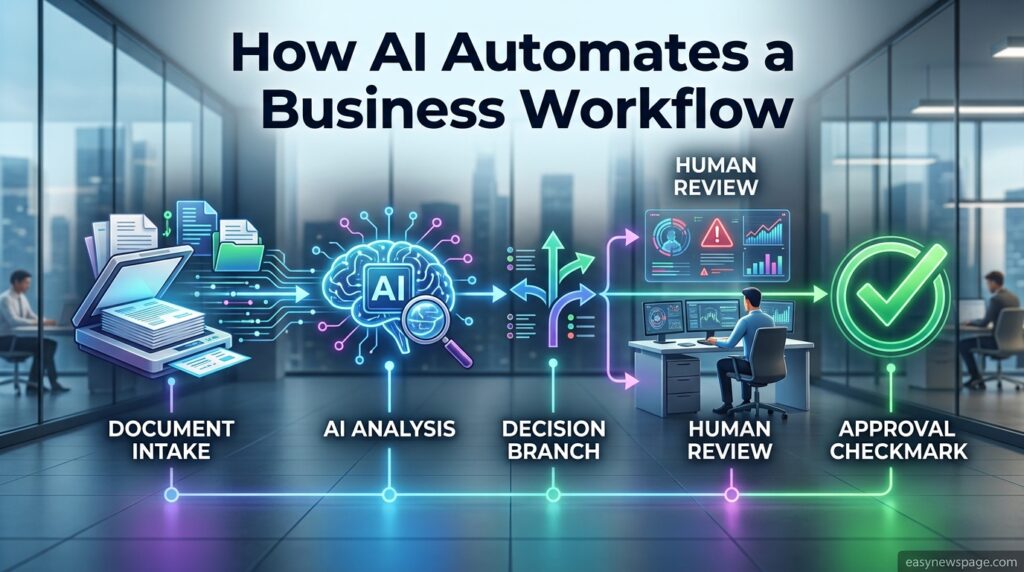
A typical enterprise automation workflow looks like this: data ingestion (the AI receives an email, form, ticket, or sensor reading), classification and reasoning (the model interprets intent and decides what type of task this is), action execution (the system performs the task or hands off to a human for edge cases), and feedback and learning (outcomes are logged and used to refine future performance).
This loop is why automation tends to spread task by task rather than replacing a whole department overnight — each stage of the loop has to be validated for accuracy and safety before a company trusts it with less human oversight, which naturally slows the rollout even when the underlying technology is capable of more.
Real-World Automation Walkthrough
Consider a mid-sized insurance company processing claims. Historically, a claims adjuster manually read each submission, checked policy terms, and approved or escalated it — a process taking 20–40 minutes per claim. With AI automation, the system now reads the claim, cross-references policy documents using natural language processing, flags anomalies using pattern recognition trained on historical fraud cases, and auto-approves straightforward claims in under two minutes.
Human adjusters still review flagged exceptions, complex claims, and any case involving a customer dispute — meaning the job hasn’t disappeared, but it has shrunk to the harder 20% of cases while the AI absorbs the easier 80%. This pattern, sometimes called the “80/20 automation split,” repeats across insurance, legal review, customer support, and basic accounting.
How Businesses Can Prepare for Automation
Companies considering AI automation should start with an audit, not a purchase — mapping which tasks are repetitive and data-driven versus which require judgment, relationship-building, or physical presence, before selecting any tool. [internal link: AI readiness audit checklist]
From there, a phased approach works better than an all-at-once rollout: pilot automation on a single low-risk workflow, measure error rates and employee feedback for 60–90 days, then expand only once the system has proven reliable. Businesses that skip the pilot phase are the ones most likely to see costly automation failures.
Step-by-Step: Auditing Your Job for AI Exposure
AI Overview: To check how exposed a specific job is to automation, list your five most time-consuming weekly tasks, then rate each one on whether it is repetitive, rules-based, and free of real-time human judgment — tasks that score high on all three are the most automatable, while tasks requiring negotiation, physical skill, or emotional nuance are the least.
List your core weekly tasks and estimate the hours spent on each one, since automation risk concentrates wherever the most repeated hours are spent. Rate each task on repetitiveness, data structure, and decision complexity, since AI automates high-repetition, low-complexity work first and struggles with the opposite. Identify which tasks require in-person trust, physical dexterity, or ethical judgment, since these remain the most resistant to full automation even as supporting tasks around them get automated. Finally, research which skills are rising in job postings within your field over the last 12 months, since this signals where employers are already reallocating human effort as automation absorbs the rest.
Use Cases
AI automation shows up differently depending on the function it touches, and understanding these patterns helps separate genuine transformation from marketing hype. In customer service, AI chatbots and voice agents now resolve a large share of first-contact inquiries, escalating only complex or emotionally sensitive cases to humans.
In software development, AI coding assistants handle boilerplate code, testing, and bug detection, while developers shift toward architecture, code review, and system design. In marketing, generative AI drafts copy, generates ad variations, and personalizes campaigns at a scale no human team could match manually. In manufacturing, computer vision and robotics automate quality inspection and repetitive assembly tasks that once required constant human monitoring.
Industry Use Cases
Healthcare: AI automates administrative work — scheduling, billing, and medical coding — while diagnostic AI assists radiologists rather than replacing them, since regulatory and liability structures require a licensed human in the final decision loop. Finance: Automated underwriting, fraud detection, and algorithmic trading have automated large portions of transactional finance, while relationship-based roles like wealth advising remain comparatively protected.
Retail and logistics: Warehouse robotics, demand forecasting, and dynamic pricing automate significant back-end operations, with WEF data showing retail automation reaching roughly 50% of relevant tasks by 2030. Legal services: AI now drafts contracts, reviews discovery documents, and summarizes case law, compressing paralegal-heavy tasks while keeping courtroom advocacy and client counseling firmly human.
Education: AI tutors and grading assistants automate feedback loops, freeing teachers for mentorship and classroom management rather than replacing the teaching role itself. Government and public sector: Automation is slower here due to procurement cycles and compliance requirements, but casework triage and citizen-service chatbots are early, growing use cases.
Benefits of AI Job Automation
The upside of automation is easy to understate in a fear-driven news cycle, but it is substantial and measurable. Productivity gains are the clearest benefit — McKinsey estimates generative AI could add $2.6 to $4.4 trillion annually to the global economy by automating a significant share of routine work hours.
Safer working conditions follow closely behind, since robotics increasingly handle the most dangerous physical tasks in manufacturing, mining, and logistics, reducing workplace injury rates in early-adopter facilities. New job categories are emerging just as fast as old ones shrink — AI trainers, prompt engineers, automation auditors, and human-AI workflow designers did not exist as job titles five years ago and are now hiring aggressively.
Lower costs and faster service for consumers is a quieter but real benefit, as automated support and processing reduce wait times and operating costs that often get passed on as savings. Democratized expertise is one of the more underrated effects — AI tools are already helping less-specialized employees perform expert-level tasks in fields like accounting, nursing, and teaching, narrowing skill gaps rather than only widening them.
Limitations and Risks
Automation’s risks are just as real as its benefits and deserve equal weight rather than being treated as a footnote. Job displacement concentration is the most immediate concern — WEF and Goldman Sachs research both show displacement falling disproportionately on entry-level, mid-skill, and administrative roles rather than spreading evenly across the workforce.
Skills mismatch compounds this problem, since the roles being created (AI oversight, technical, and specialized human-centered work) often require different training than the roles being lost, creating a gap that reskilling programs have not yet closed at scale. Bias and accuracy risks persist in automated decision-making, particularly in hiring, lending, and healthcare triage, where flawed training data can automate discrimination at scale rather than eliminating it.
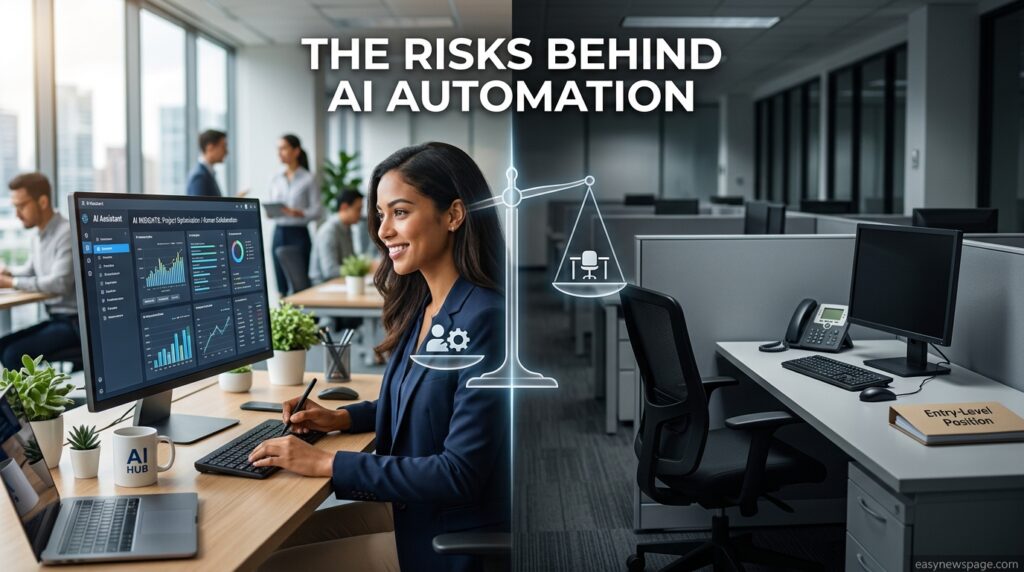
Erosion of entry-level career pathways is a subtler but growing risk — as AI absorbs junior-level tasks, some employers report fewer true entry-level openings, potentially narrowing the traditional route into a profession for new graduates. Overreliance and skill atrophy rounds out the risk list, as workers who rely too heavily on AI output without verifying it can lose the underlying expertise needed to catch AI’s mistakes.
[IMAGE PROMPT — Risk Concept]
Create a realistic, high-quality blog image for AI Careers Hub, about the risks and limitations of AI job automation, for a balanced analysis article.
REQUIREMENTS:
- Show a split visual: one side a confident professional working alongside AI tools, the other side an empty desk symbolizing displaced entry-level roles, connected by a subtle balance scale motif
- Add the text “AI Careers Hub” as a small, clean watermark in a corner
- Add the title text “The Risks Behind AI Automation” in bold, modern typography
- Style: Real-World Lifestyle Shot
- Aspect ratio: 16:9, ultra-realistic quality, professional editorial aesthetic, cinematic lighting, high detail, no text errors, no distorted logos
- Make it visually “amazing” and scroll-stopping — eye-catching colors, depth, and clean composition suitable for Google Images ranking (clear subject, high contrast, not cluttered)
Pros and Cons Table
| Pros | Cons |
|---|---|
| Higher productivity and lower operating costs | Displacement concentrated in entry-level roles |
| Removes humans from dangerous physical tasks | Skills mismatch between lost and created jobs |
| Creates new AI-oversight job categories | Bias risk in automated decision-making |
| Frees skilled workers for higher-value tasks | Potential erosion of career-entry pathways |
| Expands access to expert-level task performance | Overreliance can erode human expertise over time |
| Scales service quality and speed for customers | Adoption costs and integration complexity for SMBs |
Explanation: The pattern across nearly every pro and con is the same: AI automation is very good at scaling routine, well-defined work and very poor at replicating judgment, trust, and physical dexterity. Businesses and workers who plan around that pattern — rather than around headlines predicting total replacement or no change at all — tend to make the most accurate decisions.
Cost Comparison: AI Automation vs Human Labor
| Cost Factor | AI Automation | Human Labor |
|---|---|---|
| Upfront investment | Moderate to high (software, integration, training data) | Low (hiring and onboarding costs) |
| Ongoing cost per task | Very low once deployed | Salary, benefits, and overhead per employee |
| Scalability | Near-instant, limited mainly by compute | Requires hiring and training time |
| Consistency | High for defined tasks | Variable, human-dependent |
| Judgment and adaptability | Limited to trained scenarios | High, especially in novel situations |
| Regulatory/liability exposure | Emerging and often unclear | Well-established legal frameworks |
AI vs Traditional Automation Comparison
| Factor | Traditional Automation (RPA) | AI-Driven Automation |
|---|---|---|
| Rule flexibility | Fixed, pre-programmed rules only | Learns and adapts from data |
| Handles unstructured data | No (structured data only) | Yes (text, images, speech) |
| Decision-making | None — follows scripts exactly | Can reason across multiple steps |
| Best suited for | Repetitive, high-volume clerical tasks | Complex workflows requiring judgment |
| Example | Auto-filling a form from a spreadsheet | Reading a contract and flagging risky clauses |
Technical Specifications Behind Modern AI Automation
AI Overview: Modern automation systems typically run on large language models with context windows measured in the hundreds of thousands of tokens, connected to enterprise systems through APIs, and increasingly coordinated through “agent frameworks” that allow multiple specialized AI models to hand tasks off to one another.
Key technical components include natural language processing (NLP) for understanding text and speech, computer vision for reading images, documents, and physical environments, robotic process automation (RPA) for structured digital tasks, and agentic orchestration layers that sequence multi-step actions across these systems. Compute cost, data quality, and integration complexity remain the three biggest technical bottlenecks slowing full-scale deployment, more so than raw model capability.
Security, Privacy, and Compliance
Security is one of the most under-discussed risks of AI job automation, since automating a workflow often means feeding sensitive data — customer records, financial details, health information — into third-party AI systems. Businesses deploying automation should require data encryption in transit and at rest, clear data-retention policies from vendors, and audit logs for every automated decision.
Privacy compliance varies significantly by region: GDPR in the EU imposes strict rules on automated decision-making that affects individuals, while U.S. regulation remains more fragmented and sector-specific. Compliance risk is highest in regulated industries like healthcare and finance, where automated decisions (loan denials, insurance claims, diagnostic suggestions) may require documented human review to satisfy existing law. [external link: GDPR automated decision-making guidance]
Performance and Adoption Data
AI Overview: As of the most recent McKinsey survey, roughly 88% of organizations use AI in at least one business function, yet only about 1% describe themselves as “AI mature,” showing a large gap between experimentation and full-scale reliable deployment.
This gap matters for anyone judging automation’s real-world pace: adoption headlines often outrun actual production use, since a company “testing” an AI tool in one department is very different from a company that has fully automated a workflow with measured accuracy and reliability. Goldman Sachs similarly notes that only a small share of companies report using generative AI in live production at any given time, which is part of why labor-market effects have so far been more gradual than some early predictions suggested. [external link: McKinsey State of AI report]
Integration Into Business Workflows
Successful automation integration typically follows the existing software stack rather than replacing it outright — AI features get added into CRMs, help desks, and enterprise resource planning (ERP) systems that employees already use, lowering the adoption barrier significantly. [internal link: best AI tools for small business workflows]
The most common integration failure point is treating AI as a bolt-on feature rather than redesigning the workflow around it — companies that simply insert an AI step into an unchanged process see far smaller productivity gains than those that rethink the entire workflow with AI’s strengths in mind.
Enterprise Deployment and APIs
Enterprise AI automation is largely delivered through API access to foundation models (from providers like OpenAI, Anthropic, and Google), wrapped in orchestration platforms (such as UiPath, Microsoft Copilot Studio, or Salesforce Agentforce) that handle authentication, logging, and workflow triggers. [internal link: enterprise AI automation platform comparison]
For businesses without in-house AI engineering teams, low-code and no-code automation platforms have become the fastest path to production, letting non-technical staff configure automated workflows through visual builders rather than custom code.
Support Resources for Displaced Workers
Workers affected by automation have a growing set of support options: government reskilling programs, employer-funded upskilling initiatives, and free or low-cost online certifications in AI-adjacent skills like data literacy, prompt engineering, and automation oversight. [internal link: free AI upskilling courses for career changers]
The WEF’s own research emphasizes that collective action between employers, educators, and policymakers — not individual effort alone — is necessary to close the widening skills gap, since displaced workers rarely have the time or resources to retrain without structured support.
Latest Updates in 2026
The defining 2026 development is the mainstream arrival of agentic AI — systems capable of completing multi-step tasks with minimal human oversight — moving from pilot programs into production at scale. Goldman Sachs raised its U.S. job displacement estimate from generative AI from 6–7% to over 9% in mid-2026, translating to roughly 15 million U.S. workers over a projected 10-year window.
McKinsey’s latest analysis suggests AI agents could automate up to 70% of routine office tasks by 2030, elevating remaining human workers into supervisory or “apex” roles overseeing multiple AI systems rather than performing the underlying tasks directly. Manufacturing has also seen faster-than-expected impact, with MIT and Boston University research estimating up to two million manufacturing job losses tied to automation.
Expert Tips
Build AI fluency before it’s required, since employees who already understand how to work alongside automation tools have consistently better job security outcomes than those who wait until a role is restructured. Focus skill development on judgment-heavy and relationship-heavy tasks within your field, since these remain the hardest for AI to fully replicate even as supporting tasks around them get automated.
Treat AI output as a first draft, not a final answer, particularly in regulated or high-stakes fields, since verification skill is becoming as valuable as the original task skill itself. Finally, audit your own role every six months using the exposure checklist above, since automation capability is advancing quickly enough that a role’s risk profile can shift meaningfully within a single year.
Common Mistakes
A frequent mistake among workers is ignoring automation until it directly affects their role, which leaves little time to reskill compared to those who start preparing proactively. Among businesses, the most common mistake is automating a broken process instead of fixing it first, which simply scales existing inefficiencies faster rather than solving them.
Another common error is assuming full automation is always the goal, when in most successful deployments the better outcome is a human-AI hybrid workflow that uses AI for volume and humans for judgment and exceptions. Finally, many organizations underinvest in change management, rolling out automation tools without adequately retraining or reassuring the employees whose workflows are affected.
Troubleshooting Career Disruption
AI Overview: If a role feels increasingly automated, the most effective response is a three-step approach: identify which specific tasks have been automated versus which remain human-dependent, pursue targeted training in the surviving and adjacent human-dependent tasks, and proactively communicate the resulting productivity gains to management rather than waiting to be evaluated against a shrinking task list.
Workers facing sudden displacement should prioritize transferable skills assessment, government or employer reskilling programs, and industries with documented labor shortages — healthcare, skilled trades, and infrastructure roles are consistently cited across WEF and government labor data as facing worker shortages rather than surpluses.
Myths vs Facts
Myth: AI will eliminate the majority of all jobs by 2030. Fact: WEF projects a net job increase of 78 million by 2030, even though 92 million existing roles will be displaced — the honest picture is churn and transformation, not net collapse.
Myth: Only low-skill jobs are at risk from automation. Fact: Research from the University of Pennsylvania and OpenAI found that some higher-earning, white-collar roles are among the most exposed to generative AI automation, alongside lower-wage administrative work.
Myth: AI automation is mostly hype and hasn’t really changed hiring yet. Fact: McKinsey finds 88% of organizations already use AI in at least one business function, and Goldman Sachs has already raised its displacement estimates multiple times based on observed labor-market data.
Decision Matrix
| Criteria | Full AI Automation | Human-AI Hybrid | No Automation |
|---|---|---|---|
| Best for repetitive, high-volume tasks | Excellent | Good | Poor |
| Best for judgment-heavy decisions | Poor | Excellent | Good |
| Cost efficiency at scale | Excellent | Good | Poor |
| Regulatory/compliance safety | Fair | Excellent | Excellent |
| Customer trust in sensitive interactions | Fair | Excellent | Excellent |
| Speed of implementation | Slow (upfront setup) | Moderate | Immediate |
Entry-Level vs Experienced Workers
Entry-level workers face the steepest near-term automation pressure, since the routine, well-documented tasks traditionally assigned to junior staff are exactly the tasks generative AI handles best, and some employers report fewer traditional entry points as a result. Experienced workers, by contrast, often hold the judgment-heavy, relationship-based, and exception-handling responsibilities that remain the hardest to automate, giving them more short-term insulation even within the same automating industry.
This dynamic creates a real structural challenge: if entry-level roles keep shrinking, the traditional pipeline that produces tomorrow’s experienced workers may weaken unless employers and educators deliberately redesign career-entry pathways around AI-augmented junior roles rather than eliminating them outright.
Read more: AI Job Automation
Alternatives to Full Automation
Businesses do not have to choose between “no AI” and “full automation” — several middle paths consistently outperform both extremes in real deployments. Human-in-the-loop automation keeps a human approver on every AI-generated decision, balancing speed with accountability. Augmentation-only tools use AI purely to assist human output (drafting, summarizing, flagging) without ever taking autonomous action.
Selective task automation targets only the most repetitive 20-30% of a role rather than attempting to automate the entire job function at once, reducing both risk and employee resistance. Each of these alternatives tends to produce more sustainable productivity gains than aggressive full automation, according to McKinsey’s research on AI deployment maturity.
Who Benefits Most From AI Automation
Businesses with high volumes of repetitive, data-heavy work — insurance, back-office finance, customer support, and logistics — see the fastest and clearest ROI from automation. Workers who position themselves as AI supervisors, trainers, or workflow designers rather than task executors tend to benefit from rising demand rather than facing displacement risk.
Consumers benefit broadly through lower costs and faster service in automated industries, even when they never interact with the underlying AI system directly.
Who Should Avoid or Limit Automation
Roles requiring licensed professional judgment (medical diagnosis, legal advocacy, financial fiduciary duty) should limit automation to support functions rather than final decisions, both for accuracy and liability reasons. Small businesses without technical support may find full automation platforms costly and complex relative to their transaction volume, making augmentation tools a better starting point.
Industries in early regulatory uncertainty around automated decision-making — particularly hiring, lending, and healthcare — should proceed cautiously and document human oversight at every automated step to reduce legal exposure.
FAQs
Is AI job automation actually eliminating jobs right now?
Yes, in specific pockets — administrative, entry-level, and highly routine roles are already shrinking in hiring data — but overall employment is not collapsing, since new AI-related and human-centered roles are being created alongside the losses.
What jobs are safest from AI automation?
Roles requiring physical dexterity in unpredictable environments (skilled trades, healthcare delivery), high-stakes judgment (surgery, courtroom law), and deep relational trust (therapy, senior sales, leadership) remain the most resistant, according to WEF and Goldman Sachs occupational exposure research.
How many jobs will AI create by 2030?
The World Economic Forum projects 170 million new jobs created globally by 2030, driven by AI and information-processing technology, alongside broader trends like an aging population and the green transition.
Will AI automation increase unemployment significantly?
Most major economic forecasts, including Goldman Sachs, project a modest unemployment increase (around 0.5 percentage points) during the transition period rather than a large or permanent spike, though effects vary by country and sector.
What skills should I learn to stay competitive against AI automation?
Prioritize AI literacy and prompt engineering, technological literacy more broadly, and durable human skills like critical thinking, creativity, and emotional intelligence — the same three categories the World Economic Forum identifies as the fastest-growing in demand through 2030.
Is agentic AI different from the AI automation we’ve had for years?
Yes — agentic AI can plan and execute multi-step tasks with minimal human input, compared to earlier automation tools that followed fixed rules or handled only single, isolated tasks.
Rating Scorecard
| Category | Score (out of 10) | Notes |
|---|---|---|
| Productivity impact | 9/10 | Strong, well-documented economic gains |
| Job creation potential | 7/10 | Real, but unevenly distributed by skill and geography |
| Risk to entry-level workers | 8/10 (high risk) | Consistently flagged across multiple sources |
| Regulatory readiness | 4/10 | Frameworks lagging behind deployment speed |
| Worker support infrastructure | 5/10 | Reskilling programs exist but remain under-resourced |
| Overall workforce outlook (2026–2030) | 7/10 | Net positive with significant transitional disruption |
Conclusion
The article’s final verdict on AI job automation is this: it is neither the job apocalypse nor the harmless non-event that opposing headlines suggest, but a genuine structural transformation that rewards early preparation and penalizes inaction. The data across the World Economic Forum, Goldman Sachs, and McKinsey converges on the same core truth — millions of jobs will be displaced, more will be created, and the net outcome is positive at a global level, but deeply uneven at an individual and industry level.
For workers, the practical takeaway is to treat automation exposure as a solvable problem rather than an inevitability: audit your own tasks, invest in judgment-heavy and relationship-heavy skills, and build baseline AI fluency now rather than after a role has already been restructured. For businesses, the lesson from the data is equally clear — automation delivers the strongest results when it targets genuinely repetitive work, keeps humans in the loop for judgment calls, and is paired with real investment in employee reskilling rather than treated purely as a cost-cutting shortcut.
For policymakers and educators, the WEF’s own conclusion is the one worth repeating: closing the skills gap requires collective action across employers, governments, and educational institutions, not individual effort alone. The next five years will likely bring faster change than the last five, driven largely by agentic AI moving from pilot projects into everyday production work. Approached with clear eyes and a proactive plan, that change is navigable — approached with denial or panic, it is far more likely to catch workers and businesses off guard.
Official Sources
- World Economic Forum, The Future of Jobs Report 2025 — weforum.org
- Goldman Sachs Research, How Will AI Affect the Global Workforce? — goldmansachs.com
- McKinsey & Company, The Economic Potential of Generative AI and Global AI Survey — mckinsey.com
- International Labour Organization, Working Papers on Generative AI and Employment — ilo.org
Author Bio
This guide was researched and written by the AI Careers Hub editorial team, specializing in workforce technology, labor-market data, and AI policy analysis. All statistics are sourced directly from primary institutional research and cross-checked for accuracy at the time of publication in August 2026.