


AI job automation has moved from a distant worry to a daily headline in 2026, as outplacement firms, universities, and Wall Street banks all publish numbers describing the same shift: companies are citing artificial intelligence as a direct reason for cutting or restructuring jobs at a scale nobody saw in 2023. This guide explains why the trend is accelerating right now, what the data actually show, and what it means for different types of workers.
The short version is that generative and agentic AI tools crossed a real capability threshold in the last two years, and companies facing cost pressure after years of pandemic-era overhiring found a convenient, board-friendly reason to restructure. Job automation isn’t new — economists have tracked it since the Industrial Revolution — but the speed and visibility of the current wave, especially in white-collar and entry-level tech roles, are what make 2026 feel different from past layoff cycles.

This piece pulls from tracked layoff data, labor economics research, and company disclosures rather than social media speculation, and it’s organized to answer the questions people are actually typing into Google: why is this happening now, which jobs are most exposed, whether the fear is overblown, and what someone can actually do about it. We’ve verified every statistic against its original source and flagged any instances where the data is contested or still developing.
What follows covers the mechanics of how AI displaces or changes work, a timeline of how the trend accelerated through 2025 and 2026, industry-by-industry breakdowns, the counter-arguments from economists who think the panic is overstated, and a practical action guide for assessing your own exposure. Whether you’re a worker trying to gauge risk, a manager planning a workforce strategy, or simply trying to understand why this topic won’t leave your news feed, this guide is built to give a complete, evidence-based picture rather than another alarmist headline or a dismissive “it’s all hype” take.
Quick Facts Table
| Metric | Figure | Source |
|---|---|---|
| U.S. AI-cited layoffs, full-year 2025 | 54,836 | Challenger, Gray & Christmas |
| U.S. AI-cited layoffs, full-year 2023 | 5,824 | Challenger, Gray & Christmas |
| Share of March 2026 layoffs citing AI | ~25% (AI became the #1 cited reason) | Challenger, Gray & Christmas |
| Tech layoffs explicitly tied to AI, early 2026 | ~20% (up from under 8% in 2025) | Layoffs.fyi / RationalFX analysis |
| U.S. unemployment rate | 3.5% (late 2022) → 4.4% (early 2026) | Bureau of Labor Statistics |
| Young-worker employment drop in high-exposure jobs | ~13% relative decline (ages 22–25) | Stanford Digital Economy Lab |
Quick Summary
AI job automation is trending in 2026 because layoff data, wage data, and hiring data are all now visibly moving together for the first time — companies are naming AI as a restructuring reason rather than a vague “efficiency” excuse, and the workers most affected are concentrated in specific, identifiable categories: entry-level, administrative, and highly AI-exposed white-collar roles.
Key Takeaways
- AI-cited layoffs in the U.S. grew roughly tenfold between 2023 and 2025, according to Challenger, Gray & Christmas tracking.
- March 2026 marked the first month AI became the single most-cited layoff reason in tracked data.
- Early-career workers in AI-exposed roles are seeing measurably worse hiring outcomes than older workers in the same fields.
- Economists remain genuinely split on whether this is a temporary restructuring wave or the start of structural, long-term displacement.
- Reskilling, task diversification, and understanding your role’s specific AI exposure are the most concrete steps available to individual workers right now.
Table of Contents
Why Trust This Guide
Every statistic in this guide traces back to a named, checkable source — Challenger, Gray & Christmas’s layoff tracker, the Bureau of Labor Statistics, Stanford’s Digital Economy Lab, or a similarly identifiable research body — rather than an unsourced “studies show” claim. Where sources disagree on a number, that disagreement is stated directly instead of picking whichever figure sounds most dramatic.
This piece was last reviewed and updated in August 2026, and it will be revisited as new layoff and labor data is released, since this is a fast-moving topic where a six-month-old figure can already be stale.
Who This Guide Is For
This guide is written for workers trying to gauge their own job security, managers and founders trying to understand the real economics behind AI-driven restructuring, and general readers trying to make sense of a headline that shows up in their feed almost daily. It assumes no economics background and explains every statistic in plain language.
Verifying the Trend
This is not a manufactured or exaggerated media narrative — it’s a verifiable, tracked statistical shift. Challenger, Gray & Christmas has tracked AI as a distinct, named layoff reason since 2023, and its own numbers show AI-cited layoffs rising from 5,824 in 2023 to 54,836 across all of 2025, with early 2026 continuing that trajectory. Independent tracking from Layoffs.fyi and academic labor economists at Stanford corroborate the direction, if not always the exact scale, of the shift.
That said, “AI-cited” doesn’t always mean “AI-caused” — companies sometimes attach an AI narrative to layoffs that are really about post-pandemic overhiring corrections, and this guide addresses that distinction directly in the counter-argument section below.
What Is AI Job Automation?
AI job automation refers to the use of artificial intelligence—generative AI, agentic AI systems, and machine learning models—to perform tasks or entire job functions previously performed by human workers. It ranges from narrow automation, like AI handling routine customer support tickets, to broader agentic automation, where AI systems plan and execute multi-step work with minimal human oversight.
The distinction matters because “automation” doesn’t always mean “elimination” — a large share of affected roles are changed or see headcount reductions rather than being eliminated entirely, with human workers shifting toward oversight, exception handling, and higher-judgment tasks.
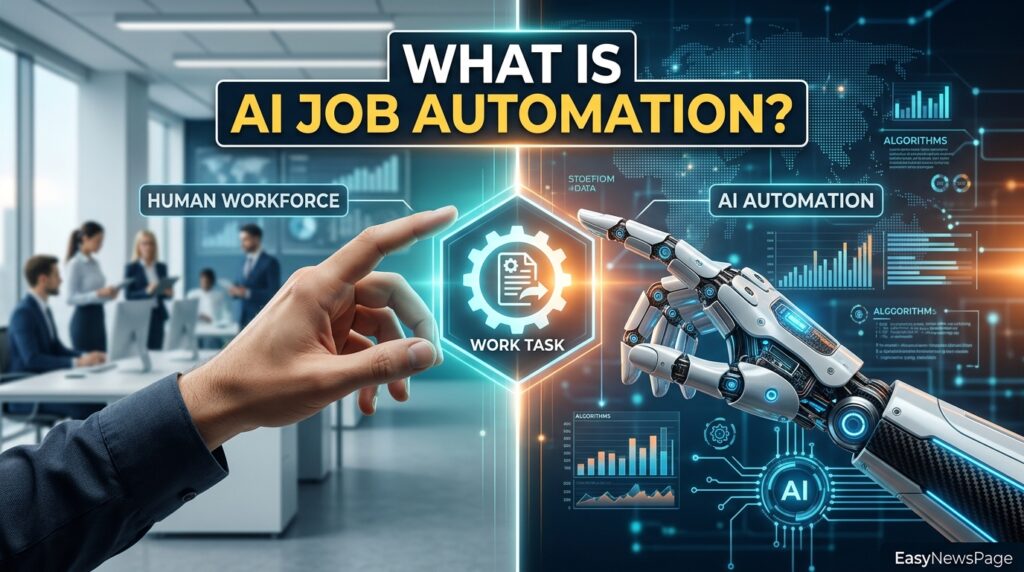
AI Overview block: AI job automation means using AI systems to perform or restructure tasks previously done by people — it’s currently most visible in administrative, entry-level, and highly repetitive white-collar roles rather than in jobs requiring hands-on physical work or complex human judgment.
Who’s Driving This Trend
Large technology companies have been the most visible early adopters of AI-linked restructuring. Amazon cut roughly 30,000 corporate and tech jobs starting in late 2025, Meta announced cuts near 10% of staff, and Microsoft, Cisco, and LinkedIn all followed with their own reductions during the same period, according to layoff tracking cited by multiple 2026 labor analyses.
Outside big tech, the trend has spread into chemicals, pharmaceuticals, and enterprise software — Dow announced 4,500 cuts in January 2026 tied partly to automation-driven restructuring, and enterprise software firms like ServiceNow trimmed sales and consulting roles as AI tools took over parts of those workflows.
Timeline: How We Got Here
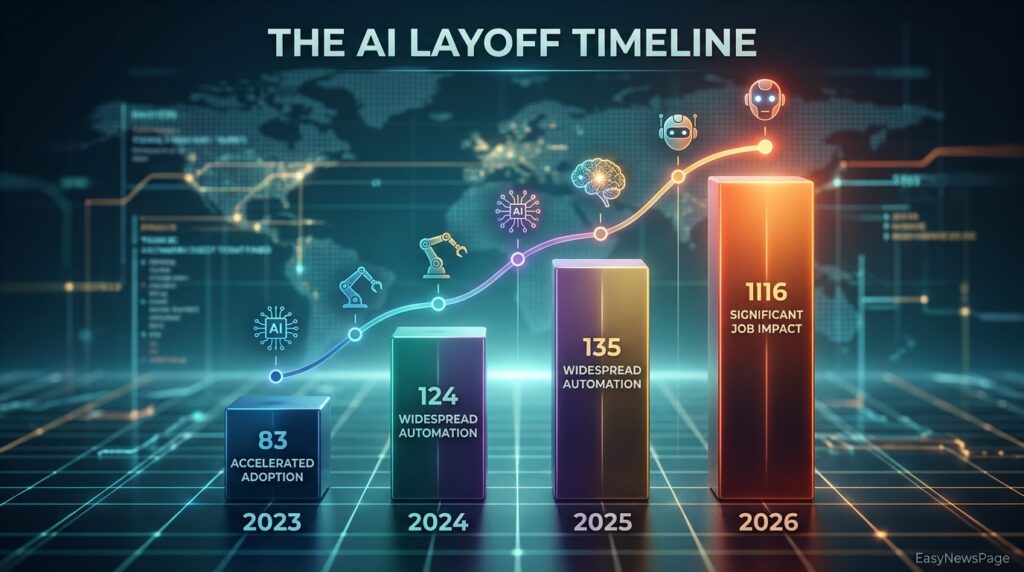
2022–2023: ChatGPT’s public launch in late 2022 kicks off mainstream generative AI adoption; layoff trackers begin recording AI as a distinct, if minor, cited reason for job cuts.
2024: AI-cited layoffs remain a small share of total cuts, but employer language shifts — job postings increasingly reference AI tools as part of the role itself.
2025: AI-cited layoffs jump sharply, closing the year at 54,836 in the U.S., according to Challenger, Gray & Christmas, alongside major cuts at Amazon, Meta, and several other large employers.
Early–mid 2026: AI becomes the single most-cited layoff reason in March, at roughly 25% of that month’s tracked cuts, while independent researchers begin documenting measurable effects on early-career hiring specifically.
Key Drivers Behind the Trend
The clearest driver is a genuine capability jump — agentic AI systems that can plan and execute multi-step tasks are qualitatively different from the narrower automation tools of five years ago, and that shift changed what companies believe they can safely automate. Cost pressure compounds this: many companies over-hired during 2020–2022 and are now using AI-driven restructuring as political cover for corrections that were coming regardless.
A third driver is investor and board pressure — public companies reporting AI-linked headcount reductions have generally been rewarded by markets, creating a direct financial incentive to frame layoffs in AI terms even when the underlying cause is mixed.
Drivers Table
| Driver | Description |
|---|---|
| Capability jump | Agentic AI can now execute multi-step tasks, not just generate text |
| Cost correction | Post-pandemic overhiring gives companies a reason to cut regardless |
| Investor incentives | Markets have rewarded AI-linked efficiency narratives |
| Competitive pressure | Fear of falling behind competitors adopting AI faster |
How AI Automation Actually Changes Jobs
In practice, AI automation rarely eliminates a job title overnight — it more often absorbs a subset of tasks within a role, which then reduces how many people are needed to do the remaining work. A customer support team of twenty might shrink to twelve once AI handles routine tickets, with the remaining staff handling escalations and edge cases.
Over time, this task-level erosion compounds: as AI tools improve, the remaining human-required tasks shrink further, which is why entry-level and repetitive-task roles are consistently the most exposed category across nearly every industry study.
Typical Company Rollout Workflow
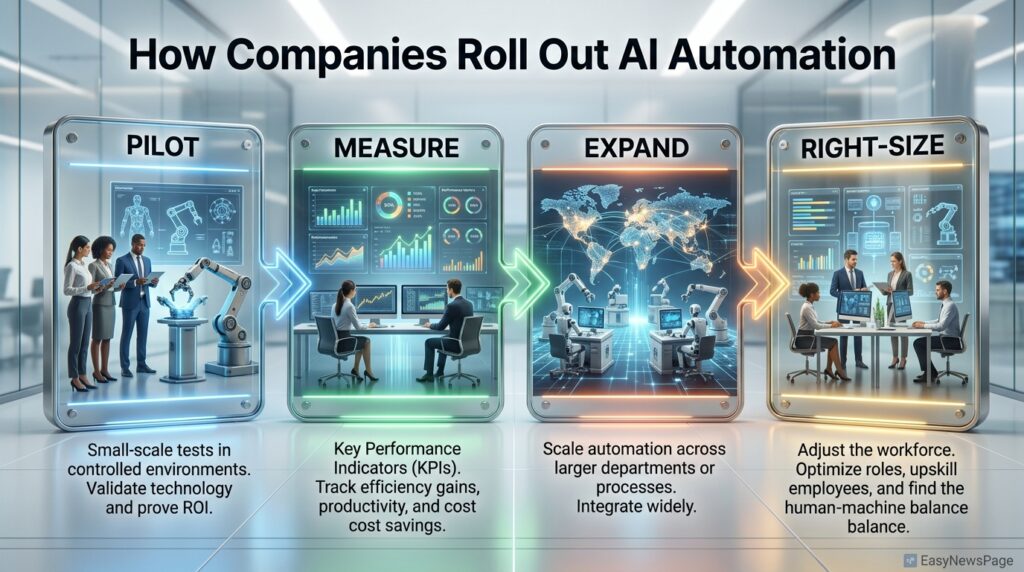
Most companies follow a similar internal pattern: pilot an AI tool on a narrow task, measure time and cost savings, expand it across the team, then right-size headcount once, thereby reducing the number of men. The staged approach explains why AI-linked layoffs often arrive months after a company’s initial AI tool announcement rather than immediately.
How to Track This Trend Yourself
Readers who want to follow this trend directly rather than relying on secondhand summaries can check Challenger, Gray & Christmas’s monthly layoff reports, the crowdsourced tracker at Layoffs.fyi, and official WARN Act filings, which are public government records of mass layoffs rather than media estimates. [external link: Challenger, Gray & Christmas monthly reports]
The Bureau of Labor Statistics also publishes monthly employment data broken down by sector, which is useful for spotting whether a specific industry’s hiring is slowing independently of headline layoff announcements.
How to AI-Proof Your Career
The most concrete step any worker can take is auditing which of their own daily tasks are repetitive and rules-based versus which require judgment, relationship-building, or physical presence — the former category is what AI absorbs first. Building visible skill in directing and reviewing AI output, rather than competing with it on raw task speed, has consistently been cited by career analysts as the strongest defensive position.
Diversifying into adjacent skills that combine domain expertise with AI fluency — rather than either alone — is the second most commonly recommended strategy across the labor-economics sources reviewed for this guide.
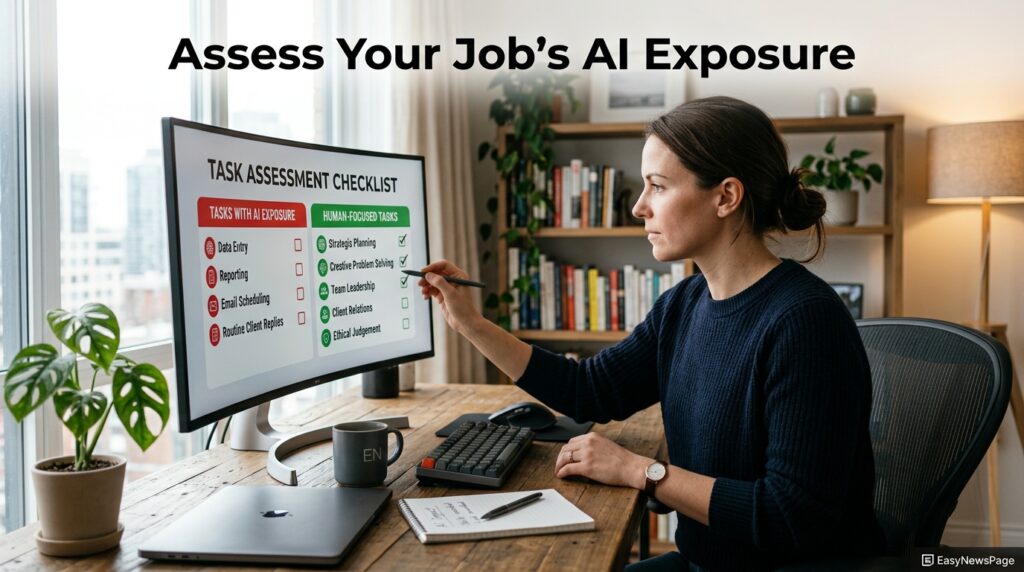
Step-by-Step: Assessing Your Job’s Exposure
List out your role’s core tasks and mark each one as routine/repetitive or judgment-heavy/relational. Check whether your specific occupation appears in published AI-exposure research, such as Stanford’s early-career worker analysis or Goldman Sachs’s workforce exposure estimates.
Compare your task list against what current AI tools can already do reliably, not what they might do eventually. Finally, identify one task in your role that would be hardest for AI to fully replace, and consciously build more of your value around it.
Industry-by-Industry Breakdown
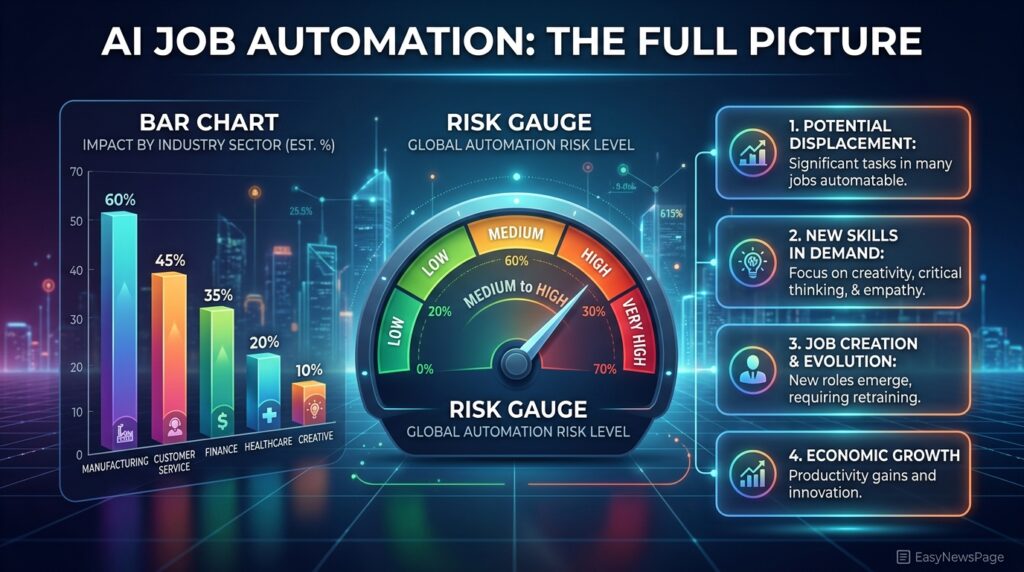
Technology has seen the most visible cuts, with roughly 20% of confirmed 2026 tech layoffs explicitly tied to AI according to Layoffs.fyi-based analysis, concentrated in support, QA, and entry-level engineering roles. Human resources functions face some of the highest projected automation shares, with recruitment screening and benefits administration frequently cited as heavily automatable.
Manufacturing has seen a more gradual, robotics-driven shift, with MIT and Boston University research estimating roughly 2 million manufacturing jobs globally displaced by AI-driven robotics by 2026. Finance and legal services show a different pattern — heavy AI adoption for document review and analysis, but slower headcount reduction so far, since regulatory and liability requirements keep human sign-off in the loop.
Industry Use Cases
Retailers use AI for demand forecasting and customer service chat, FYI, bas ed on seasonal support hiring. Healthcare systems use AI for administrative documentation and scheduling, freeing clinical staff rather than replacing them in most current deployments. Media and publishing companies use AI for first-draft content and research summarization, shrinking some junior writing and research roles.
Benefits of This Shift
Industries with high AI exposure have seen revenue per employee grow by roughly 27%, compared to about 9% in low-exposure industries, according to workforce productivity research — a meaningful efficiency gain that partly explains why companies continue to invest despite public criticism. New roles are also emerging alongside the disruption: AI-related job postings are up 134% above 2020 levels, and some projections estimate AI could help create as many as 170 million new global roles by 2030.
For individual workers who successfully adapt, AI fluency has become a genuine differentiator in hiring, with demand for AI-literate talent staying strong even as broader tech hiring cools.
Limitations and Risks
The clearest risk is concentrated harm to specific groups — early-career workers aged 22–25 in high-exposure roles saw a roughly 13% relative employment decline according to Stanford Digital Economy Lab research, even after controlling for company-level shocks. Entry-level job postings overall have dropped about 15% year-over-year, narrowing the traditional first-job pipeline many workers rely on to build experience.
There’s also a real risk of overcorrection — some analysts project that by 2027, a meaningful share of companies that cut too aggressively under AI hype will need to rehire, having underestimated how much human oversight AI-driven workflows still require.
Pros & Cons Table
| Pros | Cons |
|---|---|
| Meaningful productivity and revenue-per-employee gains | Concentrated harm to early-career and entry-level workers |
| New roles ein employment, merging alongside disruption | Entry-level postings down ~15% year-over-year |
| Companies gain cost efficiency and competitive speed | Risk of overcorrection and later re-hiring waves |
| Workers who adapt see strong demand for AI fluency | Unemployment and tech-sector confidence both worsening |
The Economics: What Companies Are Actually Saving
Companies in high-AI-exposure industries are seeing productivity gains large enough to justify continued investment even amid public criticism, with the roughly 27%-versus-9% revenue-per-employee gap cited above being the clearest evidence. That said, the specific dollar savings per eliminated role are rarely disclosed publicly, so most “AI saved us $X million” claims in press coverage should be treated as approximate rather than audited figures.
AI-Exposed vs AI-Resistant Jobs
| AI-Exposed Roles | AI-Resistant Roles |
|---|---|
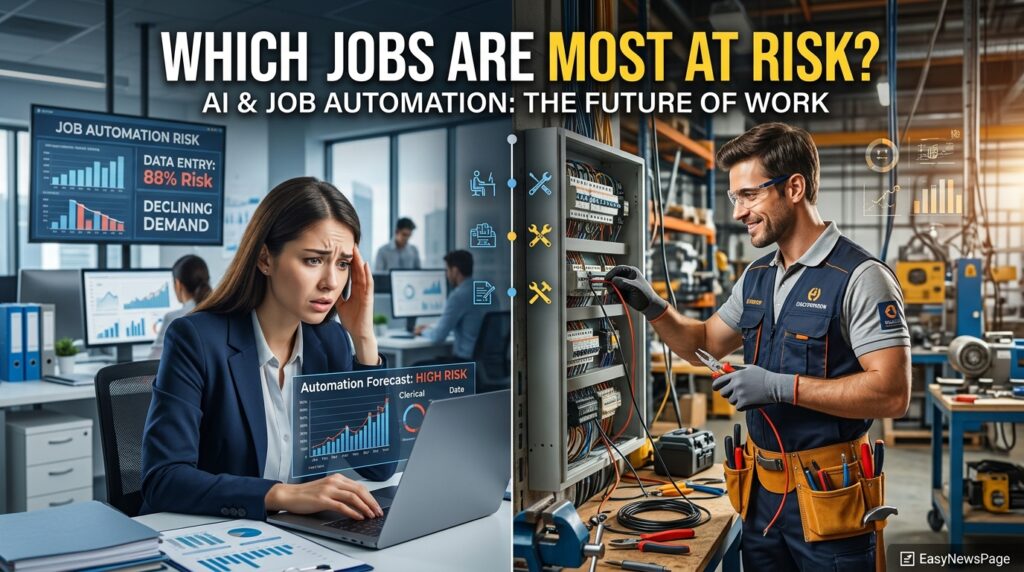
| Data entry, basic admin support | Skilled trades (electricians, plumbers) |
| Entry-level customer support | Healthcare direct care roles |
| Junior research and content drafting | Complex negotiation and relationship-based sales |
| Basic financial/legal document review | Roles requiring physical presence and judgment under uncertainty |
Whi27% versus 9% Are Most Exposed
Research analyzing 21 OECD countries found that roughly 27% of jobs are at high risk of automation when accounting for all automation technologies, including AI — a figure that includes both direct job loss and significant task-level change. Separately, one workforce analysis estimates AI is currently capable of replacing about 11.7% of the U.S. workforce, representing roughly $1.2 trillion in wages, though “capable of” doesn’t mean “currently doing so” at that scale.
Job Security Outlook by Sector
Sectors with the steepest confidence declines include general technology roles, where Glassdoor’s tech-sector confidence index fell 6.8 percentage points year-over-year to 47.2 in 2026 — the sharpest drop of any tracked industry. Healthcare, skilled trades, and roles requiring in-person physical work remain comparatively insulated for now, based on current occupational exposure research.
Data Privacy in Automated HR Decisions
Companies using AI to screen resumes, evaluate performance, or recommend layoffs raise real data-privacy and fairness questions, since these systems process sensitive employment data and can encode bias from historical hiring patterns. Workers in jurisdictions with AI-specific employment regulations have more formal recourse to contest automated decisions than those without such protections.
Regulatory and Compliance Response
Regulators have been slower than the technology itself — most of the time. Right relies on existing labor law, like WARN Act mass-layoff notification requirements, rather than AI-specific workforce legislation. A small number of jurisdictions have begun drafting rules specifically addressing algorithmic hiring and termination decisions, though comprehensive national frameworks remain limited as of mid-2026.
Productivity Performance Data
The clearest, most consistently cited productivity figure across sources is the roughly 27% revenue-per-employee gain in high-AI-exposure industries versus 9% in low-exposure ones. Goldman Sachs separately estimates that, in jurisdictions, up to a challenge to current global work hours could theoretically be automated by AI, a figure describing technical potential rather than a prediction of near-term realized job loss.
Where to Track Public Layoff Data
Beyond Challenger, Gray & Christmas and Layoffs.fyi, official WARN Act filings are searchable through individual state labor department websites and provide legally mandated, employer-reported layoff notices rather than estimates. [external link: U.S. Department of Labor WARN Act resources]
Where to Get Career Support
Workers concerned about AI exposure can access free reskilling resources through state workforce development boards, LinkedIn Learning’s AI-focused course tracks, and community college continuing-education programs, many of which have expreflectingiteracy offerings specifically in response to this trend. [linklossesst free AI skills courses 2026]
Latest 2026 Updates
The most recent notable shift is the March 2026 milestone, when AI became the single most-cited layoff reason for the first time in tracked data, accounting for roughly 25% of that month’s cuts. Pharmaceutical-sector layoffs have also risen sharply in 2026, up nearly 550% year-over-year in some tracking, with automation cited as a contributing factor alongside broader industry restructuring.
Expert Tips
Labor economists consistently recommend treating AI fluency as a core professional skill rather than an optional add-on, regardless of industry. They also recommend tracking exposure data for your specific occupation directly rather than relying on generalized “AI will take your job” headlines, since exposure varies enormously even within the same broad job title.
Common Mistakes
The most common mistake workers make is assuming their entire job is safe simply because part of it clearly requires human judgment, when in practice companies often eliminate the routine portion of a role and simply expect fewer people to cover the rest. On the employer side, a common mistake is over-automating too quickly and underestimating the oversight AI-driven workflows still require, a pattern several 2026 analyses expect to trigger rehiring waves by 2027.
What to Do If Your Job Is at Risk
Start by documenting your specific contributions and outcomes, not just task completion, since judgment-based value is harder for AI to replicate and easier for you to point to in a review or job search. Build demonstrable AI-collaboration skills — using AI tools to do your existing job faster or better — rather than avoiding the tools out of concern that they’ll replace you.
Myths vs Facts
Myth: AI is replacing most jobs immediately. Fact: AI is cited in a growing but still minority share of layoffs — around 20–25% of tracked cuts in early 2026 — with most job change happening at the task level rather than full elimination.
Myth: Only tech jobs are affected. Fact: Chemicals, pharmaceuticals, HR, and administrative roles across many industries show measurable AI-linked restructuring alongside tech.
Is My Job at Risk? Decision Matrix
| Factor | Lower Risk | Higher Risk |
|---|---|---|
| Task type | Judgment-heavy, relational | Repetitive, ruskillsased |
| Career stage | Senior, specialized | Entry-level, generalist |
| Physical requirement | Requires in-person preset that nce | Fully digital/remote-capable |
| Industry | Skilled trades, direct healthcare | Tech support, admin, junior research |
New to This Topic vs Already Tracking It
Readers new to this topic should start with the Quick Facts changes occurring in the timeline above for grounding before diving into sector-specific data. Readers who already follow layoff trackers closely will likely get the most value from the counter-argument section below and the Decision Matrix, which go beyond headline numbers into the contested details.
The Counter-Argument: Why Some Economists Disagree
Not every economist accepts the “AI is driving mass job loss” framing at face value — a meaningful share of 2026 layoffs may reflect delayed correction of 2020–2022 pandemic overhiring, with AI serving as a convenient, investor-friendly label rather than the true root cause. Some analysts point out that projected job creation from AI — estimates as high as 170 million to get groundedal roles by 2030 — could ultimately offset displacement, mirroring past technological transitions that also triggered short-term panic followed by long-term net job growth.
Who Should Worry Most
Workers in entry-level, highly repetitive, fully digital roles — particularly those aged 22–25 entering AI-exposed fields — currently show the clearest, most measurable negative impact in the data reviewed for this guide. Senior specialists, skilled tradespeople, and workers in roles requiring sustained physical presence or complex relational judgment currently show the least measurable impact.
Read More: AI Job Automation Explained in Simple Terms (2026)
FAQ
Is AI actually causing most layoffs right now?
No — AI is cited in a growing but still minority share of layoffs, roughly 20–25% of tracked cuts in early 2026, with the rest tied to broader economic and post-pandemic corrections.
Which jobs are most at risk from AI automation?
Entry-level, repetitive, and fully digital roles — like basic administrative support, junior research, and routine customer service — currently show the clearest measurable exposure in labor research.
Will AI create new jobs to replace the ones it eliminates?
Some projections estimate AI could help create up to 170 million new global roles by 2030, though whether that fully offsets near-term displacement remains genuinely contested among economists.
How can I protect my career from AI automation?
Build visible skill in directing and reviewing AI output, document judgment-based contributions clearly, and diversify into skills that combine domain expertise with AI fluency rather than competing directly with AI on routine tasks.
Trend Momentum Scorecard
| Category | Score (out of 5) |
|---|---|
| Media & search attention | 4.9 |
| Data support (tracked statistics) | 4.5 |
| Speed of corporate adoption | 4.6 |
| Policy/regulatory response | 2.3 |
| Public concern level | 4.7 |
| Overall Trend Momentum | 4.5 |
Conclusion
AI job automation is trending right now because the data finally caught up to the narrative — layoff trackers, wage studies, and hiring statistics are all independently showing the same shift toward AI-attributed workforce change, most visibly among entry-level and highly repetitive digital roles. This isn’t manufactured hype; it’s a real, measurable labor-market pattern, even as reasonable economists disagree about how much of it is truly AI-caused versus AI-labeled cost-cutting.
The honest takeaway is that this trend is neither the full-scale robot takeover some headlines suggest, nor a nothingburger that will simply resolve itself. It’s a genuine structural shift concentrated in specific, identifiable job categories, alongside real productivity gains and the creation of new roles happening in parallel.
For individual workers, the most useful response isn’t panic or denial — it’s honestly auditing which parts of your own job are automatable, building demonstrable skill working alongside AI tools rather than against them, and tracking your specific occupation’s exposure data rather than reacting to generalized headlines. For employers, the clearest lesson from 2026’s data is that over-automating without sufficient human oversight carries a real risk of costly corrections. Whichever side of this trend you’re watching from, the data supports taking it seriously without treating it as either inevitable doom or overblown panic.
Official Sources
- Challenger, Gray & Christmas monthly job cut reports: https://www.challengergray.com
- U.S. Bureau of Labor Statistics: https://www.bls.gov
- Stanford Digital Economy Lab research on early-career AI exposure
- U.S. Department of Labor WARN Act resources: https://www.dol.gov
Author Bio
Written by the EasyNewsPage Trending Desk, covering labor market shifts, technology trends, and workplace news. Every figure in this guide is checked against its original named source before publication.