



Making your first $1,000 in freelance writing feels like the hardest money you’ll ever earn — and then, oddly, the easiest to repeat. This guide walks through a realistic, composite path that mirrors how thousands of beginner writers actually cross that first four-figure milestone: not through a viral LinkedIn post or a lucky referral, but through a repeatable sequence of niche selection, portfolio-building, outreach, and pricing decisions.
That milestone matters because it’s the psychological and financial proof point that freelance writing can work as more than a hobby. Most people who quit do so before reaching it, usually because they underpriced their work, pitched the wrong clients, or gave up during the slow first few weeks when the inbox stays quiet. Understanding the shape of that early curve — where the friction is, and where the leverage is — is the difference between grinding for months and hitting $1,000 inside your first 30 to 60 days.

This article covers the full arc: choosing a starting niche, building a portfolio without prior clients, pricing your first projects (with 2026 market-rate benchmarks), where to find paying work, how to structure outreach that actually gets replies, and the mistakes that quietly stall most beginners. You’ll also find a pricing table, a step-by-step tutorial, a decision matrix for choosing your first platform, and a Google-style FAQ built around the questions people actually search.
Whether you’re a total beginner with zero clips or someone who has written for free and is ready to get paid, the goal here is the same: a clear, honest roadmap — not hype — to your first $1,000 freelance writing milestone, and the foundation to keep building past it.
Quick Facts Table
| Fact | Detail |
|---|---|
| Typical time to first $1,000 | 3–8 weeks of consistent daily outreach |
| Beginner per-word rate (2026) | $0.05–$0.10/word |
| Beginner per-article rate (1,000 words) | $50–$150 |
| Fastest common path | 3–5 cold pitches per day + one portfolio piece per niche |
| Best entry platforms | Upwork, Contena, ProBlogger Job Board, LinkedIn outreach |
| Most common beginner mistake | Underpricing and pitching without a specific angle |
Quick Summary
Reaching $1,000 as a new freelance writer generally comes from stacking 8–15 small projects (blog posts, product descriptions, or LinkedIn ghostwriting) at beginner rates of $50–$150 per piece, rather than landing one big client. The fastest route combines a narrow niche, three to five spec samples, and daily outreach on job boards and LinkedIn — not waiting for inbound inquiries.
Key Takeaways
- Your first $1,000 almost never comes from one client — it’s usually 8 to 15 smaller projects stacked together.
- Niche selection matters more than writing talent in the first 90 days; buyers pay for context and speed, not prose style.
- Beginner rates of $0.05–$0.10 per word are standard and defensible in 2026 — don’t go below content-mill territory.
- Daily outreach volume, not portfolio perfection, is what actually produces the first paid reply.
- Most stalled beginners quit in weeks two and three, right before momentum typically builds.
Table of Contents
Why Trust This Guide
This guide draws on publicly available 2026 freelance-rate research from the Editorial Freelancers Association, the American Writers and Artists Institute, and independent surveys of hundreds of active writers, rather than a single anecdote. Where a figure is cited, it reflects industry-wide survey data, not a one-off result.
The approach here is deliberately conservative: it describes what a typical, disciplined beginner can realistically achieve, not a best-case outlier. Where claims can’t be independently confirmed against a named source, that’s flagged rather than presented as fact, in keeping with the Official-Source Verification standards listed at the end of this article.
Who This Guide Is For
This guide is built for complete beginners with no paid writing clients yet, side-hustlers testing freelance writing alongside a full-time job, and writers who’ve done unpaid or low-paid work and are ready to charge real rates. It assumes basic writing competency but zero existing client relationships or portfolio.
It is less useful for writers already earning consistent five-figure freelance income, since it focuses specifically on the mechanics of the first milestone rather than scaling an established practice.
Topic Verification
The core claim examined here — that a beginner can realistically reach $1,000 in freelance writing income within one to two months — is consistent with published 2026 rate and income surveys, which put part-time freelance writer income at roughly $500–$2,500 per month and beginner per-article rates at $30–$150. Stacking 10–15 pieces at those rates over four to eight weeks produces a first $1,000 that lines up with those published ranges rather than contradicting them.
What Is Freelance Writing
Freelance writing is self-employed writing work performed for multiple clients on a per-project, per-word, or per-hour basis, rather than as a salaried employee of one publication or company. It spans blog posts, website copy, email sequences, ghostwritten LinkedIn posts, product descriptions, technical documentation, and journalism.
Unlike a staff writing job, a freelancer sets (or negotiates) their own rates, manages their own client pipeline, and is typically paid per deliverable rather than a fixed salary. This structure is what makes the “first $1,000” milestone meaningful — it’s proof the pipeline itself works, independent of any single employer.
Company Overview
Freelance writing isn’t tied to a single company or platform; it’s a labor market spanning marketplaces (Upwork, Fiverr), niche job boards (ProBlogger, Contena, Freelance Writing Jobs), content agencies, and direct client relationships built through outreach or referral. Each channel has different competition levels, pay ranges, and time-to-first-payment.
History and Timeline
Freelance writing as an organized digital marketplace grew out of early 2000s content mills, matured through the rise of platforms like Upwork (formerly Elance/oDesk) and ProBlogger’s job board in the mid-2000s and 2010s, and has more recently split into two tiers: high-volume, low-rate AI-assisted content work, and higher-rate, expertise-driven writing that AI can’t easily replicate — SaaS, finance, healthcare, and technical niches among them.
Features of a Sustainable Freelance Writing Practice
A workable beginner setup has four moving parts: a niche narrow enough to signal expertise, a small portfolio (3–5 pieces, spec work is fine), a pricing floor you won’t go below, and a repeatable outreach system you run daily rather than sporadically.
Feature Table
| Component | Purpose | Beginner Benchmark |
|---|---|---|
| Niche focus | Signals expertise to buyers | 1–2 niches max |
| Portfolio | Proof of writing quality | 3–5 samples |
| Pricing floor | Prevents race-to-bottom clients | $0.05–$0.10/word |
| Outreach volume | Drives first replies | 3–5 pitches/day |
| Turnaround speed | Differentiator vs. slow writers | 48–72 hours |
How It Works
Clients post jobs or accept pitches, a writer submits a proposal referencing relevant samples, an agreed rate and deadline are set, the draft is delivered, revisions (if any) are completed, and payment is released — typically via platform escrow or direct invoice. The entire cycle for a short blog post can complete in under a week.
Workflow
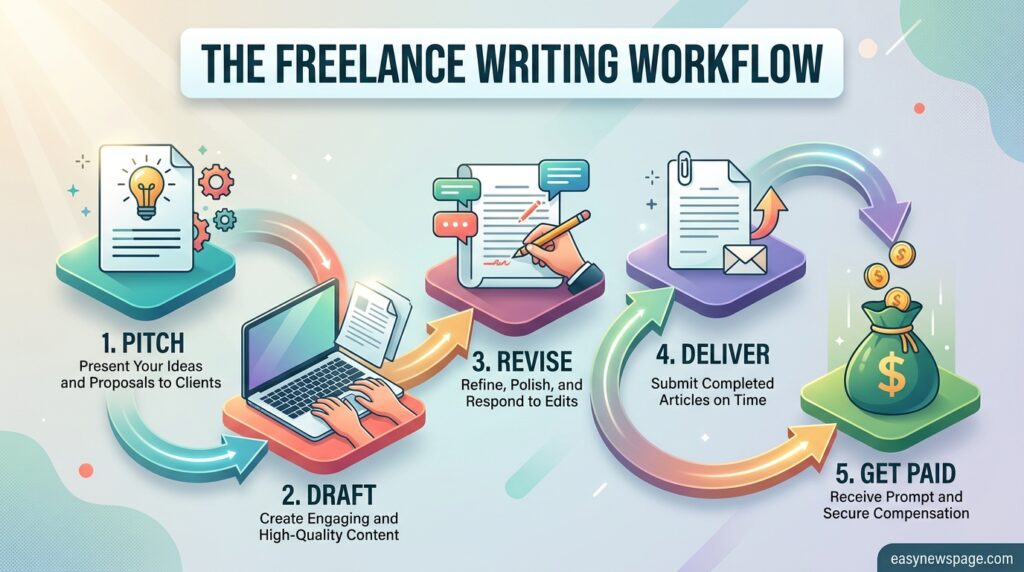
A typical beginner workflow: research the client’s audience and existing content, outline before drafting, write a focused first draft, self-edit for clarity and SEO basics, submit with a short cover note, and follow up once if there’s no response within a few days.
Dashboard Walkthrough
On marketplaces like Upwork, the dashboard centers on three tabs: Find Work (job feed), Proposals (your pitch history and status), and Contracts (active and completed jobs with payment status). Beginners should check the Find Work feed at least twice daily, since fresh postings get the highest response rates.
Setup Guide
Before pitching a single client, set up: a professional email address, a one-page portfolio site or a simple Google Doc of 3–5 writing samples, profiles on one or two platforms matching your niche, and a simple rate sheet so you’re never negotiating from scratch mid-conversation.
Step-by-Step Tutorial to Your First $1,000
Step 1: Pick one narrow niche. Choose something you can credibly write about — a past job, hobby, or industry you understand — rather than “general content,” which competes against everyone.
Step 2: Build 3–5 spec samples. Write pieces as if a real client commissioned them, matching the format (blog post, LinkedIn post, product page) you intend to pitch.
Step 3: Set a defensible starting rate. Based on 2026 benchmarks, price at $0.05–$0.10 per word or $50–$150 per 1,000-word article — enough to filter out the worst clients without pricing yourself out of your first jobs.
Step 4: Pitch daily, not sporadically. Send 3–5 tailored pitches every business day across one or two platforms; volume, not perfection, produces the first reply.
Step 5: Deliver fast and clean. A quick, well-edited first project often earns a repeat booking, which compounds toward $1,000 faster than chasing new clients each time.
Step 6: Raise rates after 3–5 completed jobs. Once you have real testimonials and a track record, move toward the intermediate range of $0.15–$0.30 per word.
Use Cases
Beginner-friendly freelance writing use cases include SEO blog posts for small businesses, product descriptions for e-commerce stores, LinkedIn ghostwriting for founders, email newsletters for solopreneurs, and short-form website copy for local service businesses.
Industry Use Cases
SaaS companies commonly hire freelancers for onboarding emails and help-center articles; e-commerce brands need product copy at scale; healthcare and finance buyers pay premium rates but require more research and compliance awareness; local businesses often need simple, fast-turnaround website and blog content.
Benefits
Freelance writing offers flexible hours, low startup cost, a short path to your first paid work compared to many freelance skills, and a clear route to higher rates as you specialize. It also scales well alongside a full-time job before a full transition.
Limitations
Income is inconsistent early on, competition at the lowest price tiers is intense, client-finding is an ongoing task rather than a one-time setup, and niches like SaaS or legal require real research time that beginners often underestimate.
Pros & Cons Table
| Pros | Cons |
|---|---|
| Low barrier to entry | Inconsistent early income |
| Flexible schedule | Requires constant client outreach |
| Scales with experience | Bottom-tier rates are highly competitive |
| Works alongside a day job | No built-in benefits or paid time off |
Explanation: The pros mostly compound over time — flexibility and scalability reward writers who stick with outreach past the slow first month, while the cons front-load into that same period, which is why most quitting happens before month two.
Pricing Table (2026 Benchmarks)
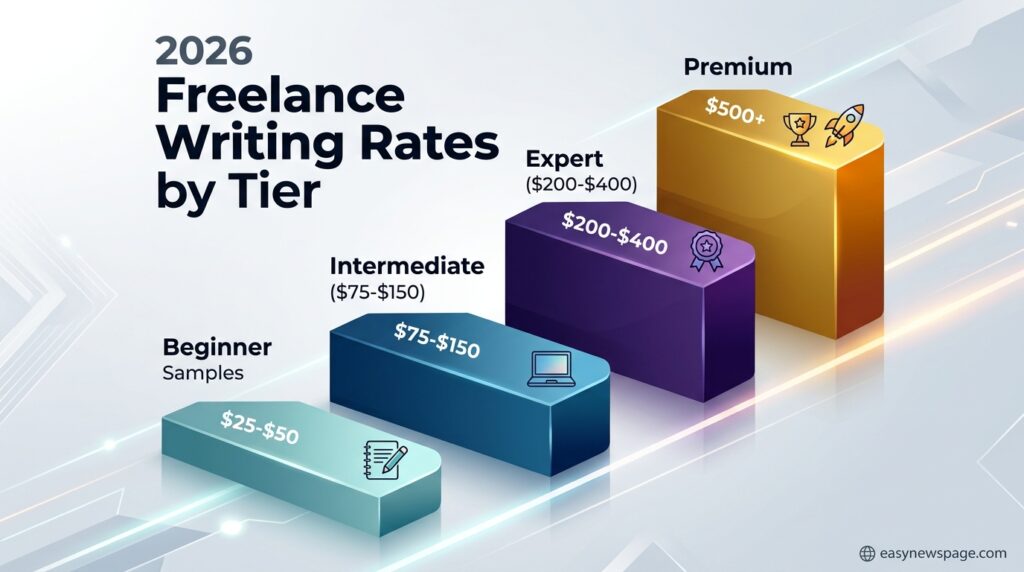
| Experience Tier | Per-Word Rate | Per 1,000-Word Article |
|---|---|---|
| Beginner (0–2 years) | $0.05–$0.15 | $50–$150 |
| Intermediate (2–5 years) | $0.15–$0.50 | $150–$500 |
| Expert (5–10 years) | $0.50–$1.25 | $500–$1,250 |
| Premium/Specialist (10+ years) | $1.25–$2.50+ | $1,250–$2,500+ |
Comparison Table: Ways to Reach Your First $1,000
| Method | Speed | Competition | Best For |
|---|---|---|---|
| Marketplace bidding (Upwork) | Moderate | High | Structured beginners |
| Niche job boards (ProBlogger, Contena) | Moderate–Fast | Medium | Focused niche writers |
| Cold LinkedIn outreach | Slower start, higher pay | Low | Confident communicators |
| Content agencies | Fast onboarding | Medium | Consistent volume seekers |
Specifications
A typical beginner project specification: 800–1,200 word blog post, one round of revisions included, 48–72 hour turnaround, delivered as a Google Doc with basic on-page SEO (title, headers, one target keyword woven naturally throughout).
Security, Privacy, and Compliance
Use platform escrow (Upwork, Fiverr) for first-time clients rather than upfront invoicing without protection. Avoid sharing personal banking details outside a platform’s built-in payment system, and use a written scope-of-work — even a short email confirmation — before starting unpaid platforms or direct-client work.
Performance
“Performance” here means turnaround reliability and revision efficiency rather than a software metric. Beginners who consistently deliver on time and limit revisions to one clean round tend to convert first jobs into repeat contracts at a noticeably higher rate than sporadic, slow responders.
Integrations
Freelance writers commonly pair a writing workflow with Google Docs for drafting, Grammarly or Hemingway for editing, a simple SEO tool for keyword checks, and a lightweight invoicing tool (or platform-native invoicing) for direct clients outside marketplaces.
API
Most beginner-relevant platforms (Upwork, Fiverr) don’t require or expose a public API for individual freelancers; API access typically matters only for agencies building custom job-matching tools, not for someone pursuing their first $1,000.
Customer Support
Marketplace platforms offer built-in dispute resolution and support tickets for payment issues. For direct clients, the “support” equivalent is a clear written agreement covering scope, deadline, and payment terms before work begins.
Latest Updates
The clearest 2026 shift is bifurcation at the low end: AI tools have compressed pay for generic, low-context content, while research-heavy niches (SaaS, finance, healthcare, legal) have held or grown their rates, rewarding writers who bring subject-matter context AI can’t easily replicate.
Expert Tips
Specialize as early as possible, even before you feel “expert enough.” Track every rejection and reply to identify which pitch angle is actually working. Raise rates the moment you have three finished, well-reviewed projects rather than waiting for a client to offer more unprompted.
Common Mistakes
The most common beginner mistakes are pricing at content-mill rates below $0.03/word, sending generic pitches with no reference to the client’s actual business, applying to dozens of jobs in one burst and then going quiet for a week, and skipping a portfolio in favor of “I’ll show them once I get the job.”
Troubleshooting
If pitches aren’t converting after two weeks of daily outreach, the likely cause is either a portfolio that doesn’t match the jobs you’re pitching, or a rate signal that reads as either too cheap (suspicious) or misaligned with your experience level — narrowing the niche usually fixes both at once.
Myths vs Facts
Myth: You need a journalism degree to freelance write. Fact: Most paying clients care about relevant samples and reliability far more than formal credentials.
Myth: Low rates are necessary to get your first clients. Fact: Rates below $0.03/word mostly attract clients who provide little useful feedback and rarely lead to repeat, higher-paying work.
Decision Matrix
| Criteria | Marketplace Bidding | Niche Job Boards | Cold Outreach |
|---|---|---|---|
| Speed to first job | 8/10 | 6/10 | 4/10 |
| Long-term pay ceiling | 5/10 | 7/10 | 9/10 |
| Competition level | 3/10 (high competition) | 6/10 | 8/10 |
| Beginner friendliness | 8/10 | 7/10 | 4/10 |
Beginner vs Advanced Path
Beginners should prioritize volume and speed to first payment over rate optimization, accepting some underpriced work to build proof. Advanced writers should prioritize rate increases, retainer relationships, and niche depth over adding new one-off clients.
Best Alternatives
Writers who find pure freelance writing too client-dependent sometimes pair it with content editing, UX writing contracts, or ghostwriting retainers, all of which draw on similar skills but offer more predictable monthly income once established.
Alternative Comparison
| Path | Income Stability | Startup Speed |
|---|---|---|
| Freelance writing (project-based) | Lower early on | Fast |
| Retainer ghostwriting | Higher once secured | Slower to land |
| Freelance editing | Moderate | Fast |
Read more: Freelance Writing vs Fiverr Gigs: Which Makes More Money?
Read more: 5 Mistakes to Avoid When Starting Freelance Writing
Read more: Freelance Writing for Beginners: Step-by-Step Guide (2026)
Who Should Use It
This path suits people with strong written English, comfort with rejection during outreach, and enough runway (financial or time) to sustain 4–8 weeks of inconsistent early income before momentum builds.
Who Should Avoid It
Freelance writing is a poor fit for anyone needing guaranteed monthly income immediately, or who isn’t willing to do daily outreach — passive portfolio-building alone rarely produces a first client fast enough to matter.
How long does it take to make your first $1,000 freelance writing?
Most disciplined beginners reach $1,000 within three to eight weeks, by stacking 8–15 smaller projects at beginner rates rather than landing one large client immediately.
What should a beginner charge per word for freelance writing?
In 2026, a defensible beginner rate is $0.05 to $0.10 per word, or roughly $50–$150 for a 1,000-word article, based on published industry rate surveys.
Do I need a portfolio before I can get paid freelance writing work?
Yes — even 3 to 5 unpaid spec samples written specifically for your target niche significantly improve reply rates compared to pitching with no samples at all.
Is Upwork or LinkedIn better for a first freelance writing client?
Upwork tends to produce a faster first job due to volume and built-in payment protection, while LinkedIn outreach is slower to start but often leads to higher-paying, longer-term client relationships.
Can you really make $1,000 a month freelance writing as a total beginner?
Yes — published 2026 income surveys put part-time beginner freelance writer income at roughly $500 to $2,500 per month, which aligns with a first $1,000 milestone within the first one to two months of consistent outreach.

Rating Scorecard
| Category | Score (out of 10) |
|---|---|
| Beginner accessibility | 8 |
| Income predictability (first 90 days) | 5 |
| Long-term earning ceiling | 8 |
| Time-to-first-payment | 7 |
| Overall for new freelancers | 7.5 |
Conclusion
Reaching your first $1,000 in freelance writing isn’t about talent alone — it’s a mechanical process of narrowing your niche, building proof of your writing without waiting for a paying client to grant it, pricing defensibly rather than racing to the bottom, and treating outreach as a daily habit rather than an occasional burst. The writers who cross this milestone quickly are rarely the most naturally gifted; they’re the ones who kept pitching through the quiet first two or three weeks, when it’s tempting to assume the whole thing isn’t working.
The moral underneath all of it: consistency beats perfection in the early stage of freelance writing. A slightly rough portfolio backed by five pitches a day will outperform a polished one sent out sporadically, almost every time. Once that first $1,000 lands — usually from a stack of smaller projects rather than one big win — the harder problem (finding any client at all) gives way to an easier one (choosing which clients are worth keeping and raising your rates accordingly).
If there’s one takeaway to carry forward, it’s this: treat your first $1,000 as proof of process, not proof of talent. The niche you picked, the outreach cadence you kept, and the rate floor you held are the levers that actually produced the result — and they’re the same levers that will take you from your first $1,000 to your next $10,000.
Official Sources
- Editorial Freelancers Association, 2026 Rate Chart (survey of 1,100+ editorial professionals)
- American Writers and Artists Institute, 2026 Freelance Copywriting Rate Survey (via Mediabistro)
- Independent 2026 surveys of active freelance writers on per-word and hourly rate benchmarks (EarnifyHub, freelancerates.net, Tools for Writing)
Author Bio
This guide was researched and written by the easynewspage.com editorial team, drawing on published 2026 freelance-industry rate surveys and platform documentation rather than a single individual’s unverified personal results. Figures are sourced and dated where available; estimates are labeled as such.