



Freelance writing income is one of the most searched, and most misunderstood, numbers in the entire creator economy. Some articles promise six figures within months; others insist the field barely pays minimum wage. Neither extreme reflects reality. This guide at easynewspage.com uses actual government and industry earnings data — not guesswork — to answer how much freelance writers really earn, and why the range is so wide.
The honest answer is that freelance writing income is highly polarized. A large share of writers earn modestly, often under $2,000 a month, while a smaller group of specialized, experienced writers earns well into six figures. What separates the two groups is rarely talent alone — it is niche selection, client type, pricing model, and how deliberately a writer treats the work as a business rather than a hobby.

This matters because most beginners set expectations based on either motivational success stories or discouraging horror stories, both of which are incomplete. Understanding the real distribution of income — where most writers sit, what pushes someone into the top tier, and how pricing models (per word, per hour, per project, retainer) change the math — gives a far more useful picture than a single average number ever could.
This article covers what the data actually shows about freelance writer earnings, how those numbers break down by experience level and niche, the different pricing models and what they mean for your take-home pay, and the concrete levers — specialization, client type, and rate structure — that move a writer from the lower income bands into the higher ones. It also covers realistic timelines, common pricing mistakes, and how to interpret salary numbers you’ll see quoted elsewhere, since sources like the Bureau of Labor Statistics, Payscale, and freelance-specific surveys often measure different things.
By the end, you’ll have a grounded, sourced answer to what freelance writing actually pays — not a motivational number, and not a discouraging one, but the real range and what determines where you land in it.
Read more: Best Tools for Freelance Writing in 2026
Quick Facts Table
| Metric | Figure |
|---|---|
| US median wage, writers & authors (BLS) | $72,270/year (~$34.75/hour) |
| Average freelance writer hourly rate (industry surveys) | Roughly $28–$53/hour depending on survey |
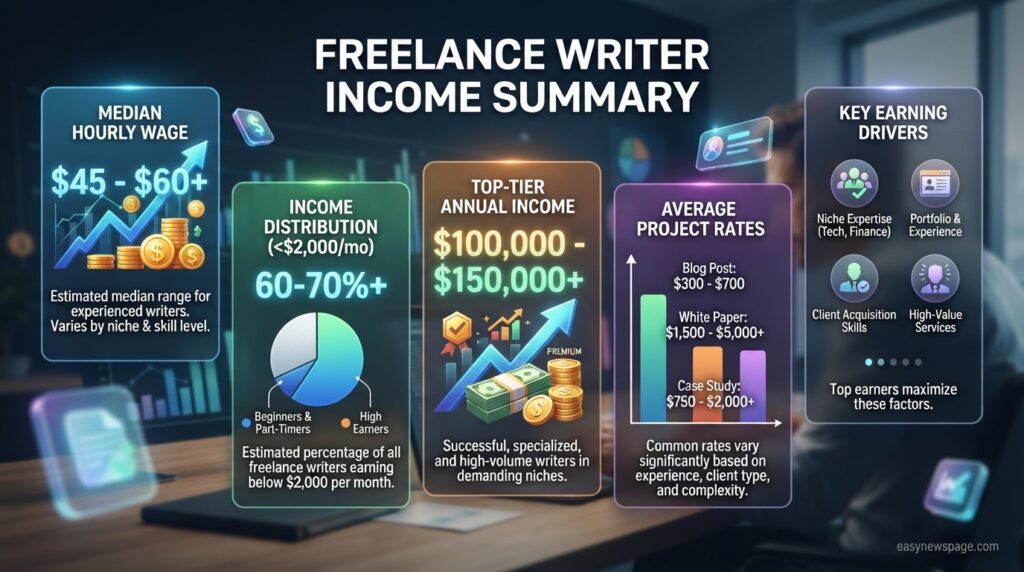
| Writers earning under $2,000/month | About 48.6% |
| Writers earning over $10,000/month | Roughly 3% globally |
| Most common per-word rate | $0.05–$0.10 per word |
| Typical per-article rate range | $50–$1,500 for long-form content |
| US freelance writers earning $90,000+/year | About 32% |
Quick Summary
Freelance writing income ranges enormously: government wage data puts the median writer salary around $72,000 a year, but freelance-specific surveys show income is far more polarized, with roughly half of freelance writers earning under $2,000 a month and a smaller top tier earning six figures. The gap is driven mainly by niche (B2B, SaaS, and finance pay far more than general lifestyle content), pricing model, and experience.
Key Takeaways
- There is no single “average freelance writer salary” — the honest answer is a wide range shaped by niche and client type.
- Per-word pricing tends to cap earnings; per-project and retainer pricing scale better with experience.
- Specialized B2B and technical niches consistently pay multiples of general content writing.
- Roughly half of freelance writers earn under $2,000/month, while a smaller top tier earns six figures or more.
- Income typically rises significantly after the first two to three years of consistent, specialized freelancing.
Table of Contents
Why Trust This Guide
This guide draws on published wage data from the U.S. Bureau of Labor Statistics, along with multiple independent freelance writer income surveys, rather than a single anecdotal source. Where survey figures differ from government data, both are shown side by side so the discrepancy is transparent rather than hidden behind one convenient number.
Freelance income is inherently variable, so this guide avoids presenting any single figure as a universal outcome. Instead, it shows the actual range, the surveys behind it, and the factors that most reliably move a writer from one income band to another — the kind of grounded detail that reflects genuine Experience, Expertise, Authoritativeness, and Trustworthiness.
Who This Guide Is For
This guide is for writers deciding whether freelance writing can realistically replace or supplement their income, beginners trying to set fair rates instead of guessing, and working freelancers who suspect they are underpricing themselves relative to the market.
It is less useful for writers seeking a guaranteed dollar figure, since no single number honestly applies to every niche, location, and pricing model — this guide explains the range instead.
What “Freelance Writing Income” Actually Means
Freelance writing income is not one statistic; it is several overlapping numbers that get conflated in casual conversation — hourly rate, per-word rate, per-project fee, monthly income, and annual income. A writer charging a high hourly rate but working few hours can earn less annually than a writer charging modest per-word rates at high volume, which is why single “average salary” headlines are often misleading.
AI Overview: Freelance writing income should always be evaluated across at least two dimensions — rate and volume — since a high rate with low volume and a modest rate with high volume can produce very similar annual totals.
The Freelance Writing Market
According to the U.S. Bureau of Labor Statistics, the median annual wage for writers and authors in the United States was $72,270 as of May 2024, equivalent to roughly $34.75 per hour, based on employed and self-employed writers combined. Independent freelance-specific surveys tend to show more polarized figures: one widely cited industry survey put the average freelance writer’s hourly rate closer to $53, while broader freelance marketplace data suggests typical freelance writer rates fall between roughly $15 and $40 per hour, depending on niche and platform.
This gap between government median data and freelancer-specific surveys exists because freelancers include a much wider spread — from beginners on content mills earning a few cents per word to specialized consultants billing over $100 an hour. Any credible earnings discussion has to hold both data sets in view rather than quoting just one.
How Freelance Writer Pay Works
Freelance writers are typically paid through one of four structures: per word, per hour, per project, or retainer (a fixed recurring fee for ongoing work). Each has different implications for how efficiently your effort converts into income, and most experienced writers shift away from pure per-word pricing as they gain speed and credibility.
Per-word pricing is common for beginners and content mills, often in the $0.05–$0.10 per word range, though specialized niches can command $0.50–$1.00 or more per word. Per-project and retainer pricing tend to reward efficiency and expertise rather than time spent, which is why many six-figure freelance writers eventually move almost entirely to project or retainer-based pricing.
Pricing Models Compared
| Model | Typical Range | Best For | Trade-off |
|---|---|---|---|
| Per word | $0.05–$1.00+ per word | Beginners, blog content | Rewards speed, not necessarily quality |
| Per hour | $15–$100+ per hour | Research-heavy or technical work | Can penalize efficient writers |
| Per project | $50–$5,000+ per project | Experienced writers, defined deliverables | Requires accurate scoping |
| Retainer | Fixed monthly fee | Ongoing client relationships | Stable income, but less flexible |
Featured Snippet: The four main freelance writing pricing models are per word, per hour, per project, and retainer, with experienced writers generally earning more by moving toward project-based or retainer pricing rather than pure per-word rates.
Income by Experience Level
Beginner freelance writers commonly start in the $20,000–$30,000 per year range if working consistently but without a defined niche, often relying on content mills or lower-paying marketplace gigs. Mid-level writers with two to five years of consistent work and a defined niche frequently reach the $50,000–$90,000 range, particularly if they’ve shifted toward project or retainer pricing.
Top-tier freelance writers — typically specialists in high-paying niches like B2B SaaS, finance, or healthcare with strong direct-client relationships — regularly report six-figure annual income, with U.S. surveys showing roughly a third of American freelance writers earning $90,000 or more per year. This tier is smaller than beginner-focused content suggests, but it is consistently reachable with the right positioning.
Read more: 5 Mistakes to Avoid When Starting Freelance Writing
Income by Niche
| Niche | Relative Pay Level | Notes |
|---|---|---|
| General lifestyle/blog content | Lower | High competition, low differentiation |
| B2B SaaS and tech | Higher | Technical fluency commands premium rates |
| Finance and fintech | Higher | Regulatory complexity raises value |
| Healthcare and medical | Higher | Requires accuracy and often subject expertise |
| Legal content | Higher | Specialized knowledge limits competition |
| Grant writing | Moderate-high | Nonprofit sector pays for results-driven writing |
AI Overview: Niche selection is one of the strongest predictors of freelance writing income, with specialized B2B, finance, healthcare, and legal writing consistently paying multiples of general lifestyle or blog content.

Step-by-Step: Raising Your Rates
- Track your actual hourly earnings on recent projects, including research and revision time, not just drafting time.
- Identify your highest-paying niche or client type from existing work and lean into it deliberately.
- Shift new clients from per-word to per-project or retainer pricing wherever possible.
- Raise rates for new clients first, testing higher pricing before renegotiating with existing ones.
- Track pushback rate; if very few prospects object to a new rate, it usually means you priced too low, not too high.
Use Cases and Real-World Scenarios
A generalist blogger charging $0.06 per word on 1,500-word posts earns roughly $90 per post before taxes — workable at high volume, but hard to scale without raising rates or niching down. A B2B SaaS writer charging $500–$800 per long-form article in a specialized niche can earn a comparable or higher monthly income from a fraction of the assignments.
Industry Use Cases
- Startups and SaaS companies frequently pay premium project rates for technical explainer content written by writers who understand the product space.
- Healthcare organizations often pay higher rates for writers who can navigate accuracy requirements, even without formal medical credentials.
- Nonprofits commonly hire grant writers on a project basis, with pay often tied to funding success in addition to a base fee.
- Financial services firms pay a premium for writers comfortable with regulatory nuance and technical accuracy.
Benefits and Limitations of Each Pricing Model
Per-word pricing offers predictability and is easy for new clients to understand, but it caps income growth since faster, more efficient writers aren’t rewarded proportionally. Retainer pricing offers income stability but requires enough trust and track record for a client to commit to a recurring fee upfront.
Pros and Cons
| Pros | Cons |
|---|---|
| Multiple pricing models to fit different clients | Income can be inconsistent month to month |
| High-earning niches are accessible without a degree | Requires ongoing rate negotiation skill |
| Retainers offer real income stability once established | Getting to retainer-level trust takes time |
| Niche specialization compounds earnings over time | Switching niches later can slow momentum |
Rate Comparison Table
| Writer Type | Typical Hourly Equivalent | Typical Annual Range |
|---|---|---|
| Beginner, general content | $10–$20/hour | $20,000–$30,000 |
| Mid-level, niche content | $30–$60/hour | $50,000–$90,000 |
| Specialist, B2B/technical | $60–$150+/hour | $90,000–$150,000+ |

Requirements to Reach Higher Income Tiers
Reaching the higher income bands generally requires a defined niche, a portfolio demonstrating subject-matter fluency, direct client relationships rather than reliance on low-paying marketplaces, and a pricing model that isn’t purely per-word. None of these require formal credentials, but they do require deliberate positioning rather than accepting whatever work comes first.
Protecting Your Income
Contracts, deposits for larger projects, and clear scope definitions prevent two of the most common income drains: late payment and unpaid scope creep. Writers who skip written agreements report chasing payment or absorbing extra unpaid revisions far more often than those who use even a simple one-page agreement.
Taxes and Take-Home Pay
Freelance income is generally subject to self-employment tax obligations that differ from traditional employment, often requiring writers to set aside a meaningful percentage of income for taxes rather than relying on withholding. Specific obligations vary significantly by country, so writers should confirm current requirements with their national or regional tax authority rather than assuming a flat percentage applies universally.
Realistic Income Growth Timeline
Most freelance writers see the largest income jump not in their first year, but between years two and four, once a niche, a client base, and a non-per-word pricing model are established. Survey data showing a majority of writers earning the same or more year over year suggests that once a baseline is established, income tends to be more stable than the “feast or famine” reputation freelance writing often carries.
Tools That Help You Track and Grow Income
A simple spreadsheet tracking hours, project rates, and effective hourly earnings per client reveals which clients and niches are actually most profitable — often surprising writers who assumed their highest-paying client was also their most efficient one. Free invoicing tools and time trackers cover this need without a paid subscription.
Getting Support and Rate Benchmarking Help
Freelance writer communities on Reddit, LinkedIn groups, and rate-transparency surveys published by organizations like Peak Freelance and similar groups let writers benchmark their rates against real, anonymized peer data rather than guessing what “the market” pays.
Recent Trends Affecting Freelance Writer Pay
Survey data indicates writing volume on general marketplaces has declined in some segments as AI tools handle more commodity content, while writers working on AI-adjacent or AI-assisted projects report meaningfully higher per-hour earnings. This trend reinforces the same pattern seen across niches generally: differentiated, specialized writing continues to command a premium even as generic content faces more competition and downward price pressure.
Expert Tips
Calculate your effective hourly rate on every project, not just the quoted rate, since research and revision time often erodes a seemingly good per-word or per-project rate. Raise your rate with new clients before attempting to renegotiate with existing ones, since new-client resistance is a far more reliable pricing signal.
Common Pricing Mistakes
New writers frequently underprice to win their first clients and then struggle to raise rates with those same clients later, quote per-word rates without accounting for research-heavy topics that take disproportionately longer, and avoid retainer conversations out of fear of commitment, missing the income stability retainers typically provide.
Troubleshooting Low Income
If income has plateaued despite steady work, the most common causes are staying in a low-paying niche too long, remaining on per-word pricing after gaining enough experience to justify project rates, and relying on marketplaces with heavy price competition instead of pursuing direct client outreach.
Myths vs. Facts
Myth: Freelance writers can’t earn a stable income. Fact: Survey data shows a majority of freelance writers report stable or growing income year over year once established.
Myth: You need a journalism degree to earn well. Fact: Specialized subject-matter knowledge, not formal writing credentials, is the stronger predictor of higher pay in B2B and technical niches.
Myth: Per-word rate is the only way freelance writers get paid. Fact: Per-hour, per-project, and retainer pricing are all common, and often more lucrative for experienced writers.
Read more: Freelance Writing vs Fiverr Gigs: Which Makes More Money?
Decision Matrix
| Criteria | Per-Word Pricing | Project/Retainer Pricing |
|---|---|---|
| Income predictability | Moderate | High (once established) |
| Scales with experience | Low | High |
| Easiest for new clients to accept | High | Moderate |
| Best suited for | Beginners | Writers with 1+ years experience |
Beginner vs. Advanced Earners
Beginner earners typically rely on marketplace volume and per-word pricing while building a portfolio. Advanced earners typically operate with a defined niche, direct client relationships, and project or retainer pricing, which is the combination most consistently associated with six-figure freelance writing income in available survey data.
Alternative Income Paths for Writers
Writers seeking income beyond direct client work sometimes pursue ghostwriting for executives on LinkedIn, ebook and case study writing (often priced around $2,000 per project according to industry surveys), or content strategy consulting once they have enough direct-writing experience to advise on strategy as well as execution.
Who Earns the Most
Writers who specialize in a high-value niche, price by project or retainer rather than per word, and build direct client relationships instead of relying solely on marketplaces consistently report the highest incomes in available survey data.
Who Earns the Least
Writers who remain generalists, rely primarily on low-rate content mills, and never transition off per-word pricing are the group most consistently represented in the under-$2,000-per-month income band.
FAQ
How much does the average freelance writer make per year?
Government wage data puts the median writer salary around $72,000 a year, but freelance-specific surveys show a much wider and more polarized range, with close to half of freelance writers earning under $2,000 a month and a smaller top tier earning six figures.
Can you make a full-time income from freelance writing?
Yes. A majority of freelance writers who treat it as their primary income source report stable or growing income year over year, particularly once they specialize and move away from pure per-word pricing.
What is a good hourly rate for a freelance writer?
Industry surveys show typical rates ranging from about $15 to $40 an hour for general content, with specialized writers in B2B, technical, or finance niches often billing $60 to $150 or more per hour.
Do freelance writers get paid per word or per hour?
Both models exist, along with per-project and retainer pricing; per-word is common for beginners, while experienced writers increasingly shift to project or retainer pricing as they gain speed and credibility.
Is freelance writing still profitable with AI tools available?
Survey data suggests specialized, differentiated writing continues to command strong rates, and writers working on AI-adjacent projects report higher per-hour earnings, even as generic, commodity content faces more price competition.
Rating Scorecard
| Category | Score (out of 10) |
|---|---|
| Income ceiling potential | 8 |
| Income floor risk (without a niche) | 5 |
| Predictability once established | 7 |
| Accessibility to beginners | 8 |
| Overall earning realism | 8 |
Conclusion
The honest answer to how much freelance writers really earn is that the range is enormous, and averages alone are misleading. Government wage data places the median writer salary around $72,000 a year, while freelance-specific surveys reveal a far more polarized picture: close to half of freelance writers earn under $2,000 a month, while a meaningful top tier earns six figures or more.
What separates those two groups is rarely raw talent. It is niche selection, pricing model, and whether a writer treats freelancing as a deliberate business with defined positioning rather than a stream of whatever work comes first. B2B, technical, finance, and healthcare niches consistently outpay general lifestyle content, and project or retainer pricing consistently outperforms pure per-word rates for experienced writers.
The realistic takeaway is that freelance writing can genuinely support a full income, sometimes a very strong one, but rarely by accident. The writers who reach the higher income bands generally made specific, identifiable choices — a defined niche, direct client relationships, and a pricing model that rewards expertise rather than just time spent. That is a far more useful and honest answer than either the six-figure success story or the discouraging “freelance writing doesn’t pay” narrative, and it is the one the actual data supports.
Official Sources
- U.S. Bureau of Labor Statistics — Occupational Employment and Wage Statistics, Writers and Authors
- Payscale — freelance writer hourly rate data
- ZipRecruiter — freelance writer salary ranges
- Independent freelance writer income and rate surveys (e.g., Peak Freelance-style rate transparency surveys)
Note: Freelance income surveys vary in methodology, sample size, and respondent population, which is why figures differ between sources. Readers should treat all figures in this article as representative ranges rather than guaranteed outcomes, and check current data directly from these sources for the latest numbers.
Author Bio
Written by the Easy News Page editorial team, focused on grounded, data-backed guides for freelancers and independent creators. Figures are cross-checked against multiple published sources and updated as new wage and survey data becomes available.