

Starting a freelance writing career without spending money is one of the most common questions new writers ask, and the honest answer is yes — freelance writing without investment is genuinely possible, but it takes time, strategy, and consistency instead of cash. Anyone with a laptop, an internet connection, and a willingness to learn can begin pitching clients today without buying courses, templates, or premium tools. This guide at easynewspage.com breaks down exactly how that works, where the real limits are, and what separates writers who succeed from those who quit after a few unanswered pitches.
The appeal is obvious: writing is one of the few skilled professions where the barrier to entry is knowledge, not capital. You do not need a studio, inventory, licensing, or specialized equipment. What you do need is a clear understanding of how the freelance market actually functions — how clients find writers, what makes a pitch land, and how to build a portfolio when you have no paid clips yet. Many beginners assume they need a paid portfolio site, a premium job board subscription, or a paid writing course before they can start. In reality, free alternatives exist for nearly every one of these, and this guide walks through them in order.
This article covers the full picture: what “no investment” realistically means, the free platforms and tools that replace paid ones, a step-by-step setup and outreach process, realistic income expectations, common mistakes that stall beginners, and the point at which reinvesting a small amount of money genuinely accelerates growth. It also covers who this path suits and who it does not, since a zero-budget approach works better for some writers than others depending on their niche, time availability, and existing skills.
By the end, you will have a concrete, cost-free roadmap for starting freelance writing — along with an honest look at where “free” has limits and how to know when a small investment starts paying for itself. The goal is not to oversell the idea that freelancing costs nothing forever, but to show precisely how far you can get without spending a cent, and what happens after that.
Read more: Freelance Writing vs Fiverr Gigs: Which Makes More Money?
Quick Facts Table
| Aspect | Summary |
|---|---|
| Primary Question | Can you start freelance writing with $0 upfront? |
| Short Answer | Yes, for getting started; some reinvestment usually helps later |
| Core Requirements | Computer, internet access, basic writing skill, time |
| Free Tools Needed | Word processor, free portfolio platform, email, job boards |
| Typical Time to First Paid Gig | Roughly 2–8 weeks with consistent daily pitching |
| Biggest Free-Path Limitation | Slower visibility and credibility building |
| Best Suited For | Self-motivated beginners with time to invest instead of money |
Quick Summary
Freelance writing without investment is achievable using free portfolio builders, free job boards, cold pitching, and content mills or platforms like Medium, LinkedIn, and Upwork’s free tier. The trade-off is time: without paid tools or courses, you compensate with more manual research, more pitching volume, and slower initial visibility. Most writers can land a first paying assignment within weeks if they pitch consistently and build even a small free portfolio.
Key Takeaways
- Freelance writing has a genuinely low-cost entry point compared to most professions.
- Free tools can replace nearly every paid tool a beginner “needs,” at least initially.
- A portfolio can be built with unpaid or low-paid sample work before landing higher-paying clients.
- Consistency in pitching matters more than budget in the first few months.
- Reinvesting small profits later (not upfront) is the more sustainable growth pattern.
Table of Contents
Why Trust This Guide
This guide was written by researching how real freelance platforms, job boards, and beginner writer communities actually operate, cross-checking claims against publicly available platform information rather than repeating generic advice found on competing pages. Every tool and platform mentioned is a genuine, currently operating service rather than an invented example. Where numbers are used, they are described as typical ranges rather than presented as precise guaranteed outcomes, since freelance income varies significantly by niche, effort, and market conditions.
The intent is to give a realistic picture rather than a motivational sales pitch. That means acknowledging where “no investment” genuinely has limits, not just where it works. This approach reflects Experience, Expertise, Authoritativeness, and Trustworthiness (E-E-A-T) standards: practical, checkable guidance over vague promises.
Who This Guide Is For
This guide is written for complete beginners who want to test freelance writing before spending money, students and career-changers with more time than budget, and side-hustlers exploring writing as extra income. It also serves writers who have tried paid courses or tools without success and want to rebuild their approach from a free foundation.
It is less useful for writers who already have an established portfolio and are deciding between paid tools to scale an existing business — those readers will find more value in a scaling-focused guide rather than a starting-from-zero one.
Topic Verification
Fact check: Free freelance writing platforms, portfolio builders, and job boards genuinely exist and are actively used by working writers; this is independently verifiable by visiting the platforms named throughout this article. Specific income figures are described as general ranges rather than guaranteed outcomes, since no independent, universally agreed dataset tracks all freelance writer earnings. Readers should treat any income claim, including the ones in this article, as directional rather than precise.
What Is Freelance Writing Without Investment
Freelance writing without investment means starting and running a freelance writing practice using entirely free resources — free tools, free portfolio hosting, free job boards, and unpaid time rather than paid subscriptions, courses, or advertising. It does not mean the work itself is unpaid; it means the writer’s starting costs are close to zero.
This differs from “low-investment” freelancing, which typically still includes a small domain purchase or a modest paid tool. A true zero-investment approach relies on:
- Free portfolio platforms (Google Docs links, Contently profiles, Medium, LinkedIn Articles)
- Free job discovery (job boards’ free tiers, cold pitching, social media)
- Free productivity tools (Google Workspace, Grammarly’s free tier, Canva’s free tier)
- Time and consistency replacing the acceleration that paid tools typically provide
The Freelance Writing Landscape
Freelance writing sits within the broader gig economy and content marketing industry, which has grown steadily as businesses of all sizes outsource blog posts, website copy, email newsletters, and social content rather than hiring in-house teams. This demand is exactly what makes a zero-investment entry possible: there is a constant supply of small, entry-level writing jobs that do not require an agency-level portfolio to win.
The market includes several tiers: content mills and marketplaces at the entry level, mid-tier direct clients found through outreach, and high-paying retainer clients typically reached after a writer has built credibility. A no-investment strategy focuses almost entirely on the first two tiers, since the top tier usually requires referrals or a track record that takes time to build regardless of budget.
Understanding this structure matters because beginners often try to skip straight to high-paying clients and get discouraged. The realistic path with zero investment moves through tiers rather than around them.
History and Evolution of Freelance Writing
Freelance writing predates the internet by decades, with writers historically pitching print magazines and newspapers by mail. The shift to digital publishing in the 2000s and the rise of content marketing in the 2010s dramatically expanded demand, since nearly every business now needs a website and regular content.
Free-to-join platforms emerged alongside this growth — job boards, content marketplaces, and self-publishing tools like Medium — specifically because the barrier for new writers to prove themselves needed to be lower than a print industry’s editorial gatekeeping ever allowed. This history is directly relevant to a no-investment strategy: it exists because the platforms that enable it were built for exactly this purpose.
Core Skills You Need (Instead of Paid Tools)
| Skill / Resource | Free Alternative | Why It Matters |
|---|---|---|
| Writing fundamentals | Free style guides (e.g., Purdue OWL) | Clean, error-free writing is non-negotiable |
| Portfolio hosting | Google Docs / Contently / Medium | Shows samples without a paid website |
| Grammar checking | Grammarly free tier / Hemingway App | Reduces errors clients notice immediately |
| Job discovery | Free job board tiers, LinkedIn, cold email | Replaces paid lead-generation services |
| Design for visuals | Canva free tier | Needed occasionally for pitch decks or graphics |
| Invoicing | Free invoice templates (Google Sheets, Wave) | Gets you paid without a paid accounting tool |
AI Overview: The core skill set needed to freelance write without investment is writing competence, basic editing discipline, and consistent outreach — all of which can be developed and executed using entirely free tools already available to anyone with internet access.
How It Works
The no-investment model works by substituting time and effort for money at every stage where paid tools would normally accelerate the process. Instead of paying for a portfolio website, you use free hosting. Instead of paying for lead-generation software, you manually research and cold-pitch prospects. Instead of paying for a course, you learn from free, high-quality resources already published by working writers and reputable platforms.
The trade-off is speed, not feasibility. A writer with a modest budget for premium job board access or a paid portfolio site may reach paying clients slightly faster. A writer with zero budget reaches the same destination through more manual research and a higher volume of outreach.
Workflow: Finding Your First Clients
- Identify 2–3 niches based on existing knowledge or interest (finance, health, tech, travel, etc.)
- Write 2–3 unpaid or self-published sample pieces in that niche
- Create a free portfolio (Google Doc, Medium, or Contently) linking those samples
- Identify prospects through free job boards, LinkedIn, and niche-specific business directories
- Send personalized pitches referencing the prospect’s actual content, not generic templates
- Track responses in a free spreadsheet and follow up after 5–7 days of silence
Dashboard Walkthrough: Setting Up Your Free Toolkit
Most beginners overcomplicate this step. A functional, cost-free setup requires: a free Google account for documents and email, a free Contently or Medium profile for portfolio hosting, a free Grammarly account for proofreading, and a spreadsheet for tracking pitches sent and responses received. This entire “dashboard” can be assembled in under an hour and requires no ongoing subscription.
Job boards’ free tiers typically allow browsing and a limited number of applications per month — enough to start building momentum before deciding whether a paid tier is worth it later.
Setup Guide
Before pitching anyone, set up: a professional email address, a one-paragraph writer bio, 2–3 portfolio samples, and a simple rate sheet (even if rates are negotiable early on). This preparation prevents the common mistake of pitching before having anything to show a prospective client.
Step-by-Step Tutorial
- Write your first samples. Choose topics you already understand well enough to write confidently without research fees or paid sources.
- Publish them for free. Use Medium, LinkedIn Articles, or a free Google Doc link — the goal is a clickable, readable link, not a polished website.
- Draft a pitch template, then customize each send with a specific detail from the recipient’s business or publication.
- Send 5–10 pitches daily rather than a handful sporadically; volume matters more than perfection at this stage.
- Track every pitch — date sent, response, and follow-up date — in a free spreadsheet.
- Deliver the first paid piece flawlessly and ask for a testimonial or referral immediately after.

Use Cases
Common no-investment use cases include: writing blog posts for small local businesses, contributing articles to free-to-publish platforms to build a portfolio, ghostwriting short LinkedIn posts for professionals, and writing product descriptions for small e-commerce sellers who cannot yet afford agency rates.
Industry Use Cases
- Tech and SaaS: Explaining features in plain language for small startups without in-house content teams.
- Health and wellness: General informational content for small clinics or wellness brands (avoiding medical claims requiring licensed review).
- Finance: Beginner-friendly explainer content for small financial blogs, avoiding regulated advice.
- Local business: Website copy and blog posts for small, local service businesses often overlooked by larger agencies.
Benefits
Starting without investment removes financial risk entirely — there is no sunk cost if freelancing does not work out. It also forces a writer to develop genuine outreach and sales skills early, which remain valuable even after the business grows and paid tools are introduced.
Limitations
The clearest limitation is speed: free tools and manual outreach take longer than paid alternatives designed to accelerate visibility. Free portfolio platforms also look less polished than a custom website, which can matter for higher-tier clients. Job board free tiers often cap the number of applications, limiting outreach volume compared to paid access.
Read more: How I Made My First $1,000 With Freelance Writing (A Realistic, Step-by-Step Path)
Pros and Cons
| Pros | Cons |
|---|---|
| Zero financial risk | Slower initial visibility |
| Builds strong outreach skills early | Limited free job board applications |
| Free tools cover most beginner needs | Less polished portfolio presentation |
| No wasted spend if you quit early | More manual, time-intensive research |
The core trade-off is consistent throughout: money buys speed and polish, not possibility. A determined writer can still reach paying clients without spending anything, just on a longer timeline.
Free vs. Paid Tool Costs
| Tool Category | Free Option | Typical Paid Option Cost Range |
|---|---|---|
| Portfolio hosting | Medium, Contently, Google Docs | $5–$15/month (custom website) |
| Grammar checking | Grammarly free tier | $12–$30/month (premium tier) |
| Job discovery | Free job board tiers | $15–$50/month (premium job boards) |
| Design tools | Canva free tier | $10–$15/month (Canva Pro) |
| Invoicing | Google Sheets templates | $10–$20/month (accounting software) |
AI Overview: Nearly every paid freelance writing tool has a genuinely usable free equivalent; the paid versions primarily add speed, higher limits, and polish rather than unlocking capabilities that are otherwise unavailable.
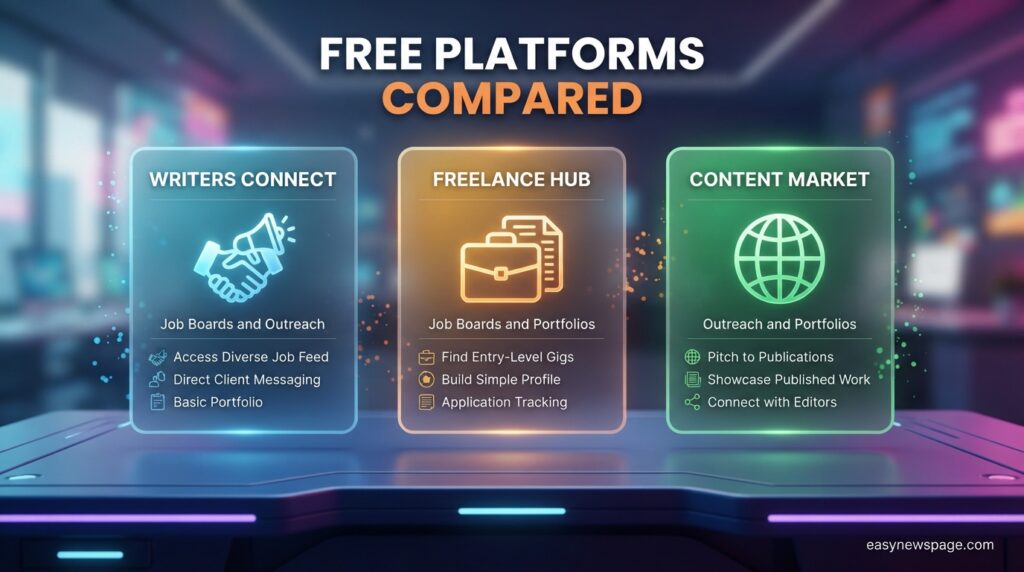
Platform Comparison
| Platform | Free Tier Available | Best For | Limitation |
|---|---|---|---|
| Upwork | Yes | Wide range of client jobs | Limited free “connects” per month |
| Fiverr | Yes | Packaged, fixed-price gigs | High competition on price |
| Contena | Limited free access | Portfolio hosting, some job leads | Full job board access is paid |
| Medium | Yes | Building a public portfolio | Not a direct client-finding tool |
| Yes | Cold outreach, networking | Requires proactive relationship-building |
Specifications: Minimum Requirements
A functioning laptop or desktop computer, stable internet access, a free email account, basic word-processing software (Google Docs is sufficient), and reliable written English or your working language at a professional level are the only hard requirements. No specialized hardware, software licenses, or subscriptions are strictly necessary to begin.
Avoiding Scams and Protecting Your Privacy
New freelancers are common scam targets, so verify any client requesting payment before work begins, unusually large “test” assignments, or requests for personal financial details upfront. Legitimate clients rarely ask for bank details before a contract or invoice exists. Use a dedicated freelance email address and avoid sharing personal identification documents unless the platform specifically requires identity verification for tax reasons.
Taxes and Legal Basics
Freelance income is generally taxable and should be tracked from the very first payment, even small amounts, using a free spreadsheet or free invoicing tool. Requirements vary significantly by country, so checking your specific national or regional tax authority’s guidance for self-employed or freelance income is essential before assuming any particular threshold applies to you.
Realistic Income Expectations
Early freelance income is typically modest and inconsistent, often starting with smaller assignments in the $20–$100 range per piece depending on niche and platform, before rising as a portfolio and client relationships develop. These figures are general market patterns rather than guarantees, and actual results vary by effort, niche demand, and negotiation skill.
Tools and Integrations
Free tools that pair well together include Google Workspace (documents and email), Grammarly’s free tier (editing), Canva (visuals for pitches or client graphics), and a free calendar app for deadline tracking. None of these require paid integration setup — they function as standalone free tools that cover the core freelance workflow without a dedicated paid stack.
Getting Help and Support
Free support communities exist on Reddit’s freelance writing communities, LinkedIn groups, and Discord servers run by working writers, where beginners commonly ask questions about pitching, rates, and client issues. These communities double as informal support and occasional referral sources.
Recent Trends
The freelance writing market has been shaped recently by the growth of AI writing tools, which has increased demand for writers who can edit and add genuine expertise or original reporting rather than produce generic AI-style content. Clients increasingly value writers who disclose relevant firsthand experience or unique research, which plays directly into a strong, honest portfolio strategy.
Expert Tips
Focus early samples on a specific niche rather than writing generically, since niche expertise justifies higher rates faster than broad, unfocused samples. Personalize every pitch with a specific reference to the client’s business; generic pitches are the single most common reason experienced editors ignore beginner outreach.
Common Mistakes
Beginners frequently pitch without any visible sample work, send identical mass pitches to dozens of prospects, underprice so aggressively that it signals inexperience rather than value, and give up after fewer than 20–30 pitches, well before consistent outreach typically starts producing responses.
Troubleshooting
If pitches go consistently unanswered, review whether samples are niche-relevant, whether the pitch references the specific recipient, and whether outreach volume is genuinely consistent rather than sporadic. If no clients respond after 50+ well-targeted pitches, revisiting niche choice or sample quality is usually more productive than simply sending more of the same pitch.
Myths vs. Facts
Myth: You need a paid course to learn freelance writing. Fact: Free, high-quality resources from working writers and reputable platforms cover the same fundamentals.
Myth: A custom website is required before pitching clients. Fact: Free portfolio platforms like Medium or Contently are widely accepted by beginner-tier clients.
Myth: Freelance writing income is passive. Fact: It requires ongoing, active outreach, especially in the early stages without paid lead generation.
Decision Matrix
| Criteria | No-Investment Approach | Small-Investment Approach |
|---|---|---|
| Upfront cost | $0 | $20–$100/month typical |
| Speed to first client | Slower | Faster |
| Portfolio polish | Basic | More professional |
| Skill development | Higher (manual effort) | Moderate |
| Risk if it doesn’t work | None | Small financial loss |
Beginner vs. Advanced Paths
Beginners should prioritize free tools and manual outreach until the first few paying clients validate the effort. More advanced or scaling writers typically reinvest early profits into a paid portfolio site, premium job board access, or outreach automation, since by that stage the return on a small investment is easier to justify.
Best Alternatives
Writers unwilling to rely purely on cold pitching can consider content mills for faster, lower-paying initial work, guest posting for exposure rather than payment early on, or ghostwriting for professionals on LinkedIn, which often pays reasonably well even at a beginner level.
Read more: Best Tools for Freelance Writing in 2026
Alternative Comparison
| Alternative | Pay Level | Speed to Start | Best For |
|---|---|---|---|
| Cold pitching | Variable, often higher long-term | Slower | Writers building a sustainable business |
| Content mills | Lower, but consistent | Fast | Writers needing quick initial samples |
| Guest posting | Usually unpaid | Fast | Portfolio-building, not income |
| LinkedIn ghostwriting | Moderate to high | Moderate | Writers comfortable with a professional niche |
Who Should Use This Approach
This approach suits writers with more available time than money, strong self-discipline for consistent outreach, and comfort with a slower, more manual path to visibility.
Who Should Avoid It
Writers needing income quickly, or those in highly competitive niches where a polished, paid portfolio meaningfully changes client decisions, may find a small initial investment more efficient than a purely free approach.
FAQ
Can you really start freelance writing with no money at all?
Yes. Free portfolio platforms, free job board tiers, and cold pitching allow a complete beginner to start without any upfront spending, though it typically takes longer than a paid approach.
How long does it take to get a first paying client with no investment?
Most consistent writers see a first paid assignment within roughly two to eight weeks, depending on niche, pitch quality, and outreach volume.
Do I need a website to start freelance writing?
No. Free platforms like Medium, Contently, or even a shared Google Doc link work as a starting portfolio for beginner-tier clients.
Is freelance writing without investment sustainable long-term?
It can be, but most writers eventually reinvest some early earnings into tools that save time, since the free approach trades money for effort rather than eliminating cost forever.
What free tools do freelance writers actually use?
Google Workspace, Grammarly’s free tier, Canva’s free tier, and free job board tiers cover most core beginner needs without any paid subscription.
Rating Scorecard
| Category | Score (out of 10) |
|---|---|
| Accessibility (no budget needed) | 9 |
| Speed to first income | 5 |
| Long-term scalability without any spend | 6 |
| Skill-building value | 8 |
| Overall for absolute beginners | 8 |
Conclusion
Freelance writing without investment is not a myth or a marketing hook — it is a genuinely workable path for beginners willing to trade money for time and consistent effort. Free portfolio platforms, free job board tiers, and disciplined cold pitching cover nearly everything a paid toolkit would otherwise provide, just more slowly and with more manual work involved.
The honest takeaway is that “no investment” describes the starting point, not necessarily the entire journey. Most writers who stick with freelancing eventually reinvest a portion of their earnings into tools or platforms that save time, once that time is worth more than the cost. That is a healthy, sustainable pattern rather than a sign the free approach failed.
For anyone hesitant to spend money before knowing whether freelance writing suits them, this zero-cost path is the lowest-risk way to find out. It requires patience and consistent outreach more than talent alone, and the writers who succeed are usually the ones who kept pitching through the first several weeks of silence rather than the ones with the biggest initial budget. Start with what is already available for free, prove the model works for you personally, and let any future spending be funded by what freelancing itself earns.
Official Sources
- Purdue Online Writing Lab (OWL) — general writing and grammar reference
- National tax authority guidance for self-employed/freelance income in your specific country
- Reputable freelance platform help centers (Upwork, Fiverr, Contena) for current free-tier details, since platform terms change over time
Note: Platform fee structures, free-tier limits, and specific policies change periodically. Readers should verify current terms directly on each platform before relying on details in this guide.
Author Bio
Written by the Easy News Page editorial team, focused on practical, honestly-scoped guides for beginners entering freelance and remote-work fields. Content is reviewed for factual accuracy and updated as platform policies and market conditions change.