

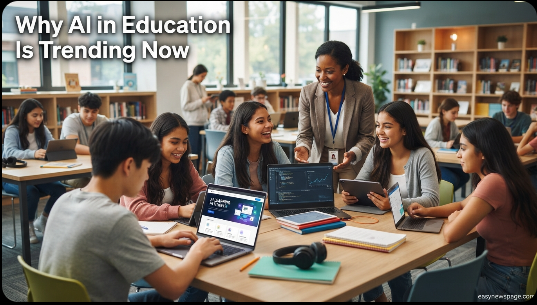
Walk into almost any classroom, lecture hall, or study session in September 2026, and artificial intelligence is already there — whether the syllabus mentions it or not. What started three years ago as a handful of students quietly pasting essay prompts into a chatbot has become the default way an entire generation studies, writes, and revises. Surveys now put global student AI adoption somewhere between 86% and 95%, up from roughly a third of students just two years ago. That is one of the fastest technology adoption curves ever measured in education, faster than laptops, faster than the internet, faster than calculators.
But adoption is only half the story of why AI in education is trending right now. The other half is backlash. In the same weeks that adoption numbers keep climbing, some of the largest school districts in the United States — including New York City and Los Angeles — have moved to restrict or pause generative AI for younger students, while cities like Boston have gone the opposite direction and made AI literacy a graduation requirement. States are passing dueling laws, some mandating AI ethics instruction, others requiring audits and safeguards. Microsoft, Google, and OpenAI are racing to sign data-privacy agreements with teachers’ unions. This tension between rapid grassroots adoption and cautious institutional policy is exactly what is pushing AI in education into headlines, school board meetings, and parent group chats all at once.

This guide breaks down what is actually happening: the adoption statistics, the tools students and teachers are using, the policy fights unfolding district by district, the classroom benefits and the genuine risks, and what a sensible approach looks like for schools, teachers, parents, and students trying to make sense of a fast-moving landscape. Whether you are an educator deciding what to allow in your classroom or a parent trying to understand what your child is doing on a school-issued laptop, this article is built to answer the questions people are actually typing into Google right now.
Read more: AI Job Automation in 2026: The Good, the Bad, and the Future
Quick Facts Table
| Metric | Figure (2026) |
|---|---|
| Global student AI usage | 86%–95% depending on survey and country |
| K-12 students using AI weekly or more | ~54% (up from ~30% two years ago) |
| U.S. teachers who have adopted AI tools | ~60% |
| Global AI-in-education market size | Roughly $10–12 billion in 2026 |
| Projected market size by 2030 | Around $32 billion |
| Schools with a formal AI policy | Only about 13%–26% |
| Accuracy of leading AI-content detectors | As low as 39.5% in independent tests |
| Notable 2026 policy shift | NYC moratorium on student-facing generative AI for grades 2-K through 8 |
Quick Summary
AI in education is trending in 2026 because two things are happening simultaneously: adoption among students and teachers has become nearly universal, and the institutions responsible for those students are only now catching up with rules, training, and safeguards. Districts are split between doubling down (Boston’s AI literacy requirement) and pumping the brakes (New York City’s moratorium for younger grades). Meanwhile, the underlying technology — adaptive tutoring, AI teaching assistants, and content generation tools — keeps improving, and the market keeps growing at roughly 30% a year. The result is a topic that touches parents, teachers, school boards, ed-tech companies, and lawmakers all at once, which is exactly the mix that keeps a subject trending.
Key Takeaways
- Student use of generative AI tools has gone from a minority behavior to the default in under three years.
- Teacher adoption is rising almost as fast as student adoption, with time savings on lesson planning and grading cited as the top benefit.
- Policy is fragmented: some cities restrict AI for younger students while others mandate AI literacy for teenagers.
- AI-detection software remains unreliable, which is fueling debates about academic integrity and assessment redesign.
- Data privacy agreements between AI vendors and school systems are becoming a major 2026 storyline in their own right.
- The AI-in-education market is one of the fastest-growing segments of ed-tech, drawing continued investment despite the policy uncertainty.
Table of Contents
Why Trust This Guide
This guide draws on recent global survey data from organizations including the Digital Education Council, HEPI, RAND Corporation, Common Sense Media, and Gallup, alongside primary reporting on 2026 school-district policy announcements in New York City, Los Angeles, San Francisco, Chicago, and Boston. Every statistic and policy claim below is grounded in named, checkable sources rather than assumption, and figures that could not be independently confirmed are flagged as such rather than presented as fact.
Because this is a fast-moving news and trends topic rather than a single product, this guide focuses on verifiable patterns across many institutions and surveys instead of promotional claims from any one company. Where sources disagreed — for example, different surveys reporting student adoption anywhere from 66% to 95% — that range is reported honestly rather than rounded up for effect.
Who This Guide Is For
This guide is written for parents trying to understand what their children are doing with AI at school, teachers and school administrators weighing whether and how to expand AI use, and students curious about how the rules around AI are changing. It’s also useful for policymakers, journalists, and ed-tech researchers who need a current, sourced snapshot of where the adoption-versus-regulation debate stands as of September 2026.
If you are looking for a review of one specific AI tutoring app, this is not that guide — instead, it explains the broader trend so you can evaluate any specific tool against real context.
What Is AI in Education
AI in education refers to the use of artificial intelligence — chatbots, adaptive learning software, AI teaching assistants, automated grading tools, and content-generation systems — inside teaching and learning. It spans everything from a student using a general-purpose chatbot to draft an essay outline, to a school district deploying an adaptive math platform that adjusts difficulty in real time based on a student’s answers.
The category is broad on purpose because the technology entered classrooms from multiple directions at once. Generative AI tools like general-purpose chatbots arrived bottom-up, through students, largely outside any school’s control. Adaptive learning platforms and AI-assisted grading tools arrived top-down, purchased and deployed by districts. That dual entry point — one driven by teenagers with smartphones, the other by procurement departments — is part of why the policy response has been so uneven.
How AI Adoption Grew So Fast
The adoption curve for AI in education is genuinely unusual. Global surveys of students across 16 countries found 54% of K-12 students now use AI for school, an increase of more than 15 percentage points in just one to two years, and separate research indicates student adoption jumped from roughly 30% to 94% in the UK over about three years. At the university level, one widely cited UK survey found 94% of students used generative AI for assessments in 2026, up from 88% in 2025 and 53% in 2024.
Teacher adoption has followed close behind rather than lagging by a decade the way many past ed-tech trends did. Reports indicate K-12 teacher AI adoption roughly doubled from 25% to 53% within a single year, and separate figures put current U.S. teacher AI adoption at around 60%. That speed matters: when both the people being taught and the people teaching adopt a technology within the same two- to three-year window, institutions rarely have time to build policy, training, or infrastructure before the behavior is already widespread — which is precisely the gap driving today’s headlines.
AI Overview: In short, AI adoption in education became mainstream faster than school policy could keep up, and that gap between behavior and governance is the core reason the topic is trending in 2026.
How Schools and Teachers Are Actually Using AI
Students overwhelmingly use AI for coursework support rather than wholesale cheating, though the line between the two is a major point of contention. Data on daily or weekly educational AI use shows 64% of students getting help with coursework they don’t understand, 60% checking homework answers, and 54% using AI to edit writing or summarize lecture notes. Fewer students use AI for higher-stakes tasks: 36% report writing full papers with AI assistance.
Teachers, meanwhile, are leaning on AI mainly to reclaim time. Roughly three in four teachers say AI saves them time and lets them interact more with students, and a majority already use AI for routine classroom tasks like drafting materials or handling administrative work. At the same time, a significant share of the teaching workforce says it isn’t ready: 41% of teachers report feeling unprepared to bring AI into the curriculum, pointing to a training gap running parallel to the adoption boom.
Featured Snippet: Top Ways Students Use AI in School
- Getting help with coursework they don’t understand
- Checking homework and assignment answers
- Editing or improving writing
- Summarizing lectures and notes
- Generating ideas for projects or papers
- Researching for papers and assignments
The Policy Backlash: Bans, Moratoriums, and Mandates
If 2024 and 2025 were the years of quiet, ungoverned AI adoption, September 2026 is turning into the month institutions push back — unevenly, and often in opposite directions in neighboring cities.
New York City announced a one-year moratorium on student-facing generative AI for children from 2-K through 8th grade, effective in the 2026–2027 school year, alongside new screen-time restrictions affecting nearly 600,000 public school students. The policy also bans companion chatbots across all grade levels and introduces twice-yearly AI critical-thinking modules for high schoolers. Los Angeles has adopted similar restrictions, and Chicago school board candidates are now debating a comparable moratorium. San Francisco, by contrast, has taken a slower path: its district relies on a resource page rather than a formal policy, though its board voted to bar screens in the earliest grades and cap daily device use.
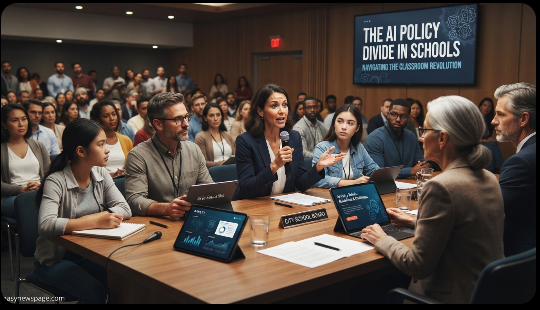
Not every city is restricting. Boston went the other direction, making AI fluency a graduation requirement through a mandatory AI-literacy program launched across all Boston Public Schools high schools starting in September 2026. At the state level, the picture is equally split: California’s governor signed legislation aimed at AI accountability through safeguards and audits, while Arizona and Illinois have moved toward mandatory instruction on the ethical and educational use of AI rather than outright bans.
Vendors are also being pulled into the policy conversation directly. Microsoft’s new agreement with teachers’ unions commits the company to not using student or educator data to train AI models, except for narrow safety and security exceptions, and not letting its AI make decisions in schools without human oversight.
AI Overview: As of September 2026, there is no single national approach to AI in schools in the United States — some of the largest districts are pausing AI for younger children while others are mandating AI literacy for teenagers, and state legislatures are adding their own patchwork of rules on top.
Benefits of AI in Education
Personalized pacing is the benefit cited most consistently across research: adaptive systems that adjust difficulty to an individual student have been linked to measurable gains in specific pilot programs, including reported exam score improvements among university students using AI-assisted study tools. Time savings for teachers is the second major benefit, freeing hours previously spent on lesson prep, first-draft grading, and administrative paperwork for more direct student interaction. Access to on-demand help outside class hours — for a student stuck on a homework problem at 9 p.m. — is a benefit families cite repeatedly, since it doesn’t depend on a tutor’s schedule or price tag.
AI also lowers the barrier to producing polished materials: teachers can generate differentiated worksheets or translated materials for multilingual classrooms in minutes rather than hours. For students with learning differences, AI reading and writing supports can reduce friction that previously made assignments disproportionately harder.
Risks and Limitations
The most-cited risk is overreliance: a large share of college faculty — around 95% in one survey — say they worry AI use is eroding students’ ability to think and write independently without assistance. Academic integrity is the second major risk, compounded by the fact that AI-detection tools remain unreliable, catching well under half of AI-generated content in independent testing.
Data privacy is a growing concern as more student data flows through third-party AI systems, which is why vendor agreements limiting data use for model training have become a 2026 negotiating point rather than fine print. There is also an equity risk: schools and families with more resources can access premium AI tools and better guidance on using them responsibly, while under-resourced schools may adopt the same tools without the training to use them well — potentially widening rather than closing achievement gaps.
Read more: How AI Job Automation Will Affect You in 2026
Pros and Cons at a Glance
| Pros | Cons |
|---|---|
| Personalized, on-demand academic support | Risk of overreliance and reduced independent thinking |
| Meaningful time savings for teachers | Unreliable AI-detection tools complicate academic integrity |
| Faster creation of differentiated materials | Formal school policies still rare (13%–26% of schools) |
| Potential to support students with learning differences | Uneven access could widen equity gaps |
| Fast-growing market driving continued investment and improvement | Student data privacy concerns with third-party vendors |
Market Size and Where the Money Is Going
Estimates vary by research firm, but the direction is consistent: the global AI-in-education market is valued at roughly $10–12 billion in 2026, with projections putting it near $32 billion by 2030 — a compound annual growth rate in the range of 30%. North America currently accounts for the largest regional share. Investment is flowing primarily into three areas: adaptive learning platforms for K-12 math and reading, AI teaching-assistant tools aimed at reducing teacher administrative load, and AI writing and research-assistance tools aimed at higher education.
Data Privacy, Security, and Compliance
Because most AI tools used in schools are built by third-party vendors rather than the schools themselves, data governance has become one of the thorniest parts of this trend. The core questions districts are now asking vendors include: Is student data used to train the underlying model? Is there human oversight before AI-driven decisions affect a student? What happens to conversation logs, and for how long are they retained? Agreements like Microsoft’s — which limits model training on student data to narrow exceptions and requires human oversight of AI decisions — are becoming templates other vendors and districts are likely to reference going forward.
Academic Integrity and Detection Problems
Independent testing has found leading AI-content detectors catch as little as 39.5% of AI-generated text, and dozens of universities across multiple countries have reportedly turned off their detection tools altogether rather than rely on inaccurate results. This has pushed some institutions toward a different strategy entirely: redesigning assessments — more in-class writing, oral defenses, process-based grading — instead of trying to police AI use after the fact.

Expert Tips for Schools and Teachers
- Start with a written AI policy, even a simple one, rather than an informal “figure it out” approach — only a minority of schools currently have one.
- Separate “AI-assisted” from “AI-generated” work explicitly in assignment instructions, rather than leaving the line ambiguous.
- Invest training budget in teachers before expanding student-facing tools; teacher confidence is currently a bigger bottleneck than access to technology.
- Ask any AI vendor directly whether student data trains their models and whether a human reviews AI-driven decisions.
- Redesign at least some assessments to be less detectable-by-AI-dependent, since detection software remains unreliable.
Common Mistakes to Avoid
A frequent mistake is banning AI outright without a plan for what replaces the time savings and support it was providing — students often keep using it privately at that point, just without any guidance. Another common mistake is adopting an AI platform district-wide without budgeting for teacher training, which research shows is the actual bottleneck to responsible use. Relying entirely on AI-detection software as an integrity strategy is also risky given documented false-positive and false-negative rates. Finally, treating “AI policy” as a one-time decision rather than a living document is a mistake given how quickly both the technology and the regulatory landscape are shifting.
Myths vs. Facts
Myth: Most students who use AI are cheating. Fact: The largest share of reported AI use is for coursework help, homework checking, and editing — not wholesale paper generation, though that use case does exist and is growing.
Myth: AI-detection tools reliably catch AI-written work. Fact: Independent testing has found detection accuracy as low as 39.5%, leading dozens of universities to abandon these tools.
Myth: Schools are unanimously restricting AI. Fact: Policy is genuinely split — some major districts are pausing student AI use while others are mandating AI literacy education.
Read more: AI Job Automation: Latest Updates You Missed
Decision Matrix: Should Your School Expand AI Use
| Criteria | Cautious Rollout | Balanced Rollout | Aggressive Rollout |
|---|---|---|---|
| Teacher training in place | Minimal | Partial | Extensive |
| Written AI policy | Not yet drafted | Draft in progress | Adopted and reviewed regularly |
| Vendor data agreements reviewed | No | Partially | Fully reviewed |
| Best fit for | Under-resourced districts, younger grades | Most mid-size districts | Well-resourced districts, older students |
Who Should Lean In vs. Who Should Be Cautious
Older students in project-based or research-heavy coursework, teachers looking to reduce administrative load, and districts with the budget for training and vendor vetting are generally well positioned to expand AI use responsibly. Younger students still developing foundational literacy and numeracy skills, districts without a written policy or training budget, and any school that hasn’t reviewed a vendor’s data practices should move more cautiously — which mirrors exactly the split decisions districts like New York City and Boston have already made in opposite directions.
FAQ
Why is AI in education suddenly such a big topic in 2026?
Because adoption and policy are colliding at the same time. Student and teacher use of AI has become nearly universal within just a few years, while formal school policies are only now catching up — producing a wave of new bans, mandates, and vendor agreements all landing in the same news cycle.
Is AI use in schools increasing or decreasing right now?
Overall use is still increasing among students and teachers, but formal permission is becoming more restricted in some major cities for younger grade levels, even as older students see expanded, more structured AI use in several districts.
Are AI detection tools accurate enough to catch AI-written homework?
Not reliably. Independent testing has found some widely used detectors catch well under half of AI-generated text, which is why a number of universities have stopped using them and shifted toward redesigned assessments instead.
Do schools have to disclose how AI tools use student data?
Increasingly, yes. Recent agreements between major AI vendors and teachers’ unions require limits on how student data can be used to train models and require human oversight of AI-driven decisions affecting students.
Should parents be worried about AI in their child’s school?
It depends heavily on the district and grade level. Parents of younger children in cities with new moratoriums have fewer concerns about classroom AI exposure right now, while parents anywhere should still ask what specific tools are used, whether there’s a written policy, and how student data is handled.
What age group uses AI the most in school?
Older students consistently show higher use rates than younger ones — high school juniors and seniors use tools like general-purpose chatbots at roughly double the rate of middle schoolers, and college students report the highest usage of any group.
Rating Scorecard
| Category | Score (out of 10) | Notes |
|---|---|---|
| Speed of adoption | 9.5 | Among the fastest technology adoption curves ever recorded in education |
| Policy readiness | 3.5 | Only a minority of schools have formal, written AI policies |
| Demonstrated learning benefit | 7 | Strong in adaptive/personalized use cases; weaker evidence for unsupervised general use |
| Data privacy safeguards | 5.5 | Improving via vendor agreements, but still inconsistent across providers |
| Long-term outlook | 8 | Market growth and institutional investment both point toward continued expansion |
Conclusion
AI in education is trending in 2026 for a simple reason: the technology moved faster than the institutions built to manage it. Students and teachers adopted generative AI and adaptive learning tools at a pace with almost no precedent in education, and now school boards, city halls, and state legislatures are scrambling to catch up with rules that often contradict each other from one district to the next. New York City pausing generative AI for younger students and Boston mandating AI literacy for teenagers aren’t contradictions born of confusion — they’re two reasonable responses to genuinely different risk profiles at different ages, made without a shared national playbook.
The honest takeaway is that neither blanket enthusiasm nor blanket alarm fits the evidence. AI is delivering real, measurable benefits in personalized learning and teacher time savings, and it is also creating real, unresolved problems around academic integrity, data privacy, and equitable access. The schools navigating this well share a few habits: a written policy that gets revisited regularly, real investment in teacher training rather than just tool access, honest conversations with vendors about data use, and assessment designs that don’t depend on detection software nobody fully trusts. For everyone else — parents, students, and educators trying to keep up — the most useful thing to track isn’t whether AI belongs in classrooms; it clearly already is there. The question worth watching through the rest of this school year is which policy approach, the caution of New York City or the mandate of Boston, actually produces better outcomes for students.
Official Sources
- Digital Education Council, AI in Higher Education Global Survey 2026
- HEPI (Higher Education Policy Institute) student AI usage survey data, 2026
- RAND Corporation research on K-12 AI adoption
- Common Sense Media student AI tool usage data
- Gallup survey on student AI usage by educational purpose
- NYC Mayor’s Office official announcement, September 2, 2026
- Chalkbeat New York reporting on NYC AI policy
- The San Francisco Standard reporting on SF/LA/NYC AI policy comparison
- The Center Square / Just the News reporting on state-level AI legislation
- eWeek reporting on Microsoft’s teachers’ union data agreement
- Pursuit.us AI-in-education news roundup, including Boston Public Schools policy
Author Bio
This guide was researched and written by the easynewspage.com editorial team, which specializes in translating fast-moving technology and policy news into clear, sourced explainers for general readers, educators, and parents.