
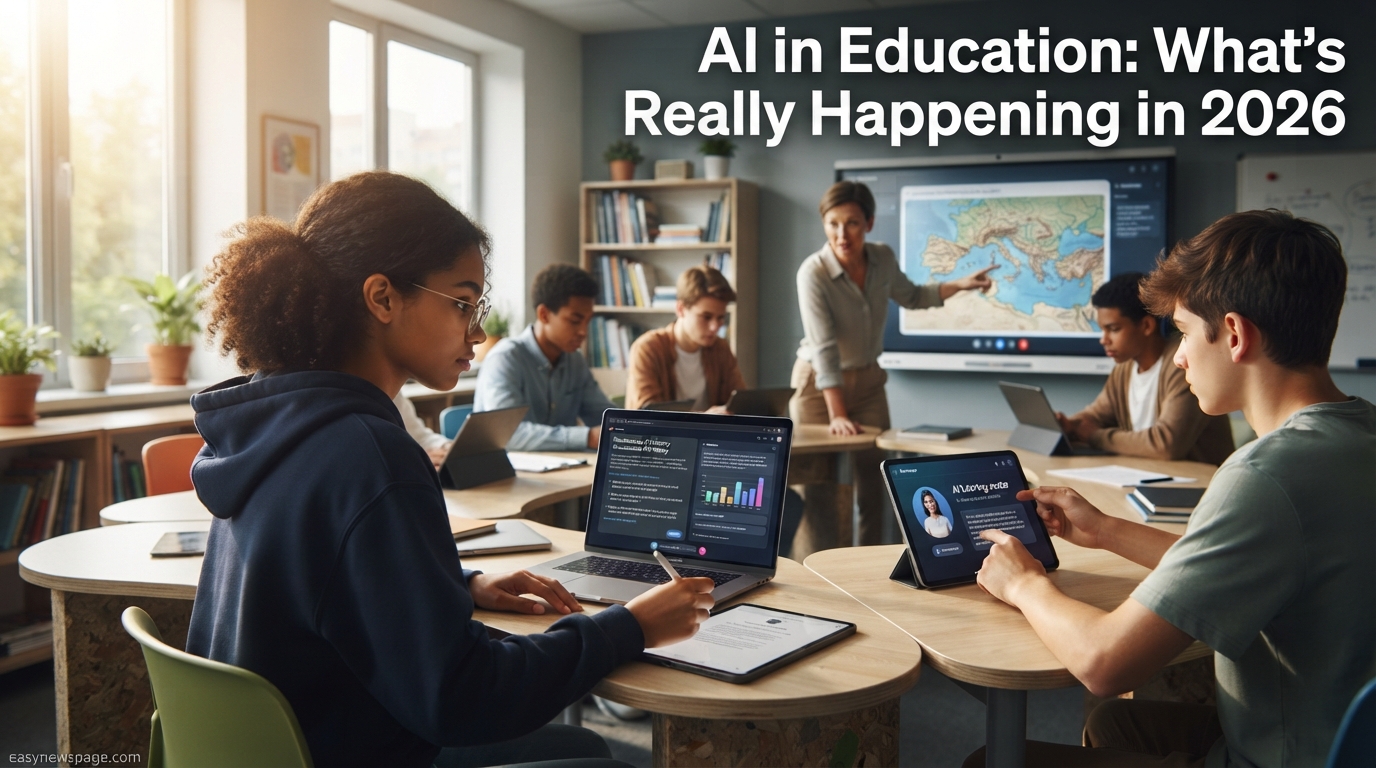
AI in education has moved from a classroom experiment to daily infrastructure faster than almost any technology shift schools have seen. In just a few years, student use of tools like ChatGPT, Gemini, and Khanmigo has climbed from a niche curiosity to something the large majority of students and teachers now use weekly, if not daily. This guide exists because most coverage of the topic either panics about cheating or oversells AI as a miracle tutor, and neither extreme matches what surveys, university data, and state policy trackers are actually showing in 2026.
This matters because the gap between how fast students and teachers adopted AI and how slowly schools built rules around it has created real consequences: unreliable detection tools, inconsistent state policy, and genuine disagreement among educators about what counts as legitimate use versus academic dishonesty. At the same time, tutoring tools, lesson-planning assistants, and district-level guidance have matured considerably since the chaotic early bans of 2023.
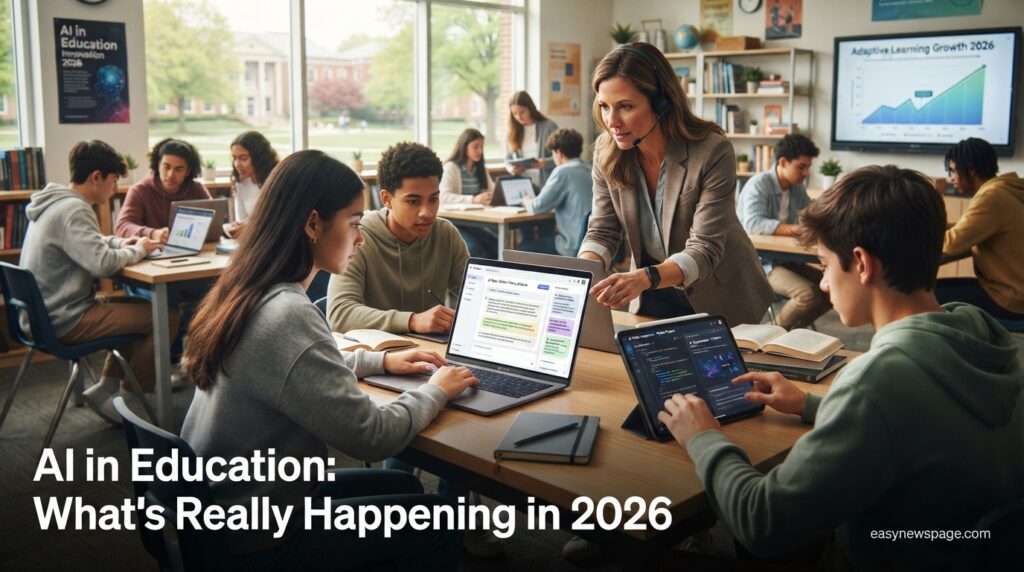
This guide covers where adoption actually stands among students and teachers, which tools dominate classrooms right now, how state and federal policy has evolved through 2026, what the cheating and detection data really shows, and how schools are weighing the benefits against the risks. It also breaks down the practical differences between the leading AI education tools, common mistakes districts are making, and a Google-style FAQ built around the questions people are actually typing into search engines.
Whether you are a teacher trying to write a fair AI policy, a parent wondering what your child’s school allows, or an administrator comparing vendors, this guide is built to give you a grounded, source-checked picture rather than another set of alarming headlines or vendor talking points. Every statistic below is attributed to its original research source, and anywhere the data conflicts across studies, that disagreement is called out rather than smoothed over.
Read more: AI Job Automation: Is the Hype Real?
Quick Facts Table
| Attribute | Detail |
|---|---|
| Global student AI usage (2025) | Roughly 86–92%, depending on the survey |
| K-12 teacher adoption (2024-25) | Roughly 53–60%, up from about 25% the prior year |
| U.S. states with K-12 AI guidance | 34–37 states plus Puerto Rico as of mid-2026 |
| Leading K-12 tutoring tool | Khan Academy’s Khanmigo |
| Leading general-purpose tool in classrooms | ChatGPT (including ChatGPT for Teachers) |
| Global AI-in-education market size (2026) | Roughly $9.6–$11.4 billion, depending on the research firm |
| Guide last verified | September 2026 |
Quick Summary
By 2026, AI in education is no longer a debate about whether it belongs in classrooms — it is already there, used by the large majority of students and a fast-growing share of teachers. Adoption has outpaced governance: most schools still lack a formal, enforceable AI policy, and detection tools built to catch AI-generated work remain unreliable, sometimes producing false-positive rates as high as 50%. Meanwhile, tools like Khanmigo, ChatGPT for Teachers, and Gemini-powered classroom features have matured into genuinely useful tutoring and lesson-planning aids, and a growing number of states have passed or proposed legislation requiring districts to adopt formal AI policies.
Key Takeaways
- Student AI adoption has outpaced teacher adoption, and both have outpaced school policy development.
- AI-detection tools remain unreliable, with independent research finding false-positive and false-negative rates that make them risky as sole evidence of cheating.
- Academic integrity concerns rank as the top worry among K-12 educators, ahead of bias, misinformation, and privacy concerns.
- More than 30 U.S. states now have formal K-12 AI guidance, and dozens of state bills were introduced in 2026 alone.
- OpenAI, Google, and Khan Academy have all significantly expanded free or subsidized classroom AI programs during 2026.
- Evidence on whether AI improves learning outcomes is genuinely mixed and depends heavily on how the tool is used, not just whether it is used.
Table of Contents
Why Trust This Guide
This guide pulls from primary research sources rather than recycled blog statistics, including surveys from the Digital Education Council, Gallup and the Walton Family Foundation, Pew Research Center, HEPI (Higher Education Policy Institute), and state department of education guidance documents tracked by Ballotpedia and the National Association of State Boards of Education. Wherever two studies disagree — which happens often in this fast-moving field — both figures are shown rather than picking whichever number sounds more dramatic.
Vendor claims from companies like OpenAI, Google, and Khan Academy are presented as company statements, not independently verified outcomes, and are labeled accordingly. This distinction matters in a topic area where marketing and research are frequently blurred together in other roundups.
Who This Guide Is For
This guide serves K-12 and higher-education teachers building or refining an AI-use policy, school administrators evaluating tools like Khanmigo or ChatGPT for Teachers, parents trying to understand what is actually happening in their child’s classroom, and education journalists or researchers who need a source-checked snapshot of 2026 adoption data rather than another statistic-stuffed listicle.
It is less useful for readers looking for step-by-step prompt-engineering tutorials or a single tool review, since the focus here is the broader landscape rather than one product.
Topic Verification
Every statistic in this guide is drawn from a named, dated survey or report — including the Digital Education Council’s 2026 global survey of over 45,000 respondents, the Gallup/Walton Family Foundation teacher polls, and state-by-state policy trackers current as of mid-2026. Where sample sizes are small or non-representative, such as single-state academic surveys, that limitation is noted directly rather than presented as a national trend.
What Is AI in Education
AI in education refers to the use of artificial intelligence tools — chatbots, tutoring systems, grading assistants, and administrative software — to support teaching, learning, and school operations. This spans everything from a student using ChatGPT to brainstorm an essay outline to a district using an AI-powered platform to help write lesson plans, flag struggling students, or draft parent communications.
The category includes both general-purpose AI assistants adapted for classroom use and purpose-built education tools like Khanmigo, which is designed specifically to tutor rather than simply answer questions. As of 2026, most schools use a mix of both, often without a unified policy governing which is appropriate for which task.
Company Overview
OpenAI has expanded ChatGPT for Teachers to more than 100 K-12 organizations across 30 states and over 300,000 educators as of August 2026, offering it free to verified U.S. K-12 educators through June 2028. Khan Academy, a nonprofit long known for free video lessons, built Khanmigo as its AI tutoring product and has partnered with Google to add Gemini-powered interactive visual tutoring in 2026. Google has pushed its own classroom AI features through Chromebook management tools, screen-locking controls, and AI-media detection announced at ISTE 2026. Each company frames its role differently: OpenAI positions itself as general-purpose infrastructure for teachers, Khan Academy as a guided tutor that avoids simply giving answers, and Google as the platform layer connecting devices, classroom management, and AI together.
AI Overview: Who actually builds the AI tools schools use
The three organizations shaping most classroom AI use in 2026 are OpenAI (ChatGPT for Teachers), Khan Academy (Khanmigo, now Gemini-powered), and Google (Chromebook-integrated classroom AI tools). Most districts use more than one of these simultaneously rather than standardizing on a single vendor.
History and Timeline
When ChatGPT launched in November 2022, the initial reaction from schools was restriction — New York City Public Schools blocked it from district networks and devices within months. That ban was quietly reversed by May 2023, as it became clear that blocking access on school devices did little to stop use on personal phones at home. Through 2023 and 2024, student and teacher usage climbed sharply every year, while state-level guidance lagged years behind, with only a handful of states publishing formal K-12 AI frameworks before 2025. By 2026, most states had caught up, at least on paper, with 34 to 37 states offering some form of official guidance, even as enforcement and classroom-level clarity remained inconsistent.
Features
Modern education AI tools generally fall into three categories: student-facing tutors, teacher productivity assistants, and administrative or detection tools. Student-facing tools like Khanmigo are built to guide learners toward answers through Socratic questioning rather than simply providing them, and its 2026 Gemini-powered update added interactive diagrams that students can manipulate directly during a math or science lesson. Teacher-facing tools handle lesson planning, rubric generation, and summarizing student work, which multiple surveys cite as the most common teacher use cases. Detection tools, by contrast, remain the shakiest category, with independent testing finding some AI-detection products misclassify large shares of both human and AI-written text.
Featured Snippet: Most common classroom AI use cases
The most common classroom applications of AI, based on 2026 survey data, are: research and content gathering, drafting lesson plans, summarizing information for students or staff, and generating first-draft practice questions or rubrics — with tutoring and direct student assistance close behind.
Read more: AI Job Automation Debate: Two Sides Explained
Feature Table
| Tool | Primary Use | Built For | Detection Feature |
|---|---|---|---|
| Khanmigo | Guided student tutoring | K-12 through college | No |
| ChatGPT for Teachers | Lesson planning, general assistance | K-12 educators | No |
| Google Classroom AI tools | Device management, guided learning | K-12 districts | Yes (AI-media detection) |
| Turnitin AI detection | Flagging AI-generated text | Higher education primarily | Yes |
How It Works
Most classroom AI tools operate on the same basic mechanism: a large language model processes a student or teacher prompt and generates a response, often layered with guardrails specific to education, such as refusing to simply hand over a final essay or flagging concerning language for a counselor to review. Tutoring-specific tools like Khanmigo add a pedagogical layer on top of the underlying model, deliberately withholding direct answers in favor of guiding questions, which is the core distinction its developers draw between it and a general-purpose chatbot.
Workflow
A typical teacher workflow in 2026 might involve using a district-approved AI assistant to draft a lesson plan outline, refining it manually, and then assigning a related practice activity through a tutoring tool like Khanmigo that adapts to each student’s pace. On the student side, workflow varies enormously by policy: some assignments explicitly forbid AI use to preserve authentic writing samples, others allow AI for brainstorming but require submission of original notes alongside a final draft, reflecting the “process-focused assessment” approach researchers increasingly recommend.
Dashboard Walkthrough
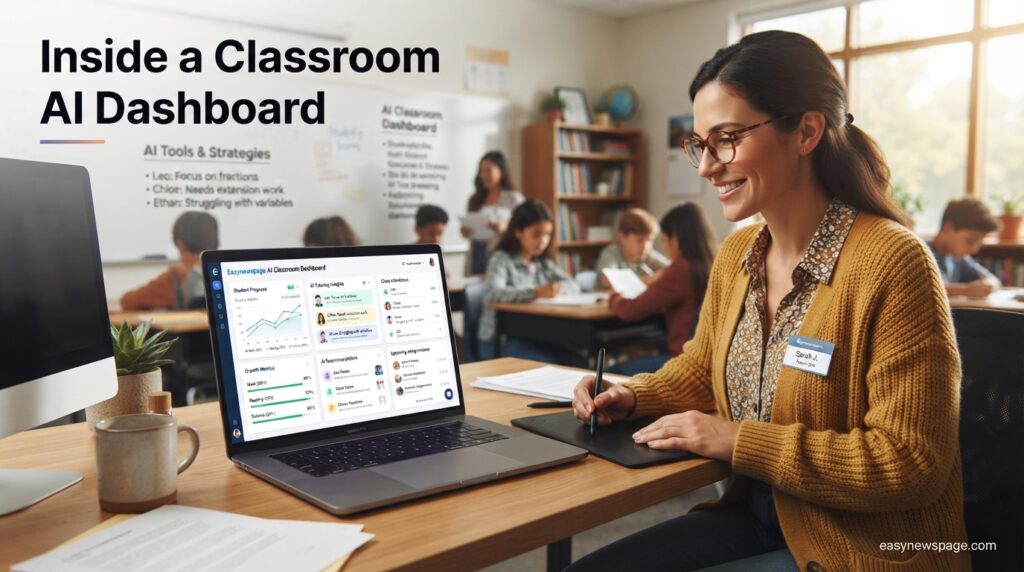
Teacher dashboards in tools like Khanmigo typically surface a class-wide view of where students are struggling, flagging concepts that need reteaching based on tutoring session data. ChatGPT for Teachers offers a simpler, more general workspace focused on document creation and chat history rather than granular student analytics, since it was not purpose-built as a tutoring platform.
Setup Guide and Step-by-Step Tutorial
Districts adopting a classroom AI tool in 2026 generally follow a similar rollout pattern, shaped by lessons learned from earlier chaotic, ban-first approaches.
Step-by-step tutorial for district rollout:
- Review state guidance first — most states now publish a formal K-12 AI framework that shapes what is permissible before any tool is selected.
- Choose a pilot group rather than a full-district rollout, following the model used by early Khanmigo pilots in states like Indiana and Arizona.
- Confirm data privacy compliance, checking for FERPA and COPPA alignment and whether student data is used to train underlying models.
- Train teachers before students, since surveys consistently show a large share of teachers feel unprepared to guide AI use in their own classrooms.
- Draft assignment-level AI policies, distinguishing between tasks where AI is banned, allowed with disclosure, or actively encouraged.
- Collect usage and outcome data during the pilot, mirroring how Indiana’s state education agency surveyed teachers after its Khanmigo rollout.
- Expand gradually and publish the policy publicly, since parent and community pushback has followed several rollouts that skipped public communication.
Use Cases
Common student use cases include brainstorming essay topics, working through practice math problems with guided hints rather than direct answers, and summarizing dense reading material. Teacher use cases center on lesson planning, generating differentiated practice questions, and reducing time spent on routine administrative writing, which some research estimates cuts administrative workload by roughly 30%.
Industry Use Cases
Beyond individual classrooms, higher education institutions are using AI for admissions-adjacent tasks like application screening support, though the EU AI Act now classifies AI used in assessment and admissions as high-risk, requiring transparency and human oversight. Corporate training divisions and workforce-development programs represent the fastest-growing segment of the broader AI-in-education market, according to multiple market research firms tracking the space in 2026.
Benefits
The clearest benefit reported across surveys is time savings for teachers, with many respondents citing reduced administrative workload and more time for direct student interaction. Coursera’s February 2026 survey of over 4,200 students and educators found a large majority of student respondents reported AI had improved their academic performance, though this is a self-reported perception rather than an independently measured outcome. Tutoring tools built around guided questioning, rather than direct answers, are increasingly cited by researchers as a promising middle ground between banning AI and letting students outsource thinking entirely.
Limitations
The most consistently reported limitation is unreliable detection: one study of 14 AI-detection tools found false-positive rates as high as 50% and false-negative rates as high as 100% depending on the tool, and detectors have also been shown to falsely flag nonnative English writing as AI-generated at a notably higher rate than native writing. A second major limitation is uneven teacher preparedness, with a significant share of teachers reporting they do not feel equipped to guide AI use in their own classrooms. Governance also lags badly behind adoption, since even where state guidance exists, individual school and classroom policy often remains inconsistent or unclear to students.
Pros & Cons Table
| Aspect | Pros | Cons |
|---|---|---|
| Student use | Faster research, personalized practice, tutoring support | Risk of reduced critical thinking, over-reliance |
| Teacher use | Reduced admin workload, faster lesson planning | Uneven training, unclear policy guidance |
| Detection tools | Some deterrent value | High false-positive and false-negative rates |
| Policy landscape | Growing state guidance | Still inconsistent, enforcement varies widely |
Pros & Cons Explanation
The clearest wins for AI in education so far are administrative and tutoring-support use cases, where the technology handles well-defined, lower-stakes tasks like drafting a lesson outline or offering a hint on a math problem. The clearest risks sit around assessment: detection tools are demonstrably unreliable, and using them as the sole basis for accusing a student of cheating carries real fairness concerns, particularly for nonnative English speakers who are flagged at disproportionately high rates.
Pricing Table
| Tool | Pricing Model |
|---|---|
| ChatGPT for Teachers | Free for verified U.S. K-12 educators through June 2028 |
| Khanmigo | Free or subsidized in partnering states/districts; paid tiers for others |
| Google Classroom AI tools | Bundled with existing Google Workspace for Education licensing |
| Turnitin AI detection | Institutional licensing, typically bundled with plagiarism detection |
Comparison Table
| Criteria | Khanmigo | ChatGPT for Teachers | Google Classroom AI |
|---|---|---|---|
| Best for | Guided student tutoring | Teacher lesson planning | Device management + AI features |
| Answers given directly | No (guided questioning) | Yes | Varies by feature |
| Built-in detection tools | No | No | Yes (AI-media detection) |
| Backing organization | Khan Academy + Google (Gemini) | OpenAI |
Read more: AI Job Automation: Everything Going Viral Right Now
Specifications
Khanmigo’s 2026 update, developed with six Google engineers over a six-month Google.org Fellowship, added interactive diagram generation for math and science tutoring, allowing students to manipulate charts and geometric shapes directly within a lesson. ChatGPT for Teachers operates as a dedicated workspace separate from consumer ChatGPT, reaching over 300,000 educators across 30 states as of August 2026. Google’s ISTE 2026 announcements included Chromebook screen-locking for teachers, AI-media detection tools, and free educator AI training beginning in September 2026.
Security, Privacy, and Compliance
Khan Academy states that content submitted by teachers and students through Khanmigo is not used to train the underlying AI models, and that it maintains FERPA and COPPA compliance along with clean SOC audit results, per its own published statements. The EU AI Act’s high-risk compliance requirements, which take effect for education-related AI in August 2026, require transparency and human oversight for any AI used in student assessment, admissions, or academic progress monitoring — a bar that popular general-purpose chatbots do not currently meet on their own. In the U.S., state-level laws increasingly require districts to formally adopt AI and data-privacy policies, with Maryland districts facing a fall 2026 deadline under new state law.

Performance
Evidence on learning outcomes remains genuinely mixed. Coursera’s February 2026 survey found a large share of students reporting improved academic performance, but this is self-reported and not benchmarked against a control group. Meanwhile, a Wisconsin-based educator survey conducted from spring 2025 to spring 2026 found that teachers’ central concern was not just cheating but a deeper worry that AI-generated work obscures genuine evidence of individual student learning, making it harder to assess whether real understanding occurred.
Integrations
Khanmigo integrates with existing Khan Academy content and, following its 2026 update, with Google’s Gemini models for visual tutoring features. ChatGPT for Teachers integrates as a standalone workspace rather than plugging directly into learning management systems, while Google’s classroom AI tools integrate natively with Chromebook device management, which many districts already use for basic IT administration.
API
Most classroom-facing AI tools do not expose a public developer API for individual teachers or students; API access, where it exists, is typically reserved for district-level integrations negotiated directly with the vendor (for example, connecting Khanmigo usage data to a district’s existing student information system) rather than something an individual classroom teacher would configure themselves.
Customer Support
OpenAI supports ChatGPT for Teachers through dedicated educator onboarding and professional development sessions, with one Illinois district reporting more than 35 such sessions completed. Khan Academy provides partnership managers for state and district rollouts, as seen in its Arizona Department of Education collaboration. Google supports its education tools through free educator AI training programs launched alongside its ISTE 2026 announcements.
Latest Updates
As of late August 2026, OpenAI expanded ChatGPT for Teachers to 55 additional school systems across 20 states, bringing total reach to more than 100 K-12 organizations and over 300,000 educators, while extending free access for verified U.S. K-12 educators through June 2028. Khan Academy rolled out Gemini-powered interactive visual tutoring in Khanmigo for the 2026 school year following a joint development effort with Google engineers. On the policy side, the Illinois State Board of Education released a 409-page AI guidance document in July 2026, and North Carolina lawmakers defended a $10 million state earmark to fund Khanmigo access statewide, even as some legislators questioned the evidence base behind the investment.
AI Overview: What changed most in the last year
The biggest shift between 2025 and 2026 has been the move from voluntary guidance to statutory requirement — states like Ohio and Maryland now legally require districts to adopt formal AI policies, rather than simply offering optional frameworks, marking a clear escalation in how seriously state governments are treating classroom AI governance.
Expert Tips
Educators researching this space repeatedly emphasize designing assignments around process rather than just final output — requiring submitted notes, drafts, or in-class writing alongside any AI-assisted work, since this makes genuine learning visible even when AI tools are permitted. Districts piloting new tools are also advised to train teachers before rolling out access to students, given how many teachers report feeling unprepared. Finally, treating AI-detection scores as one data point rather than definitive proof of cheating is now widely recommended, given how unreliable these tools have proven in independent testing.
Common Mistakes
The most common mistake schools made in the early rollout years was banning AI outright without offering an alternative, a strategy that multiple state trackers describe as having simply faded away rather than succeeding. Another frequent mistake is relying solely on AI-detection software to penalize students, despite published false-positive rates as high as 50% for some tools. Rolling out district-wide AI access without first training teachers, and without clear communication to parents, has also triggered organized pushback in cities like New York, including community petitions calling for a moratorium.
Troubleshooting
If a district’s AI policy feels inconsistent across classrooms, the recommended fix is publishing a single, school-wide framework — similar to Illinois’s Traffic Light system — that clearly categorizes assignment types by permitted AI use, rather than leaving each teacher to define standards independently. If a detection tool repeatedly flags students unfairly, especially nonnative English speakers, the recommended response from researchers is to deprioritize the tool as standalone evidence and pair it with a conversation about the student’s writing process instead.
Myths vs. Facts
Myth: Most schools have already banned AI. Fact: after the initial 2023 wave of bans largely reversed, most districts now permit at least some AI use, often through district-approved tools rather than open access to any chatbot.
Myth: AI-detection tools reliably catch AI-generated writing. Fact: independent research has found some detection tools misclassify large shares of both human-written and AI-written text, including notably higher false-flag rates for nonnative English writers.
Myth: Teachers are resisting AI adoption. Fact: teacher usage roughly doubled year over year through 2025, though a meaningful share still report feeling unprepared to guide its classroom use effectively.
Decision Matrix
| Criteria (1–5 scale) | Khanmigo | ChatGPT for Teachers | Google Classroom AI |
|---|---|---|---|
| Ease of district rollout | 4 | 4 | 5 |
| Built-in pedagogical guardrails | 5 | 2 | 3 |
| Cost accessibility | 4 | 5 | 4 |
| Detection/oversight features | 2 | 1 | 4 |
| Teacher training support | 4 | 4 | 4 |
Beginner vs. Advanced
Districts new to classroom AI generally start with a single, well-supported tool like Khanmigo through a state or Google.org-backed pilot program, which comes with built-in pedagogical guardrails and partnership support. More advanced districts, often those with dedicated ed-tech staff, tend to combine multiple tools — a general assistant like ChatGPT for Teachers for staff productivity, plus a tutoring-specific product like Khanmigo for students — layered with their own locally drafted, assignment-level AI policy.
Best Alternatives
Beyond the three tools covered in depth here, districts also evaluate Microsoft Copilot for staff productivity within existing Microsoft 365 education licenses, Anthropic’s Claude in some higher-education pilot programs, and traditional plagiarism-detection incumbents like Turnitin, which has faced growing scrutiny after institutions including the University of Cape Town and Australian Catholic University discontinued its AI-detection feature over reliability concerns.
Alternative Comparison
| Alternative | Best For | Notable 2026 Development |
|---|---|---|
| Microsoft Copilot | Staff productivity in Microsoft-based districts | Bundled expansion into education licensing |
| Claude (Anthropic) | Higher-education pilot programs | Limited K-12 classroom deployment so far |
| Turnitin AI detection | Plagiarism and AI-text flagging | Discontinued by some universities over reliability concerns |
Who Should Use It
Teachers looking to reduce time spent on lesson planning and administrative writing, districts seeking a structured tutoring supplement for struggling students, and administrators building formal AI governance frameworks are all well served by adopting one or more of these tools deliberately, alongside clear policy.
Who Should Avoid It
Schools that have not yet trained staff on responsible AI use, or that plan to rely primarily on AI-detection software as the basis for disciplinary action, should pause before wide rollout, given the documented unreliability of detection tools and the risk of unfair outcomes for students, particularly nonnative English speakers.
FAQ
Is AI actually being used in most schools in 2026?
Yes. Multiple 2026 surveys, including the Digital Education Council’s global study, put student AI usage between 86% and 92%, with teacher usage between roughly 53% and 77% depending on the region and survey.
Can AI-detection tools reliably catch students who cheat with ChatGPT?
Not reliably. Independent research has found some AI-detection tools carry false-positive rates as high as 50% and false-negative rates as high as 100%, which is why several universities have discontinued them as a standalone enforcement tool.
Do most U.S. states have official AI guidance for schools?
Yes, as of mid-2026, roughly 34 to 37 states plus Puerto Rico have published some form of official K-12 AI guidance, though the depth and enforceability of that guidance varies significantly by state.
Is Khanmigo the same as ChatGPT?
No. Khanmigo is built specifically to tutor by guiding students toward answers through questions, rather than providing direct answers the way general-purpose chatbots like ChatGPT typically do.
Does using AI in school actually improve learning outcomes?
The evidence is mixed. Some surveys show students reporting improved academic performance, but researchers caution that self-reported perception is not the same as measured learning, and some educators worry AI-generated work can obscure whether real understanding occurred.
Are schools banning ChatGPT in 2026?
Most are not. After early 2023 bans like New York City’s were reversed, most districts now permit AI use through district-approved tools, though public networks may still restrict open access to consumer chatbots.
Rating Scorecard
| Tool | Adoption Strength | Pedagogical Design | Governance/Oversight | Overall Score |
|---|---|---|---|---|
| Khanmigo | 8/10 | 9/10 | 6/10 | 7.7/10 |
| ChatGPT for Teachers | 9/10 | 6/10 | 5/10 | 6.7/10 |
| Google Classroom AI | 8/10 | 7/10 | 8/10 | 7.7/10 |
Conclusion
The real story of AI in education in 2026 is not whether it belongs in classrooms — that question has effectively been settled by adoption numbers that now sit above 85% for students in most surveys. The real story is the widening gap between how fast students and teachers embraced these tools and how slowly schools, states, and detection technology have caught up to govern them responsibly.
The verdict from the evidence gathered here is a cautious but real optimism. Tools built with pedagogy in mind, like Khanmigo’s guided-questioning approach, appear to be a genuinely promising middle path between banning AI outright and letting it quietly replace independent thinking. General-purpose tools like ChatGPT for Teachers are delivering real time savings for overworked staff, and state policy has shifted meaningfully from vague suggestion to legal requirement in states like Ohio and Maryland.
The clearest warning sign is detection technology: schools that lean on unreliable AI-detection scores as their primary enforcement mechanism risk real unfairness, especially toward nonnative English speakers who are flagged at disproportionately high rates. The moral of 2026 is simple — AI in education works best when it is paired with deliberate, process-focused policy rather than either blanket permission or blanket prohibition, and the districts moving fastest toward that balance are the ones seeing the most stable results.
Official Sources
- Digital Education Council, Global AI Student and Faculty Survey (2026)
- Gallup / Walton Family Foundation, teacher AI usage polling (2025–2026)
- Coursera, AI in Higher Education Report (February 2026)
- Ballotpedia, “AI guidance issued by state departments of education”
- National Association of State Boards of Education (NASBE), “States Take Next Steps on Governing AI Use in Schools”
- The Conversation, Wisconsin educator AI survey (July 2026)
- EdTech Innovation Hub, “Khan Academy adds Gemini-powered tools to Khanmigo”
- Winss Solutions, “OpenAI expands ChatGPT for Teachers to 55 school systems”
- Playlab Learning Hub, “AI State Policies” tracker (June 2026)
Author Bio
This guide was compiled by the easynewspage.com Education & Technology desk, which specializes in cross-referencing primary research, state policy documents, and vendor announcements to produce fact-checked coverage of how AI is actually being used in classrooms, free of both alarmist framing and vendor marketing bias.