



On-page SEO doesn’t just make a page more pleasant to read — it directly changes how Google’s ranking systems interpret, trust, and rank that page against every competing result. Understanding this mechanism, rather than treating on-page SEO as a vague checklist, is what separates site owners who can diagnose a ranking drop from those who are left guessing after an algorithm update.
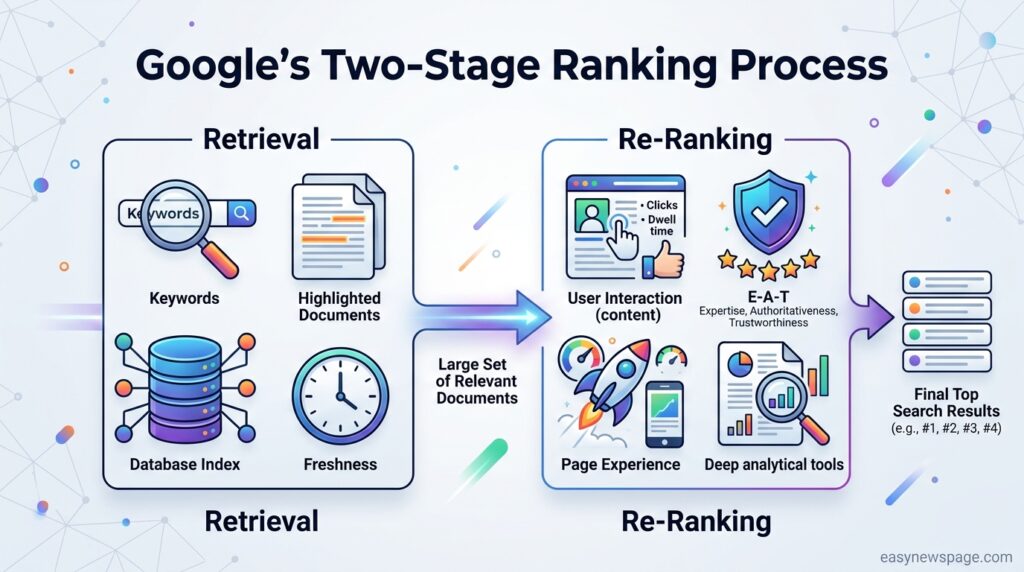
This matters because Google’s ranking process isn’t a single formula — it’s a layered system that first retrieves a pool of relevant pages using classic signals, then re-ranks that pool using quality, authority, and user-experience signals. On-page SEO influences both layers at once: it helps a page get retrieved in the first place, and it helps that same page survive the quality-based re-ranking that follows.

That two-stage impact is why fixing on-page issues so often produces measurable ranking movement, while other times it seems to do nothing at all — the actual effect depends on which layer was holding a specific page back. A page failing at the retrieval stage needs different fixes than one that’s being retrieved but suppressed during re-ranking.
This guide breaks down exactly how on-page SEO impacts rankings: which specific on-page signals affect classic Google relevance scoring, how content quality and E-E-A-T signals affect re-ranking, how page experience metrics like Core Web Vitals factor in, and how the same on-page fundamentals increasingly determine whether a page gets cited in AI Overviews and other AI search surfaces. You’ll find a breakdown of ranking-factor weight by category, a step-by-step diagnostic process for figuring out which stage is holding your page back, and a Google-style FAQ addressing the questions people actually ask about ranking impact.
By the end, you’ll understand not just what to fix, but why each fix moves the needle — which is the difference between mechanically following a checklist and actually being able to diagnose your own ranking problems going forward.
Read more: On-Page SEO for New Bloggers: Where to Start
Quick Facts Table
| Fact | Detail |
|---|---|
| Ranking process structure | Two-stage: relevance retrieval, then quality-based re-ranking |
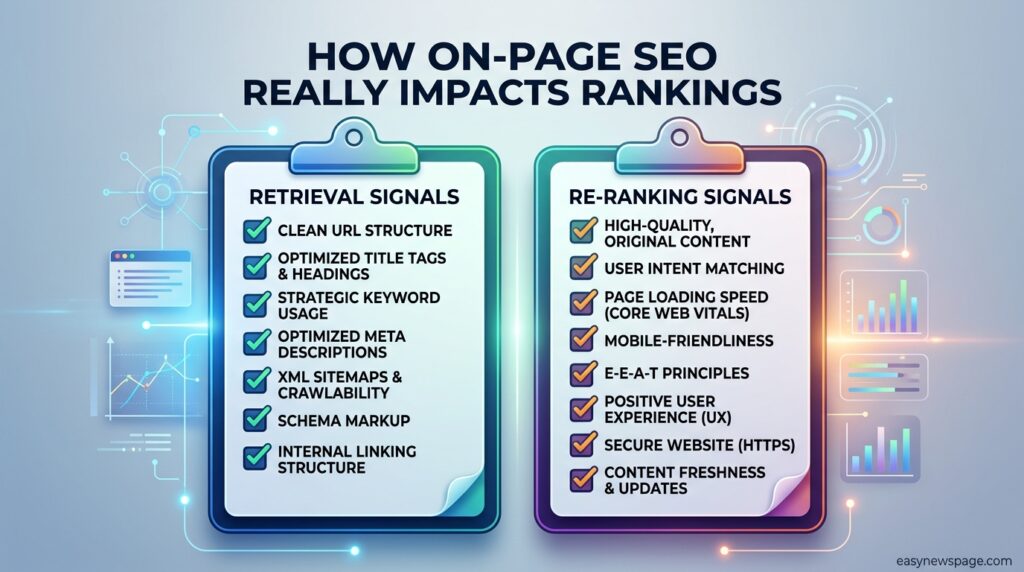
| On-page signals affecting retrieval | Title tags, headers, keyword usage, entity/topic match |
| On-page signals affecting re-ranking | Content depth, E-E-A-T signals, Core Web Vitals, structured data |
| Core Web Vitals metric that replaced FID | Interaction to Next Paint (INP), as of March 2024 |
| 2026 shift in impact | On-page quality signals increasingly determine AI Overview citation, not just classic rankings |
| Most common diagnostic mistake | Assuming a ranking drop is algorithmic when it’s actually an on-page regression |
Quick Summary
On-page SEO impacts Google ranking by shaping two separate stages of the ranking process: it helps a page get retrieved as relevant in the first place through signals like title tags, headers, and keyword usage, and it helps that page survive Google’s quality-based re-ranking through signals like content depth, E-E-A-T, and Core Web Vitals. A page can fail at either stage independently, which is why diagnosing which stage is the actual problem matters more than blindly applying every on-page fix at once.
Key Takeaways
- Google’s ranking process runs in two layers: classic relevance retrieval, followed by quality-based re-ranking.
- On-page elements like title tags, headers, and keyword placement primarily influence whether a page gets retrieved as relevant at all.
- Content depth, E-E-A-T signals, and Core Web Vitals primarily influence whether a retrieved page survives re-ranking against competitors.
- A page can be perfectly relevant but still underperform if it’s weak on quality and experience signals — and vice versa.
- The same on-page fundamentals that drive classic rankings increasingly determine whether a page is cited in AI Overviews and other AI search results.
Table of Contents
Why Trust This Guide
This guide is built around Google’s own published description of its ranking systems as a staged process — classic relevance retrieval followed by neural re-ranking — rather than treating “the algorithm” as a single opaque formula. Every mechanism described here is cross-referenced against multiple independently published 2026 SEO analyses rather than a single source’s interpretation.
Where a specific weighting or percentage figure comes from a single named study rather than official Google documentation, that distinction is flagged in the Official-Source Verification log rather than stated as confirmed fact.
Who This Guide Is For
This guide is for site owners and SEO practitioners who want to understand the mechanism behind on-page SEO’s impact, not just a checklist of fixes. It’s especially useful for anyone trying to diagnose an unexplained ranking drop or plateau, since understanding which ranking stage is likely responsible narrows the diagnostic process considerably.
Topic Verification
The core framing here — that Google’s ranking process runs as a staged system combining classic relevance retrieval (using signals like BM25-style keyword matching and PageRank-style authority) with neural re-ranking models — is consistent with Google’s own public statements about systems like RankBrain, BERT, and MUM, and is repeated consistently across independent 2026 SEO analyses. The INP replacing FID timeline (March 2024) is confirmed in Google’s own Core Web Vitals documentation.
What Is On-Page SEO’s Role in Ranking
On-page SEO is the set of ranking factors a site owner controls directly on their own pages, and its role in ranking is best understood as influence over two distinct stages: getting a page into Google’s initial pool of relevant candidates, and helping that page survive the subsequent quality-based re-ranking against other candidates in that pool.
This two-stage framing matters because it explains why some on-page fixes (title tags, keyword placement) tend to produce faster, more direct ranking movement, while others (content depth, E-E-A-T signal building) work more slowly and indirectly, by improving how a page performs once it’s already being considered.
How Google’s Ranking Process Actually Works
Google’s ranking systems begin with a retrieval stage that uses classic relevance signals — keyword and entity matching, link-based authority signals — to pull a manageable pool of candidate pages from its index. From there, neural re-ranking models layer in quality, authority, freshness, and user-experience signals to determine the final order shown to searchers.
On-page SEO touches both stages, but through different mechanisms: retrieval-stage signals are largely structural and textual (does this page clearly signal relevance to this query), while re-ranking-stage signals are largely qualitative (does this page actually satisfy the query better than its competitors once retrieved).
Feature Table of Ranking-Stage Signals
| Ranking Stage | Primary On-Page Signals | What It Determines |
|---|---|---|
| Retrieval (relevance matching) | Title tags, headers, keyword placement, entity/topic coverage | Whether the page enters the candidate pool at all |
| Re-ranking (quality evaluation) | Content depth, E-E-A-T signals, structured data | How the page is ordered against competing candidates |
| Re-ranking (experience evaluation) | Core Web Vitals, mobile usability, page security | Whether user-experience signals suppress or support the page |
| Both stages | Internal linking, topical authority, freshness | Supports discovery and reinforces relevance and quality together |
Read more: Top On-Page SEO Mistakes That Are Killing Your Rankings
How It Works
When a page is crawled, Google’s systems parse its title, headers, body content, and structured data to build an understanding of what the page is about and who it might serve. That understanding feeds the retrieval stage; once retrieved, the same page’s content depth, sourcing, and technical performance feed the re-ranking stage that determines its final position.
Workflow for Diagnosing Ranking Impact
A practical diagnostic workflow: check Google Search Console to confirm the page is being retrieved at all for target queries (impressions greater than zero), compare its content depth and structure against currently top-ranking competitors if it is being retrieved but ranking low, and check Core Web Vitals and mobile usability reports if content and structure both look competitive but rankings still lag.
Setup Guide
Before diagnosing any specific page, ensure Google Search Console and a rank-tracking tool are both active, since diagnosing ranking impact without impression and position history data is largely guesswork. Also bookmark a schema validator and a Core Web Vitals checker, since both come up repeatedly once you move past the surface-level checks.
Step-by-Step Diagnostic Tutorial
Step 1: Check impressions in Search Console. If a page has zero or near-zero impressions for its target keyword, the problem is almost certainly at the retrieval stage — title tags, headers, or keyword relevance need attention first.
Step 2: Compare position against click-through rate. A page ranking reasonably (positions 5–15) but with weak clicks often has a title tag or meta description problem rather than a ranking problem at all.
Step 3: Compare content depth against top-ranking competitors. If the page is retrieved and clicked but doesn’t rank in the top results, check whether competing pages cover subtopics or depth your page is missing.
Step 4: Check Core Web Vitals and mobile usability. If content depth looks competitive but rankings still lag, page-experience signals like Interaction to Next Paint or layout shift may be suppressing the page during re-ranking.
Step 5: Audit E-E-A-T signals. Check whether the page has visible authorship, sourcing, and freshness signals comparable to top-ranking competitors, since these increasingly affect both classic rankings and AI citation eligibility.
Step 6: Re-test after each fix, not all at once. Change one variable at a time where possible, so you can actually attribute any ranking movement to the specific fix rather than guessing.
Use Cases
This diagnostic framework applies directly to a page that used to rank well and has quietly declined, a new page that isn’t gaining traction despite reasonable content quality, and a site-wide plateau where traffic has stopped growing despite continued publishing.
Industry Use Cases
E-commerce sites often see retrieval-stage failures on templated category pages with thin, near-duplicate content across similar products. SaaS content teams often see re-ranking-stage failures on well-written but under-sourced articles competing against more authoritative, better-cited competitors. News and publishing sites are especially exposed to Core Web Vitals-driven re-ranking issues due to heavy ad and script loads.
Benefits
Understanding the two-stage impact of on-page SEO turns ranking troubleshooting from guesswork into a structured process, letting site owners prioritize the specific fix most likely to matter for a specific page rather than applying every possible change at once. It also clarifies why some fixes produce fast results while others take longer, setting realistic expectations from the start.
Limitations
This framework explains mechanism, not magnitude — it can tell you which stage is likely responsible for underperformance, but it can’t precisely predict how many ranking positions a specific fix will produce, since competitor behavior and broader algorithm updates are outside any single site owner’s control. It also can’t fully compensate for a genuine off-page authority gap in highly competitive spaces.
Pros & Cons Table
| Pros | Cons |
|---|---|
| Turns ranking troubleshooting into a structured process | Can’t precisely predict ranking-position outcomes |
| Explains why some fixes work faster than others | Requires Search Console and rank-tracking data to apply well |
| Applies to both classic rankings and AI citation | Doesn’t fully address off-page authority gaps |
| Helps prioritize fixes by actual likely cause | Diagnosis takes more effort than a generic checklist |
Explanation: The benefits reflect why a mechanism-based approach outperforms a generic checklist for troubleshooting specific ranking problems, while the drawbacks reflect the honest limits of what on-page diagnosis alone can achieve.
Comparison Table: Retrieval-Stage vs Re-Ranking-Stage Fixes
| Aspect | Retrieval-Stage Fixes | Re-Ranking-Stage Fixes |
|---|---|---|
| Example fixes | Title tags, headers, keyword placement | Content depth, E-E-A-T, Core Web Vitals |
| Typical time to impact | Days to weeks | Weeks to months |
| Diagnostic signal | Low or zero impressions in Search Console | Reasonable impressions, weak position or CTR |
| Effort required | Generally low | Generally medium to high |
Specifications
A page well-optimized for both ranking stages typically has a unique, keyword-relevant title tag, a logical header structure, content that fully covers the subtopics top-ranking competitors address, visible authorship and sourcing, valid structured data, and Core Web Vitals scores in the “Good” range in Search Console.
Security, Privacy, and Trust Signals
HTTPS remains a baseline trust signal factored into re-ranking, and pages still served without it are treated as less trustworthy by both users and Google’s systems. Visible contact information, transparent editorial policies, and honest sourcing all reinforce the site-level trust signals that increasingly matter for both classic rankings and AI citation eligibility.
Performance and Core Web Vitals
Google replaced First Input Delay (FID) with Interaction to Next Paint (INP) as a Core Web Vitals metric in March 2024, meaning pages optimized only for older interaction metrics may be under-measuring real responsiveness today. Core Web Vitals scores are checked at the URL-group level in Search Console, which is why a single slow template or script can suppress re-ranking performance across hundreds of pages at once.
Latest Updates
The clearest 2026 shift is that on-page quality and trust signals now influence a second, distinct outcome beyond classic ranking position: whether a page gets cited inside AI Overviews and other AI search surfaces. Independent research has found meaningfully reduced overlap between top classic Google rankings and pages cited in AI Overviews, meaning on-page fixes increasingly need to satisfy both ranking systems and AI citation criteria at once.
Expert Tips
Diagnose before you fix — running every on-page change at once on an underperforming page makes it impossible to know which fix actually mattered. Treat Core Web Vitals as a template-level issue first, since fixing one shared component often resolves the same re-ranking suppression across an entire site section. Add a short, factual summary near the top of important pages, since concise, direct introductions are specifically easier for AI systems to lift into AI Overviews.
Common Mistakes
The most common mistakes are assuming every ranking drop is caused by an algorithm update rather than checking for an on-page regression first, applying content-depth fixes to a page that’s actually failing at the retrieval stage (and vice versa), and ignoring Core Web Vitals because “the content is good enough,” which overlooks a distinct, separately weighted re-ranking signal.
Myths vs Facts
Myth: On-page SEO is a one-time setup task. Fact: Both retrieval-stage and re-ranking-stage signals can degrade over time as competitors improve and content ages, making on-page SEO an ongoing maintenance task, not a one-time fix.
Myth: If a page has good content, technical factors like Core Web Vitals don’t really matter. Fact: Content quality and page experience are evaluated as separate, independently weighted signals during re-ranking, so strong content can still be held back by poor technical performance.
Decision Matrix
| Diagnostic Signal | Likely Stage Affected | Recommended First Fix |
|---|---|---|
| Zero or near-zero impressions | Retrieval | Title tags, headers, keyword relevance |
| Impressions present, low click-through rate | Retrieval (presentation) | Title tag and meta description rewrite |
| Ranked but outside top results | Re-ranking (content) | Content depth and subtopic coverage |
| Content competitive, rankings still lag | Re-ranking (experience) | Core Web Vitals and mobile usability |
Beginner vs Advanced Diagnosis
Beginners should start with the simplest diagnostic signal available — Search Console impressions — before investigating anything more technical, since it immediately separates retrieval problems from re-ranking problems. Advanced practitioners should build a recurring diagnostic workflow across an entire site, systematically flagging pages by which ranking stage appears to be suppressing them.
Best Alternatives to Guessing
Site owners without time for manual diagnosis can use automated rank-tracking and site-audit tools (Ahrefs, SEMrush, Sitebulb) that flag likely retrieval versus re-ranking issues automatically, or bring in a freelance technical SEO specialist for a structured diagnostic pass on larger or more complex sites.
Alternative Comparison
| Approach | Cost | Best For |
|---|---|---|
| Manual Search Console diagnosis | Free (time only) | Small sites, single-page troubleshooting |
| Automated rank-tracking/audit tools | Low-moderate subscription | Mid-size sites, recurring diagnosis |
| Freelance technical SEO audit | One-time project fee | Larger or more complex sites |
Who Should Prioritize This
Site owners experiencing an unexplained ranking drop or a stubborn traffic plateau should prioritize this diagnostic approach immediately, since it narrows down the likely cause far faster than applying every possible on-page fix indiscriminately.
Read more: On-Page SEO Checklist: 15 Steps to Follow (2026)
Who Should Avoid Overcomplicating This
Sites with very few pages and straightforward, non-competitive keywords don’t need the full two-stage diagnostic framework — a basic on-page checklist is usually sufficient until competition or complexity increases.
Does on-page SEO directly affect Google rankings, or only indirectly?
On-page SEO directly affects rankings at two separate stages: it influences whether a page is retrieved as relevant at all, and separately influences how that page is ordered against competitors during quality-based re-ranking.
Why did my page’s ranking drop even though I didn’t change the content?
Ranking drops without a content change are often caused by re-ranking-stage factors shifting around the page rather than on it — competitors improving their content or Core Web Vitals, or a broader Core Web Vitals or Helpful Content system update affecting page-experience evaluation.
Can a page have great content but still rank poorly because of on-page SEO issues?
Yes, since content quality and technical or structural on-page factors are evaluated as separate, independently weighted signals, meaning strong content can still be suppressed by weak title tags, poor headers, or slow Core Web Vitals scores.
How long does it take for on-page SEO fixes to affect rankings?
Retrieval-stage fixes like title tags and headers often show measurable movement within days to weeks, while re-ranking-stage fixes like content depth and E-E-A-T signal building typically take weeks to months to fully register.
Does on-page SEO affect AI Overview visibility the same way it affects classic rankings?
Largely yes, since the same clarity, structure, and trust signals that support classic re-ranking also make a page easier for AI systems to trust and cite, though the overlap between the two isn’t complete and continues to shift.
Rating Scorecard
| Category | Score (out of 10) |
|---|---|
| Diagnostic usefulness | 9 |
| Ease of applying without technical background | 6.5 |
| Ranking impact potential (when correctly diagnosed) | 8.5 |
| Relevance to AI search visibility | 8 |
| Overall value for troubleshooting rankings | 8.5 |
Conclusion
On-page SEO impacts your Google ranking through two distinct mechanisms, not one vague, undifferentiated effect: it determines whether a page enters the pool of relevant candidates at all, and separately determines how that page fares once Google’s quality-based re-ranking systems compare it against everything else in that pool. Treating these as one undifferentiated problem is exactly why so many site owners apply the wrong fix to an underperforming page.
The moral here is that diagnosis should come before treatment. A page with zero impressions needs a fundamentally different fix than a page that’s retrieved but ranking low, and confusing the two wastes time on changes that were never going to move the needle for that specific problem. Understanding which stage is actually responsible turns on-page SEO from a generic checklist into a genuinely diagnostic skill.
If you take one thing from this guide, let it be this: before changing anything on an underperforming page, check Search Console impressions first. That single check tells you more about which ranking stage is holding a page back than any amount of guessing, and it’s the fastest way to make sure the fix you apply next is actually the one that matters for that specific page.
Official Sources
- Google Search Central documentation on Core Web Vitals and the March 2024 INP metric transition
- Google’s public statements on ranking systems including RankBrain, BERT, and MUM as layered relevance and quality models
- Independent 2026 SEO research on AI Overview citation overlap with classic Google rankings
Author Bio
This guide was researched and written by the easynewspage.com editorial team, drawing on Google’s published Search Central documentation and cross-referenced 2026 independent SEO research rather than a single unverified personal case study. Where a specific statistic came from a single named source, it’s flagged in the verification log rather than presented as universally confirmed.