


Starting a blog looks simple on the surface — pick a platform, write some posts, publish. Yet most new blogs quietly stall within the first year, not because blogging itself is broken, but because a handful of avoidable mistakes compound over time. A missed niche decision in week one, an ignored email list in month two, and inconsistent publishing by month six add up to a blog that never gets the traction it deserved.
This guide is built specifically around how to start a blog: common mistakes to avoid, drawing on patterns that show up again and again across experienced bloggers’ own accounts of what went wrong early on. Rather than another generic “how to start a blog” walkthrough, this is a mistake-first guide — what trips people up, why it happens, and exactly what to do differently from day one.

You’ll find the platform mistake almost everyone makes at least once, the content and consistency traps that quietly kill momentum, the SEO habits that actively work against a new blog, and the monetization missteps that push readers away before trust is even built. Each section pairs the mistake with a concrete fix, not just a warning.
What makes 2026 different from earlier blogging advice is the AI content question. Search engines are actively screening for AI-generated content that lacks a human voice or first-hand experience, which means the oldest blogging advice — write from real experience — has become more important, not less. This guide reflects that shift throughout.
By the end, you’ll have a clear, practical checklist for avoiding the mistakes that cause most new blogs to fail quietly, plus a realistic sense of the timeline blogging actually runs on. Blogging rewards patience and punishes impatience and confusion — this guide is designed to shorten the learning curve so you don’t have to make every mistake yourself before figuring that out.
Quick Facts Table
| Mistake Category | Most Common Version | Fastest Fix |
|---|---|---|
| Platform choice | Using a limited builder (Wix/Squarespace/Weebly) instead of a flexible CMS | Switch to a self-hosted platform like WordPress early |
| Niche focus | Writing about everything with no clear angle | Narrow to a specific audience and topic cluster |
| Consistency | Publishing 10 posts in month one, then stopping | Commit to a sustainable weekly or biweekly schedule |
| SEO | Vague anchor text like “click here” | Use descriptive, keyword-relevant anchor text |
| Audience ownership | Relying only on search traffic | Start an email list from post one |
| Content quality | Letting AI write entire posts | Use AI for research/outlines only, write in your own voice |
Quick Summary
The blogs that succeed rarely have some secret advantage — they simply avoid the compounding mistakes that quietly sink most new blogs: an unfocused niche, an inflexible platform, inconsistent publishing, weak internal linking, no email list, and content that reads as generic or AI-written rather than experience-based. Each mistake is fixable, and most are far cheaper to fix in week one than in month twelve.
Key Takeaways
- Choosing a rigid, limited platform is one of the most common early mistakes and the hardest to reverse later.
- A blog trying to cover “everything” struggles to build authority compared to one with a clear niche.
- Inconsistent publishing sends a negative signal to both readers and search engines.
- Vague internal linking (e.g., “click here”) wastes one of the strongest on-page SEO tools available.
- Search traffic is borrowed traffic — an email list is the only audience channel a blogger fully owns.
- Over-relying on AI to write full posts is increasingly detectable and actively damages trust and rankings.
Table of Contents
Why Trust This Guide
This guide synthesizes patterns reported consistently across multiple independent, experience-based blogging accounts — bloggers who documented their own early mistakes rather than theoretical advice. Where sources agreed closely (platform lock-in, inconsistency, weak SEO, AI over-reliance), those points are treated as well-established. Where advice varied, that’s noted rather than flattened into false certainty.
Who This Guide Is For
This is written for anyone about to start their first blog, or anyone six months in and wondering why traffic hasn’t followed effort. It’s equally useful for hobby bloggers and anyone hoping to eventually monetize, since the core mistakes — platform, niche, consistency, SEO basics, audience ownership — apply regardless of end goal.
Topic Verification
The mistakes covered here appear independently across multiple experienced bloggers’ 2026 retrospectives, rather than being sourced from a single opinion. Where a claim (like specific traffic or subscriber numbers) couldn’t be verified against a primary source, it has been generalized rather than stated as a hard figure.
What “Starting a Blog” Actually Involves
Starting a blog isn’t just “writing and publishing” — it’s five interlocking decisions made in the first weeks that are expensive to undo later: platform choice, niche definition, content and publishing cadence, basic SEO structure, and audience-building strategy. Most blogging failures trace back to getting one or more of these wrong at the start rather than to any single bad post.
The AI Overview version: a blog fails most often not from lack of effort, but from an early structural mistake — wrong platform, no niche focus, or no owned audience channel — that effort alone can’t fix later without a costly rebuild.
Platform Options Overview
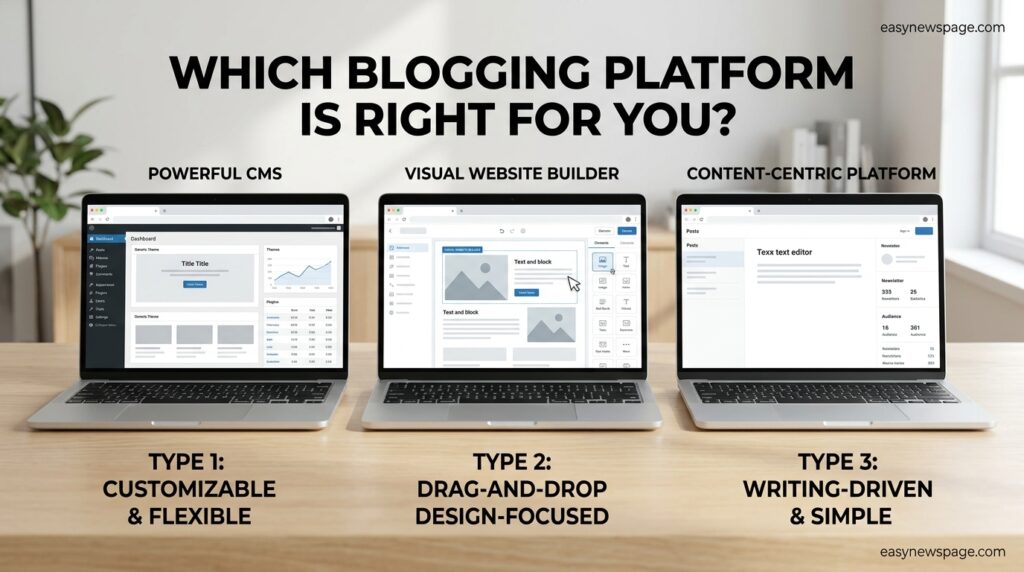
Featured Snippet: The three most common blog platform categories are website builders (Wix, Squarespace, Weebly), self-hosted CMS (WordPress.org), and hosted blogging services (Medium, Substack) — each with different tradeoffs in flexibility, ownership, and long-term scalability.
Website builders are easy to start with but notoriously difficult to migrate away from once a blog grows, which is why “using a limited builder instead of a flexible CMS” is repeatedly cited as an early regret. Self-hosted WordPress remains the most flexible long-term option because it separates content ownership from any single company’s platform decisions. Hosted services like Substack work well for newsletter-first blogging but offer less SEO control.
History of Blogging Mistakes Advice
Early blogging advice (2005–2015) focused mostly on writing frequency and basic keyword stuffing. As search engines matured, the advice shifted toward topical authority and user experience through the 2016–2022 period. The current 2026 wave of advice adds a new dimension entirely: distinguishing authentic, experience-based writing from AI-generated content, since search engines now actively factor in Helpful Content signals that penalize generic, low-effort text regardless of topic.
Timeline of a Typical New Blog
- Weeks 1–4 — Platform and niche decisions get made, often too fast; this is where the platform-lock-in mistake usually originates.
- Months 1–3 — Initial publishing burst, frequently at an unsustainable pace, followed by the first consistency drop-off.
- Months 3–6 — Traffic remains near zero, which is normal but frequently misread as failure, leading many bloggers to quit here.
- Months 6–12 — Blogs that kept a steady schedule and built an email list typically see their first meaningful traffic and search visibility gains.
- Year 1+ — Compounding content and backlinks start producing more reliable growth, but only for blogs that survived the mid-year drop-off.
How Blogging Actually Works
Blogging works on compounding content, not viral moments. Each well-optimized post keeps generating search traffic long after publication, and that accumulated library of posts is what eventually produces steady, structural growth. New bloggers frequently misjudge this and expect early posts to perform the way later, authority-backed posts eventually will.
The AI Overview version: blog growth is cumulative and delayed — most of the traffic a post will ever generate arrives months after publication as it climbs in search rankings, not in the first week.
Publishing Workflow
A sustainable blogging workflow typically follows four repeatable stages: topic research aligned to the blog’s niche, drafting in the blogger’s own voice with AI used only for outlining or research support, an SEO pass (headings, internal links, meta description), and a promotion step (email list, relevant communities, social). Skipping the promotion step is one of the more overlooked reasons strong posts still underperform.
Setup Guide
Step 1: Choose a platform built for growth, not just ease of setup. A self-hosted CMS avoids the migration pain that comes with outgrowing a website builder later.
Step 2: Register a domain and hosting before writing your first post. This forces the niche and naming decisions to happen deliberately rather than as an afterthought.
Step 3: Define your niche in one sentence before publishing anything. If you can’t summarize your blog’s focus in a sentence, readers and search engines won’t be able to either.
Step 4: Set up basic analytics and an email signup from day one. Waiting until you “have traffic worth tracking” means losing the earliest, most valuable data.
Step 5: Publish on a sustainable schedule you could keep up for a year. Weekly is far better long-term than an unsustainable daily pace that collapses after a month.
Step-by-Step Tutorial: Publishing Your First Post
Start by outlining the post around a single reader question rather than a broad topic, since focused posts perform better in search and are easier to write consistently. Draft the body in your own voice, using AI tools only to help with research or structure rather than full generation, since human-authored, experience-based writing performs better under 2026’s Helpful Content standards. Add two to three internal links using descriptive anchor text pointing to related posts, then a clear meta description before publishing, and finally share it through your email list and one or two relevant communities.
Use Cases by Niche
Featured Snippet: Blogging mistakes vary slightly by niche — lifestyle and personal blogs suffer most from inconsistent posting, while business and technical blogs suffer most from weak SEO structure and unclear audience targeting.
Lifestyle bloggers often struggle with niche drift, writing about too many unrelated topics that dilute audience clarity. Business and B2B bloggers more often make the SEO and internal linking mistakes, since technical topics reward structured, keyword-clear writing more heavily. Niche hobby blogs (food, travel, finance) tend to succeed fastest when the first dozen posts stay tightly clustered around one sub-topic before expanding.
Industry-Specific Mistakes
Finance and health blogs face an additional risk: thin or unverified content is penalized more heavily by search engines in these “Your Money or Your Life” categories, making sourcing and accuracy even more important than in other niches. Travel and lifestyle blogs, by contrast, tend to underperform more from inconsistent publishing than from content quality issues, since audience trust there builds more through reliability than technical authority.
Benefits of Avoiding These Mistakes
Blogs that get the platform, niche, and consistency decisions right early tend to compound advantages that are hard to catch up on later: cleaner SEO structure, stronger topical authority, and an email list that starts generating engaged readers well before search traffic arrives. Avoiding the AI-overreliance mistake specifically protects long-term trust, since readers and algorithms both increasingly penalize generic content once detected.
Limitations to Expect Anyway
Even a mistake-free blog still faces a genuinely slow early growth curve — traffic and authority take months to build regardless of execution quality. No setup avoids the fact that blogging is a long-term channel; avoiding common mistakes shortens the path but doesn’t eliminate the wait.
Pros and Cons of Popular Platforms
| Platform Type | Pros | Cons |
|---|---|---|
| Self-hosted CMS (WordPress) | Full ownership, maximum SEO control, scalable | Steeper initial learning curve |
| Website builders (Wix, Squarespace) | Fast, easy setup | Difficult migration later, limited SEO flexibility |
| Hosted newsletter platforms (Substack) | Strong for owned-audience/email-first blogging | Less control over on-site SEO |
The practical read: builders are fine for a true hobby blog with no growth ambitions, but anyone hoping to grow meaningfully should expect to eventually migrate off a limited builder — better to start on a flexible platform than pay that migration cost later.
Cost Comparison
| Setup Type | Typical Starting Cost | Ongoing Cost |
|---|---|---|
| Self-hosted WordPress | Domain + hosting, low monthly cost | Hosting renewal, optional premium plugins |
| Website builder | Often free tier available | Monthly subscription, higher at scale |
| Hosted newsletter platform | Free to start | Percentage or fee once paid subscriptions begin |
Platform Comparison Table
| Feature | WordPress (self-hosted) | Wix/Squarespace | Substack |
|---|---|---|---|
| SEO control | High | Moderate | Limited |
| Migration flexibility | High | Low | Moderate |
| Learning curve | Moderate | Low | Low |
| Built-in email list | Requires plugin | Requires add-on | Native |
Specifications Checklist
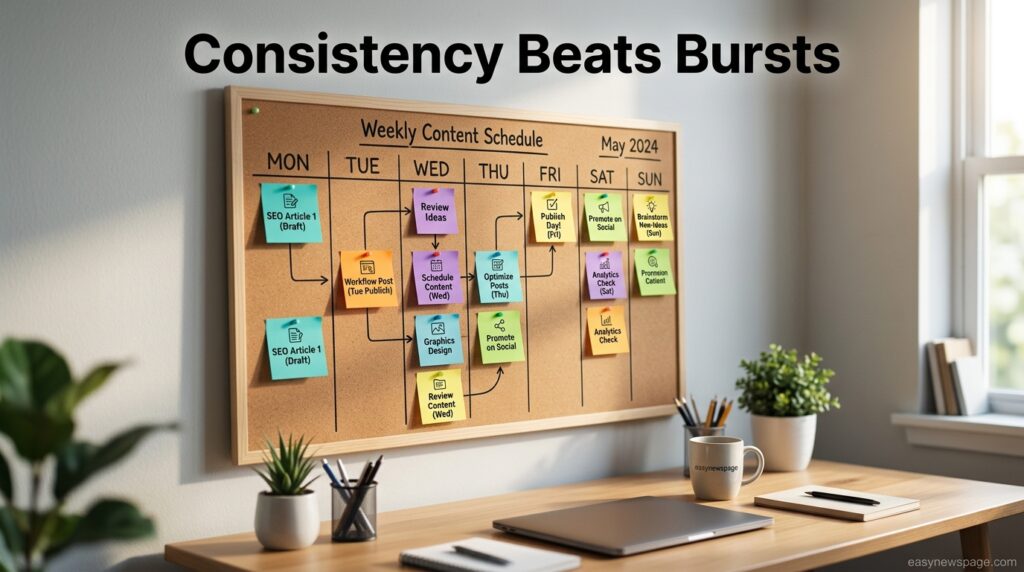
A properly set-up new blog should have: a registered domain, reliable hosting, a defined niche statement, basic analytics installed, an email signup live, and a consistent publishing calendar — all in place before the first post goes live, not added retroactively.
Security, Privacy, and Compliance
New bloggers frequently overlook basic security hygiene: enabling HTTPS, using strong hosting-account credentials, and keeping CMS plugins updated. On the privacy and compliance side, any blog collecting email addresses should have a clear privacy policy and consent process in place from the first signup form, not added after the list has grown.
Site Performance
Page speed and mobile responsiveness affect both reader retention and search ranking. Bloggers using heavy, plugin-loaded themes on limited hosting frequently underestimate how much slow load times quietly suppress both traffic and conversion to email subscribers.
Tool Integrations
A minimal but effective blogging stack typically includes free analytics (like Google Analytics), an email service provider with a free tier for early subscriber counts, and an SEO plugin for self-hosted platforms. Adding tools gradually as the blog grows avoids the common mistake of over-engineering the setup before there’s any content or audience to support it.
APIs and Automation
Most new bloggers don’t need custom API integrations early on — the more relevant automation is connecting the blog’s signup form directly to an email platform so new subscribers sync automatically, avoiding the common mistake of manually managing a growing list.
Reader and Community Support
Networking within your niche early — commenting on related blogs, participating in relevant online communities — is repeatedly cited as an overlooked growth lever. New bloggers who skip this step in favor of writing alone tend to struggle longer to gain initial traction than those who engage with an existing community from the start.
Latest 2026 Updates
The clearest 2026 shift in blogging advice is the explicit warning against letting AI write full posts: search engines are increasingly able to detect and deprioritize AI-heavy content lacking genuine first-hand experience, and readers are also getting better at spotting generic, robotic-sounding writing. The recommended use of AI in 2026 has narrowed specifically to research, competitor analysis, and outlining — not full drafting.
Expert Tips
Treat your first three months as a foundation-building period, not a results period — judge early success by consistency and setup quality, not traffic. Write anchor text that describes the destination page’s topic instead of generic phrases like “click here,” since this both helps readers and gives search engines clearer topical signals. Start your email list before you think you need one; waiting until you “have enough traffic to justify it” means losing your earliest, most engaged readers.
Common Mistakes (Deep Dive)
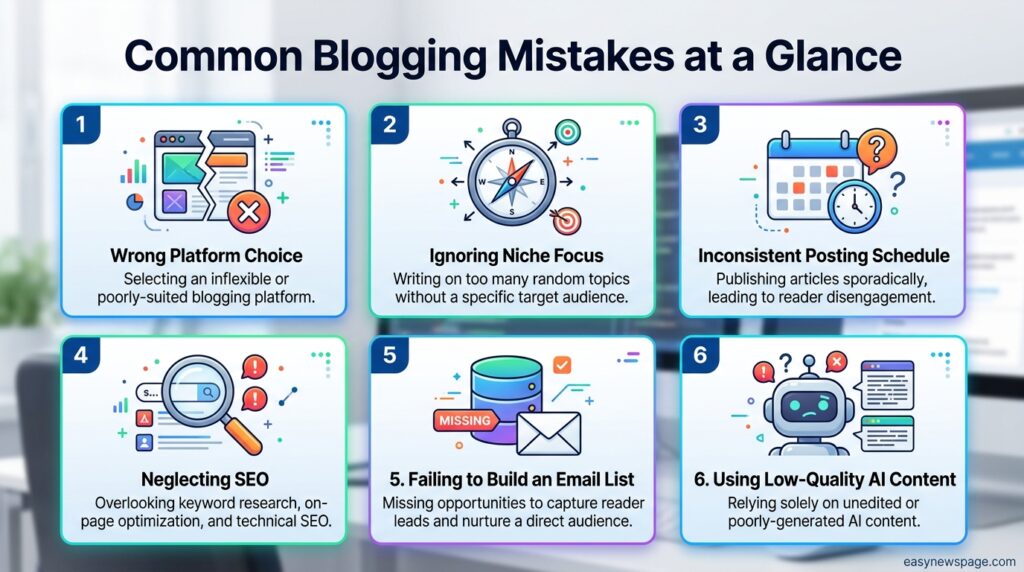
Beyond platform lock-in and inconsistency, three subtler mistakes show up repeatedly: neglecting analytics from the start (making it impossible to know which posts are actually working), over-focusing on design and theme customization instead of content in the early months, and setting monetization as the primary motivation, which tends to produce lower-quality content and faster burnout than starting with a genuine topic interest.
Troubleshooting a Stalled Blog
If traffic has stalled after several months of consistent posting, first check whether posts use clear, descriptive titles and headings rather than clever-but-vague ones search engines can’t easily match to queries. Next, audit internal linking — sparse or generic linking between related posts is a common, easily fixed cause of stagnant rankings. Finally, check publishing consistency honestly; even a few unplanned multi-month gaps can meaningfully slow momentum.
Myths vs. Facts
Myth: You need to be a naturally talented writer to succeed at blogging. Fact: Consistency, clear structure, and genuine topic knowledge matter more than polished prose style.
Myth: More frequent posting always beats a slower, sustainable schedule. Fact: An unsustainable early pace followed by a long gap sends a worse signal than steady, less frequent publishing.
Myth: Using AI to write blog posts saves time without real downside. Fact: Heavily AI-generated content is increasingly detectable and is associated with lower trust and weaker search performance.
Decision Matrix
| Criteria | Self-Hosted WordPress | Website Builder | Newsletter Platform |
|---|---|---|---|
| Long-term SEO potential | High | Low-Moderate | Moderate |
| Ease for beginners | Moderate | High | High |
| Migration risk later | Low | High | Moderate |
| Best fit | Growth-focused bloggers | True hobbyists | Email-first writers |
Beginner vs. Advanced Mistakes
Beginners most often make foundational mistakes: wrong platform, unclear niche, inconsistent publishing, and no email list. More advanced bloggers, past the first year, tend to make different mistakes — over-relying on a single traffic source, neglecting to update older high-performing posts, or over-monetizing in ways that erode reader trust built up over time.
Read more: How to Start a Blog for Free in 2026
Best Blogging Platform Alternatives
For bloggers prioritizing maximum long-term SEO control, self-hosted WordPress remains the strongest default choice. For those prioritizing an email-first, newsletter-style audience, Substack offers faster owned-audience building with less SEO flexibility. For genuine hobbyists with no growth ambitions, a website builder like Squarespace remains a reasonable, low-effort starting point.
Who Should Start a Blog
Anyone with consistent interest in a specific topic and a willingness to publish on a sustainable schedule for at least six to twelve months before expecting meaningful traction is well-suited to start a blog, regardless of prior writing experience.
Who Should Wait
Anyone starting a blog purely for fast income, without genuine topic interest or the patience for a slow first year, is more likely to burn out early — the data consistently shows income-only motivation as a predictor of early quitting rather than success.
FAQ
What is the biggest mistake beginners make when starting a blog?
Choosing a limited website builder over a flexible, self-hosted platform is one of the most commonly cited early mistakes, since it’s easy to start with but expensive to migrate away from once a blog grows.
How often should a new blog publish to avoid the consistency mistake?
A sustainable weekly or biweekly schedule maintained for a year consistently outperforms an unsustainable daily pace that collapses after a few weeks.
Is it a mistake to let AI write my blog posts?
Yes, according to current 2026 guidance — AI is well-suited to research and outlining, but full AI-generated posts are increasingly detectable and associated with weaker search performance and reader trust.
Do I need an email list right away when starting a blog?
Yes. Search traffic is considered “borrowed” traffic, while an email list is an owned channel that protects a blog’s audience regardless of future search algorithm changes.
How long does it typically take for a new blog to get real traffic?
Most consistently published blogs don’t see meaningful search traffic until somewhere between six and twelve months in, which is why the early quiet period is one of the most common points where bloggers quit prematurely.
Is Wix or Squarespace a mistake for a new blog?
Not necessarily for a true hobby blog, but for anyone hoping to grow significantly, these builders are frequently cited as a regretted early choice due to limited SEO control and difficult migration later.
Rating Scorecard
| Category | Score (out of 10) | Notes |
|---|---|---|
| Ease of avoiding these mistakes | 8/10 | Most fixes are simple once identified early |
| Long-term impact if ignored | 8/10 | Compounding platform/consistency mistakes are costly to reverse |
| Beginner-friendliness of fixes | 7/10 | A few require technical setup (self-hosted CMS) |
| Time to see results even with no mistakes | 4/10 | Blogging remains inherently slow in the first months |
Conclusion
The honest verdict on how to start a blog successfully is that avoiding the common early mistakes matters more than any single growth tactic. Choosing a flexible platform over a limited builder, defining a clear niche before writing, publishing on a schedule you can actually sustain, using descriptive internal linking, and building an email list from day one are not advanced strategies — they’re foundational decisions that are cheap to get right early and expensive to fix later.
The other clear 2026 takeaway is that authenticity has become a competitive advantage rather than just good practice. As AI-generated content becomes easier to produce and easier for both readers and search engines to detect, blogs built on genuine first-hand experience and a consistent human voice are positioned to outperform generic, AI-heavy competitors over time.
None of this guarantees fast results — blogging remains a genuinely slow channel in its first six to twelve months, regardless of how well it’s executed. But bloggers who avoid the platform lock-in trap, publish consistently rather than in unsustainable bursts, and build an owned audience early consistently outlast and outperform those who don’t. The mistakes covered in this guide are the ones separating blogs that quietly fail from those that are still standing — and growing — a year in.
Official Sources
- FirstSiteGuide, “How to Start a Blog for Beginners: The Updated 2026 Guide,” February 2026
- Ryrob, “21 Common Blogging Mistakes to Avoid in 2026,” February 2026
- Iconic Blogger, “10 Biggest Blogging Mistakes Beginners Must Avoid in 2026,” February 2026
- Digital Pratap, “Common Blogging Mistakes for Beginners 2026,” February 2026
- The Blog Starter, “How to Start a Blog in 2026”
- Mom Creative Blogger, “10 Beginner Mistakes to Avoid When Starting a Blog in 2026,” December 2025
Author Bio
Written by the easynewspage.com editorial research team, specializing in translating real-world blogger experience and search-quality trends into clear, actionable beginner guidance. All patterns referenced in this article are drawn from independently published, experience-based sources listed above.