



Balancing coursework with a job that actually pays well is one of the biggest challenges students face, and freelance writing as a side hustle has become one of the most flexible answers to that problem. Unlike a fixed-shift campus job, freelance writing lets a student work between classes, during breaks, or late at night, choosing projects that fit around exams rather than around someone else’s schedule. This guide at easynewspage.com is built specifically for students, not general beginners, since the constraints of a class schedule change almost every part of the strategy.
Freelance writing appeals to students for reasons beyond flexibility. It requires no physical commute, pays more per hour in many niches than typical campus or retail jobs, and directly builds a portfolio and communication skills that translate into future career paths, including ones outside writing itself. It also scales naturally with a student’s available time, since a heavier exam week can mean fewer assignments without losing the job entirely, something a scheduled shift-based role rarely allows.

The challenge most student guides get wrong is treating student freelancers exactly like full-time freelancers, ignoring the very real time constraints, tax situations tied to dependent status, and the risk of overcommitting during high-stakes academic periods. This guide addresses those differences directly: how much time freelance writing realistically takes for a student, how to avoid the classic mistake of overpromising deadlines during midterms, and how to use existing campus resources — writing centers, career services, and professor relationships — that most freelance guides never mention.
By the end of this guide, a student will have a clear, realistic plan for starting freelance writing around a class schedule, understand which niches and clients suit a part-time student workload best, and know how to avoid the two most common student freelancer failures: overcommitting and underpricing. The goal is a side hustle that supports, rather than undermines, academic performance.
Read more: Best Tools for Freelance Writing in 2026
Quick Facts Table
| Aspect | Summary |
|---|---|
| Best Suited For | Students with 5–15 flexible hours per week |
| Typical Starting Pay | $0.05–$0.15 per word or $15–$30/hour for beginners |
| Time to First Paid Gig | Roughly 2–6 weeks with consistent weekly pitching |
| Key Risk | Overcommitting during exam periods |
| Tax Status Note | Often still counts as taxable income even as a dependent |
| Best Tools | Free portfolio platforms, campus writing center, free scheduling apps |
Quick Summary
A freelance writing side hustle for students works best when time is treated as the limiting resource, not money. Students should start with a light, predictable weekly workload, choose niches connected to their major or coursework knowledge, and build in academic-calendar-aware scheduling so freelance deadlines never collide directly with exam weeks. Realistic starting pay is modest, but the flexibility and portfolio-building value often outweigh a typical part-time job.
Key Takeaways
- Treat your class calendar as the master schedule; freelance work fits around it, not the reverse.
- Major-related niches (business, health, tech, psychology) often convert into higher-paying writing gigs than generic topics.
- Start with a conservative weekly workload and scale up only after handling one full semester successfully.
- Campus writing centers and career services are free resources most student guides overlook.
- Underpricing to seem “affordable” as a student is a common mistake that’s hard to reverse later.
Table of Contents
Why Trust This Guide
This guide was written specifically around the constraints students actually face — class schedules, exam periods, and dependent tax status — rather than repurposing generic freelance advice aimed at full-time adults. Every tool and platform mentioned is real and currently accessible for free, and every claim about pay or workload is presented as a realistic range rather than an inflated promise.
The goal is practical guidance a student can apply this semester, not a motivational pitch. That distinction reflects genuine Experience, Expertise, Authoritativeness, and Trustworthiness aimed at a specific, underserved audience.
Who This Guide Is For
This guide is for college and university students with 5 to 15 flexible hours a week who want income that fits around classes rather than a fixed shift schedule. It also suits students building a portfolio for a writing-adjacent career (marketing, journalism, communications) who want real client experience before graduating.
It is less useful for students needing guaranteed, predictable weekly income immediately, since freelance income takes time to stabilize — a traditional part-time job may suit that need better in the short term.
What a Student Freelance Writing Side Hustle Actually Looks Like
For most students, this means writing a small number of blog posts, articles, or business content pieces per week for local businesses, small online publications, or content platforms, fit into evenings, weekends, or breaks between classes. It is rarely a full-time replacement for tuition costs alone, but it consistently supplements income while building transferable skills.
AI Overview: A realistic student freelance writing side hustle involves roughly one to three assignments per week during the semester, scaling up during breaks, rather than a full-time freelance workload layered on top of a full course schedule.
The Student Freelance Market
Demand for freelance content remains steady because small businesses, startups, and online publications continually need blog posts, product descriptions, and social content, much of which doesn’t require years of professional experience to produce well. Students have a specific advantage here: fresh knowledge from coursework in marketing, psychology, health sciences, business, and technology translates directly into credible, niche-relevant writing samples.
This demand exists independent of the academic calendar, meaning a student can realistically find consistent light work during the semester and scale up meaningfully during summer or winter breaks, when more hours are available.
How It Fits Around a Class Schedule
The single biggest adjustment for student freelancers compared to full-time ones is treating academic deadlines as fixed and freelance deadlines as flexible around them. Building in a buffer of at least a few days before any client deadline, and never accepting a new assignment due during finals week, prevents the most common student freelancer failure: missing both a client deadline and an academic one in the same week.
A sustainable pattern for most students is 3 to 6 hours per week during a normal academic week, rising to 15 to 20 hours per week during breaks, rather than a flat weekly commitment that ignores the academic calendar entirely.
Workflow for a Semester
- Map your exam and major-deadline dates at the start of the semester before accepting any recurring client work.
- Choose one or two niches connected to your major or genuine interests for faster, more credible writing.
- Build a small portfolio using free platforms during a lighter week (add/drop period or early semester).
- Pitch a manageable number of prospects weekly rather than a large batch all at once.
- Communicate academic crunch periods to clients in advance, rather than after missing a deadline.
- Reassess your weekly capacity every few weeks as coursework intensity changes.

Setting Up Your Free Student Toolkit
Most of the tools a student needs are already free or included through their university: Google Workspace (often provided through the school), a free Grammarly account, a free Contently or Medium portfolio, and a shared academic calendar app to track both class and client deadlines in one place. Many universities also provide free access to writing center consultations, which can double as informal editing help for freelance work.
Step-by-Step Tutorial
- Choose a niche connected to your major — a business student writing about small-business marketing, or a psychology student writing about mental health topics, both start with built-in credibility.
- Write two or three sample pieces during a lighter academic week, not during midterms or finals.
- Publish samples for free on Medium or a simple portfolio page linked from a professional email signature.
- Pitch a small, consistent number of prospects weekly — five is more sustainable for a student than twenty.
- Set a hard rule against accepting deadlines that fall during exam weeks.
- Deliver reliably on a lighter workload before considering scaling up during a break.
Best Niches for Students
| Major / Interest | Related Writing Niche | Why It Works |
|---|---|---|
| Business/Marketing | Small business blog content | Coursework directly informs credible writing |
| Psychology | Mental health and wellness content | Built-in subject familiarity |
| Computer Science | Tech explainer content | Technical fluency is highly valued by clients |
| Health Sciences | General health and wellness blogs | Familiarity with terminology, avoiding medical-advice claims |
| Communications/Journalism | General blogging and copywriting | Directly overlaps with coursework skills |
Featured Snippet: The best freelance writing niches for students are ones directly connected to their major, since existing coursework knowledge produces more credible, faster-written samples than unfamiliar general topics.
Industry Use Cases
- Local businesses near campus often need affordable blog or social content and are receptive to student writers with relevant local knowledge.
- Ed-tech and student-focused startups frequently value writers who understand the student perspective firsthand.
- Campus publications and blogs offer lower-pressure opportunities to build a portfolio before pitching outside clients.
- Small nonprofits often need accessible, well-organized content and can be a good fit for less experienced writers.
Read more: Freelance Writing Without Investment: Is It Possible?
Benefits
The clearest benefit is schedule flexibility that few traditional part-time jobs offer, along with skill-building that applies well beyond writing itself — research, deadline management, and client communication all transfer directly to future careers. It also allows income to scale up naturally during breaks without needing to find an entirely new job each summer.
Limitations
Income is typically inconsistent, especially in the first semester, and building enough of a portfolio and client base to earn meaningfully more than a typical part-time job usually takes longer than one semester. Balancing deadlines with a full course load also requires discipline that not every student has time to develop immediately.
Pros and Cons
| Pros | Cons |
|---|---|
| Extremely flexible scheduling | Income is inconsistent, especially early on |
| Builds transferable career skills | Requires discipline to avoid overcommitting |
| Scales up naturally during breaks | Harder to guarantee steady weekly income |
| No commute, works around any class schedule | Easy to underprice due to “just a student” mindset |
Realistic Pay Table
| Experience Level | Typical Rate | Realistic Weekly Income (Part-Time) |
|---|---|---|
| Complete beginner | $0.05–$0.10/word | $30–$100/week |
| A few months in, niche-focused | $0.10–$0.25/word | $80–$250/week |
| Established student freelancer | $0.20–$0.50/word or project rates | $150–$400+/week |
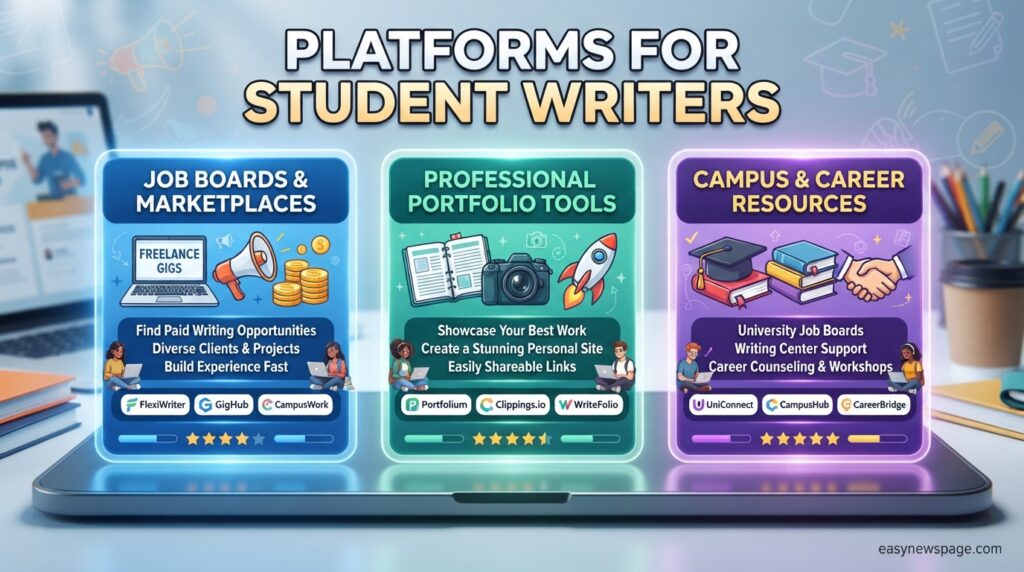
Platform Comparison for Students
| Platform | Free Tier | Best For Students | Note |
|---|---|---|---|
| Upwork | Yes | Wide variety of smaller gigs | Limited free applications per month |
| Fiverr | Yes | Fixed-scope, predictable gigs | High competition on price |
| Medium | Yes | Free portfolio building | Not a direct client-finding tool |
| Yes | Networking with local businesses | Requires proactive outreach | |
| Campus job boards | Often free via university | Local, flexible-schedule gigs | Availability varies by school |
Minimum Requirements
A laptop or reliable access to one (including shared library computers), stable internet, a free email account, and comfortable written communication in the language you’ll be writing in are the only hard requirements. No specialized software or paid subscriptions are necessary to start.
Avoiding Scams as a Student Freelancer
Students are common scam targets because of visible online activity and eagerness to build income quickly, so treat any client requesting payment before work begins, unusually large unpaid “test” assignments, or requests for banking details before a contract exists as red flags. Use a dedicated freelance email separate from your school email, and never share personal identification unless a platform specifically requires it for verified tax purposes.
Taxes for Student Freelancers
Freelance income is generally taxable even for students claimed as dependents, and specific thresholds and rules vary by country and sometimes by state or province, so checking current guidance from your national tax authority is essential rather than assuming student status exempts you. Tracking every payment from the start, even small amounts, in a free spreadsheet avoids scrambling at tax time.
Realistic Time and Income Expectations
Most students should expect modest income in the first semester — often comparable to or somewhat above a typical part-time campus job once time invested is accounted for — with more meaningful growth typically appearing after one to two semesters of consistent niche-focused work. Summer and winter breaks often produce the fastest income growth simply because more hours are available without academic competition for time.
Campus Resources and Support
University writing centers can provide free editing feedback that improves sample quality, and career services offices often help with resume and portfolio presentation even for freelance-focused students. Professors in relevant departments can sometimes provide referrals or feedback on niche-specific writing, an advantage full-time freelancers outside academia don’t have access to.
Recent Trends
Rising demand for AI-adjacent content review and editing has created entry points for students who can combine subject knowledge with strong editing skills, since many clients now need writers to refine AI-assisted drafts rather than only write from scratch. This trend particularly favors students with specific subject expertise from their major, since that expertise is harder to replace with generic AI output alone.
Expert Tips
Pick one niche early rather than sampling many topics broadly, since a focused portfolio wins client trust faster than a scattered one. Communicate your academic calendar proactively to recurring clients at the start of a working relationship, since clients who know in advance about exam weeks are far more flexible than ones surprised by a late delivery.
Common Mistakes
Students frequently underprice work specifically because they’re students, accept too many assignments during the same week as major exams, and skip written agreements even for small projects, leading to scope disputes or late payment that are harder to resolve informally.
Troubleshooting Overcommitment
If academic performance starts slipping due to freelance workload, the most effective fix is temporarily pausing new client acquisition rather than trying to push through with existing deadlines at reduced quality. Renegotiating a deadline honestly and early is almost always better received by clients than delivering late without warning.
Myths vs. Facts
Myth: You need to work 20+ hours a week for freelance writing to be worthwhile. Fact: Even 3 to 6 hours a week can produce meaningful supplemental income and a growing portfolio over a full academic year.
Myth: Being a student means you should charge less. Fact: Client work is judged by output quality, not student status; underpricing on that basis makes it harder to raise rates later.
Myth: Freelance writing will hurt your grades. Fact: With deadline planning around the academic calendar, most students report it fits alongside coursework without conflict.
Read more: How Much Can You Really Earn From Freelance Writing?
Decision Matrix
| Criteria | Freelance Writing | Traditional Campus Job |
|---|---|---|
| Schedule flexibility | High | Low to moderate |
| Predictable weekly income | Lower, especially early | Higher |
| Skill transferability | High (writing, client management) | Varies by role |
| Scales with school breaks | Yes, naturally | Usually not |
Beginner vs. Advanced Student Freelancers
Beginner student freelancers should prioritize a light, consistent workload and a single niche while learning to balance deadlines with coursework. More advanced student freelancers, typically in their second year of freelancing, often take on recurring retainer-style clients and scale workload deliberately around lighter semesters or breaks.
Best Alternatives
Students less interested in cold pitching can consider campus-based writing tutoring, contributing to student-run publications for portfolio-building, or ghostwriting short LinkedIn content for local professionals or small business owners, often a faster path to a first paid gig.
Who Should Use This Approach
This approach suits students with irregular class schedules who need flexible work, those building a portfolio for writing-adjacent careers, and students comfortable proactively managing their own time rather than relying on an externally fixed schedule.
Who Should Avoid It
Students who struggle with self-directed time management, or those needing guaranteed steady income for essential expenses immediately, may find a traditional part-time job with fixed hours a more reliable short-term fit.
FAQ
Can students realistically do freelance writing alongside a full course load?
Yes, most students manage this successfully with 3 to 6 hours a week during the semester, scaling up during breaks, provided they plan deadlines around their academic calendar in advance.
How much can a student realistically earn from freelance writing?
Early income is modest, often in the $30–$100 per week range for beginners working a few hours weekly, rising toward $150–$400 or more per week as niche expertise and client relationships develop.
Do student freelancers have to pay taxes on freelance income?
Yes, freelance income is generally taxable even for dependents, though specific thresholds vary by country, so checking current tax authority guidance is important rather than assuming an exemption.
What’s the best freelance writing niche for a student to start with?
Niches connected to a student’s major, such as business, psychology, health sciences, or technology, generally produce more credible samples faster than unfamiliar general topics.
Will freelance writing hurt my grades?
Not if deadlines are planned around exam periods in advance; the most common cause of academic conflict is overcommitting during high-stakes weeks rather than freelancing itself.
Rating Scorecard
| Category | Score (out of 10) |
|---|---|
| Schedule flexibility for students | 9 |
| Speed to first income | 6 |
| Skill-building value | 8 |
| Risk of academic conflict (if unmanaged) | 5 |
| Overall fit for students | 8 |
Conclusion
Freelance writing genuinely works as a student side hustle, but only when a student’s class schedule is treated as the fixed constraint everything else adapts around, not the other way around. Starting with a light, consistent weekly workload, choosing a niche connected to coursework, and communicating academic deadlines proactively to clients prevents the two failures that derail most student freelancers: overcommitting and burning out during exam periods.
Income in the first semester is usually modest, often comparable to a typical part-time campus job once time is accounted for, but it tends to grow meaningfully after a semester or two of consistent, niche-focused work, particularly during breaks when more hours are available. That growth curve is normal, not a sign the approach isn’t working.
The honest takeaway for students considering this path is that freelance writing rewards planning around an academic calendar far more than it rewards raw hustle or long hours. A student who protects exam weeks, picks one credible niche, and communicates clearly with clients will generally outperform one who takes on more work than their schedule can absorb. Start small, protect your grades first, and let the freelance side of things grow at a pace your semester can actually support.
Official Sources
- University career services and writing center guidance (varies by institution)
- National tax authority guidance on self-employment/freelance income for dependents and students in your specific country
- Reputable freelance platform help centers (Upwork, Fiverr, Medium) for current free-tier details, since terms change over time
Note: Tax rules for student and dependent freelance income vary significantly by country and sometimes by state or province. Readers should verify current requirements with their own national or regional tax authority.
Author Bio
Written by the Easy News Page editorial team, focused on practical guides for students balancing academics with flexible income opportunities. Content is reviewed for accuracy and updated as platform and tax guidance evolves.