


If you typed this question into Google, you already suspect the honest answer isn’t a simple yes or no — and you’re right. The freelance writing market didn’t shrink evenly in 2026. It split down the middle.
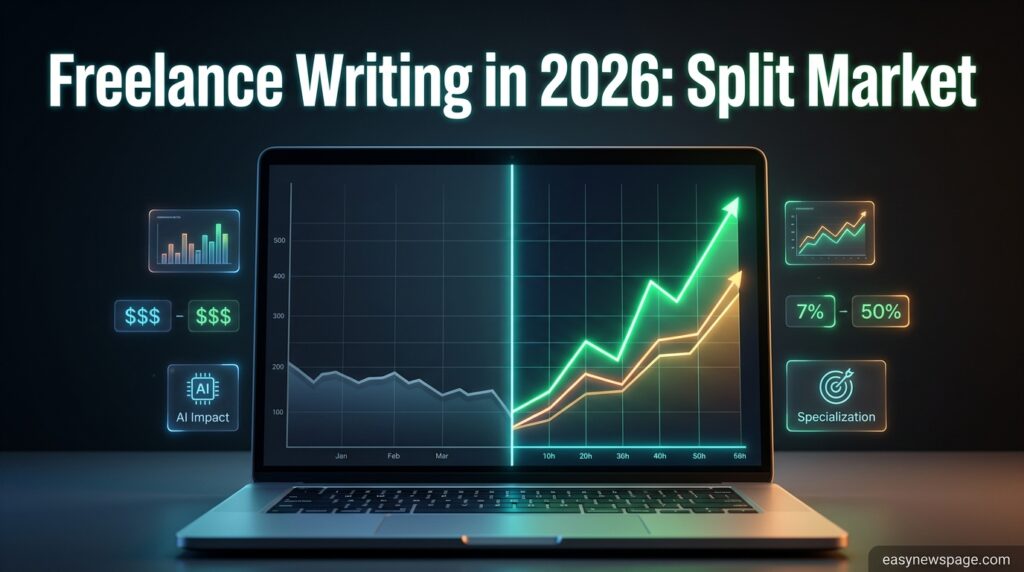
On one side, generic content work has genuinely collapsed. Writing-related job postings on major freelance platforms have dropped by roughly a third since AI writing tools went mainstream, and that decline is concentrated almost entirely in low-skill, low-context work: thin product descriptions, generic “top 10” listicles, and blog posts that require no research or judgment. If your entire freelance pitch is “I can write 1,000 words on any topic quickly,” you’re now competing directly with a free chatbot, and you will lose on price every time.
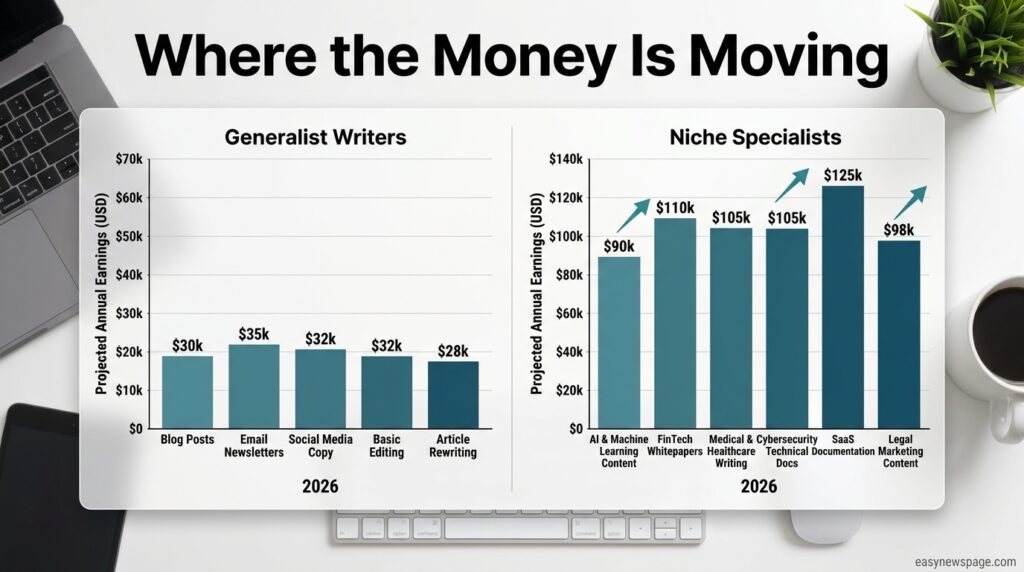
On the other side, something less widely reported is happening: writers who bring specialized knowledge AI can’t fake — regulatory fluency, technical accuracy, lived industry experience, a byline clients trust — are charging more than ever and turning down work. Finance, healthcare, cybersecurity, and SaaS writers are seeing some of the strongest rate growth in the industry’s history, even as the overall market contracts.
This matters right now because the gap between these two groups is still widening in 2026, not stabilizing. Writers who haven’t picked a lane yet are running out of time to do so before the “generalist” category disappears entirely. The good news is that the underlying demand for expert writing hasn’t gone away — if anything, as AI floods the internet with mediocre content, clients are paying a premium to stand out from it.
This article walks through what the current data actually shows, who’s thriving versus who’s struggling, and what a realistic path to profitability looks like for a freelance writer starting or repositioning in 2026.
Freelance writing is still profitable in 2026, but only for a shrinking group of writers. Commodity content writing has collapsed — generic blog posts and “what is” explainers pay less and get outsourced to AI. Meanwhile, writers with real subject-matter expertise in fields like finance, healthcare, SaaS, and technical documentation are earning more than they did before AI arrived. The floor dropped; the ceiling rose. Where you land depends almost entirely on whether you’re replaceable by a prompt.
Byline: easynewspage.com Staff Writer Last Updated: August 1, 2026 Methodology: Figures below are drawn from Upwork’s 2025 platform data, the Freelancer Kompass 2026 report, Bureau of Labor Statistics wage data, and independent surveys of freelance writers conducted in early-to-mid 2026. Where sources disagreed, the more conservative figure is used, and estimates are labeled as such.
Recent Updates: A February 2026 analysis of company spending patterns found that freelance marketplace spending has fallen sharply as a share of overall business budgets since 2022, while AI tool spending has risen from almost nothing to a meaningful budget line. At the same time, Upwork’s data shows writers working on AI-adjacent projects now earn well above the platform average per hour — a gap that has widened, not narrowed, over the past year.
Background: how we got here
Freelance writing was already a volatile field before generative AI, but the last three years accelerated everything. When AI writing tools reached mainstream adoption, clients who had been paying for basic blog content realized a first draft could be produced almost instantly. Budgets shifted fast. Businesses that once spent meaningfully on freelance marketplaces have pulled that spending back sharply, while spending on AI tools has grown from a rounding error to a real line item in company budgets.
That shift didn’t hit every type of writing equally. Entry-level, low-context work absorbed the deepest cuts. Automation-prone freelance writing roles have declined at roughly double the rate of writing jobs requiring specialized domain knowledge, according to research spanning dozens of countries and multiple years of job-posting data. The pattern is consistent everywhere it’s been measured: the more replaceable the work, the harder it got hit.

What’s really happening in the freelance writing market
Here’s the core dynamic worth understanding: AI didn’t kill freelance writing — it killed the writing that AI can already do well.
Basic content rates have fallen noticeably as clients lean on AI for first drafts, while rates for premium, clearly human-verified content have climbed by a comparable margin in the other direction. That’s not two separate markets by coincidence — it’s the same market re-pricing itself around a new floor. Anyone competing purely on speed and volume is now competing against software that’s faster and cheaper than any human could be.
Meanwhile, the freelance writing industry as a whole is still growing in dollar terms. Global market estimates put the freelance writing sector’s value in the single-digit billions in 2025, with continued growth projected through the early 2030s at a healthy compound annual rate. That’s the detail most “AI is killing writing jobs” headlines leave out: total spend is not collapsing, it’s concentrating in fewer, more specialized hands.
Key numbers worth knowing
- Roughly a third — the estimated year-over-year decline in freelance writing job postings on major platforms, concentrated in commodity content.
- 40%+ — the rate premium many niche-specialized writers (finance, healthcare, SaaS, cybersecurity) now command over generalist writers, according to multiple 2026 surveys.
- 44% more per hour — how much more freelancers on AI-related writing projects earn compared to those on non-AI projects, per Upwork’s 2025 platform data.
- Sub-9% — the entry-level project share on one major freelance platform in 2025, down from around 15% the prior year, showing where the contraction is concentrated.
Who’s affected — and who’s actually winning
The writers struggling most in 2026 share a common profile: general-topic bloggers, low-rate content mill writers, and anyone whose pitch is speed rather than expertise. This group is competing on price against AI tools that work for pennies, and that’s a race they can’t win.
The writers pulling ahead share a different profile: deep subject-matter knowledge in a regulated or technical field, an established byline or portfolio clients can verify, and workflows that use AI to speed up drafting while keeping judgment, fact-checking, and voice firmly human. Finance, medical, legal-adjacent, and SaaS/technical writers appear repeatedly at the top of 2026 rate surveys — not because those fields are AI-proof forever, but because the accountability and liability involved still require a human name attached to the work.
Industry commentary from freelance platforms and writer communities points to the same conclusion from a different angle: clients aren’t necessarily paying less for writing overall — they’re paying differently, funneling more budget toward writers who can be trusted with complex or high-stakes content and less toward interchangeable filler.
What happens next
Expect the split to keep widening before it stabilizes. Commodity content rates will likely keep compressing as AI tools improve further, while demand for verified, expert-backed writing keeps growing as the internet fills with AI-generated noise clients don’t want their brand associated with. For working or aspiring freelance writers, the practical takeaway is a narrowing window: pick a defensible niche now, build a portfolio that proves domain expertise, and treat AI as a drafting tool rather than a competitor or a replacement for
Read more: Freelance Writing: How to Earn $500+ a Month in 2026
FAQ
Is freelance writing dying because of AI?
No — total freelance writing spend is still growing, but it’s concentrating in specialized, expert-level niches. Generic, low-context content writing is the segment actually shrinking, not the industry as a whole.
What’s the best-paying freelance writing niche in 2026?
Finance, healthcare, SaaS/technical documentation, and cybersecurity consistently rank as the highest-paying niches in 2026 surveys, largely because they require domain expertise and accountability AI can’t independently provide.
Should I use AI as a freelance writer?
Most successful freelance writers in 2026 use AI for drafting speed while keeping research, fact-checking, and final judgment human. Writers on AI-related projects report notably higher hourly earnings than those avoiding AI entirely.
How much do freelance writers actually make in 2026?
Rates vary enormously by niche and experience — commodity blog content can pay well under $0.10 per word, while specialized niches like finance or technical writing regularly reach $0.50–$1.50+ per word or more for senior writers.
Conclusion: the actionable takeaway
Freelance writing in 2026 isn’t a dying career — it’s a career that stopped rewarding generalists. If your current work could be produced by a reasonably good AI prompt with light editing, that’s the clearest signal you’re in the shrinking half of the market, regardless of how busy you feel right now. The single most useful thing you can do this month isn’t writing faster or applying to more jobs — it’s auditing your last ten projects and asking which ones genuinely required your specific expertise versus which ones just required a writer.
If most of your work falls into the second category, start narrowing toward one defensible niche where your background, credentials, or hands-on experience gives you an edge a general-purpose AI tool doesn’t have. That doesn’t mean abandoning AI — the writers earning the most in 2026 use it constantly, just as a drafting accelerator rather than a substitute for expertise.
Update your portfolio to lead with proof of that expertise, not just writing samples. Reach out to one past client this week and ask what specialized work they’d pay more for. The market has already decided who it’s willing to pay well — the fastest path to profitability now is deciding to become that writer on purpose, rather than waiting to see if the generalist lane recovers. It won’t, and the sooner you reposition, the more of the current premium you’ll capture before more writers catch on.