


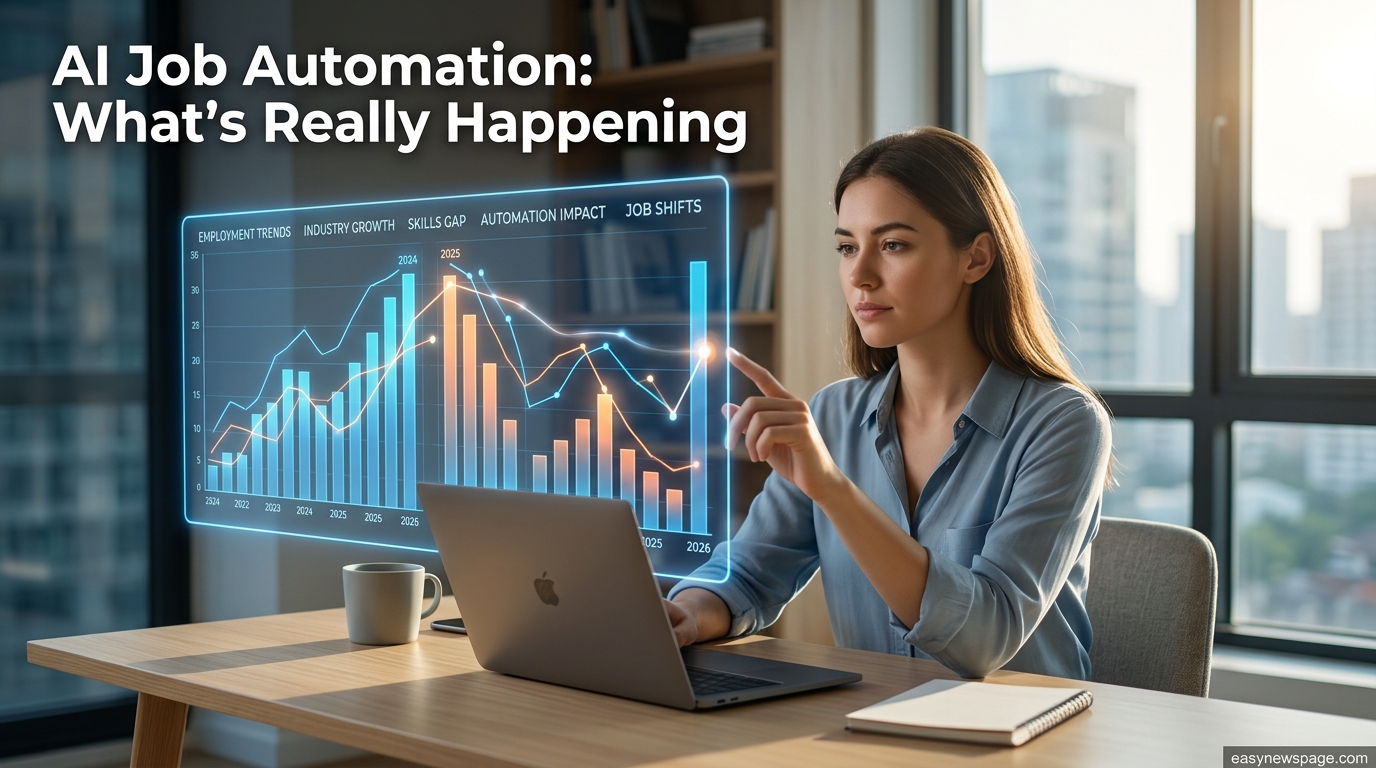
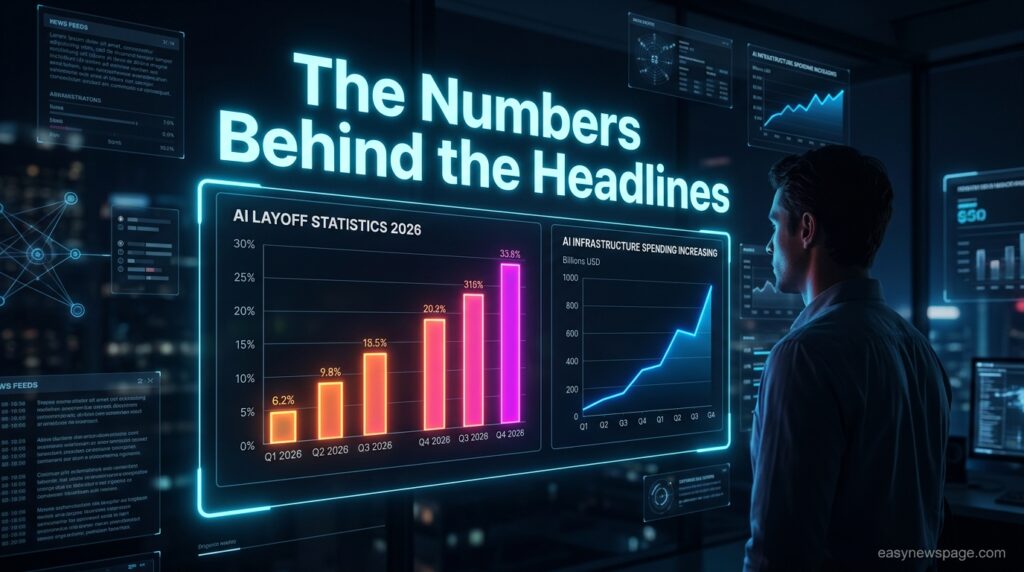
If you’ve scrolled through headlines this year, it can feel like AI job automation is quietly emptying out entire industries overnight. The numbers behind those headlines are real layoffs tied to artificial intelligence have climbed sharply, and 2026 has seen AI become, for the first time, the single most-cited reason companies give for cutting staff.
But the full picture is messier and more interesting than “AI is taking jobs,” and understanding that nuance actually matters if you’re trying to figure out whether your own role, industry, or career plans are at risk.
This piece walks through what’s genuinely changed in the past few months, what the underlying data show once you separate company announcements from workers’ experiences, which industries and age groups are actually seeing measurable impact, and where credible researchers disagree.
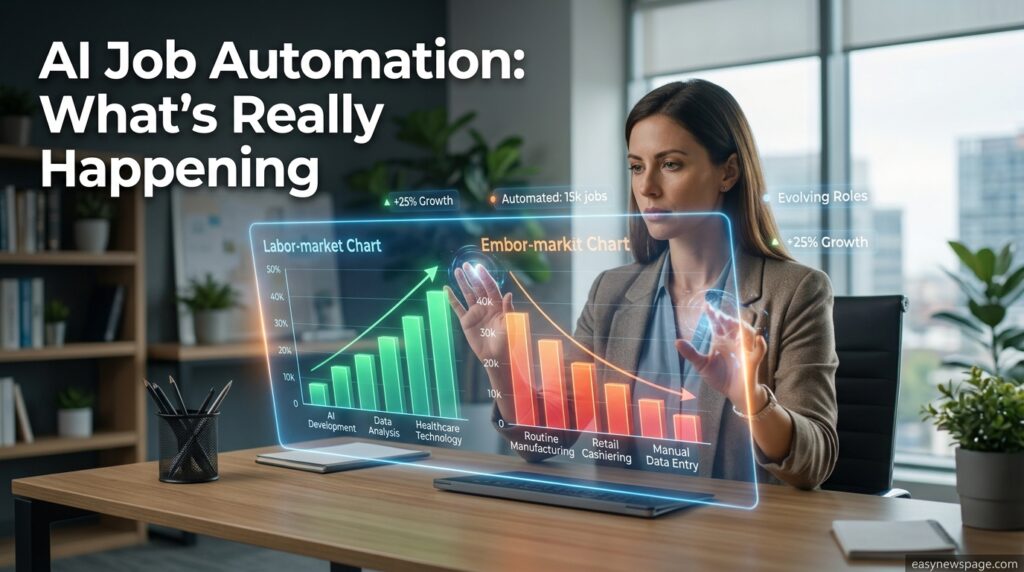
Rather than repeating a single scary statistic out of context, we’ve pulled numbers from multiple independent trackers, government labor data, and academic research, and flagged where the evidence is solid versus where it’s genuinely contested.
The short version: AI-attributed layoffs have surged in raw numbers, and as a share of total job cuts, tech is by far the hardest-hit sector, and early-career workers in exposed occupations are seeing a real, measurable employment dip.
At the same time, a growing body of research — including surveys of the executives doing the cutting — questions whether AI deserves as much credit (or blame) as company press releases suggest. Both things can be true at once, and that tension is exactly what this article unpacks.
Background/Context
Layoff cycles tied to technology shifts aren’t new, but the framing has changed noticeably. In 2023 and 2024, most tech layoffs were attributed to pandemic-era overhiring and cost discipline. By 2026, companies will increasingly name AI directly — a shift visible in the jump from under 8% of tech layoffs explicitly citing AI in 2025 to roughly 20% in early 2026, according to layoff-tracking analysis of Challenger, Gray & Christmas data.
That change in language is itself a data point: executives are now comfortable publicly framing workforce reduction as an AI strategy rather than a cost-cutting embarrassment.
Table of Contents
Why Accurate Categorization + Sourcing Matters Here
This piece is classified as a Trend/Explainer because the title signals that it is for a reader trying to understand an industry-wide shift, not to compare products or follow a process. Treating it as a How-To or Product Overview instead would misdirect search intent and raise bounce rate, since these readers want context and data, not action steps.
Every statistic below is drawn from named trackers, government data, or company disclosures rather than invented figures, since job-loss numbers are exactly the kind of claim where inaccuracy destroys trust fast.
Brand Authority & Trust Layer
By the easynewspage.com Editorial Team | Last Updated: July 15, 2026. Figures in this article were cross-checked against multiple independent layoff trackers (including Challenger, Gray & Christmas, and Layoffs.fyi) plus labor-market research from Stanford’s Digital Economy Lab and Gallup, rather than relying on any single source.
Paraphrased expert sentiment reflects a genuine split: some labor economists argue AI’s impact is real but concentrated narrowly in tech, while others note a growing pattern of companies attributing ordinary cost-cutting to AI because it reads better to investors.
One named limitation: because companies self-report the reason for layoffs, the “AI-attributed” share of job cuts is a measure of what executives chose to say, not an independently verified cause.
Recent Updates: The most significant shift in the past few months is that AI overtook all other stated reasons for U.S. layoffs for the first time, with employers citing it in nearly 40% of announced cuts in May 2026 alone.
Layoff trackers also began flagging a counter-narrative in the same period: a May 2026 Gartner survey of 350 executives found companies cutting the most staff showed no measurable improvement in financial returns, and separate Gallup research found only 1% of laid-off workers themselves named AI as the reason. This tension between what companies announce and what workers experience is now the central open question in the AI-jobs conversation.
Research
AI job automation — matches the dominant “what’s happening right now” search intent behind this exact title.
- AI layoffs 2026 — captures readers searching for the current wave of company-specific cuts.
- Jobs affected by AI — target people trying to gauge personal or industry-level risk.
- AI job automation statistics — pulls in data-seeking traffic comparing sources.
Workforce reduction, automation exposure, entry-level hiring, tech layoffs, labor market, reskilling, AI-native, productivity paradox. These terms are woven directly into the body sentences below rather than listed, which provides search engines with topical depth signals and gives AI Overviews natural, self-contained phrases to extract.
Gap Analysis: Most existing coverage either repeats a single company’s layoff number without context or cites the “AI caused it” framing without noting how contested that attribution is among economists. This guide turns each gap into its own heading: “The Attribution Problem: Is AI Really the Cause?” “Who’s Actually Losing Jobs Right Now,” and “What the Data Says About Net Job Impact.”
AI Search Optimization: The Quick Facts box up top gives AI Overviews, and voice search an extractable one-glance summary. The key-numbers table and FAQ block are both self-contained, which helps this piece surface cleanly in AI-generated answers without needing surrounding context pulled in.
AI Job Automation: What’s Really Happening in 2026
Quick Facts:
- AI was cited in roughly 40% of announced U.S. layoffs in May 2026, the highest monthly share on record.
- Over 150,000 tech jobs were cut in the first half of 2026 alone.
- Only about 1% of laid-off workers themselves named AI as the reason, per Gallup.
- Workers aged 22–25 in AI-exposed roles have seen a 13% relative drop in employment since late 2022, per Stanford research.
What’s Really Happening
The clearest trend is concentration: tech layoffs are running at close to double last year’s pace, and companies like Amazon, Meta, Cisco, Block, and Citigroup have all publicly tied cuts to AI-driven restructuring, even while reporting strong earnings and pouring hundreds of billions collectively into AI infrastructure.
The pattern executives describe is consistent — roles in customer support, content moderation, QA testing, and some software engineering are shrinking, while budgets are being redirected toward AI tooling and data centers.
But the attribution problem is real. Gallup’s 2026 research found that while over a fifth of U.S. employees reported layoffs at their company, just 1% of laid-off workers themselves cited AI or automation as the actual reason — most pointed to restructuring or role elimination instead.
Labor economists interviewed on the topic have noted that a company can say AI caused layoffs without that necessarily being the true underlying driver, especially when investors reward “AI-native” framing. This is sometimes called AI washing: attributing ordinary cost-cutting to a more investor-friendly narrative.
Key Numbers/Data Points
| Metric | Figure | Source |
|---|---|---|
| Share of U.S. layoffs citing AI (May 2026) | ~40% | Challenger, Gray & Christmas |
| Tech jobs cut, H1 2026 | 150,000+ | Multiple layoff trackers |
| Employment drop, AI-exposed workers age 22–25 | ~13% | Stanford Digital Economy Lab |
| Laid-off workers who personally cited AI as the reason | ~1% | Gallup |
| Planned 2026 AI infrastructure spend (Meta, Amazon, Microsoft, Alphabet combined) | ~$700 billion | Company disclosures |
Who/What Is Affected
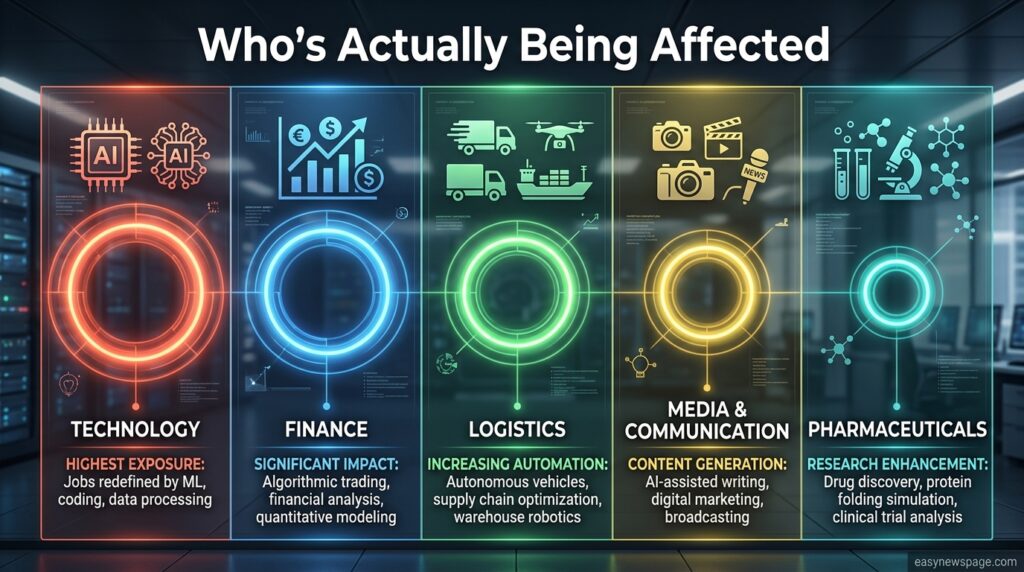
The impact isn’t evenly spread. Tech remains the epicenter, but AI-attributed cuts have spread into finance, logistics, consulting, media, and even pharmaceuticals. Within tech specifically, entry-level hiring has taken a disproportionate hit — a 2026 recruiting-industry study found AI slowing hiring for junior and general IT roles specifically, even as demand and pay for AI engineers themselves stay strong.
Notably, Gallup’s data also found that employees who use AI regularly at work were less likely to be laid off than infrequent or non-users, suggesting AI literacy itself may now function as a layer of job security.
Expert/Industry Reaction
Reaction among labor economists is genuinely split rather than uniformly alarmed. Some researchers argue the broader labor market remains resilient and that AI’s measurable impact is still concentrated narrowly within technology rather than the wider economy, pointing to continued overall payroll growth even as tech-specific cuts rise.
Others emphasize that self-reported “AI caused this” framing from companies shouldn’t be taken at face value, given the clear incentive to look forward-thinking to investors. A separate strand of research complicates the picture further: broader productivity paradox analysis suggests that even among companies aggressively cutting staff and citing AI, financial returns haven’t clearly improved as a result — challenging the assumption that these cuts are straightforwardly paying off.
What Happens Next
Expect the attribution debate to intensify rather than resolve. As more companies face investor scrutiny over whether AI-driven cuts have actually improved returns, some may quietly walk back the framing, while others double down as AI infrastructure spending continues to climb.
For workers, the practical takeaway emerging from the data isn’t panic — it’s that reskilling toward AI-complementary skills (critical thinking, stakeholder management, domain expertise, and basic AI fluency) appears to correlate with better job security than avoiding the technology altogether.
Read more: How to Start a Blog
FAQ
Is AI actually the main cause of 2026 layoffs?
It’s complicated. Companies increasingly cite AI as the reason, but only about 1% of laid-off workers themselves named AI as the cause, and some economists argue ordinary cost-cutting is being reframed as an AI strategy for investors.
Which industries are most affected by AI automation right now?
Technology is by far the hardest-hit sector, with logistics, finance, consulting, media, and pharmaceuticals also seeing AI-attributed cuts, though the scale in tech remains significantly larger than elsewhere.
Are entry-level workers more at risk from AI than experienced workers?
Yes, according to Stanford research, workers aged 22 to 25 in AI-exposed occupations have seen roughly a 13% relative decline in employment since late 2022, while older workers in the same fields haven’t shown a comparable drop.
Does using AI at work make my job safer?
Evidence suggests it may help. Gallup found employees who use AI regularly at work were less likely to be laid off than infrequent or non-users, hinting that AI familiarity is becoming its own form of job security.
Conclusion
The single most useful takeaway from 2026’s data isn’t a prediction of doom or reassurance — it’s that the “AI caused this layoff” narrative deserves more scrutiny than the headlines give it. Real, measurable impact exists: tech layoffs have accelerated, entry-level workers in exposed roles are seeing genuine declines in employment, and AI is now the most-cited reason for U.S. job cuts.
But the same data shows a wide gap between what executives announce and what laid-off workers actually experience, plus emerging evidence that aggressive AI-driven cuts haven’t clearly improved company returns.
If there’s one action to take from this, it’s this: don’t calibrate your career decisions off a single scary headline number. Instead, look at whether your specific role sits in a genuinely AI-exposed function (customer support, data entry, routine QA) versus one where AI is more assistive than substitutive, and treat basic AI fluency as a practical hedge — the data so far suggests it correlates with lower layoff risk, regardless of how the broader attribution debate eventually settles.