
The digital world is evolving faster than ever, and Generative AI content creation has emerged as one of the most transformative technologies shaping the future of online communication. From automated blog writing to AI-generated videos, graphics, and marketing campaigns, artificial intelligence is revolutionizing how brands, businesses, creators, and publishers produce content at scale.
As online competition intensifies, companies are seeking smarter ways to create engaging, optimized, and high-quality content. Generative AI delivers exactly that. By combining machine learning, natural language processing, and predictive analytics, AI-powered systems can generate human-like text, visuals, audio, and even interactive experiences within seconds.
Modern digital publishing now depends heavily on speed, personalization, consistency, and SEO optimization. Traditional content production methods often require large teams, extensive research, and long turnaround times. AI changes the equation by automating repetitive tasks while enhancing creativity and efficiency.
In today’s highly competitive digital ecosystem, organizations that adopt AI-driven content strategies gain a major advantage in visibility, audience engagement, and marketing performance.
Table of Contents
What Is Generative AI?
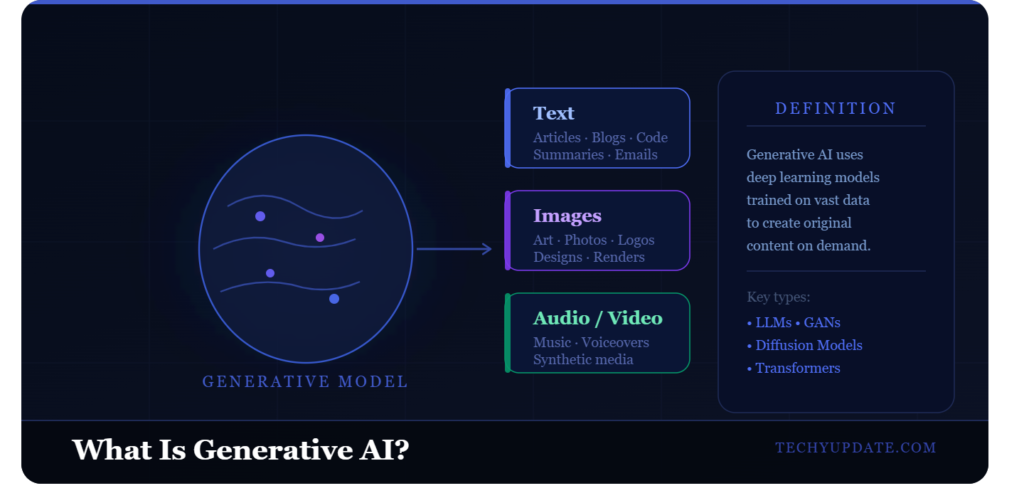
Generative AI refers to advanced artificial intelligence systems designed to create original content based on data patterns, prompts, and user instructions. Unlike traditional AI that focuses mainly on analysis or automation, generative AI produces entirely new outputs, including:
- Blog articles
- Website copy
- Product descriptions
- Social media captions
- AI-generated images
- Videos and animations
- Music and audio
- Emails and ad campaigns
- Chatbot conversations
- Marketing strategies
These systems rely on technologies such as:
- Machine Learning (ML)
- Natural Language Processing (NLP)
- Deep Learning
- Neural Networks
- Large Language Models (LLMs)
Generative AI tools analyze enormous datasets to understand language structure, user intent, tone, context, and semantic relationships. As a result, AI-generated content can closely resemble human writing while remaining highly optimized for search engines and user engagement.
The rise of AI platforms has democratized content creation, allowing businesses of all sizes to produce professional-level content without requiring massive budgets or large creative departments.
How AI Is Transforming Digital Publishing
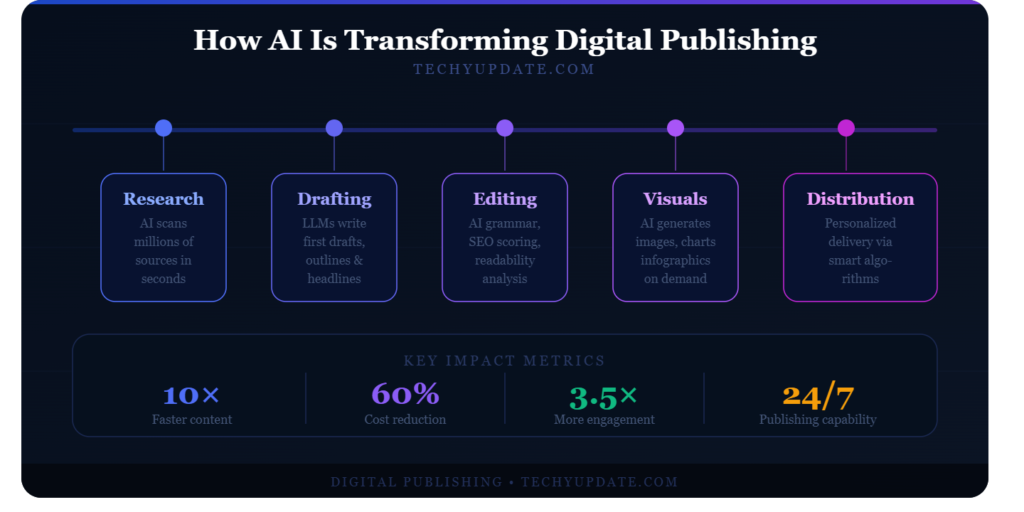
1. Faster Content Production
One of the biggest advantages of generative AI is speed. Traditional content workflows may take hours or even days to complete a single article or campaign. AI-powered systems can generate high-quality drafts in minutes.
Publishers now use AI to:
- Create breaking news summaries
- Generate SEO blog posts
- Produce automated newsletters
- Draft video scripts
- Repurpose existing content
This accelerated workflow allows media companies and marketers to publish more frequently while maintaining consistency across multiple channels.
2. Improved SEO Optimization
Search engine optimization has become increasingly complex. Modern AI systems help businesses create content optimized for:
- Semantic search
- Voice search
- Featured snippets
- User intent
- Keyword clustering
- Internal linking strategies
- NLP-based ranking signals
AI tools analyze top-ranking competitors and generate keyword-rich content structures that align with Google’s evolving algorithms. This dramatically improves visibility in search engine results pages (SERPs).
By leveraging AI-assisted SEO, businesses can target long-tail keywords, improve readability, and increase organic traffic more effectively than manual optimization alone.
3. Personalized User Experiences
Personalization has become essential in digital marketing. Generative AI enables businesses to create customized content experiences based on:
- User behavior
- Search history
- Geographic location
- Interests
- Purchase patterns
- Audience segmentation
Instead of publishing generic content for everyone, companies can deliver highly targeted messaging that resonates with individual users.
Examples include:
- Personalized email campaigns
- Dynamic website content
- AI-generated product recommendations
- Customized landing pages
- Adaptive social media messaging
This level of personalization significantly increases engagement, conversion rates, and customer satisfaction.
4. Multilingual Content Creation
Global audiences require multilingual communication strategies. AI-powered translation and content generation tools help businesses create localized content efficiently.
Generative AI can adapt:
- Tone
- Cultural references
- Writing style
- Regional SEO keywords
- Localization nuances
This capability allows international brands to expand into new markets without the massive costs associated with traditional translation teams.
Importance of AI in Modern Marketing
Enhanced Content Scalability
Modern marketing demands continuous content production across multiple platforms, including websites, blogs, YouTube, TikTok, Instagram, LinkedIn, and email newsletters.
AI allows businesses to scale content operations rapidly while maintaining quality and consistency. Marketing teams can now create:
- Daily blog updates
- Social media posts
- Ad copy variations
- Product descriptions
- Sales funnels
- Webinar scripts
- Video captions
This scalability helps brands maintain an active online presence while reducing production bottlenecks.
Data-Driven Decision Making
AI systems analyze massive amounts of marketing data in real time. This allows marketers to identify:
- High-performing keywords
- Trending topics
- Audience behavior patterns
- Content gaps
- Conversion opportunities
Businesses can then optimize campaigns based on actionable insights rather than guesswork.
Predictive analytics also helps marketers forecast future trends, enabling proactive content planning and strategic positioning.
Cost Efficiency and Resource Optimization
Hiring writers, editors, designers, and strategists can be expensive. Generative AI reduces operational costs by automating repetitive and time-consuming tasks.
Organizations can allocate resources more efficiently by allowing AI to handle:
- Content drafting
- Research summaries
- Metadata generation
- SEO recommendations
- Automated editing
- Headline creation
Human professionals can then focus on higher-level creative strategy, storytelling, and brand development.
The Role of Generative AI in Content Marketing
AI-Powered Blogging
AI blogging tools assist with:
- Topic generation
- Content outlines
- Keyword integration
- Meta descriptions
- Readability optimization
- Content expansion
This improves publishing consistency while enhancing SEO performance.
Businesses using AI-driven blogging strategies often experience:
- Increased organic traffic
- Better search rankings
- Higher user engagement
- Improved lead generation
Social Media Automation
Social media marketing requires constant activity. AI simplifies this process by generating:
- Platform-specific captions
- Hashtag strategies
- Engagement hooks
- Viral content ideas
- Posting schedules
AI also analyzes engagement metrics to determine optimal publishing times and content formats.
This helps brands maintain stronger audience connections while maximizing reach and visibility.
AI in Video Content Creation
Video marketing dominates digital engagement, and AI is transforming video production through:
- Automated video editing
- AI voiceovers
- Script generation
- Avatar creation
- Subtitle automation
- Visual effects enhancement
AI-powered video tools significantly reduce production time while making professional-quality videos accessible to smaller businesses and creators.
Generative AI Content Creation
The rise of Generative AI content creation has transformed the way businesses, publishers, marketers, and creators produce digital content. Artificial intelligence is no longer limited to automation or data analysis. Today, AI systems can generate human-like articles, social media captions, videos, graphics, product descriptions, emails, and even complex marketing campaigns with remarkable accuracy.
Modern AI-powered platforms are built on advanced technologies such as machine learning, natural language processing (NLP), and deep neural networks. These technologies enable AI systems to understand language patterns, predict user intent, and generate highly relevant content tailored to specific audiences.
As digital competition increases across search engines and social media platforms, organizations are turning to AI-driven solutions to scale content production, improve SEO performance, and personalize user experiences. Understanding how generative AI works is essential for businesses seeking to stay competitive in the rapidly evolving digital landscape.
What Is Generative AI Content Creation?
Generative AI content creation refers to the use of artificial intelligence models that generate original content from training data, prompts, and contextual instructions. Unlike traditional software that follows fixed programming rules, generative AI systems learn patterns from enormous datasets and create new outputs that resemble human-generated content.
AI-generated content can include:
- Blog posts
- Website copy
- Marketing content
- Social media posts
- Product descriptions
- Video scripts
- AI-generated images
- Podcasts and voiceovers
- Interactive chat responses
- Email marketing campaigns
These systems rely on predictive modeling to determine the most likely sequence of words, visuals, or audio elements based on learned patterns.
The primary goal of generative AI is to simulate human creativity while increasing efficiency, scalability, and personalization.
Machine Learning and NLP Technologies
Understanding Machine Learning in AI Content Creation
At the core of generative AI lies machine learning (ML), a branch of artificial intelligence that enables systems to learn from data without explicit programming.
Machine learning models analyze vast amounts of data and identify relationships, patterns, and structures within it. Over time, the AI improves its accuracy and performance through continuous training and feedback.
Machine learning in content generation works through several stages:
1. Data Collection
AI systems require massive datasets containing:
- Articles
- Books
- Websites
- Research papers
- Conversations
- Social media posts
- Marketing copy
- Technical documents
The larger and more diverse the dataset, the better the AI can understand language, tone, structure, and context.
2. Pattern Recognition
Machine learning algorithms identify patterns such as:
- Sentence structure
- Grammar rules
- Word relationships
- Semantic meaning
- Writing styles
- Topic relevance
This enables the AI to predict how words and phrases naturally fit together.
3. Model Training
During training, the AI repeatedly processes data and adjusts internal parameters to improve prediction accuracy.
The model learns:
- Contextual meaning
- Language flow
- Topic associations
- User intent
- Writing tone
Advanced systems undergo billions of training iterations to achieve highly sophisticated language understanding.
Natural Language Processing (NLP) in AI Writing
Natural Language Processing (NLP) is the technology that allows AI systems to understand, interpret, and generate human language.
NLP combines computational linguistics with machine learning to enable more natural communication between humans and machines.
Key NLP functions include:
- Language understanding
- Text generation
- Sentiment analysis
- Keyword extraction
- Language translation
- Speech recognition
- Conversational AI
NLP enables generative AI systems to create content that feels conversational, relevant, and contextually accurate.
Semantic Understanding and Contextual Analysis
Modern NLP systems focus heavily on semantic understanding rather than simple keyword matching.
Instead of treating words individually, AI analyzes:
- Context
- Intent
- Sentence relationships
- Topic hierarchy
- Emotional tone
For example, the word “apple” could refer to:
- A fruit
- A technology company
- A brand name
NLP models determine the correct meaning based on surrounding words and contextual clues.
This semantic understanding improves:
- Content relevance
- Search engine optimization
- User engagement
- Voice search compatibility
AI Algorithms for Text Generation
How AI Text Generation Algorithms Work
AI text generation relies on sophisticated algorithms that predict language sequences with exceptional precision.
These algorithms analyze previous words in a sentence and estimate the most probable next word based on learned patterns.
The process involves:
- Input prompt analysis
- Context interpretation
- Predictive token generation
- Sentence structuring
- Coherence optimization
- Grammar refinement
This allows AI systems to generate complete articles, stories, marketing content, and conversations that resemble human writing.
Transformer Models and Large Language Models
One of the biggest breakthroughs in AI content creation came with the introduction of the Transformer architecture.
Transformers revolutionized natural language processing by improving how AI systems handle long-range context and complex sentence relationships.
Large Language Models (LLMs) based on transformer technology can:
- Understand detailed prompts
- Generate coherent paragraphs
- Maintain contextual consistency
- Adapt writing styles
- Produce multilingual content
These models process enormous amounts of text data to develop advanced language understanding capabilities.
Tokenization in AI Writing
Before generating content, AI systems break text into smaller units called tokens.
Tokens may represent:
- Words
- Parts of words
- Characters
- Symbols
For example:
“Artificial intelligence transforms marketing.”
Could be tokenized into:
- Artificial
- intelligence
- transforms
- marketing
AI models predict the next token based on previous tokens, gradually constructing complete sentences and paragraphs.
Probability-Based Language Prediction
Generative AI operates through probability calculations.
When generating text, the AI evaluates multiple possible next words and selects the option with the highest contextual probability.
For example:
“Content marketing improves…”
Possible predictions may include:
- visibility
- engagement
- conversions
- SEO rankings
The AI selects the word that best fits the context and sentence structure.
This probability-driven approach enables fluid, natural-sounding writing.
Training Data and Content Modeling
What Is Training Data in Generative AI?
Training data is the foundation of every AI content generation system. It consists of massive collections of text, images, audio, and other digital information used to teach AI models how language and communication work.
Training datasets often include:
- Online articles
- Academic journals
- Digital books
- Webpages
- User interactions
- Technical manuals
- Marketing campaigns
- News archives
The quality of training data significantly impacts AI performance.
High-quality datasets produce:
- More accurate content
- Better grammar
- Stronger contextual understanding
- Improved factual reliability
Content Modeling in AI Systems
Content modeling refers to how AI organizes and structures information during training.
AI systems create internal representations of:
- Topics
- Concepts
- Relationships
- Writing patterns
- Contextual meanings
This modeling process helps the AI understand how different ideas connect within human communication.
For example, AI learns that:
- SEO relates to digital marketing
- Blogging supports content marketing
- Keywords influence search rankings
These relationships enable AI systems to generate logically connected and contextually relevant content.
Deep Learning and Neural Networks
Generative AI relies heavily on deep learning, a subset of machine learning inspired by the structure of the human brain.
Deep learning models use artificial neural networks containing multiple layers of interconnected nodes.
These neural networks process information through stages:
- Input layer
- Hidden layers
- Output layer
Each layer extracts increasingly complex patterns and relationships from the data.
Deep neural networks allow AI systems to:
- Understand language nuance
- Recognize writing styles
- Generate realistic responses
- Adapt to different contexts
This technology powers the advanced capabilities of modern AI writing tools.
How Generative AI Improves SEO Content Creation
Semantic SEO Optimization
AI systems understand semantic relationships between keywords and topics, enabling better optimization for modern search engines.
Generative AI enhances:
- Keyword clustering
- Topic authority
- Internal linking opportunities
- NLP keyword relevance
- User intent alignment
This improves search visibility while maintaining natural readability.
Content Personalization
AI-powered personalization enables businesses to create tailored content experiences for different audiences.
AI analyzes:
- User behavior
- Demographics
- Search patterns
- Engagement metrics
This data helps generate customized:
- Blog recommendations
- Email campaigns
- Landing pages
- Product suggestions
Personalized content significantly improves engagement and conversion rates.
Scalable Content Production
AI dramatically increases content production speed.
Businesses can generate:
- Multiple blog articles daily
- Social media campaigns
- Product descriptions at scale
- Automated SEO content
- Video scripts and captions
This scalability gives brands a major competitive advantage in digital marketing.
Challenges in Generative AI Content Creation
Content Accuracy and Fact Verification
AI-generated content can occasionally include factual inaccuracies or outdated information.
Human oversight remains essential for:
- Fact-checking
- Source verification
- Editorial review
- Quality assurance
Bias in Training Data
AI systems may inherit biases present in training datasets. Developers must continuously improve data diversity and ethical AI practices.
Originality and Plagiarism Concerns
Ensuring unique and authentic content remains a critical challenge. Businesses should combine AI generation with human editing to maintain originality.
Benefits of Generative AI Content Creation
The digital marketing landscape has undergone a major transformation with the rise of Generative AI content creation. Businesses, publishers, entrepreneurs, and marketers are increasingly adopting artificial intelligence technologies to streamline content production, improve SEO performance, reduce operational costs, and deliver highly personalized user experiences.
In today’s competitive online environment, brands must consistently produce high-quality content across multiple platforms, including websites, blogs, social media channels, email campaigns, video platforms, and eCommerce stores. Traditional content creation methods often require significant time, large creative teams, and expensive production resources.
Generative AI solves these challenges by enabling organizations to automate and optimize content workflows at scale. Using technologies such as machine learning, natural language processing (NLP), and deep learning, AI-powered systems can generate human-like content within seconds while maintaining relevance, consistency, and SEO optimization.
As search engines continue prioritizing valuable, relevant, and user-focused content, businesses leveraging AI-driven content strategies are gaining a strong competitive advantage in visibility, engagement, and digital growth.
What Is Generative AI Content Creation?
Generative AI content creation refers to the use of advanced artificial intelligence systems that produce original digital content based on prompts, training data, and contextual understanding.
AI-generated content includes:
- Blog articles
- Website copy
- Product descriptions
- Social media captions
- Email marketing campaigns
- Video scripts
- AI-generated images
- Chatbot conversations
- Landing pages
- Advertising copy
Modern AI systems analyze enormous datasets to understand:
- Language patterns
- Writing styles
- Semantic meaning
- User intent
- Topic relevance
- Audience behavior
This enables businesses to quickly and efficiently produce large volumes of optimized content.
Faster Content Production
Accelerating Digital Publishing Workflows
One of the biggest benefits of generative AI content creation is dramatically faster content production.
Traditional content workflows often involve:
- Topic research
- Keyword analysis
- Content outlining
- Draft writing
- Editing and proofreading
- SEO optimization
- Publishing preparation
These processes can take hours or even days for a single article.
AI-powered systems significantly reduce production time by automating multiple stages simultaneously. Businesses can generate complete content drafts within minutes instead of days.
This increased speed allows organizations to:
- Publish content more frequently
- Respond quickly to industry trends
- Cover breaking news faster
- Maintain active social media engagement
- Scale marketing campaigns efficiently
Real-Time Content Generation
Generative AI enables real-time content creation for dynamic digital environments.
Examples include:
- Live event coverage
- Automated news summaries
- Instant product descriptions
- AI-powered chat responses
- Personalized email generation
Brands can instantly adapt content strategies based on audience behavior, market changes, and trending topics.
This responsiveness improves audience engagement and strengthens digital competitiveness.
Enhanced Productivity for Marketing Teams
AI automation eliminates repetitive writing tasks, allowing marketing teams to focus on:
- Creative strategy
- Brand storytelling
- Campaign development
- Audience analysis
- Business growth initiatives
Instead of spending hours drafting routine content, teams can prioritize higher-value activities that drive innovation and engagement.
Improved Scalability
Scaling Content Across Multiple Platforms
Modern businesses must maintain visibility across numerous digital platforms, including:
- Websites
- Blogs
- YouTube
- TikTok
- Email newsletters
- eCommerce marketplaces
Managing large-scale content production manually becomes extremely difficult as businesses grow.
Generative AI enables organizations to rapidly scale content creation while maintaining consistency in tone, messaging, and quality.
AI systems can simultaneously generate:
- Blog articles
- Social media posts
- Video captions
- Product descriptions
- Meta titles and descriptions
- Ad copy variations
This scalability supports continuous digital expansion without requiring proportional increases in staffing or resources.
Supporting Global Content Strategies
International businesses often require multilingual content for diverse audiences.
AI-powered translation and localization tools enable companies to create region-specific content tailored to:
- Language preferences
- Cultural nuances
- Local search behavior
- Geographic SEO trends
This capability helps businesses expand into global markets more efficiently and cost-effectively.
Consistent Brand Messaging
Maintaining a consistent brand voice across large content operations is challenging.
Generative AI helps standardize:
- Writing tone
- Messaging style
- Keyword strategy
- Brand terminology
- Audience targeting
Consistency strengthens brand identity and improves customer trust across all communication channels.
Cost-Effective Content Marketing
Reducing Operational Expenses
Traditional content production often requires large investments in:
- Writers
- Editors
- Designers
- SEO specialists
- Social media managers
- Video production teams
Generative AI significantly reduces these operational costs by automating many repetitive tasks.
Businesses can generate high-quality content at scale without continuously increasing staffing expenses.
This makes AI particularly valuable for:
- Startups
- Small businesses
- eCommerce brands
- Digital agencies
- Content publishers
Maximizing Marketing ROI
AI-powered content strategies improve return on investment by enabling businesses to produce more content with fewer resources.
Organizations can:
- Increase publishing frequency
- Improve search visibility
- Generate more organic traffic
- Reduce outsourcing costs
- Optimize conversion-focused content
Higher productivity combined with lower production costs creates stronger long-term profitability.
Automated Content Repurposing
AI systems can repurpose existing content into multiple formats, including:
- Blog summaries
- Social media snippets
- Video scripts
- Infographics
- Email campaigns
- Podcast outlines
This maximizes the value of every piece of content while extending audience reach across multiple platforms.
SEO Optimization Opportunities
AI-Powered Keyword Research
Search engine optimization remains one of the most important drivers of online visibility.
Generative AI enhances SEO by identifying:
- High-ranking keywords
- Long-tail keyword opportunities
- Semantic search phrases
- User intent patterns
- Topic clusters
AI systems analyze search engine trends and competitor data to create content optimized for modern ranking algorithms.
Semantic SEO and NLP Optimization
Search engines increasingly prioritize semantic relevance rather than simple keyword density.
AI-powered systems use natural language processing to optimize:
- Topic relationships
- Contextual relevance
- Search intent alignment
- NLP keyword integration
- Conversational search patterns
This improves visibility for:
- Voice search
- Featured snippets
- AI-powered search experiences
- Conversational queries
Automated Metadata Generation
Generative AI streamlines technical SEO tasks, including:
- Meta title creation
- Meta descriptions
- Header optimization
- Image alt text
- Internal linking suggestions
Automating these processes improves efficiency while maintaining SEO best practices.
Content Gap Analysis
AI tools analyze competitor websites and identify opportunities to fill content gaps.
Businesses can discover:
- Underserved topics
- Trending keywords
- Audience pain points
- Search demand gaps
This enables smarter content planning and stronger topical authority.
Personalized User Experiences
AI-Driven Content Personalization
Modern consumers expect personalized digital experiences.
Generative AI allows businesses to create customized content based on:
- User interests
- Search history
- Purchase behavior
- Geographic location
- Demographic data
- Browsing activity
This personalization significantly improves user engagement and conversion rates.
Dynamic Website Experiences
AI-powered systems can adapt website content in real time based on visitor behavior.
Examples include:
- Personalized product recommendations
- Customized landing pages
- Dynamic email messaging
- Adaptive homepage content
- AI-generated chatbot interactions
Dynamic personalization enhances customer satisfaction and strengthens brand relationships.
Improved Customer Engagement
Highly relevant content keeps users engaged longer.
AI-generated personalization improves:
- Click-through rates
- Time on site
- Social engagement
- Customer retention
- Conversion performance
Businesses that deliver tailored experiences gain stronger competitive advantages in crowded digital markets.
Additional Benefits of Generative AI Content Creation
24/7 Content Production
AI systems operate continuously without time limitations.
Businesses can generate content around the clock for:
- International audiences
- Global customer support
- Continuous publishing schedules
- Automated campaign management
This ensures consistent online activity regardless of time zones or staffing limitations.
Data-Driven Decision Making
Generative AI analyzes massive datasets to identify:
- Content performance trends
- Audience preferences
- Conversion opportunities
- Engagement patterns
This enables smarter marketing decisions backed by real-time insights.
Creative Idea Generation
AI assists with brainstorming:
- Blog topics
- Campaign ideas
- Headline variations
- Social media concepts
- Product marketing angles
This enhances creativity while reducing ideation bottlenecks.
Challenges and Considerations
Despite its advantages, businesses should balance AI automation with human oversight.
Content Quality Control
Human editing remains essential for:
- Fact-checking
- Brand alignment
- Emotional storytelling
- Strategic messaging
Ethical AI Usage
Organizations should prioritize:
- Transparency
- Data privacy
- Responsible automation
- Bias reduction
- Authentic communication
Ethical AI practices build consumer trust and long-term credibility.
The Future of Generative AI in Content Marketing
The future of AI-driven content creation will include:
- Hyper-personalized marketing experiences
- AI-generated video production
- Advanced conversational AI
- Predictive content strategies
- Real-time audience adaptation
- Fully automated publishing ecosystems
As technology evolves, AI will become an even more integral component of digital marketing and online communication.
Businesses that adopt AI strategically will gain stronger visibility, scalability, and customer engagement in the digital economy.
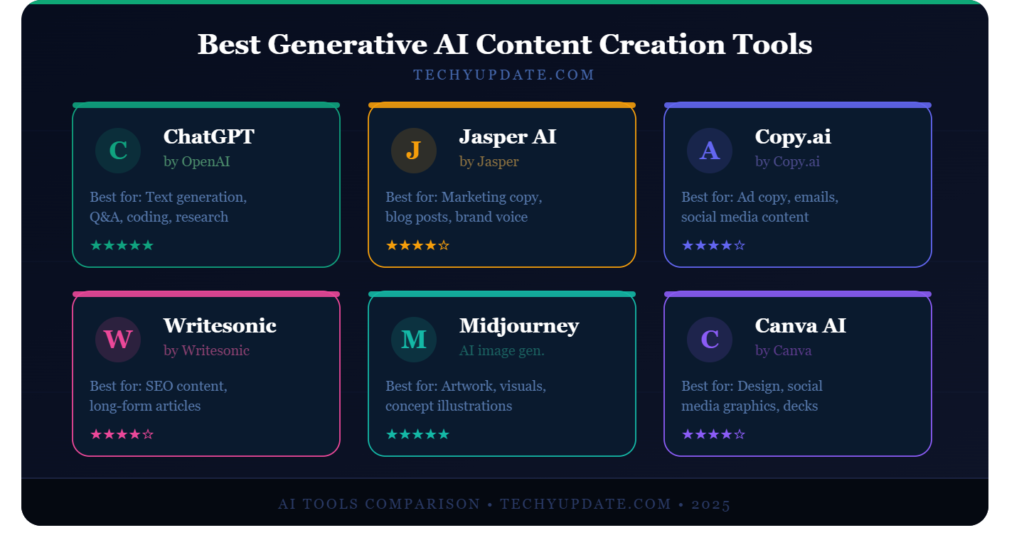
Best Generative AI Content Creation Tools
Generative AI tools are transforming the digital content industry by helping businesses, marketers, bloggers, designers, and creators produce high-quality content faster and more efficiently. From AI writing assistants and image generators to video production platforms and marketing automation software, modern AI technologies are reshaping how content is created, optimized, and distributed.
Businesses now rely on AI-powered platforms to improve productivity, scale marketing campaigns, enhance creativity, and deliver personalized user experiences across multiple digital channels.
This guide explores the best generative AI content creation tools for writing, image generation, video production, audio creation, and marketing automation.
AI Writing Assistants
AI writing assistants help users quickly and efficiently generate blog articles, website copy, social media posts, emails, scripts, and SEO content. These tools use machine learning and natural language processing to produce human-like text optimized for readability and search engine performance.
1. ChatGPT
ChatGPT is one of the most advanced AI writing assistants available today. It helps users create:
- Blog posts
- SEO articles
- Product descriptions
- Email campaigns
- Social media captions
- Video scripts
- Marketing copy
Key Features
- Natural conversational writing
- Long-form content generation
- SEO-friendly outputs
- Multilingual support
- Content brainstorming
- Coding and technical writing
Best For
- Bloggers
- SEO professionals
- Digital marketers
- Freelancers
- Businesses creating scalable content
2. Jasper AI
Jasper AI is a powerful AI content platform designed specifically for marketers and businesses.
Key Features
- AI blog writing
- Brand voice customization
- Marketing templates
- SEO integrations
- AI image generation
- Campaign management tools
Best For
- Content marketing agencies
- Enterprise marketing teams
- Brand-focused businesses
3. Copy.ai
Copy.ai specializes in fast marketing copy generation and social media content creation.
Key Features
- Ad copy generation
- Product descriptions
- Email writing tools
- Social media captions
- Sales copy automation
Best For
- eCommerce businesses
- Social media marketers
- Sales teams
4. Writesonic
Writesonic combines AI writing with SEO optimization and chatbot capabilities.
Key Features
- Long-form article generation
- SEO article writer
- AI chatbot integration
- Landing page content
- Google Ads copywriting
Best For
- SEO content creators
- Affiliate marketers
- Website owners
5. Grammarly
Although primarily known as a grammar tool, Grammarly AI now offers advanced generative writing assistance.
Key Features
- Grammar correction
- AI rewriting
- Tone adjustments
- Clarity enhancement
- Professional communication suggestions
Best For
- Business communication
- Professional writing
- Academic content
AI Image Generators
AI image generators create stunning visuals, illustrations, artwork, marketing graphics, and realistic photos using text prompts.
These tools have become essential for content creators, designers, advertisers, and social media marketers.
1. Midjourney
Midjourney is widely recognized for producing high-quality artistic and cinematic AI-generated images.
Key Features
- Photorealistic image generation
- Artistic illustrations
- Concept art creation
- Advanced prompt customization
- High-resolution outputs
Best For
- Graphic designers
- Artists
- Branding agencies
- Creative professionals
2. DALL·E
DALL·E generates highly detailed images from text descriptions using advanced AI models.
Key Features
- Text-to-image generation
- Image editing
- Object replacement
- Creative visual design
- AI illustration tools
Best For
- Marketing visuals
- Website graphics
- Social media content
- Creative campaigns
3. Canva
Canva AI combines graphic design tools with AI-powered image generation.
Key Features
- AI image creation
- Presentation design
- Social media templates
- Brand kits
- Drag-and-drop editing
Best For
- Small businesses
- Content creators
- Social media managers
4. Adobe Firefly
Adobe Firefly integrates AI-powered creativity into Adobe’s professional design ecosystem.
Key Features
- AI-generated graphics
- Text effects
- Image editing
- Commercial-safe AI assets
- Adobe Creative Cloud integration
Best For
- Professional designers
- Creative studios
- Branding professionals
Video and Audio Generation Platforms
AI video and audio tools are revolutionizing content production for YouTube creators, podcasters, marketers, educators, and businesses.
These platforms automate editing, voice generation, subtitles, animations, and script-based video production.
1. Synthesia
Synthesia allows users to create AI-generated videos using realistic digital avatars.
Key Features
- AI presenters and avatars
- Text-to-video generation
- Multilingual voiceovers
- Corporate training videos
- Educational content creation
Best For
- Businesses
- Corporate training
- Educational platforms
- Marketing videos
2. Runway
Runway is a powerful AI video generation and editing platform.
Key Features
- AI video editing
- Text-to-video generation
- Background removal
- Motion tracking
- Visual effects automation
Best For
- Video creators
- Filmmakers
- Social media content producers
3. Descript
Descript combines audio editing, transcription, podcasting, and AI voice generation.
Key Features
- Podcast editing
- AI voice cloning
- Automatic transcription
- Video editing
- Screen recording
Best For
- Podcasters
- YouTubers
- Audio content creators
4. Pictory
Pictory converts written content into AI-generated videos.
Key Features
- Blog-to-video conversion
- AI video summarization
- Subtitle generation
- Stock footage integration
Best For
- Bloggers
- Content marketers
- Social media video creators
5. Murf AI
Murf AI specializes in AI-generated voiceovers and audio production.
Key Features
- Realistic AI voices
- Voice customization
- Text-to-speech conversion
- Podcast narration
- Video voiceovers
Best For
- Voice content creators
- Video producers
- Educators
Marketing Automation Tools
AI-powered marketing automation tools help businesses streamline campaigns, improve customer engagement, and optimize marketing performance.
1. HubSpot
HubSpot integrates AI into CRM, email marketing, customer service, and sales automation.
Key Features
- AI email generation
- Marketing automation workflows
- Lead management
- Customer analytics
- CRM integration
Best For
- Businesses
- Marketing agencies
- Sales teams
2. Mailchimp
Mailchimp uses AI to optimize email marketing campaigns and audience targeting.
Key Features
- AI-powered email campaigns
- Audience segmentation
- Behavioral analytics
- Marketing automation
Best For
- Small businesses
- Email marketers
- Online stores
3. Semrush
Semrush combines SEO intelligence with AI-powered marketing optimization.
Key Features
- Keyword research
- AI SEO writing tools
- Competitor analysis
- Content optimization
- Rank tracking
Best For
- SEO professionals
- Bloggers
- Digital marketing agencies
4. Surfer SEO
Surfer SEO helps optimize AI-generated content for search engines.
Key Features
- NLP keyword optimization
- Content scoring
- SERP analysis
- AI article generation
Best For
- SEO content writers
- Affiliate marketers
- Website publishers
How to Choose the Best AI Content Creation Tool
When selecting an AI tool, businesses should evaluate:
Content Type Requirements
Choose tools based on whether you need:
- Written content
- Visual design
- Video production
- Audio generation
- Marketing automation
SEO Optimization Features
For blogging and search marketing, prioritize tools with:
- Keyword analysis
- Semantic SEO
- Content optimization
- NLP capabilities
Scalability and Workflow Integration
Businesses should consider:
- Team collaboration
- API integrations
- Automation workflows
- Multi-platform publishing
Budget and Pricing
Some AI tools offer:
- Free plans
- Subscription models
- Enterprise solutions
- Pay-as-you-go pricing
Choose platforms aligned with your operational needs and growth goals.
Generative AI for SEO and Blogging
The digital marketing industry is rapidly evolving, and Generative AI for SEO and blogging has become one of the most powerful innovations shaping modern content strategies. Search engines are becoming smarter, user expectations are increasing, and businesses now require scalable, data-driven, and highly optimized content to remain competitive online.
Generative AI is transforming how bloggers, marketers, publishers, and businesses perform keyword research, optimize content, generate metadata, and improve search engine visibility. By combining machine learning, natural language processing (NLP), predictive analytics, and automation, AI-powered SEO tools help websites rank higher while improving user engagement and content relevance.
Modern SEO is no longer based only on keyword density. Search engines now prioritize:
- Search intent
- Semantic relevance
- User experience
- Conversational search
- Voice search optimization
- Topical authority
- Content quality
Generative AI helps businesses adapt to these evolving ranking factors efficiently and at scale.
What Is Generative AI in SEO and Blogging?
Generative AI in SEO and blogging refers to artificial intelligence systems that can create, optimize, analyze, and improve digital content for search engines and users.
AI-powered SEO systems can:
- Generate blog articles
- Suggest SEO keywords
- Optimize content structure
- Create meta descriptions
- Generate SEO titles
- Improve readability
- Analyze competitor content
- Predict search trends
- Optimize for voice search
These systems process massive amounts of search engine data to understand ranking patterns and user behavior.
As a result, businesses can create highly targeted content strategies that improve organic traffic and search engine visibility.
AI-Driven Keyword Research
The Evolution of Keyword Research
Traditional keyword research often required hours of manual analysis using spreadsheets, SEO tools, and competitor research.
Generative AI has transformed this process by automating:
- Keyword discovery
- Search intent analysis
- Competitor analysis
- Semantic keyword clustering
- Trend forecasting
AI-powered keyword research tools analyze billions of search queries and identify opportunities faster and more accurately than manual methods.
Understanding Search Intent With AI
Modern SEO depends heavily on understanding user intent.
AI systems categorize search intent into several types:
Informational Intent
Users searching for knowledge or answers.
Examples:
- What is generative AI?
- How does SEO work?
Navigational Intent
Users looking for specific websites or brands.
Examples:
- OpenAI website
- YouTube login
Transactional Intent
Users ready to purchase or take action.
Examples:
- Buy SEO tools
- Best AI writing software
Commercial Investigation
Users comparing products or services.
Examples:
- Best AI content generators
- Jasper vs ChatGPT
AI identifies these intent patterns and recommends keywords aligned with user behavior.
This improves:
- Content relevance
- Click-through rates
- Search rankings
- Conversion performance
Semantic Keyword Clustering
Search engines now understand semantic relationships between words and topics.
Generative AI groups related keywords into clusters based on:
- Topic relevance
- User behavior
- NLP analysis
- Search context
For example, AI may connect:
- AI blogging tools
- SEO AI software
- AI content writing
- Automated blogging platforms
This semantic clustering helps websites build stronger topical authority and improve rankings for multiple related search queries.
Long-Tail Keyword Opportunities
AI-driven SEO tools excel at identifying long-tail keywords with:
- Lower competition
- Higher conversion potential
- Specific search intent
Examples:
- Best generative AI tools for bloggers
- AI SEO optimization for small businesses
- Voice search optimization strategies
Long-tail keywords often generate highly targeted organic traffic and better engagement rates.
Content Optimization Strategies
AI-Powered SEO Content Optimization
Generative AI helps optimize content for both search engines and human readers.
AI systems analyze:
- Top-ranking pages
- Competitor structures
- Keyword usage
- Readability patterns
- User engagement signals
Based on this analysis, AI suggests improvements for:
- Headings
- Keyword placement
- Internal linking
- Content depth
- Semantic relevance
This ensures content aligns with modern SEO best practices.
Natural Language Processing and Semantic SEO
Search engines increasingly rely on Natural Language Processing (NLP) to evaluate content quality.
AI optimization tools help writers create content that:
- Sounds natural
- Matches user intent
- Includes semantic keyword variations
- Improves contextual relevance
Instead of overusing exact-match keywords, AI systems recommend related phrases and entities that strengthen topic authority.
This improves rankings for:
- Conversational queries
- Featured snippets
- Voice search
- AI-powered search results
Readability and User Experience Optimization
AI tools also enhance:
- Sentence clarity
- Paragraph structure
- Reading flow
- Mobile readability
- Engagement potential
Search engines prioritize content that users can easily consume and understand.
AI optimization improves:
- Time on page
- Bounce rates
- Scroll depth
- User interaction
A better user experience directly contributes to improved SEO performance.
Automated Internal Linking Strategies
Internal linking strengthens website structure and topical relevance.
AI tools identify opportunities to:
- Connect related articles
- Improve crawlability
- Distribute page authority
- Increase session duration
Automated linking recommendations help websites build stronger SEO architectures.
AI-Generated Meta Descriptions and Titles
The Importance of Metadata in SEO
Meta titles and descriptions play a major role in:
- Search visibility
- Click-through rates
- User engagement
- SERP performance
Well-optimized metadata encourages users to click on search results.
Generative AI automates the creation of compelling metadata optimized for:
- Keywords
- User intent
- Emotional triggers
- Search engine guidelines
AI-Generated SEO Titles
AI systems generate SEO-friendly titles by analyzing:
- Search trends
- Competitor headlines
- User engagement data
- Keyword opportunities
Effective AI-generated titles often include:
- Primary keywords
- Power words
- Emotional appeal
- Clear user benefits
Examples:
- Best Generative AI Tools for SEO in 2026
- How AI Is Transforming Content Marketing
- Top AI Blogging Strategies for Higher Rankings
AI helps create titles that balance search optimization with human engagement.
Automated Meta Description Creation
AI-generated meta descriptions summarize content concisely while encouraging clicks.
Optimized meta descriptions typically include:
- Primary keywords
- Search intent alignment
- Clear value propositions
- Action-oriented language
Example:
“Discover the best generative AI tools for SEO, blogging, keyword research, and content optimization to boost rankings and organic traffic.”
AI-generated metadata improves:
- CTR performance
- Search relevance
- User engagement
Dynamic Metadata Optimization
Advanced AI systems can dynamically update metadata based on:
- Search trends
- Seasonal demand
- User behavior
- Performance analytics
This ensures content remains competitive in evolving search environments.
Voice Search and AI Search Optimization
The Rise of Voice Search
Voice search continues growing through:
- Smartphones
- Smart speakers
- Virtual assistants
- AI chat interfaces
Users increasingly perform conversational searches such as:
- What are the best AI SEO tools?
- How does generative AI work?
- Which AI tool is best for blogging?
Voice searches are typically:
- Longer
- More conversational
- Question-based
Generative AI helps optimize content for these patterns.
Conversational SEO Optimization
AI-powered SEO tools optimize content for natural language queries by:
- Using conversational phrasing
- Answering direct questions
- Structuring FAQ sections
- Improving semantic clarity
This increases the likelihood of appearing in:
- Voice search results
- Featured snippets
- AI-generated search summaries
Featured Snippet Optimization
Featured snippets occupy premium positions in search results.
AI systems optimize content for snippets by:
- Creating concise answers
- Structuring headings clearly
- Using bullet points and tables
- Improving semantic relevance
Snippet optimization significantly increases visibility and click-through rates.
AI Search Engines and Future SEO
Search engines are increasingly integrating AI-generated summaries and conversational experiences.
Future SEO strategies will focus heavily on:
- Entity-based optimization
- Semantic relevance
- Conversational content
- Personalized search experiences
Generative AI helps businesses adapt to these changes proactively.
Benefits of Using Generative AI for SEO and Blogging
1. Faster Content Production
AI dramatically reduces content creation time.
2. Improved Search Rankings
Semantic optimization enhances visibility across search engines.
3. Better User Engagement
Personalized and relevant content improves interaction metrics.
4. Scalable Content Strategies
Businesses can publish more content consistently.
5. Cost-Effective SEO Operations
Automation reduces manual workload and operational costs.
Challenges of AI-Driven SEO
Despite its advantages, AI-generated SEO content still requires:
- Human editing
- Fact-checking
- Brand alignment
- Strategic oversight
Businesses should combine AI efficiency with human creativity to maintain authenticity and trustworthiness.
The Future of AI in SEO and Blogging
The future of SEO will be increasingly shaped by:
- AI-powered search engines
- Personalized search experiences
- Voice-first optimization
- Predictive content strategies
- Automated SEO workflows
Generative AI will continue transforming how websites create, optimize, and distribute content online.
Businesses adopting AI-driven SEO strategies today will gain stronger visibility, higher engagement, and long-term competitive advantages in the digital marketplace.
Challenges and Limitations of AI Content
Generative AI has transformed digital publishing, content marketing, SEO, and online communication. Businesses now use AI tools to create blog articles, social media posts, product descriptions, videos, and marketing campaigns at unprecedented speed and scale. However, despite its advantages, AI-generated content also presents several important challenges and limitations that organizations must address carefully.
As artificial intelligence becomes more integrated into content creation workflows, businesses must balance automation with quality control, originality, ethical responsibility, and human creativity. Understanding the risks associated with AI-generated content is essential for building trustworthy, effective, and sustainable digital strategies.
Accuracy and Misinformation
The Risk of Inaccurate AI-Generated Content
One of the most significant limitations of generative AI content is the risk of factual inaccuracies. AI systems generate responses based on patterns learned from training data rather than genuine understanding or real-time verification.
As a result, AI may occasionally produce:
- Incorrect statistics
- Outdated information
- Fabricated references
- Misleading claims
- Inaccurate summaries
This issue is often referred to as AI hallucination, in which the system confidently generates information that appears credible but is factually incorrect.
For businesses, publishing inaccurate content can damage:
- Brand reputation
- Customer trust
- SEO performance
- Professional credibility
Industries such as healthcare, finance, education, and legal services face particularly high risks because misinformation in these fields can lead to serious consequences.
Why AI Produces Misinformation
AI systems rely heavily on:
- Historical training data
- Predictive language modeling
- Statistical probability
They do not inherently understand truth, logic, or context the way humans do.
If the training data contains:
- Biases
- Inaccuracies
- Outdated material
- Conflicting information
The AI may reproduce similar issues in generated outputs.
Additionally, AI models may struggle with:
- Breaking news
- Rapidly changing trends
- Technical accuracy
- Nuanced interpretations
This makes human oversight essential.
Impact on SEO and Digital Publishing
Search engines increasingly prioritize:
- Accuracy
- Trustworthiness
- Expertise
- User value
Publishing misleading or low-quality AI-generated content can negatively impact:
- Search rankings
- Organic traffic
- User engagement
- Domain authority
Modern SEO strategies require high-quality, verified, and authoritative content rather than mass-produced automation alone.
Duplicate Content Risks
AI Content Similarity Issues
Generative AI models are trained on vast amounts of publicly available content. Because of this, AI-generated outputs may occasionally resemble existing material found online.
This creates risks related to:
- Duplicate content
- Content similarity
- Reduced originality
- SEO penalties
- Intellectual property concerns
Even when AI does not copy content directly, similar phrasing and structural patterns may appear across multiple websites using the same AI tools.
SEO Consequences of Duplicate Content
Search engines prioritize unique and valuable content.
If websites publish highly repetitive AI-generated material, they may experience:
- Lower search rankings
- Reduced visibility
- Indexing issues
- Weak topical authority
Duplicate or low-value content can also reduce user trust and engagement.
To maintain strong SEO performance, businesses must ensure that AI-generated content is:
- Original
- Personalized
- Well-edited
- Contextually valuable
Content Saturation Challenges
As AI tools become more widely adopted, the internet is experiencing rapid growth in automated content production.
This creates:
- Increased competition
- Content oversaturation
- Reduced differentiation
Businesses relying solely on generic AI-generated articles may struggle to stand out in crowded search results.
Human creativity, expertise, and unique perspectives remain essential for creating memorable and authoritative content.
Ethical Concerns
Transparency and Disclosure
One major ethical concern surrounding AI content creation is transparency.
Users increasingly want to know:
- Whether the content was AI-generated
- How AI is being used
- What role did humans play in content production
Failing to disclose excessive AI automation may reduce audience trust, particularly in industries where authenticity and expertise are critical.
Responsible businesses should maintain transparency regarding AI usage while ensuring that human oversight remains part of the process.
Bias in AI Systems
AI models learn from existing datasets that may contain societal, cultural, or informational biases.
As a result, AI-generated content may unintentionally reflect:
- Gender bias
- Cultural stereotypes
- Political bias
- Incomplete perspectives
Bias can negatively affect:
- Brand reputation
- Inclusivity
- Audience trust
- Ethical credibility
Organizations must carefully review AI outputs to ensure fairness, diversity, and balanced representation.
Copyright and Intellectual Property Issues
Generative AI raises complex questions about:
- Ownership rights
- Copyright protection
- Content licensing
- Intellectual property
Since AI systems learn from large datasets that may include copyrighted materials, businesses must remain cautious about:
- Reproducing copyrighted content
- Unauthorized use of creative assets
- Legal compliance
Proper editing and originality checks are essential for minimizing legal risks.
Job Displacement Concerns
AI automation has also sparked debates about the future of creative professions.
Some concerns include:
- Reduced demand for entry-level writers
- Automation of repetitive creative tasks
- Shifts in digital marketing employment
However, AI is more likely to transform content workflows rather than completely replace human creators.
Human professionals still provide:
- Strategic thinking
- Emotional storytelling
- Brand identity development
- Critical analysis
- Creative innovation
The future of content creation will likely involve collaboration between humans and AI rather than full automation.
Human Creativity vs AI Automation
The Strengths of Human Creativity
While AI excels at speed and efficiency, human creativity remains irreplaceable in several areas.
Humans bring:
- Emotional intelligence
- Personal experiences
- Cultural understanding
- Creative originality
- Strategic judgment
Authentic storytelling, humor, emotional resonance, and deep audience connection still depend heavily on human insight.
Limitations of AI Creativity
AI generates content based on learned patterns rather than genuine imagination or lived experience.
As a result, AI-generated content may sometimes feel:
- Repetitive
- Generic
- Emotionally flat
- Formulaic
- Predictable
Without human editing, AI content may lack:
- Unique perspectives
- Brand personality
- Creative nuance
- Narrative depth
The Ideal Human-AI Collaboration
The most effective content strategies combine:
- AI efficiency
- Human creativity
- Editorial oversight
- Strategic expertise
AI should support creators rather than replace them entirely.
Businesses that integrate AI responsibly while maintaining authentic human input achieve stronger:
- Audience engagement
- SEO performance
- Brand trust
- Content originality
Best Practices for Using Generative AI Content Creation
Combining AI With Human Editing
AI-generated content should always undergo human review before publication.
Human editors help:
- Improve clarity
- Refine tone
- Add originality
- Correct inaccuracies
- Enhance storytelling
Combining AI with professional editing ensures content remains:
- Accurate
- Engaging
- Brand-aligned
- User-focused
The best results come from using AI as a productivity tool rather than a fully autonomous publishing system.
Fact-Checking AI-Generated Content
Fact verification is essential for maintaining credibility and trustworthiness.
Businesses should:
- Verify statistics
- Check sources
- Confirm technical accuracy
- Review current information
- Validate industry claims
Fact-checking is especially important for:
- Medical content
- Financial advice
- News reporting
- Educational resources
- Legal information
Accurate content strengthens:
- SEO authority
- User trust
- Brand reputation
Maintaining Originality and Brand Voice
AI-generated content should reflect the brand’s unique identity.
To maintain originality:
- Customize AI outputs
- Add personal insights
- Include real experiences
- Use distinctive brand language
- Avoid publishing raw AI drafts
Strong brand voice differentiation improves:
- Audience loyalty
- User engagement
- Content memorability
Originality remains one of the most important factors in successful digital publishing.
Using AI Responsibly
Responsible AI usage involves balancing automation with ethics, transparency, and quality standards.
Best practices include:
- Avoiding misinformation
- Respecting copyright laws
- Maintaining editorial oversight
- Disclosing AI usage when appropriate
- Monitoring bias and fairness
- Prioritizing user value over mass automation
Businesses should focus on creating meaningful, accurate, and helpful content rather than simply maximizing publishing volume.
The Future of Responsible AI Content Creation
As AI technology evolves, content creation will become increasingly intelligent, personalized, and automated. However, the importance of:
- Human creativity
- Ethical standards
- Accuracy
- Trustworthiness
- Originality
will continue growing alongside technological advancements.
Future AI content strategies will likely focus on:
- Human-AI collaboration
- Ethical AI frameworks
- Advanced fact-checking systems
- Personalized content experiences
- Authentic storytelling
Organizations that prioritize responsible AI adoption will build stronger long-term relationships with both audiences and search engines.
READ MORE: Free SEO Tools for Bloggers & Websites
Future Trends in Generative AI Content Creation
The future of digital publishing is being shaped by rapid advancements in Generative AI content creation. Artificial intelligence is no longer limited to simple automation or text generation. Modern AI systems are evolving into highly intelligent platforms capable of creating personalized, interactive, multimedia-rich, and real-time content experiences across websites, social media, search engines, and digital marketing ecosystems.
As businesses compete for visibility and audience engagement, AI-powered content technologies are becoming essential for scalability, personalization, and search optimization. The next generation of AI tools will dramatically change how content is created, distributed, and consumed online.
Emerging innovations such as hyper-personalized AI content, AI-generated multimedia, real-time content automation, and integration with AI-powered search engines will define the future of digital communication.
Hyper-Personalized AI Content
The Shift Toward Personalized Digital Experiences
Modern users expect highly relevant and customized online experiences. Generic content is becoming less effective as audiences increasingly prefer content tailored specifically to their interests, behaviors, and preferences.
Generative AI is enabling businesses to move beyond mass communication toward hyper-personalized content experiences.
AI systems can analyze:
- Search history
- Browsing behavior
- Purchase activity
- Geographic location
- Device usage
- Demographic information
- User engagement patterns
Using this data, AI can generate highly targeted content designed for individual users rather than broad audiences.
Dynamic AI-Generated Website Content
Future AI platforms will create websites that adapt in real time based on visitor behavior.
Examples include:
- Personalized landing pages
- Customized product recommendations
- Adaptive blog suggestions
- Dynamic homepage messaging
- Individualized call-to-actions
Instead of showing identical content to every visitor, AI will deliver unique experiences optimized for each user profile.
This level of personalization improves:
- User engagement
- Conversion rates
- Customer retention
- Brand loyalty
AI-Powered Personalized Email Marketing
Email marketing will become significantly more intelligent through AI-driven personalization.
Future AI systems will automatically generate:
- Personalized subject lines
- Dynamic email content
- Product recommendations
- User-specific offers
- Behavioral follow-up sequences
AI will optimize email campaigns based on:
- Open rates
- User activity
- Purchase history
- Audience segmentation
This automation will increase engagement while reducing manual marketing workloads.
Predictive Content Recommendations
AI will increasingly predict what users want before they actively search for it.
Predictive AI systems will recommend:
- Articles
- Videos
- Products
- Services
- Educational content
- Entertainment media
based on behavioral analysis and contextual understanding.
This proactive content delivery model will become a major competitive advantage in digital marketing and publishing.
AI-Powered Multimedia Content
The Rise of AI-Generated Visual Content
Visual communication is becoming increasingly important in digital marketing. AI-powered multimedia creation tools are transforming how businesses produce graphics, videos, animations, and interactive experiences.
Modern AI systems can already generate:
- Realistic images
- AI artwork
- Marketing graphics
- Product visuals
- Brand illustrations
- Social media creatives
Future AI image generation technologies will become even more advanced, producing highly realistic and customized visual assets instantly.
AI Video Production and Automation
Video content dominates online engagement across platforms like:
- YouTube
- TikTok
- Instagram Reels
AI-powered video tools are rapidly simplifying production workflows.
Future AI video platforms will automate:
- Script generation
- Scene creation
- Voiceovers
- Video editing
- Subtitles
- Animations
- Personalized video content
Businesses will be able to create professional-quality videos at scale without large production teams.
AI-Generated Voice and Audio Content
Voice technology is becoming a critical part of digital experiences.
AI-powered systems now generate:
- Human-like voiceovers
- Podcast narration
- AI-generated music
- Audio advertisements
- Multilingual speech synthesis
Future advancements will make AI-generated voices nearly indistinguishable from human speech.
This will significantly impact:
- Podcasting
- Audiobooks
- Voice assistants
- Customer support
- Educational platforms
Interactive AI Experiences
The future of multimedia content will involve interactive AI-driven experiences, including:
- Virtual influencers
- AI avatars
- Interactive storytelling
- Augmented reality content
- AI-powered gaming experiences
Businesses will use AI to create immersive digital environments that increase user engagement and retention.
Real-Time Content Generation
Instant AI Content Creation
One of the most important future trends in generative AI is real-time content generation.
AI systems will increasingly create and publish content instantly based on:
- Trending topics
- Breaking news
- Live events
- User interactions
- Search behavior
This capability will allow businesses to react to market changes faster than ever before.
AI-Powered News and Publishing
Media companies are already using AI to automate:
- News summaries
- Financial reports
- Sports updates
- Weather reports
- Market analysis
Future AI systems will generate more sophisticated real-time journalism with:
- Automated research
- Fact extraction
- Live data analysis
- Personalized news delivery
This will reshape the future of digital publishing and information distribution.
Real-Time Social Media Automation
AI will increasingly manage social media activity in real time.
Future AI marketing systems will:
- Detect trending conversations
- Generate instant social posts
- Respond to audience comments
- Optimize engagement timing
- Personalize interactions
Brands will maintain continuous online engagement without relying entirely on manual management.
Adaptive AI Content Systems
Future AI platforms will continuously adapt content based on live performance metrics.
AI systems will optimize:
- Headlines
- Images
- Calls-to-action
- SEO elements
- User engagement strategies
in real time using predictive analytics and behavioral data.
This continuous optimization will improve:
- Conversion rates
- Search rankings
- Audience retention
- Revenue generation
Integration With Search Engines and SGE
The Evolution of AI-Powered Search
Search engines are evolving from traditional keyword-based systems into AI-driven conversational platforms.
Generative AI is now influencing:
- Search results
- Search summaries
- User recommendations
- Conversational search experiences
Modern search engines increasingly prioritize:
- Semantic understanding
- Contextual relevance
- User intent
- Conversational content
Businesses must adapt their content strategies to align with these AI-powered search ecosystems.
What Is Search Generative Experience (SGE)?
Search Generative Experience (SGE) refers to AI-powered search interfaces that provide conversational and summarized answers directly within search results.
Instead of showing only links, AI-powered search systems generate:
- Contextual summaries
- Personalized recommendations
- AI-generated answers
- Interactive search experiences
This fundamentally changes how users discover and consume information online.
Optimizing Content for AI Search Engines
Future SEO strategies will focus heavily on:
- Conversational content
- Semantic optimization
- Entity-based SEO
- Structured data
- NLP relevance
- User intent alignment
AI-generated search experiences require content that is:
- Informative
- Contextually rich
- Well-structured
- Highly authoritative
Businesses that optimize for AI-driven search systems will gain stronger visibility in future search environments.
Voice Search and Conversational AI
Voice search will continue growing through:
- Smart speakers
- Mobile assistants
- AI chatbots
- Wearable devices
Future AI content strategies will prioritize:
- Natural language phrasing
- Question-based content
- Conversational SEO
- Voice-friendly formatting
This shift will redefine traditional keyword optimization methods.
Conclusion
The Growing Impact of AI on Digital Media
Generative AI is rapidly transforming every aspect of digital media, content marketing, SEO, advertising, publishing, and online communication. From personalized blog articles and AI-generated videos to automated customer experiences and conversational search engines, artificial intelligence is becoming the foundation of modern digital ecosystems.
AI-driven technologies are improving:
- Content scalability
- Production efficiency
- User engagement
- Search visibility
- Marketing performance
Businesses that adopt AI strategically are gaining significant competitive advantages in rapidly evolving online markets.
Why Businesses Should Adopt AI Content Strategies
Organizations that embrace generative AI can:
- Produce content faster
- Reduce operational costs
- Personalize user experiences
- Improve SEO performance
- Scale marketing campaigns
- Enhance audience targeting
AI enables businesses to remain agile, competitive, and responsive in a content-driven digital economy.
However, successful implementation requires balancing automation with:
- Human creativity
- Editorial oversight
- Ethical responsibility
- Fact-checking
- Brand authenticity
The most effective strategies combine AI efficiency with human expertise and storytelling.
Final Thoughts on the Future of AI-Generated Content
The future of AI-generated content will be defined by:
- Hyper-personalization
- Real-time automation
- AI-powered multimedia
- Conversational search optimization
- Intelligent content ecosystems
As AI technologies continue advancing, digital experiences will become more immersive, interactive, and personalized than ever before.
Generative AI is no longer just a productivity tool. It is becoming a central force shaping the future of communication, digital marketing, publishing, entertainment, and online business growth.
Businesses that adapt early and use AI responsibly will lead the next generation of digital innovation and audience engagement.
Generative AI content creation is fundamentally reshaping the digital landscape. From automated blogging and personalized marketing to AI-generated videos and multilingual publishing, artificial intelligence is becoming an essential component of modern content strategies.
Businesses that embrace AI-driven content production gain advantages in scalability, efficiency, SEO performance, and audience engagement. As technology continues advancing, generative AI will play an even greater role in shaping the future of digital publishing and online communication.
The future belongs to organizations that combine the speed and intelligence of AI with the authenticity and creativity of human expertise. By integrating AI strategically, businesses can build stronger digital brands, reach wider audiences, and remain competitive in an increasingly content-driven world.
Generative AI content creation represents one of the most significant technological advancements in modern digital communication. Through machine learning, NLP technologies, transformer models, and advanced neural networks, AI systems can generate highly sophisticated and human-like content at scale.
By understanding how AI algorithms work, how training data shapes content modeling, and how NLP enables contextual understanding, businesses can leverage generative AI more effectively for SEO, marketing, publishing, and audience engagement.
As digital ecosystems continue evolving, generative AI will remain at the center of content innovation, transforming how brands communicate, market, and grow online.
The benefits of generative AI content creation extend far beyond simple automation. AI empowers businesses to produce content faster, scale operations efficiently, reduce marketing costs, optimize SEO performance, and deliver highly personalized user experiences.
By integrating machine learning, natural language processing, and advanced AI algorithms into content workflows, organizations can transform their digital marketing strategies and remain competitive in rapidly evolving online markets.
Generative AI is not simply a trend. It is the future foundation of scalable, intelligent, and data-driven content marketing.
The best Generative AI content creation tools are transforming how businesses create, optimize, and distribute digital content. From AI writing assistants and image generators to advanced video platforms and marketing automation systems, artificial intelligence is becoming essential for modern content strategies.
Organizations that leverage AI tools effectively can improve productivity, scale content operations, enhance SEO performance, reduce marketing costs, and deliver personalized user experiences across digital channels.
Generative AI offers enormous opportunities for content marketing, SEO, blogging, and digital publishing, but it also introduces significant challenges related to accuracy, misinformation, duplicate content, ethics, and creativity.
Businesses that rely entirely on automation risk producing low-quality, repetitive, or misleading content that damages both search rankings and audience trust.
The most successful approach combines AI-powered efficiency with human expertise, creativity, and editorial oversight. By fact-checking content, maintaining originality, preserving brand voice, and using AI responsibly, organizations can leverage the benefits of generative AI while minimizing its limitations.
The future of content creation will not belong solely to machines or humans. It will belong to businesses that successfully integrate both into intelligent, ethical, and audience-focused digital strategies.
Frequently Asked Questions (FAQs)
1. What is generative AI content creation?
Generative AI content creation refers to the use of artificial intelligence systems that can automatically produce written, visual, audio, or video content based on user prompts and training data. These systems use advanced technologies such as machine learning and natural language processing (NLP) to generate human-like content, including blog articles, social media posts, marketing copy, images, and videos.
Instead of manually creating content from scratch, users provide instructions, and AI generates relevant, structured, and context-aware outputs within seconds.
2. How does AI content creation work?
AI content creation works through a combination of data training, pattern recognition, and predictive modeling.
The process includes:
- Data training: AI is trained on massive datasets, including books, articles, websites, and conversations
- Pattern learning: The system learns grammar, structure, tone, and meaning
- Prompt processing: Users provide input instructions or topics
- Content generation: AI predicts and generates the most relevant words and sentences
- Refinement: The model adjusts output based on context and probability
This allows AI to generate coherent and human-like content across multiple formats.
3. What are the benefits of generative AI content creation?
Generative AI offers several powerful advantages for businesses and content creators:
- Faster content production for blogs, ads, and social media
- Improved scalability across multiple platforms
- Cost-effective marketing solutions with reduced manual effort
- SEO optimization opportunities through keyword integration and structure
- Personalized content experiences for different audiences
- Increased productivity for marketing teams
Overall, AI helps businesses create more content in less time while maintaining quality and consistency.
4. Which are the best generative AI content creation tools?
Some of the most widely used AI content creation tools include:
- ChatGPT – AI writing assistant for blogs, marketing, and creative content
- Jasper AI – Marketing-focused AI content platform
- Copy.ai – AI tool for ads, product descriptions, and social content
- Writesonic – SEO-optimized long-form content generator
- Midjourney – AI image generation for creative visuals
- Canva – AI design and content creation platform
These tools support different aspects of digital content creation, from writing to visuals and marketing automation.
5. Is AI-generated content good for SEO?
Yes, AI-generated content can be highly effective for SEO when used correctly. It helps in:
- Keyword optimization
- Content structuring
- Topic expansion
- Meta description generation
- Semantic keyword integration
However, for the best SEO performance, AI content must be:
- Edited by humans
- Fact-checked for accuracy
- Optimized for user intent
- Unique and original
Search engines prioritize high-quality, helpful, and trustworthy content, so human oversight remains essential.
6. Can generative AI replace human writers?
No, generative AI cannot fully replace human writers. While AI is excellent at generating fast and structured content, it still lacks:
- Emotional intelligence
- Deep creativity
- Real-world experience
- Strategic thinking
- Brand storytelling ability
Human writers are essential for adding originality, personality, and emotional depth. The most effective approach is a hybrid model in which AI supports human creativity rather than replacing it.
7. What are the risks of AI-generated content?
AI-generated content comes with several risks:
- Inaccurate information or misinformation
- Duplicate or repetitive content
- Lack of originality or creativity
- Ethical concerns and transparency issues
- Potential bias in outputs
- Over-reliance on automation
To minimize these risks, businesses must combine AI tools with human editing and fact-checking processes.
8. How can businesses use generative AI content creation?
Businesses can use generative AI in multiple areas of digital marketing and content strategy:
- Blog writing and SEO content creation
- Social media post generation
- Email marketing campaigns
- Product descriptions for eCommerce
- Video scripts and marketing copy
- Customer support chatbots
- Website content optimization
- Advertising and campaign creation
By integrating AI into workflows, businesses can scale content production while reducing time and cost.
9. What is the future of generative AI in digital marketing?
The future of generative AI in digital marketing is highly advanced and transformative. Key trends include:
- Hyper-personalized content experiences
- Real-time AI content generation
- AI-powered video and multimedia creation
- Integration with AI search engines and SGE (Search Generative Experience)
- Voice search optimization and conversational AI
- Fully automated marketing ecosystems
AI will continue to reshape how brands create, distribute, and optimize content across all digital platforms.
10. How can beginners start using AI content creation tools?
Beginners can start using AI content tools by following simple steps:
- Choose beginner-friendly platforms like ChatGPT or Canva
- Start with basic tasks, such as blog ideas or social media captions
- Learn how to write effective prompts for better AI output
- Edit and refine AI-generated content manually
- Experiment with SEO keywords and content optimization
- Gradually explore advanced tools for automation and marketing
With consistent practice, beginners can quickly learn to integrate AI into their content-creation workflow.