
In 2026, smartphones have evolved into powerful, AI-driven ecosystems that seamlessly integrate into everyday life. From advanced computational photography to on-device artificial intelligence, modern smartphones are no longer just communication tools they are productivity hubs, entertainment centers, and personal assistants.
We now see devices capable of desktop-level performance, real-time language translation, and battery life that comfortably exceeds a full day of heavy use. This transformation has made choosing the right smartphone more critical than ever, especially with fierce competition between iPhone and Android models.
Evolution of Smartphones: What Changed Since 2024
The leap from 2024 to 2026 has been nothing short of revolutionary. Several key innovations define this era:
1. AI Integration at the Core
Modern smartphones now rely heavily on AI-powered chipsets. These processors optimize everything from photography to battery usage. Tasks such as voice recognition, image editing, and predictive typing are faster and more accurate.
2. Battery and Charging Breakthroughs
Battery technology has advanced with solid-state batteries and faster wireless charging, allowing full charges in under 30 minutes for many flagship devices.
3. Display Technology Advancements
Displays now feature:
- Adaptive refresh rates up to 165Hz
- Higher brightness for outdoor visibility
- Ultra-thin bezels and under-display cameras
4. Camera Innovation
Smartphone cameras now rival professional DSLRs with:
- Periscope zoom lenses up to 10x optical
- AI-enhanced night photography
- 8K video recording with stabilization
5. Foldable and Rollable Designs
Foldable smartphones have matured, offering durability and practicality, while rollable screens are emerging as a futuristic alternative.
Why 2026 Is a Landmark Year for Mobile Technology
This year marks a turning point where hardware innovation meets software intelligence. Smartphones are now designed to anticipate user needs rather than react to them.
Key reasons why 2026 stands out:
- Seamless ecosystem integration across devices
- Enhanced privacy features with on-device processing
- Cloud-independent performance powered by AI chips
- Cross-platform compatibility between operating systems
Consumers now expect premium performance even in mid-range devices, raising the bar across all price segments.
iPhone vs Android: The Ongoing Debate
The rivalry between iPhone and Android continues to dominate the smartphone landscape. Both platforms offer distinct advantages, and the choice ultimately depends on user preferences.
iPhone Strengths
- Optimized hardware-software integration
- Consistent and timely software updates
- Premium build quality and longevity
- Strong ecosystem with seamless device connectivity
Android Strengths
- Wide range of devices across all price points
- Customization and flexibility
- Faster adoption of new technologies
- Diverse hardware options and innovations
In 2026, the gap between the two has narrowed, making both ecosystems highly competitive.
Why 2026 Is a Game-Changing Year for Smartphones
This year introduces true flagship experiences across multiple brands, not just a few dominant players. Innovations once exclusive to high-end devices are now available in mid-tier smartphones.
We are seeing:
- AI-driven personalization at scale
- Long-term software support across Android brands
- Flagship-level cameras in affordable models
- Enhanced gaming performance with dedicated GPUs
This democratization of technology has reshaped the market entirely.
Overview of iPhone vs Android Competition
The competition in 2026 is defined by innovation, performance, and user experience rather than just brand loyalty.
Top iPhone Models in 2026
iPhone 16 Pro Max
- A18 Pro chip with advanced AI capabilities
- Titanium frame for durability
- Improved periscope zoom camera
- Exceptional battery optimization
iPhone 16
- Balanced performance and affordability
- Enhanced display with ProMotion technology
- Reliable camera system for everyday users
Top Android Models in 2026
Samsung Galaxy S26 Ultra
- Snapdragon 8 Gen 5 processor
- 200MP camera with advanced AI processing
- S Pen integration
- Massive AMOLED display with 165Hz refresh rate
Google Pixel 10 Pro
- AI-first experience with Tensor G5 chip
- Best-in-class computational photography
- Clean Android interface with long-term updates
OnePlus 14 Pro
- Fastest charging in the industry
- Smooth OxygenOS experience
- Competitive pricing with flagship features
Xiaomi 16 Ultra
- Cutting-edge camera collaboration
- High-performance chipset
- Premium design at a lower price point
Detailed Comparison: iPhone vs Android in 2026
Performance
Both platforms deliver blazing-fast performance, but iPhones still hold a slight edge in optimization and efficiency, while Android devices lead in raw power and multitasking capabilities.
Camera Systems
- iPhone: Consistent color accuracy and video quality
- Android: Higher megapixels and more versatile zoom options
Software Experience
- iPhone: Smooth, secure, and user-friendly
- Android: Customizable and feature-rich
Battery Life
Android devices often offer larger batteries, while iPhones excel in power efficiency.
Price Range
- iPhone: Premium pricing with fewer options
- Android: Wide variety from budget to ultra-premium
What This Guide Will Help You Decide
Choosing the right smartphone depends on your priorities. We simplify the decision-making process:
Choose iPhone if you want:
- Long-term reliability
- Seamless ecosystem integration
- Consistent performance and updates
Choose Android if you want:
- Flexibility and customization
- More hardware choices
- Better value for money
Buying Advice: How to Choose the Best Smartphone in 2026
1. Define Your Budget
Set a clear budget range to narrow down your options. Mid-range phones now offer flagship features, making them a great value.
2. Prioritize Features
Identify what matters most:
- Camera quality
- Battery life
- Gaming performance
- Software experience
3. Consider Longevity
Look for devices with:
- Extended software support
- Durable build quality
- Strong resale value
4. Evaluate Ecosystem Compatibility
If you already use certain devices (laptops, tablets, smartwatches), choose a smartphone that integrates seamlessly.
5. Read Real-World Reviews
Performance benchmarks are important, but user experience and reliability matter more in daily use.
Smartphone Market Trends in 2026
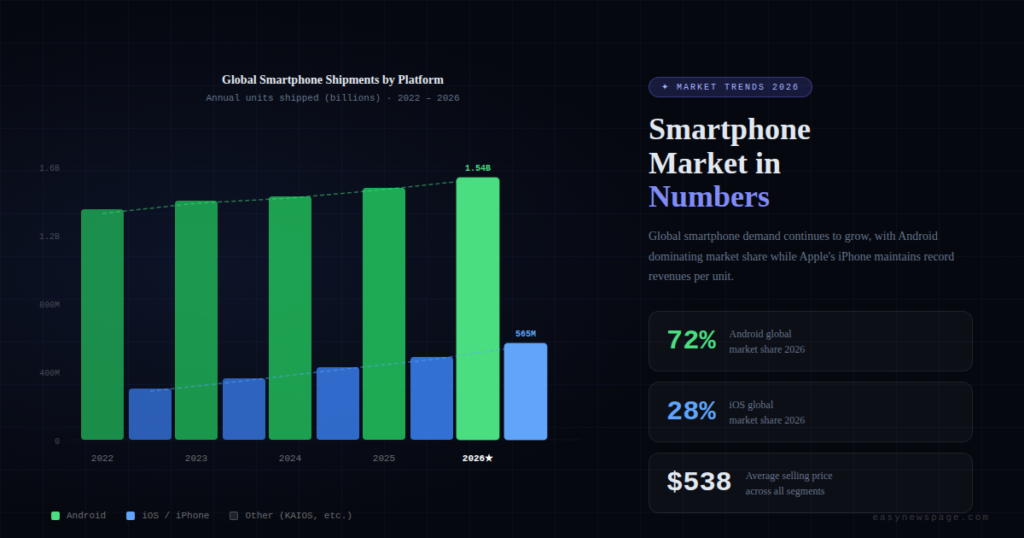
The smartphone industry in 2026 is defined by rapid technological convergence, AI-driven innovation, and the evolution of user-centric design. Manufacturers are no longer competing solely on hardware specifications; instead, the focus has shifted toward intelligent experiences, sustainability, and long-term value. These trends are reshaping how consumers interact with their devices and how brands position themselves in an increasingly saturated market.
Rise of AI-Powered Smartphones
One of the most dominant trends in 2026 is the widespread adoption of AI-powered smartphones. Artificial intelligence is no longer a background feature it is now deeply embedded into the core functionality of devices.
Modern smartphones leverage AI for:
- Real-time language translation and transcription
- Advanced image processing and scene recognition
- Personalized user experiences based on behavior patterns
- Smart battery optimization and app management
AI chips, such as neural processing units (NPUs), enable devices to perform complex computations locally, reducing reliance on cloud processing. This not only enhances speed but also improves privacy and security. Users now experience smartphones that anticipate needs, automate tasks, and adapt dynamically to usage habits.
Foldable and Rollable Devices Going Mainstream
Foldable smartphones have officially transitioned from niche products to mainstream consumer devices. In 2026, they offer durability, refined hinges, and seamless multitasking capabilities, making them practical for everyday use.
Key advancements include:
- Crease-resistant flexible displays
- Improved hinge mechanisms for long-term durability
- Enhanced multitasking with split-screen optimization
Rollable devices are also emerging, offering expandable screen sizes without folding mechanisms. These devices provide:
- Compact portability with larger display expansion
- Innovative form factors for productivity and entertainment
The shift toward flexible displays signals a future where device form factors are no longer fixed, allowing users to adapt their smartphones to different scenarios.
Improvements in Battery and Charging Technology
Battery innovation has become a critical differentiator in 2026. Manufacturers are focusing on longer battery life, faster charging, and improved safety.
Key breakthroughs include:
- Solid-state battery technology for higher energy density
- Ultra-fast charging (0–100% in under 30 minutes)
- Advanced thermal management systems
- AI-driven power consumption optimization
Wireless charging has also improved significantly, with faster speeds and greater efficiency, making cables increasingly optional. Reverse wireless charging enables smartphones to power other devices, reinforcing their role as central hubs in the digital ecosystem.
Sustainability and Eco-Friendly Designs
Sustainability is no longer a marketing tactic—it is a core pillar of smartphone design in 2026. Consumers are demanding environmentally responsible products, and manufacturers are responding with tangible changes.
Eco-friendly innovations include:
- Recycled materials in device construction
- Modular components for easier repairability
- Reduced packaging and plastic usage
- Energy-efficient manufacturing processes
Software longevity also contributes to sustainability, with brands offering extended update cycles, reducing the need for frequent upgrades. This shift reflects a broader industry commitment to reducing electronic waste and carbon footprints.
How We Selected the Best Phones
Our selection process is based on a data-driven and user-focused evaluation framework, ensuring that only the most capable and reliable smartphones are recommended.
We analyze devices across multiple dimensions, combining technical benchmarks with real-world usability. This approach ensures that our recommendations reflect actual performance, not just marketing claims.
Performance Benchmarks and Real-World Usage
Performance remains a cornerstone of smartphone evaluation. In 2026, devices are equipped with next-generation chipsets that handle intensive tasks with ease.
Key evaluation factors:
- Processor speed and efficiency
- GPU performance for gaming and graphics
- Multitasking capabilities
- Thermal performance under sustained load
However, benchmarks alone are not sufficient. Real-world usage tests include:
- App launch speeds
- Background task management
- Gaming stability over extended sessions
- Everyday responsiveness
The best smartphones deliver consistent performance without overheating or throttling, ensuring a smooth user experience.
Camera Quality and AI Enhancements
Camera systems in 2026 are defined by AI-driven computational photography. Megapixels are no longer the sole indicator of quality; software plays an equally important role.
Key camera evaluation criteria:
- Image clarity and dynamic range
- Low-light performance
- Optical zoom capabilities
- Video stabilization and resolution
AI enhancements enable features such as:
- Automatic scene detection
- Real-time HDR processing
- Portrait mode improvements with depth accuracy
- AI-assisted video editing
The result is a camera system that delivers professional-grade results with minimal user effort.
Battery Life and Charging Speed
Battery performance is assessed through both endurance and charging efficiency. In 2026, users expect smartphones to last a full day under heavy usage.
Testing parameters include:
- Screen-on time across different activities
- Standby battery consumption
- Charging speed (wired and wireless)
- Battery health over time
Devices that combine long battery life with ultra-fast charging offer the best overall experience, minimizing downtime and maximizing productivity.
Software Experience and Updates
Software quality plays a crucial role in defining the overall smartphone experience. In 2026, the focus is on clean interfaces, intelligent features, and long-term support.
Key considerations:
- User interface design and responsiveness
- Frequency and reliability of updates
- Security features and privacy controls
- Integration with ecosystems and services
Devices that offer consistent updates and optimized software maintain their performance and security over time, providing better long-term value.
Price-to-Value Ratio
The final and most critical factor is the price-to-value ratio. In a market filled with high-end devices, consumers are increasingly seeking maximum value for their investment.
Evaluation includes:
- Feature set مقارنة price
- Performance relative to cost
- Longevity and durability
- Resale value
Mid-range smartphones in 2026 are particularly competitive, offering flagship-level features at significantly lower prices. This has made it possible for users to access premium experiences without overspending.
Best iPhone Models in 2026
Flagship iPhones: Premium Performance Leaders
Best Overall iPhone
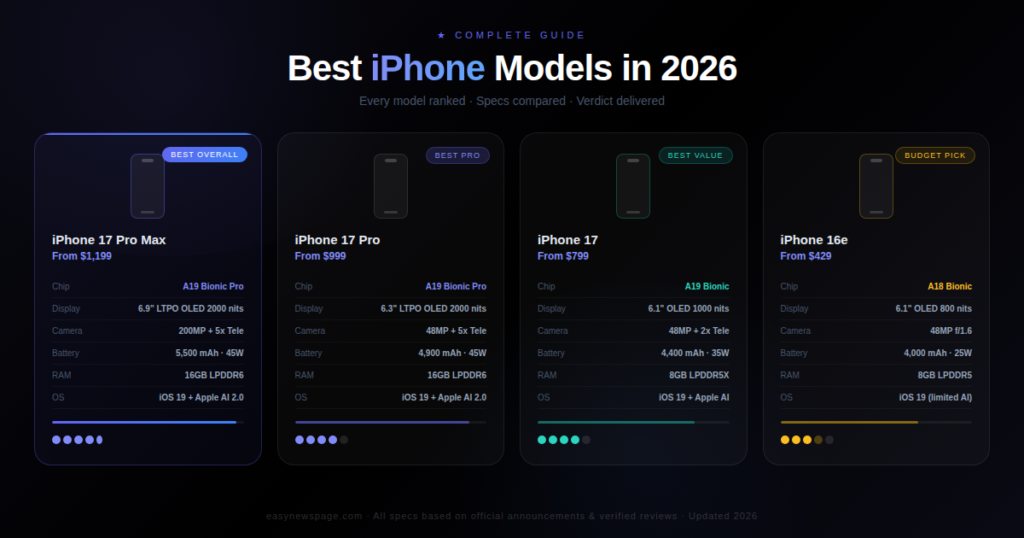
The iPhone 16 Pro Max stands as the best overall iPhone in 2026, delivering unmatched balance across performance, battery life, and camera capabilities. Powered by the A18 Pro chip, it offers exceptional efficiency and speed, making it ideal for both everyday tasks and intensive workloads. Its long battery life, recorded among the best in its class, ensures extended usage without frequent charging.
We consider this model the ultimate choice for users seeking premium performance, longevity, and ecosystem integration.
Best iPhone for Photography
For photography enthusiasts, the iPhone 16 Pro excels with advanced computational photography and consistent color accuracy. Apple continues to dominate in:
- Video recording quality
- Natural color tones
- Reliable portrait mode performance
While competitors may offer higher megapixels, the iPhone’s image processing and real-world consistency make it a top-tier choice for creators.
Best iPhone for Gaming
The iPhone 16 Pro Max also leads in gaming due to:
- Powerful GPU performance
- Optimized iOS gaming ecosystem
- Thermal efficiency during long sessions
Its ability to sustain high frame rates without throttling makes it ideal for mobile gamers and performance users.
Mid-Range iPhones: Value for Money
Best Budget-Friendly iPhone
The iPhone 15 remains the best budget-friendly iPhone in 2026, offering:
- Strong performance for everyday use
- Solid camera quality
- Long-term software support
It provides an excellent entry point into the Apple ecosystem without compromising essential features.
Best Older iPhone Still Worth Buying
The iPhone 14 Pro continues to be a smart purchase due to:
- Premium build quality
- Reliable camera system
- Ongoing iOS updates
It delivers flagship-level performance at a reduced price, making it a high-value option.
iPhone Innovations in 2026
AI Integration in iOS
Apple has significantly enhanced AI capabilities within iOS, focusing on:
- On-device processing for privacy
- Smarter Siri interactions
- AI-powered photo editing and organization
This results in a seamless and intelligent user experience without compromising security.
Battery and Charging Improvements
Recent iPhones feature:
- Improved battery optimization
- Fast charging via USB-C
- Enhanced wireless charging (MagSafe & Qi2)
These advancements ensure longer battery life and faster charging, addressing one of the most critical user needs.
Camera Advancements
Apple continues refining its camera systems with:
- Improved low-light performance
- Advanced video stabilization
- AI-driven image enhancement
The focus remains on real-world usability and consistency, rather than on hardware specifications alone.
Best Android Phones in 2026
Flagship Android Phones
Best Overall Android Phone
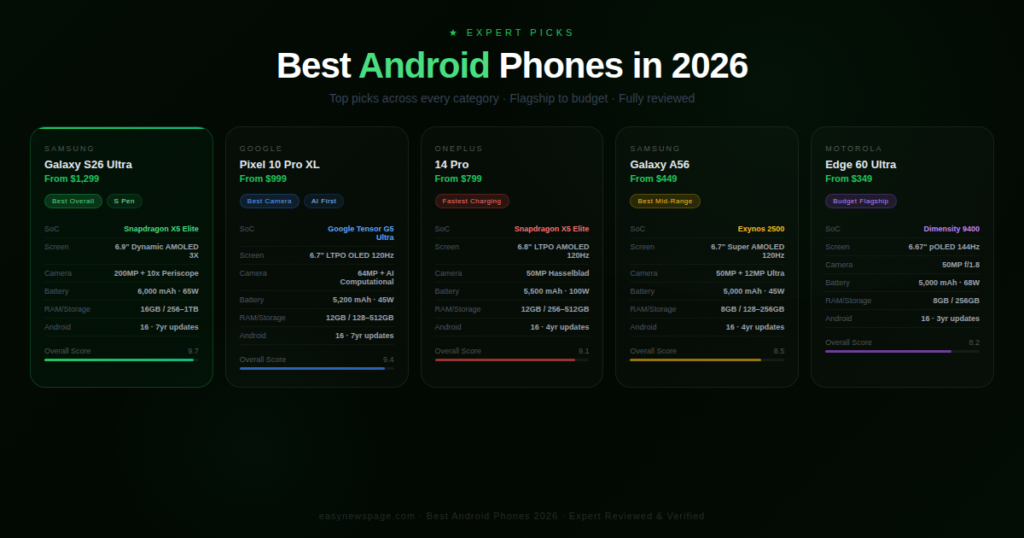
The Samsung Galaxy S26 Ultra is widely regarded as the best overall Android phone in 2026, offering:
- Snapdragon 8 Gen 5 performance
- 200MP camera system
- Advanced AI features
- Premium build with S Pen support
Its combination of power, versatility, and innovation makes it the top choice for Android users.
Best Android for Camera Enthusiasts
The Samsung Galaxy S26 Ultra dominates mobile photography with:
- Industry-leading zoom capabilities
- AI-enhanced image processing
- Superior low-light performance
It consistently outperforms competitors in zoom clarity and detail retention, making it ideal for photography enthusiasts.
Best Android for Gaming Performance
The OnePlus 15 / 14 Pro series is the best choice for gaming due to:
- High refresh rate displays (up to 165Hz)
- Fast charging technology
- Optimized performance for sustained gaming sessions
These devices prioritize speed, responsiveness, and thermal management.
Mid-Range Android Phones
Best Value Android Phone
The Google Pixel 10 offers the best value by combining:
- AI-powered features
- Clean Android experience
- Competitive pricing
It delivers flagship-level features at a more accessible price point.
Best Budget Android Device
The Google Pixel 10a stands out as the best budget Android phone, offering:
- Reliable performance
- Excellent camera software
- Affordable pricing
It is ideal for users seeking high value without premium costs.
Foldable and Innovative Android Devices
4.3.1 Best Foldable Phone
The Samsung Galaxy Z Fold 7 leads the foldable segment with:
- Large internal display for multitasking
- Flagship-level performance
- Improved durability
It is perfect for users who want a tablet-like experience in a smartphone form.
Best Dual-Screen Experience
The Samsung Galaxy Z Flip 7 offers the best compact foldable experience:
- Enhanced external display usability
- Portable and stylish design
- Improved hinge durability
It delivers a unique blend of innovation and practicality.
Key Factors to Consider Before Buying a Smartphone in 2026
Choosing the right smartphone in 2026 requires a strategic evaluation of performance, usability, and long-term value. With rapid technological advancements, focusing on the right specifications ensures you invest in a device that delivers consistent performance, reliability, and future-proof capabilities.
Performance and Chipset Power
The processor (chipset) is the most critical component of any smartphone. It determines how fast your device operates, how efficiently it handles tasks, and how well it performs under pressure.
Modern chipsets such as Snapdragon 8 series, Apple A-series, and Dimensity processors deliver flagship-level performance. A strong processor ensures:
- Faster app launches
- Smooth multitasking
- Efficient gaming performance
- Better thermal management
Even with high RAM, a weak processor can cause lag, making the chipset the primary driver of overall performance.
For power users, choosing a latest-generation chipset is essential for longevity and consistent speed.
Camera Capabilities and AI Enhancements
Camera systems in 2026 rely heavily on AI-powered computational photography. The quality of images depends not only on megapixels but also on:
- Sensor size and aperture
- Image processing algorithms
- AI enhancements for HDR and night mode
Modern smartphones use AI to automatically adjust settings, resulting in better color accuracy, improved low-light shots, and sharper details.
Users should prioritize real-world image quality over specifications, as software optimization often makes a bigger difference than hardware alone.
Battery Life and Charging Speed
Battery performance is a decisive factor for daily usability. A good smartphone should offer:
- All-day battery life under normal usage
- Fast charging capabilities
- Efficient power management
Battery capacity (measured in mAh) matters, but real performance depends on software optimization, display efficiency, and usage patterns.
Fast charging technology has become essential, allowing users to quickly recharge and minimize downtime, especially for heavy users.
Display Quality and Refresh Rates
The display is the most interacted-with component, making its quality crucial. Key aspects include:
- AMOLED or OLED panels for vibrant colors
- High resolution for sharp visuals
- Refresh rates of 120Hz or higher for smooth scrolling
Higher refresh rates significantly improve responsiveness and user experience, particularly in gaming and animations.
Adaptive refresh rate technology also helps conserve battery by adjusting based on usage.
Software Experience and Updates
Software defines how a smartphone feels in daily use. A well-optimized operating system ensures:
- Smooth navigation and responsiveness
- Regular security updates
- Long-term OS support
Phones with strong update policies remain secure and relevant for years, increasing their overall value.
Clean and optimized software also enhances performance, even on mid-range hardware.
Storage and RAM Requirements
Storage and RAM directly impact multitasking and usability.
Recommended standards in 2026:
- RAM: 6GB–8GB for average users, 12GB+ for heavy users
- Storage: Minimum 128GB, ideally 256GB or more
RAM allows multiple apps to run smoothly, while storage determines how much data, apps, and media you can keep. However, processor efficiency matters more than excessive RAM alone.
Faster storage technologies, such as UFS 3.1 or higher, also improve app load times and system responsiveness.
Price vs Value
The final and most practical factor is the price-to-value ratio. A higher price does not always guarantee a better experience.
When evaluating value, consider:
- Features offered مقابل price
- Long-term software support
- Build quality and durability
- Performance consistency over time
Modern mid-range smartphones often deliver flagship-level features at significantly lower costs, making them ideal for most users.
Smart buyers focus on overall experience rather than marketing specifications, ensuring maximum return on investment.
READ MORE: Latest AI Tools in 2026 that boost online earning
iPhone vs Android: Head-to-Head Comparison in 2026
The competition between iPhone and Android in 2026 is defined by refinement, intelligence, and ecosystem maturity. Both platforms have reached a level where performance gaps are minimal, but differences in philosophy, user control, and long-term value still shape the decision. Below is a detailed comparison across the most important factors.
Operating System Experience (iOS vs Android)
The operating system experience is the foundation of any smartphone.
iOS Experience
iOS delivers a clean, consistent, and highly optimized interface. Every element is tightly controlled, resulting in:
- Smooth animations and transitions
- Minimal bugs and system crashes
- Seamless integration with Apple devices
Apple’s closed ecosystem ensures that software and hardware work in perfect harmony, creating a “it just works” experience.
Android Experience
Android offers a flexible and customizable environment with:
- Multiple UI styles depending on the manufacturer
- Advanced multitasking features
- Broader hardware compatibility
Android’s strength lies in variety and adaptability, allowing users to choose devices and interfaces that match their preferences.
Verdict: iOS excels in simplicity and consistency, while Android leads in flexibility and diversity.
Design and Build Quality
iPhone
iPhones are known for:
- Premium materials (aluminum, titanium, glass)
- Precision engineering
- Consistent design language across models
Apple prioritizes minimalism and durability, resulting in devices that feel refined and high-end.
Android
Android devices vary significantly by brand:
- Flagship models offer premium builds rivaling iPhones
- Mid-range devices provide affordable yet durable designs
- Innovative designs like foldables and dual-screen phones
Android manufacturers lead in design experimentation, while Apple focuses on perfection and consistency.
Verdict: iPhone wins in consistency; Android wins in variety and innovation.
App Ecosystem and Compatibility
iOS Ecosystem
- Apps are highly optimized for performance
- Developers prioritize iOS for early feature releases
- Strict App Store policies ensure quality control
This results in a more stable and polished app experience.
Android Ecosystem
- Larger app availability, including third-party sources
- Greater compatibility across devices
- Faster updates for some apps via Play Store modular updates
However, app performance may vary due to device fragmentation.
Verdict: iOS leads in optimization and consistency; Android offers broader access and flexibility.
Customization and User Control
iOS
- Limited customization options
- Controlled file system and app permissions
- Focus on simplicity and security
Android
- Extensive customization (launchers, themes, widgets)
- Greater control over system settings
- Ability to install apps outside official stores
Android allows users to fully personalize their devices, making it ideal for advanced users.
Verdict: Android dominates in customization and user control.
Security and Privacy Features
Security remains a major differentiator in 2026.
iOS Security
- Strict app review process
- Strong sandboxing system
- Consistent security updates across all devices
Apple’s ecosystem minimizes vulnerabilities by limiting external access.
Android Security
- Improved significantly with Google Play Protect and AI-based threat detection
- Offers more control over privacy settings
- Security varies depending on the manufacturer and update frequency
While Android can be highly secure, it often requires user awareness and proper configuration.
Verdict: iOS provides stronger default security; Android offers advanced control for experienced users.
Longevity and Software Updates
Longevity is one of the most critical factors for long-term value.
iPhone Longevity
- 5–7 years of consistent iOS updates
- Updates are delivered simultaneously to all supported devices
- Strong resale value
Apple’s unified update system ensures devices remain secure and relevant for years.
Android Longevity
- Flagships (Google Pixel, Samsung Galaxy) now offer up to 7 years of updates
- Mid-range and budget devices receive fewer updates
- Updates may be delayed depending on the manufacturer
Android has significantly improved, but consistency still varies across brands.
Verdict: iPhone leads in consistency; Android flagships now match or exceed in duration.
Budget Breakdown: Which Segment Should You Choose?
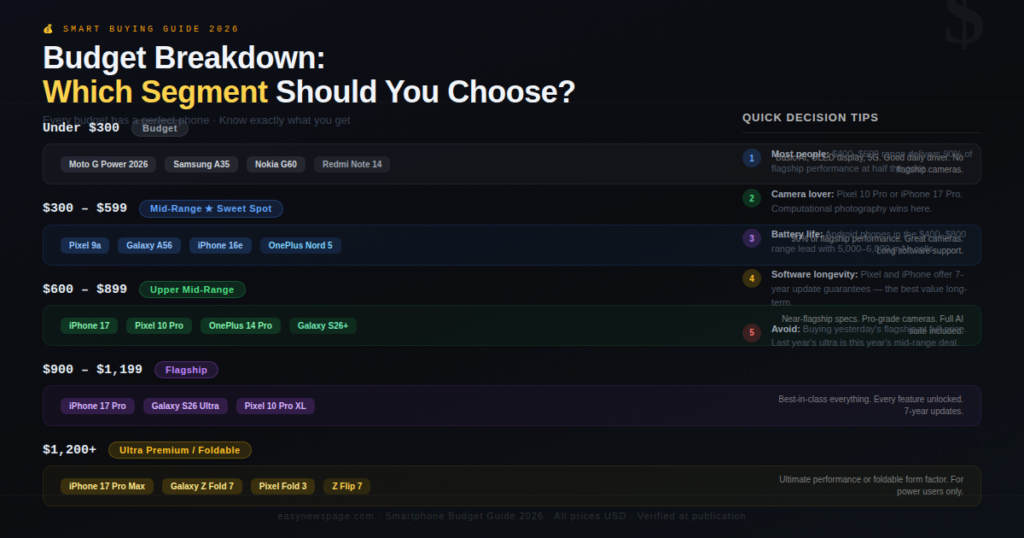
Understanding the right price segment is essential when buying a smartphone in 2026. With innovation reaching every tier, choosing wisely ensures you get maximum performance, longevity, and value without overspending.
Premium Smartphones (Flagship Tier)
Premium smartphones represent the cutting edge of mobile technology. These devices are designed for users who demand top-tier performance, best-in-class cameras, and advanced features.
What you get in flagship devices:
- Latest chipsets with AI acceleration
- Professional-grade camera systems
- Premium materials (titanium, glass, aluminum)
- High refresh rate OLED displays (120Hz–165Hz)
- Long-term software support
Flagships are ideal for:
- Content creators
- Gamers
- Power users requiring maximum performance
While expensive, they offer the best longevity and future-proofing, making them a smart investment for long-term use.
Mid-Range Smartphones (Best Value Picks)
Mid-range smartphones in 2026 deliver exceptional value, offering many flagship features at a fraction of the cost.
Key benefits:
- Strong performance for everyday tasks
- High-quality cameras with AI enhancements
- Solid battery life and fast charging
- Modern designs and displays
These devices are perfect for:
- Most users who want performance without premium pricing
- Students and professionals
- Casual gamers and content consumers
Mid-range phones strike the perfect balance between price and performance, making them the most popular choice in 2026.
Budget Smartphones (Affordable Options)
Budget smartphones cater to users seeking basic functionality at the lowest cost.
What to expect:
- Reliable performance for calls, messaging, and apps
- Decent battery life
- Simplified camera systems
- Lower refresh rate displays
They are best suited for:
- First-time smartphone users
- Light users with minimal requirements
- Backup or secondary devices
While they lack premium features, modern budget phones still deliver solid everyday usability.
Refurbished and Older Models: Are They Worth It?
Refurbished and older smartphones are a high-value alternative for budget-conscious buyers.
Advantages:
- Lower cost for flagship-level hardware
- Proven reliability
- Access to premium features at reduced prices
Things to consider:
- Battery health
- Software update support
- Warranty and seller credibility
In 2026, many older flagship models still provide excellent performance, making them a smart and economical choice.
Innovations Defining Smartphones in 2026
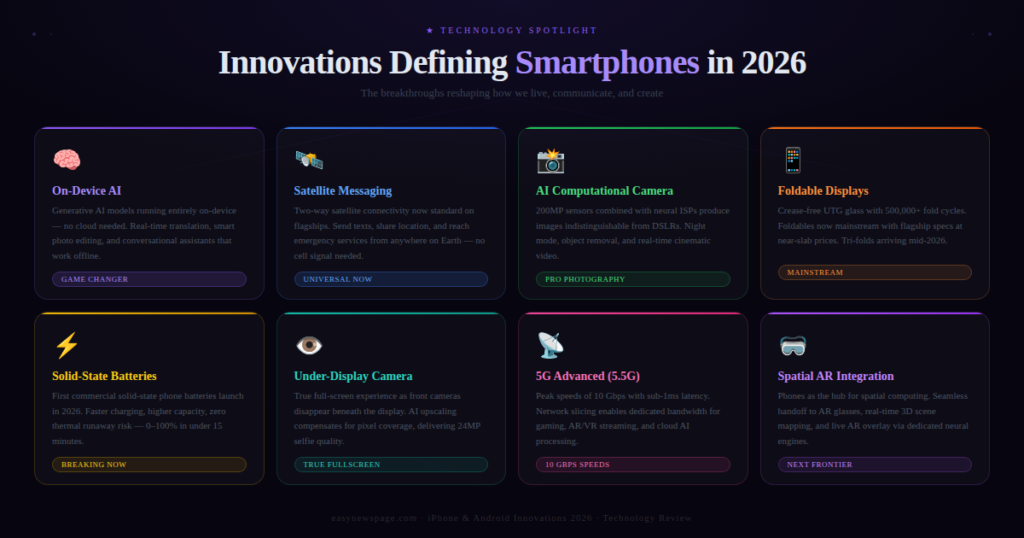
9.1 AI Assistants and On-Device Intelligence
AI is at the core of modern smartphones. Devices now offer:
- Real-time assistance and predictive actions
- On-device processing for speed and privacy
- Smart automation of daily tasks
This results in personalized and efficient user experiences.
Satellite Connectivity and Emergency Features
Smartphones now support satellite communication, enabling:
- Emergency messaging without cellular networks
- Location sharing in remote areas
- Enhanced safety features
This innovation transforms smartphones into lifesaving tools in critical situations.
Advanced Biometric Security
Security has advanced with:
- Under-display fingerprint sensors
- 3D facial recognition
- AI-driven authentication systems
These technologies provide faster, more secure access to devices and sensitive data.
Next-Gen Display Technology
Displays in 2026 feature:
- Ultra-high brightness levels
- Adaptive refresh rates
- Foldable and flexible designs
These improvements deliver immersive visuals and enhanced usability across different form factors.
Pros and Cons of iPhones in 2026
Advantages of Choosing an iPhone
- Seamless ecosystem integration
- Consistent and long-term software updates
- High resale value
- Optimized performance and efficiency
- Strong focus on privacy and security
iPhones offer a refined, reliable, and premium experience.
Limitations and Drawbacks
- Higher price compared to competitors
- Limited customization options
- Restricted file management system
- Fewer hardware choices
These limitations may affect users who prefer flexibility and control.
Pros and Cons of Android Phones in 2026
Advantages of Android Devices
- Wide range of devices across all budgets
- Extensive customization options
- Innovative hardware (foldables, high refresh displays)
- Faster adoption of new technologies
Android provides freedom, variety, and cutting-edge features.
Common Downsides
- Inconsistent software updates across brands
- Potential performance variations
- Security depends on user behavior and manufacturer support
Despite improvements, fragmentation remains a challenge.
Tips for Choosing the Right Smartphone
Matching Features to Your Needs
Focus on what matters most:
- Camera for photography
- Performance for gaming
- Battery for long usage
Avoid choosing features you won’t use regularly.
Avoiding Overpaying for Unnecessary Specs
Not every user needs:
- Maximum RAM
- The highest megapixel camera
- Ultra-premium materials
Choose a device that fits your actual usage, not marketing hype.
When Is the Best Time to Buy?
The best time to buy is:
- During major sales events
- After the new model launches
- At seasonal discounts
Timing your purchase can save significant money.
Where to Find the Best Deals
Look for deals through:
- Official brand stores
- Trusted online marketplaces
- Authorized retailers with warranties
Always prioritize authenticity and after-sales support.
Future of Smartphones Beyond 2026
What to Expect in 2027 and Beyond
The future will bring:
- More advanced AI integration
- Seamless cross-device ecosystems
- Improved battery technologies
Smartphones will become even more intelligent and autonomous.
Emerging Technologies to Watch
Key innovations on the horizon include:
- Augmented reality (AR) integration
- Wearable-smartphone convergence
- Invisible or embedded displays
These technologies will redefine how users interact with devices.
Will Smartphones Replace Other Devices?
Smartphones are already replacing:
- Cameras
- GPS devices
- Music players
In the future, they may also replace:
- Laptops for basic tasks
- Wallets through digital payments
- Remote controls via smart home integration
The smartphone is evolving into a central digital hub, consolidating multiple functions into a single powerful device.
Conclusion
The smartphone market in 2026 is driven by innovation, intelligence, and sustainability. From AI-powered features to flexible designs and eco-conscious manufacturing, the industry is evolving rapidly to meet modern demands.
By focusing on performance, camera capabilities, battery life, software experience, and overall value, we ensure that our recommendations reflect the best smartphones available today.
Consumers now have more choices than ever, making it essential to evaluate devices based on real-world performance and long-term usability. The future of smartphones is not just about power, it is about delivering smarter, more meaningful experiences.
The smartphone market in 2026 offers unprecedented variety and innovation. Whether you choose an iPhone or an Android device, you can be sure to get cutting-edge technology, powerful performance, and an exceptional user experience.
We recommend focusing on your personal needs rather than brand loyalty. The best smartphone is the one that aligns perfectly with your lifestyle, usage habits, and budget.
The smartphone landscape in 2026 is defined by AI innovation, powerful hardware, and diverse form factors.
- iPhones dominate in performance optimization, ecosystem, and video quality
- Android phones lead in customization, camera hardware, and device variety
Whether choosing an iPhone or an Android device, users now benefit from cutting-edge technology and exceptional performance across all price ranges.
A well-informed smartphone purchase is based on balanced decision-making, not just headline features. By prioritizing:
- Performance
- Camera quality
- Battery efficiency
- Display excellence
- Software longevity
- Value for money
You can confidently choose a device that delivers long-term satisfaction and cutting-edge functionality.
In 2026, the best smartphone is not necessarily the most expensive it is the one that aligns perfectly with your needs, usage habits, and expectations.
The choice between iPhone and Android depends on your priorities and usage style:
- Choose iPhone for:
- Seamless experience
- Long-term reliability
- Strong security and consistent updates
- Choose Android for:
- Customization and flexibility
- Wider device selection
- Cutting-edge hardware innovation
In 2026, there is no absolute winner. Instead, the decision comes down to whether you value control and variety or simplicity and consistency.
In 2026 and beyond, choosing the right smartphone is about aligning innovation with personal needs and budget. With rapid advancements in AI, design, and performance, users now have access to powerful tools that enhance productivity, creativity, and connectivity like never before.
The smartphone market in 2026 offers unmatched diversity, innovation, and value. By understanding your priorities and evaluating key features, you can confidently select a device that delivers performance, reliability, and long-term satisfaction in an ever-evolving digital world.
FAQs – Best Smartphones in 2026
1. What is the best smartphone in 2026?
The best smartphone in 2026 depends on your needs, but flagship models from Apple and Samsung are leading the market. The latest iPhone Pro series and Samsung Galaxy S/Ultra series are expected to offer the best overall performance, camera quality, and software support. If you want the most balanced device, a flagship model from either brand is the safest choice.
2. Which is better, iPhone or Android, in 2026?
Both are excellent in 2026.
- iPhone (iOS): Better privacy, long software updates, smooth performance, and a strong ecosystem.
- Android: More customization, wider price range, and more hardware variety.
If you want simplicity and stability, choose iPhone. If you prefer flexibility and choice, Android is better.
3. What are the best Android phones in 2026?
The best Android phones in 2026 include flagship devices from Samsung, Google Pixel, OnePlus, and Xiaomi. These phones offer high-end performance, AI-powered cameras, fast charging, and advanced displays. Samsung Galaxy Ultra and Google Pixel Pro models are especially strong contenders.
4. Which iPhone is best to buy in 2026?
The best iPhone to buy in 2026 is the latest iPhone Pro or Pro Max model, as it offers the most powerful chip, the best camera system, and the longest software support. If you want a more affordable option, the standard iPhone model from the latest series is also a great choice.
5. What is the best budget smartphone in 2026?
The best budget smartphones in 2026 come from brands like Samsung (A-series), Xiaomi (Redmi series), and Realme. These devices offer good performance, decent cameras, and long battery life at a lower price, making them ideal for everyday users.
6. Which phone has the best camera in 2026?
In 2026, the best camera phones are expected to be the latest iPhone Pro models and Samsung Galaxy Ultra devices. They use advanced AI photography, improved low-light performance, and professional-grade video recording features.
7. Are flagship smartphones worth it in 2026?
Yes, flagship smartphones are worth it if you want the best performance, camera quality, and long-term software updates. However, if you only use basic apps like social media and browsing, mid-range phones may offer better value for money.
8. What features should I look for in a smartphone?
Key features to consider in 2026 include:
- Fast processor (latest chipsets)
- High refresh rate display (120Hz or more)
- Strong battery life and fast charging
- Good camera system with AI features
- Long-term software updates
- 5G/advanced connectivity
9. Is it better to buy an iPhone or an Android for gaming?
For gaming:
- iPhone: Offers smoother optimization, powerful chip, and stable performance.
- Android: Offers a wider variety of gaming-focused phones and better cooling systems in some models.
If you want consistent performance, the iPhone is better. For gaming features and customization, Android gaming phones are strong.
10. How long do smartphones last in 2026?
In 2026, most smartphones last around 3 to 5 years, depending on usage and brand. iPhones generally last longer due to extended software updates, while high-end Android phones can also last several years if well-maintained.